Originally published in 2000. This book provides insights, practical suggestions and clear-cut strategies for integrating media across the K-12 curriculum. This contribution to teaching and curriculum design uses students' own media experiences or media vignettes from students' lives to enter teaching and learning. It provides a road map for teachers longing to reflect and take seriously the knowledge students bring to school from their homes and communities, and to draw upon this background to develop students' critical thinking, viewing and reading of written texts, visuals, and other electronic images and messages.
eBook - ePub
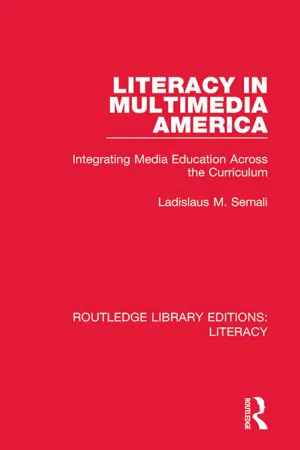
Literacy in Multimedia America
Integrating Media Education Across the Curriculum
- 258 pages
- English
- ePUB (mobile friendly)
- Available on iOS & Android
eBook - ePub
About this book
Information
CHAPTER 1
Media, Technology, and Schools
When the world crashes in, into my living room
Television made me what I am
People like to put the television down
But we are just good friends
I’m a television man.
—DAVID BYRNE’S REFRAIN, “TELEVISION MAN,” p. 603
Multimedia—the integration of sound, text, graphics, and full-motion video—is enriching the way in which users interact with computer technology. Technology developers are creating multimedia-driven applications. Areas include interactive television, distance learning, telemedicine, corporate presentations, electronic publishing, video conferencing, video broadcasting, Web marketing, and electronic commerce. At the same time, technology innovators are scheming to find ways to meet the challenges of achieving the fast delivery of rich multimedia Internet content to users using communications media that include the plain old telephone system, satellite communication and even the electrical power supply.
Furthermore, instead of flying scores of students across the United States from Colorado to attend a lecture at a University on the East Coast or to chat with peers, it is now possible to place a camera at the function so that they may participate “virtually” by visiting a Web site, or via videoconference and e-mail. Today, this is possible through the continuing convergence of different media technologies—radio, TV, Internet, books on compact discs or tape, and so on. The use of video streaming technology, which takes up less bandwidth by allowing the user to watch part of the presentation while the rest of it is being streamed across the communications medium, has opened up many possibilities not possible before. This phenomenon has in turn impacted learning, behavior, and individual attitudes.
Kids in school have grown up with multimedia software, VCRs, the Internet, and a host of electronic gadgetry—games and toys—since infancy. College students are now able to have a conference call set up so that they can discuss the subject matter with peers at another location and ask questions at the same time. What might be the implications of these new developments to learning and instruction? What role can schools and teachers play to facilitate this new way of constructing knowledge and disseminating information? How are our lives affected by multimedia technologies?
Over the past quarter century, communication technologies have spawned an explosion of possible ways in which “text” is part of the out-of-class curriculum, both written and electronic, from photographs to film to videotext. One major irony is that American education has failed to develop a philosophy or pedagogy based on the role of visuals in instruction while it has spent an increasingly large share of its budget on iconic technologies such as computers, VCRs, video cameras, and interactive video. These technologies are much more than electronic envelopes for delivering the old curriculum in a marginally new way. But as made clear by Bennett (1995), an important question lies just beneath the surface of the much glorified electronic superhighway: How will democracy cope with news/information that is ever more standardized and politically managed at its source, while becoming ever more personalized and socially isolated at its destination? The answer awaits not only the input of citizens but also of teachers and students themselves.
This book engages teachers in new forms of inquiry using the pedagogy of critical media literacy to integrate the new forms of visual and electronic “texts” across the curriculum in the multi-subject learning environments found in the United States. The technologies of reading, writing, and viewing have outpaced our pedagogy, our curriculum and instruction methods, and the definitions of what it means to be literate in multimedia America. Moving into the twenty-first century, print no longer dominates our lives as it did in the nineteenth century. The fundamental question that this chapter attempts to answer is: With recent advancement of multiforms of media, can kids learn anything from the multimedia and multiform screens—television screen, video screen, computer screen, and from other media environments that modern multimedia technology has to offer? A response to this question aims to expose the emerging literacies and to bridge the widening gap between the curriculum of the classroom and the emerging curriculum of the screen.
My task in this chapter is to show that American schools can no longer continue to define literacy in terms of print or the classics alone. Students in many public high schools today find the classic works of Shakespeare, Milton, Bronte, and other revered writers remote and disconnected from their experiences, whereas they find contemporary film to be connected and near. Just as the debates have focused on the canon of acceptable literary works, so too is it time for the debate to broaden the canon and the curriculum to include the expanding technologies of television, film, video, and computers.
CHALLENGES FACING SCHOOLS IN MULTIMEDIA AMERICA
Many new challenges will face teachers in the years to come: How does a teacher teach reading or language arts, science, or social studies to today’s students who are constantly exposed to multimedia and technological advances in a world of virtual intelligence and electronic communities? Can these multimedia technologies be integrated in the K-12 curriculum as a critical project without conflict or competition with other courses? Would students and teachers want American schools to create a politicized citizenry capable of fighting responsibly for various forms of public life, equality, and social justice? Are teachers willing to struggle and make sacrifices necessary to put critical content into democracy? These rhetorical questions provide a broad and important area of inquiry that this book attempts to address.
The rationale for integrating critical media literacy education is based on the notion that if we are to provide students with media skills for today and tomorrow, we must help them comprehend and communicate through both traditional and emerging technologies of communication. This means making them understand (1) the programs themselves—how they produce meaning, how media language forms are organized, and how they construct reality; (2) the contexts in which the programs are transmitted; (3) the organizations or culture industries that produce them; (4) the technologies of production, distribution and reception—how they represent individuals and groups; and (6) the different ways in which audiences use and respond to the mass media, especially television. These important aspects of understanding media are the central tenet of this chapter.
Drawing upon the work of Jürgen Habermas and other critical theorists, who have executed epochal “learning turn” in social theory, I introduce media literacy that is revamped by a critical learning theory, and which takes its direction from Habermas. Moreover, by situating the discussion of media literacy in this volume around critical literacy education, the reader gains a deeper understanding and appreciation of contributions from cultural studies on representation, popular culture, the construction of youth, subjectivity, positioning, and perspectives of critical consciousness that have been made possible by the work of theorists like Stuart Hall, Henry Giroux, Paulo Freire, Doug Kellner, Alan Luke, Joe Kincheloe, and others. In this discussion, the emerging discipline of cultural studies provides an interdisciplinary approach for the study of subjectivities that views popular culture as a site of social differences and struggle. This view is of theoretical and practical importance within the literacy community because the popular culture forms we set out to analyze in this book are connected to economic and social relations, power and oppression, particularly in terms of gender, class, race, sexuality, and age.
When I discuss critical media literacy within such a broad theoretical framework, I hope to engage the reader and challenge him or her to find a more sustainable analysis of popular culture and other media texts, and eventually make sense of examples of a classroom practice that is anchored in critical pedagogy. In this book, I propose analytical frameworks that use a critical pedagogy approach. As will become clearer in the following chapters, the term pedagogy simply means the realities of what happens in classrooms. Conceptualized as critical pedagogy, media literacy education hopes to provide the necessary theoretical opening for understanding how an educative process might enable students and their parents to give up bias, myths, clichés and illusions largely created by mass media constructions. Furthermore, because of its cross-disciplinary approach, media literacy education moves to cross-disciplinary borders. Using critical pedagogical tools, media literacy helps students to interpret the layered meanings embedded in the stories they read and the characters they encounter in media texts. Also, it enables learners to question the intentions of the producer, writer, distributor, as well as the larger social context—such as history, social economic status, familiarity and comfort with the subject matter, benefits, and one’s privileged position in the culture—within which the story is created, read, and interpreted, to uncover the oppressive spaces in which difference and unequal power exist in relations of inequality and resistance.
The notion of media literacy suggests a process of understanding and using different media (including the mass media) in an active and nonpassive way. This process involves analyzing, comparing, interpreting, and finding meaning that is different from the usual, routine, and preferred meaning. Typically, preferred meanings are found in texts that insist on the existing dominant interpretation or ideology, that explain why things are the way they are. When such texts are read or viewed in this particular way, their interpretation or meaning tends to coincide with mythical beliefs, clichés, and stereotypical or hidden bias. By applying critical media literacy strategies to read these texts, the reader or viewer is able to read against the grain, and to evaluate the texts using multiple frameworks that go beyond the myth, cliché, and stereotype. In this sense-making process, the reader/viewer can make an informed decision to either question the proposed premise/explanation of the media text, or to partially accept it, or even to reject it completely. Such critical reading of media texts is part of the active and nonpassive reading, viewing, and listening that individuals can acquire from the critical pedagogy of media literacy education.
Critical pedagogy, however, introduces something more to the classroom. As will be further developed in Chapter 2, the notion of critical pedagogy stresses that the realities of what happens in classrooms not only instruct students as recipients of knowledge. But rather, (1) it stresses how teachers work within an institutional context; (2) specifies a particular version of what knowledge is of most worth; (3) clarifies in what direction we should desire; (4) explains what it means to know something; and (5) shows how we might construct representations of ourselves, others, and our physical and societal environment. Critical pedagogy is practiced not only in schools, but also in the family, public discourse, the church, the media, and so on. A critical pedagogy must address these spheres in its explication of education, as well as “what happens in schools” (Kincheloe & Steinberg, 1995, p. 5).
In his book, Teaching Media Literacy, Masterman (1985) argues that it is only a matter of time before schools realize that they must teach students to critically analyze media texts and visual images. The increased use of video and other visual materials will require students to “assess visual evidence” and “will be a cross-curricula skill which will need to inform teaching and learning in all subjects” (p. 14). For Masterman (1985), the gulf between the heavily print-based education in the classroom and education outside of school continues to grow and there is no likelihood of narrowing this gap any time soon. He adds:
Schools continue to be dominated by print. To have difficulties in decoding print is, in school terms, to be a failure. Outside of school the most influential and widely disseminated modes of communication are visual (or oral).
As we have seen, television is probably the most important source of political information in our society and is regarded by most people as the most reliable sources of news, perhaps because of its ability to present a visual record of events. Even print is coming to be regarded as a visual medium. Layout, design and typography are widely understood to be a significant part of the total communicating process, whilst even the term “print media” is frequently a misnomer, since in most texts print is rarely accompanied by visual images. (p. 13)
As we enter a new millennium, Masterman urges us to take a closer look at the new media technologies. They provide our children with new language forms that need to be evaluated, learned, and taught. Olson (1988) is even more convinced that media literacy is a skill that one learns just as one learns to read the written word. “For all new media, new categories for interpretation and criticism, must be developed and taught to children so that they will have interpretive skills that are as powerful as those exploited in the literate tradition” (p. 34).
Development in communication technology has provided some important questions regarding the literate tradition, the nature of education, learning, and thinking. For Davies (1996), a school administrator in Florida, the mass media are ushering in a new period of learning, which he refers to as “the new learning.” The advent of this new but rapidly evolving learning of literacy turns the world into a big classroom. Based on the mass media and the fast growing Internet as the dominant force in this country, learning depends heavily upon visual imagery outside the walls of the schoolhouse. What can we as educators do about it? Do we have the material as well as academic resources to deal with these new forms of knowledge production? McLaren and Hammer (1995) clearly point out the new dynamics playing into contemporary classrooms and how literacy is taught and acquired.
In the current historical juncture of democratic decline in the United States, ideals and images have become detached from their anchorage in stable and agreed-upon meaning and associations and are now beginning to assume a reality of their own. The self-referential world of the media is one that splinters, obliterates, peripheralizes, partitions and segments social space, time, knowledge, and subjectivity in order to unify, encompass, entrap, totalize and homogenize them through the meta-form of entertainment. [Emphasis in original.] What needs to be addressed is the way in which capitalism is able to secure this cultural and ideological totalization and homogenization through its ability to insinuate itself into social practices and private perceptions through various forms of media knowledges. (p. 196)
McLaren and Hammer urge us to take a hard look to realize the new situation brought upon us by multimedia technologies. Teachers, students, parents, and school administrators need to think carefully about the implications of the looming self-referential world of media. McLaren and Hammer raise the following critical questions:
• How are the subjectivities and identities of individuals and the production of media knowledges within popular culture mutually articulated?
• To what extent does the hyperreal correspond to practices of self and social constitution in contemporary society?
•...
Table of contents
- Cover
- Half Title
- Title Page
- Copyright Page
- Table of Contents
- Preface
- CHAPTER 1 Media, Technology, and Schools
- CHAPTER 2 Integrating Critical Media Literacy across the Curriculum
- CHAPTER 3 Foundations of Critical Media Literacy
- CHAPTER 4 Critical Viewing, Reading, Authoring, and Thinking: The Practice of Media Literacy
- CHAPTER 5 Analytical Frameworks of Interpreting Media Representations
- CHAPTER 6 Values in Media Representations
- CHAPTER 7 Reflection on Praxis: Media Literacy in the Classroom
- Index
Trusted by 375,005 students
Access to over 1.5 million titles for a fair monthly price.
Study more efficiently using our study tools.
Frequently asked questions
Yes, you can cancel anytime from the Subscription tab in your account settings on the Perlego website. Your subscription will stay active until the end of your current billing period. Learn how to cancel your subscription
No, books cannot be downloaded as external files, such as PDFs, for use outside of Perlego. However, you can download books within the Perlego app for offline reading on mobile or tablet. Learn how to download books offline
Perlego offers two plans: Essential and Complete
- Essential is ideal for learners and professionals who enjoy exploring a wide range of subjects. Access the Essential Library with 800,000+ trusted titles and best-sellers across business, personal growth, and the humanities. Includes unlimited reading time and Standard Read Aloud voice.
- Complete: Perfect for advanced learners and researchers needing full, unrestricted access. Unlock 1.5M+ books across hundreds of subjects, including academic and specialized titles. The Complete Plan also includes advanced features like Premium Read Aloud and Research Assistant.
We are an online textbook subscription service, where you can get access to an entire online library for less than the price of a single book per month. With over 1.5 million books across 990+ topics, we’ve got you covered! Learn about our mission
Look out for the read-aloud symbol on your next book to see if you can listen to it. The read-aloud tool reads text aloud for you, highlighting the text as it is being read. You can pause it, speed it up and slow it down. Learn more about Read Aloud
Yes! You can use the Perlego app on both iOS and Android devices to read anytime, anywhere — even offline. Perfect for commutes or when you’re on the go.
Please note we cannot support devices running on iOS 13 and Android 7 or earlier. Learn more about using the app
Please note we cannot support devices running on iOS 13 and Android 7 or earlier. Learn more about using the app
Yes, you can access Literacy in Multimedia America by Ladislaus M Semali in PDF and/or ePUB format, as well as other popular books in Education & Education General. We have over 1.5 million books available in our catalogue for you to explore.