Originally published in 1998. This book presents a model of social-contextual influences on children's literacy and literate language. Literate language is similar to the language teachers use and to the language used in reading books for young children. Based on a longitudinal study in homes and schools, the authors here present the results of how diverse and close social relationships influence children's literacy learning as they progress through the first three years of formal schooling, and discuss implications for teaching practice. Different types of reading matter in the home are examined and it is suggested that peers are helpful to the learning of literacy. Rather than separate friends as often happens in the classroom, this book suggest that interaction should be encouraged. It will be of interest to researchers and students of developmental and educational psychology, and to anyone interested in early cognitive and social development.
eBook - ePub
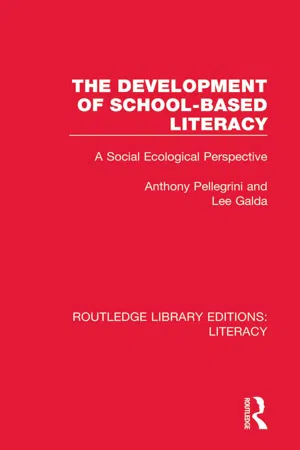
The Development of School-based Literacy
A Social Ecological Perspective
- 190 pages
- English
- ePUB (mobile friendly)
- Available on iOS & Android
eBook - ePub
The Development of School-based Literacy
A Social Ecological Perspective
About this book
Information
Chapter 1
Early literacy
Background and theory
A basic premise of this book is that becoming literate in the schools in most industrial societies involves learning a variety, or register, of what we have called ‘literate’ or ‘school’ language. While we believe that one register is inherently no better or worse than another for the purpose of communicating, learning the school language register seems to be an important precursor to becoming literate in schools. We argue that children’s use of literate language is a very early form of school-based literacy.
In this chapter we will present our view of children’s early literacy development by first discussing what it is we mean by ‘developmental’.
A developmental view of literacy
Our orientation is a developmental one, involving a search for patterns and changes across the life span. It is a search for continuity and discontinuity across time, as well as across different situations, within the period of early childhood. To this end we discuss children’s literacy learning from the preschool through the early primary grades, both at home and school. An important initial consideration is the way in which ‘literacy’ is defined. A developmental orientation suggests that literacy may be defined differently by individuals at different ages and in different contexts.
Our developmental orientation also includes consideration of the social ecological niche of literacy learning. Briefly, we consider the transactional relation between children and their environments, both in and out of school, as continuous or discontinuous between home and school interaction patterns and these patterns predict, respectively, school success or failure. We stress the ways in which social interaction between children and adults and children and peers structure children’s social behavior and language.
It is important to stress our developmental orientation because it has important implications for the ways in which we define and measure literacy. Correspondingly, it also has implications for the ways in which literacy is taught in schools.
Qualitative and quantitative differences
Probably the most basic principle guiding our developmental orientation is that children are ‘qualitatively’ different from adolescents and adults. Such a notion is made clear in most stage theories of development that specify defining characteristics of children at different ‘stages’. Qualitative differences, or differences in kind, are typically contrasted with quantitative differences, or differences in degree. Piaget (1983) provided some clear examples of these differences. For example, he suggested that the preoperational child sees the world in ways characterized as egocentric and nonconserving. Consequently, young children do not take others’ points of view very well and cannot conserve basic identities. For preschoolers an array of candy canes arranged as follows: x x x x x would be considered greater than the following array: xxxxx. Thus, it is not simply a matter of seeing less of something; children see their world differently.
Further we view these qualitative differences as adaptive to the specific niche of childhood, not as imperfect variants of adult behavior. So, literate language is important for the period of childhood because it enables children to communicate with a variety of people from a variety of perspectives; it is not merely a step along the road to becoming literate.
Applied directly to literacy, quantitative differences in children’s and adults’ literacy status would be gauged in terms of degree. For example, children’s literacy might be defined in terms of recognizing letters and a limited number of words. Adults, on the other hand, are able to read more words. In short, quantitative differences as applied to literacy would have children possessing fewer skills than adults. Pedagogical implications of this theory would have the adult model of literacy being broken down into its component parts. Children are then taught the individual components, from simple to more complex. Literacy is achieved when the individual parts sum to the adult model. This is not a developmental model in the sense that quantitative, not qualitative, differences separate children from adults.
In contrast, qualitative differences between children’s and adults’ literacy implies that child and adult literacy are different constructs altogether; they involve different skills. Children’s skills are useful for their solutions to problems presented within childhood, as well as being useful for developing adult forms of literacy. Teaching children in this mode entails having them use literacy to solve their local problems, such as scribbling an imaginary grocery list or retelling a story. In short, qualitative differences are more basic and also allow a more positive focus on what children know and can do.
Continuity and discontinuity
It becomes a developmental task to chart the ways in which these qualitatively different constructs change across time. To undertake this task we must consider continuity and discontinuity in developmental processes. Continuity, as noted by Kagan (1971), can take two general forms: homotypic and heterotypic. Homotypic continuity involves similar responses across time. Kagan assumes that this sort of development is rare during the first ten years of life, a time when heterotypic continuity is more likely.
Heterotypic continuity, on the other hand, has the same underlying phenomenon expressing itself differently across time and it is very difficult to gauge. The ways that seemingly different phenomena at times 1 and 2 are interrelated are typically explained in terms of qualitative changes, or ‘transformations’, in structures. Such abrupt, and qualitative, changes are commonly observed in children around 2-years-of-age and again between 5- and 7-years-of-age. Thus the developmental antecedents of a 12-year-old’s competence in one area, such as literacy, may have been expressed in a seemingly different area in kindergarten. Deciphering this level of ‘cryptography’ (Kagan, 1971: 15) is a daunting task. We assume, in these cases, that children are changing rapidly and we also assume that there is underlying stability. The obvious question is how do we know what to look for in gauging heterotypic continuity?
Guidance in developmental inquiry should, of course, come from theory. Theory tells us what is important and why it is important. Further, it also (should) tell us where to look to uncover hidden continuities. Where theory does not provide explicit guidance in the search for continuity researchers (from a variety of disciplines) rely on ‘design feature arguments’. By design features we mean structural and physical aspects of behavior that are similar across time. We assume that the earlier behaviors are functionally related to later behaviors. An example of a structural design feature would be alternating roles.
Many forms of young children’s play are characterized by reciprocal roles, such as alternating between chaser and chased in vigorous play. Continuity in design features can be observed in the games of older children (players alternate between offense and defense modes). In the specific case of literacy development, design features of children’s oral language, especially the sorts of language used when children are being read to and when they are engaged in social pretend play, are similar to the features of school-based literacy. However, similarity between sets of design features does not guarantee that they are functionally related. The antecedent may lead to a consequence that does not resemble it. Similarly, consequences could have origins in antecedents with which they do not share design features.
It may be the case, for example, that there is little continuity across development and the behaviors utilized in childhood are unique to that period, and then become irrelevant in adulthood. Our position is that literate language is both important to the niche of childhood and important to subsequent development.
In the next section we discuss different definitions of literacy and their often implied rather than explicitly stated theories of learning or development.
Individual differences
Another basic tenet of a developmental orientation is that, despite regularities in development as indicated in stage-like progression, individual differences exist. Individuals and their environments influence each other in a dialectical fashion. Not all children proceed through the developmental process in the same way or at the same rate. By extension, not all children become literate in the same way. The systems theory notion of equifinality posits that there is more than one route to competence. Equifinality reminds us again that the relations between antecedents and consequences are very complex.
Our conceptualization of development also recognizes the unique contributions that individuals make to the developmental process. Individual differences, often expressed in terms of children’s temperament, mediate the transaction between children and their social and physical environments. We must take account of individuals’ contributions if we consider development something more than a unidirectional, cultural reproduction process (Tooby and Cosmides, 1992). Cultural reproduction models of development are unidirectional to the extent that the values and practices of society are directed at and internalized by children with little consideration for the ways in which individuals (independent of society) affect their environments.
Temperament and relationships
Temperament is an excellent construct to gauge individuals’ contributions to the developmental process in that it has a biological expression, appears very early in life, and is stable across the life span. Children with a certain temperament, for example, sociable, extroverted children, may seek out a variety of different social partners with whom to interact. These children might come to learn literate language by interacting with a variety of others and taking on a variety of roles. By interacting with others from a variety of backgrounds children learn to explicate the meaning of their messages so that they can be understood by those with whom they may share minimal background.
Children who are less social and introverted may interact with fewer social actors than their more social counterparts. Their social relationships may be characterized as intensive or ‘close relationships’, such as friendships. Children may learn literate language in this sort of relationship through the conceptual conflicts and resolutions that typify close relationships (Hartup, 1996). That is, friends, compared to acquaintances, are more likely to disagree with each other. These disagreements, because they are important to the participants, are closely monitored, remembered (Dunn and Slomkowski, 1992), and usually resolved in the interest of maintaining the relationship. By monitoring conceptual conflict and working toward resolution children become aware of their friends’ feelings and needs. They, in turn, monitor their own behavior so as to accommodate to those needs. This sort of perspective taking is an important psychological precursor to affective communication, both oral and written (Jones and Pellegrini, 1996; Pellegrini et al., 1984b).
Of course individual differences are mediated by larger societal mores. It may be the case, for example, that children are discouraged from taking a variety of roles. As we will discuss below, ‘positional’ socialization orientations limit children’s role experiences: children are restricted to certain roles, due to their being a ‘child’ or a ‘girl’.
Dialectical relationships
The final aspect of development that we will discuss is the dialectical relation between individuals and their environments. Socialization theories of development posit a unidirectional force from society to the children. As we noted in our discussion of individual differences, we consider development a dialectical, or transactional, process. Children influence their environments and their environments influence them. Some of the best examples of this transactional relation come from child language (Ninio and Bruner, 1978; Pellegrini et al., 1995b) and the mother–child interaction literature (Snow, 1972). In cases where mothers read and talk to their children they gauge the sophistication of their interaction strategies and talk to children’s levels of sophistication. When we consider the twin notions of child effects on the environment in conjunction with individual differences a clearer picture of the transactional nature of development emerges. Individual children self-select themselves into environments which are supportive of their temperament; for example, choosing a certain peer group. In this way they affect their environment. The environment, which might be composed of certain children, in turn affects the child by providing models for social behavior.
Development involves children changing across time. The nature of the change, we think, is qualitative in the sense that children at different periods of life see the world differently. Individual development is embedded in an ecological matrix where children and their social and physical environments affect each other. We now consider in detail the ways in which literacy develops and the ways in which individual children learn literacy at home and at school.
What is literacy?
Literacy, as Wolf and colleagues (1988) at Harvard Project Zero note, can be defined very broadly, in terms of creating and interpreting various symbol systems, such as maps, music scores, graphs and traditional alphabetic scripts. In this book we are concerned not only with literacy in alphabetic scripts but also with the specific form of alphabetic script used in schools. At the simplest level, literacy in this context means being able to read and write school-based texts. Part of this process invariably involves children being able to use the sort of oral language which characterizes literacy instruction. Moving beyond this simple level, we must ask ourselves what exactly we mean by reading and writing. We suggest that the nature of literacy varies in functional terms, as well as according to the developmental status of the learner.
By functional we mean that literacy has many different uses, and consequently is defined differently, in different communities. So reading (in the form of singing) from a hymnal is one form of literacy that differs from reading required on a standardized test or in a children’s book at school. Similarly for writing, the variety of writing required to convey a telephone message to a friend is very different from that required in a school essay. Scribner and Cole’s (1978) categorization scheme for literacy among the Vai captures this functional variety quite nicely. One level of literacy is not learned in school and is used for personal needs. Examples of this include writing to complete an application, to make a grocery list, or used as a mnemonic aid. Another form of literacy is that which is used in religious ceremonies, such as Koranic literacy or Scripture reading. This sort of literacy is learned across a long period of time in formal settings but is different from school literacy, or the type of literacy taught in western schools. School-based literacy is also taught across a long period of time but it entails reading and writing about specified topics.
Being literate in one area often does not include similar levels of facility in another area. Applying these findings to children in western schools, we have instances, as we will illustrate in later chapters, where children and mothers are literate in one area (a personal, non-schooled type of literacy) but they are not very facile with school-based texts. The design features, or rules for interacting with the print and the participants of the two events, in these two literate events are dissimilar.
School-based literacy is something that must be taught either implicitly or explicitly. It is not ‘acquired’ in the same sense that oral language is acquired. Virtually all individuals (under conditions ranging from highly supportive to highly restrictive) develop aspects of oral language that render them functional, while many individuals do not become literate. Further, no scholars, to our knowledge, have suggested a biological program for literacy as they have for oral language development (e.g. the Language Acquisition Device). Where literacy seems to be learned ‘naturally’, as in cases of precocious readers described by Durkin (1966) and Clark (1976), the home environment in which literacy is learned is very close to the environment of school. For example, these children are read to frequently by parents, the books that are read are similar to those used in school literacy events, and the sort of talk that surrounds home literacy events is similar to the talk of school literacy events (Bernstein, 1960, 1972; Cook-Gumperz, 1973; Heath, 1983; Scollon and Scollon, 1981). In this case, the design features of school and home li...
Table of contents
- Cover
- Half Title
- Title Page
- Copyright Page
- Table of Contents
- 1 Early literacy: background and theory
- 2 Methods in the study of children’s literacy development at home and at school
- 3 Joint reading between parents and children
- 4 Peer interaction, play, and literate language: naturalistic and experimental evidence from preschool and primary school classrooms
- 5 Social networks at home and school: diverse social contacts as affordances for literacy development
- 6 Role of social relationships in literacy development
- 7 Relationships, individual differences, and children’s use of literate language
- 8 A case study of school–based literacy learning
- 9 What is to be done?
- References
- Index
Trusted by 375,005 students
Access to over 1.5 million titles for a fair monthly price.
Study more efficiently using our study tools.
Frequently asked questions
Yes, you can cancel anytime from the Subscription tab in your account settings on the Perlego website. Your subscription will stay active until the end of your current billing period. Learn how to cancel your subscription
No, books cannot be downloaded as external files, such as PDFs, for use outside of Perlego. However, you can download books within the Perlego app for offline reading on mobile or tablet. Learn how to download books offline
Perlego offers two plans: Essential and Complete
- Essential is ideal for learners and professionals who enjoy exploring a wide range of subjects. Access the Essential Library with 800,000+ trusted titles and best-sellers across business, personal growth, and the humanities. Includes unlimited reading time and Standard Read Aloud voice.
- Complete: Perfect for advanced learners and researchers needing full, unrestricted access. Unlock 1.5M+ books across hundreds of subjects, including academic and specialized titles. The Complete Plan also includes advanced features like Premium Read Aloud and Research Assistant.
We are an online textbook subscription service, where you can get access to an entire online library for less than the price of a single book per month. With over 1.5 million books across 990+ topics, we’ve got you covered! Learn about our mission
Look out for the read-aloud symbol on your next book to see if you can listen to it. The read-aloud tool reads text aloud for you, highlighting the text as it is being read. You can pause it, speed it up and slow it down. Learn more about Read Aloud
Yes! You can use the Perlego app on both iOS and Android devices to read anytime, anywhere — even offline. Perfect for commutes or when you’re on the go.
Please note we cannot support devices running on iOS 13 and Android 7 or earlier. Learn more about using the app
Please note we cannot support devices running on iOS 13 and Android 7 or earlier. Learn more about using the app
Yes, you can access The Development of School-based Literacy by Anthony Pellegrini,Lee Galda in PDF and/or ePUB format, as well as other popular books in Education & Education General. We have over 1.5 million books available in our catalogue for you to explore.