- 210 pages
- English
- ePUB (mobile friendly)
- Available on iOS & Android
eBook - ePub
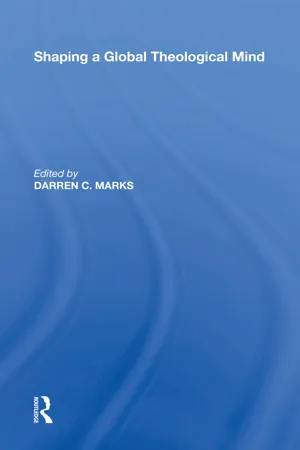
Shaping a Global Theological Mind
About this book
Theological thinkers are placed into contexts which inform their theological tasks but that context is usually limited to a European or North American centre, usually ignoring minorities and lesser mainstream theologies even in that context. This work focuses on the shift of Christian theological thinking from the North Atlantic to the Global South, even within the North Atlantic Church and Academy. It gives a Global perspective on theological work, method and context. Theologians from North America, Great Britain and Europe, Africa, Asia, Central and South America comment on how their specific context and methodology manifests, organizes and is prioritized in their thought so as to make Christian theology relevant to their community. By placing the Global South alongside the newly emerging presence of non-traditional Western forms such as Pentecostal, Aboriginal, and Hispanic theologies and theologians a clearer picture of how Christian theology is both enculturated and still familial is offered..
Information
Chapter 1
Living in a Global World and in a Global Theological World
Darren C. Marks
It has become almost too trite to speak of living in a global world. As in many other slogans of the Zeitgeist, the meaning is both clear and unclear. It is clear that living in a global world means that persons, things and ideas are now easily mobile and thus one is aware of analogues with, differences from, and so forth in places other than 'here'. For some this means that living in a global world is a phenomenon of a largely disposable, multi-complex, and inter-related historical place of 'now'. For others, it is about finding a buttress or fortress in the sea of changes caused by a 'them' whose consumption, presumption and assumption of power is an inevitable juggernaut. Whatever 'global' means, it rides the coattails of a long sixteenth century of Western modernity and scholars, usually sociologists (for they are the last of the truly grand systematizers/metaphysicians allowed in the wissenschaftliche academy), offering competing visions of this new borderless world.
Perhaps the most common definition of 'global' is actually a misconstrual of the term, being 'globalization'. Globalization, given its best articulation by the political theorist Francis Fukayama,1 is the economic reality of the free market arising out of the European seventeenth-century and the rise of capitalism.2 It is the true triumph of the free Cartesian/Kantian West, namely a choice on whether one drinks 'Coca-cola' or 'Pepsi', complete with the moral arguments for why one should or shouldn't. The argument is that the market in its desire to provide choice, and here what is really meant is a 'dis-embedding' of human need from the local, necessarily created a new abstract space from which now local-global actors do business. It is an abstract space in that globalized agents - law, governance bodies - or the 'experts' are everywhere and nowhere at the same time. Take, for example, any trade organization - it clearly has a 'headquarters' but is also enacted in all locations. It may have traders in, and all working under, a common charter but with applications or amendments configured by the local situation. This 'glocalization'3 is a nexus of determination and cooperation between the abstract centre and realized points on the circle. In any event, globalization is understood in the economic sense as the abuse of the new 'nation-states' of international corporations. However, there is another dimension to this globalization and abstract space. Just as the older nation-states, as in Hobbes' Leviathan (1651), treated all subjects (and places) as a uniform Euclidean world regardless of difference (if only for the purposes of taxation), the multinational corporation acts likewise, treating all peoples and places as the same. The global world for the multinational corporation, according to John Law and John Urry,4 is the largest abstract Euclidean container ever imaginable - it treats everyone the same, at least in terms of the corporate goals, and offers the choice to opt into the program as it were. This choice is ironically called the 'golden straitjacket'.5
Anthony Giddens extends this idea more fully when he argued that globalization is actually the world phenomenon of Western modernity extended to the remainder of the world.6 Giddens predicted that the response of such a mode of cultural and economic imperialism would be a series of defensive reactions or fundamentalisms. In particular, as in the work of Samuel Huntington and others,7 those cultures which are especially impervious to Western modern ideas of deliberative, rational and disembodied public spheres as an extension of the self (see, for example, J.J. Rousseau) are going to be hotspots of dissent. 'Embattled traditions', 'fundamentalisms' are then to be expected in the runaway world of the Western juggernaut. Of course, this includes the usual suspects, rife with Said's Orientalism, of so-called pre-modern or 'axial' societies connected with Islam or those groups bearing general uncertainty or anxiety in and towards the West. Utilizing Jaspers' motif of modernity as a new axial age - an age in which there is a threat of collapse of the old order8 - theorists can connect fundamentalisms in the Islamic non-Western world with Western fundamentalists in that both are reacting to change and both harken to a pre-cataclysmic vision of order in their traditions. In an axial age such as ours, the traditional 'order of things' is represented by a new theocratic aristocracy of priests and mediators.9 This ontotheological abuse is the rise of fundamentalisms or religious extremists. Religion, in the Marxist-sense, functions to sooth the rumblings of modernity and market but does so in a naive, retrograde and repressive manner. Of course, what is operative is the tacit assumption that whatever modernity is, it is essentially correct and the equally tacit idea that eventually the rest of the world will come of age and embrace the same movements, including the religiously-inclined. The global world is then a series of dialogues or interactions with a dominant centre and defensive or reactive margins that reject, modify or succumb according to the author.
In this instance of dominant centre and reactive margins many consider that what is occurring is exactly a rehearsal of old modes replaced by new actors in the network. Instead of abstract and (apparently) uniform intentional actors in nation-states, a globalized world has new and equally abstract and (apparently) uniform actors in corporations, NGOS, and associations or 'denominations'/networks. This shift occurs in multiple ways, on new 'landscapes' (or rather vast vistas) of ethnicity, finance, media, technology and finally ideology.10 Each of these interpenetrate the others and like the 'butterfly effect' of quantum mechanics, a shift in one alters the others so that the old order, birthed in modernity, is by-passed, weakened and altered by the far-away, near and complex.11 The modern reflective autarkic monadic culture (although it never really existed) is displaced by the reflexive combinard bricolage postmodern 'scapes. The world-machine is less and less sensible, functioning in an imagined community, and expects that this fluid container hold all of the waves of as many voices and 'scapes as possible. Of course, this means a new and almost by definition ahierarchial authority structure must be the new global agent(s). It is not 'there' or even 'here and now'; nor is it a visible body with representational authority that is the engine in a globalized world. Instead, before a 'we' creating a 'here' positing a 'now' and selecting a 'there'; what exists in the globalized world is the great theological conundrum - an 'I' living in isolation from God and thus from humanity and creation.
Thus, in a very real sense, the globalized world is treated as a collection of de-subjectivized, incoherent 'I's' and this reality stumbles into our collective experience while we try to raise the dead in a myriad of 'Zombie categories' in order to order the an-archic 'I'.12 And so, theory-in-hand, new battlegrounds are envisioned for the global world: ideological in terms of materialism, racism, sexism and nationalism, and ontological or institutionalist in terms of formal representative bodies as the only legitimate actors.13 Thus, the world-culture is a grand museum from which the local is able to select and organize the various exhibits which is useful to it. However, and centrally, there is again a theological problem in such a conception of the world regardless of how optimistic (and most remain pessimistic) this kind of transposition or interaction can be. Connecting the ideological and the institutional, however that latter category is conceived, is the invisible educational. Institutions run, as Immanuel Wallenstein correctly hits upon in every one of his texts, on the fuel of ideas, commitments, values, and these are 'taught' in the execution of culture. Just as, he points out, one needs a 'French Revolution' to centrist Liberalism in order to have a capitalist system, so the market (our great educator) teaches in all its myriad ways that this is the normative vista of human life. This is education, formally and informally in the 'scapes of technology, media and even in order to simply exist (cf. Rev 13:17). John Meyer argues in his work14 that the formal systems, actual educational institutes (in complete concordance with the initial Western desire to educate for good peaceable/conforming citizens) are the most important place of enculturation or rejection. In educational structures - a real ontological entity with its own life and rules etc. - occur the attempts for global peaceable citizenship with its assumption of isomorphism while giving lip-service to exomorphism.
So what then is the theological problem in the global world? I intimated two in the preceding paragraphs, but there are many more and many of these are themes recurrent in the essays of the theologians and Christian leaders/thinkers that follow. Clearly the two easiest, if I have argued well, are the tacit stresses on the 'I' before a 'We' and the competition of a new idol to God in capitalism and its near cousin of progressive liberalism reinforced informally in the 'scapes of technology/media and formally taught in the educational institutions of the world, underpinned by the desire of the governments to have peaceable/conforming citizens. In the case of the former, the Christian Church, transtemporally and translocally, is not an 'I' (or at least that 'I' is Christ) but always a 'We'. In the case of the latter, not only does it mean that much of the global Christian is in a virulent and necessary denouncement of an idol, but also that the global Christian is in a virulent and necessary denouncement of its mouthpiece - literally Balaam's ass for many - of theological education which imposed, imposes and silences in favor of the idol. This not only rejects the assumptions and method(s) of largely Western Protestant theology and spirituality, but also church organization, experiences (spirituality) and even to the secular itself. Global Christians, I repeatedly need to point out to my students, are not exactly enamored with their governments and tend to be suspicious of them and often heroic in opposition. Even in the West, for example, Christians ought to be creation-centered, and this 'green' space is clearly against industry and government. Further, Global Christians tend to 'find God' in their mission and often in ways that fit poorly or create anxiety for their Western counterparts whether they be of the 'John Hick' or 'Jerry Falwell' brand. Why, as Philip Jenkins points out so cogently,15 they even have the audacity to read the Bible differently!
Overcoming Globalization: A Theological Proposal
The essays in this book are all, in their own ways, about overcoming globalization in the sense outlined above. What they ask for and engage in are two major critiques and with several developments, although one needs to be careful to equate development with novelty for it may be both a rehearsal of something older in the Christian tradition and a new dialogue with another religion, culture or even need. We must remember that Christianity, despite Jasper's 'axial age model', was born in a dialogue with Judaism, itself in dialogue with ancient near eastern religions, and then spread by engaging the multifaceted Hellenistic and Roman worlds, eventually spreading into the frontiers of Europe and Asia with their unique cultural combinations. In short, there has never been an unambiguous Christian place. Christianity, or Christians living out their theology, has always been a theological Creole from Jesus to the present day. But this engaged nature is not the same as declaring it without a centre or without an origin, for God is the centre and origin of the Church.
The first theological critique is what I identify as a critique of modernity and specifically modernity's twins in market-capitalism and liberalism (or neo-liberalism and liberalism as some like to call them). The global theological account has to address Western modernity's basic categories, categories which treat people as products or consumers, creation as an expendable resource and culture as a battleground of colonial or imperialist ideology. Global theologians ask the question of this anthropological and creation impoverishment, or how it is possible to speak of God to a world made scarcely human(e) because of the imposition of an idol in Western Imperialism and all its legacies. This involves a recasting of many of modernity's precious icons - namely the autonomous and reflective self ('I') as the arbitrator of reality and Western culture's preoccupation with the individual as critical, essential and normative. In the multiplex of the global Christian, such decisions and preoccupations are the root of much of what impacts, on a daily level, the lives of countless people, destroys creation and marginalizes culture. The theological question to be asked is not merely how did we get here (and there are a myriad suggestions from scholars) but more importantly to ask how idolatrous, Godforsaken, such assumptions are and what in the Christian theological toolbox can be used in order to recognize 'the other'. One dominant theme in the global theological toolbox is pneumatology. If one aspect, but not the only aspect, of pneumatology is the recognition of the Spirit in another or culture or place, then the profound proliferation of pneumatology as a, if not the, theological category is to be expected in global theology and so it is in reality. Global theologies are highly interested in the Spirit because in pneumatology there is a promise of finding God's fore-coming for mission and disclosure for critique with its assumption of unity in Spirit. This is nothing short of contextual theology, making explicit the Gospel mission for this people here and now. Thus, in the essays that follow we see scholars engaged with essential questions of critique but mainly from the perspective of promise and hope, the fruit of the Spirit, and a confidence that such a hope can indeed be manifest when Christians indeed live in their witness. Of course, it must al...
Table of contents
- Cover
- Dedication
- Title
- Copyright
- Contents
- Notes on Contributors
- Preface
- 1 Living in a Global World and in a Global Theological World
- 2 A Christology from Advaita Vedanta of India
- 3 Theological Popevki: Of the Fathers, Liturgy and Music
- 4 The Missionary Enterprise in Cross-Cultural Perspective: With Particular Focus on Madagascar
- 5 Constructing a South African Theological Mind
- 6 Globalization, Religion and Embodiment: Latin American Feminist Perspectives
- 7 A Chicano Theological Mind
- 8 The Gospel is the Power of God for the Salvation of Everyone who Believes
- 9 Mujerista Theology: A Praxis of Liberation — My Story
- 10 A Tale of Many Stories
- 11 Indigenous Peoples in Asia: Theological Trends and Challenges
- 12 Global Warming: A Theological Problem and Paradigm
- 13 Beyond Suffering and Lament: Theology of Hope and Life
- 14 Method and Context: How and Where Theology Works in Africa
- 15 My Theological Pilgrimage
- 16 A Life Story Intertwined with Theology
- 17 To Give an Account of Hope
- 18 On Belonging: Doing Theology Together
- 19 Catching the Post or How I Became an Accidental Theorist
- 20 On Being Radical and Hopefully Orthodox
- 21 Between the Local and the Global: Autobiographical Reflections on the Emergence of the Global Theological Mind
- Index
Trusted by 375,005 students
Access to over 1.5 million titles for a fair monthly price.
Study more efficiently using our study tools.
Frequently asked questions
Yes, you can cancel anytime from the Subscription tab in your account settings on the Perlego website. Your subscription will stay active until the end of your current billing period. Learn how to cancel your subscription
No, books cannot be downloaded as external files, such as PDFs, for use outside of Perlego. However, you can download books within the Perlego app for offline reading on mobile or tablet. Learn how to download books offline
Perlego offers two plans: Essential and Complete
- Essential is ideal for learners and professionals who enjoy exploring a wide range of subjects. Access the Essential Library with 800,000+ trusted titles and best-sellers across business, personal growth, and the humanities. Includes unlimited reading time and Standard Read Aloud voice.
- Complete: Perfect for advanced learners and researchers needing full, unrestricted access. Unlock 1.5M+ books across hundreds of subjects, including academic and specialized titles. The Complete Plan also includes advanced features like Premium Read Aloud and Research Assistant.
We are an online textbook subscription service, where you can get access to an entire online library for less than the price of a single book per month. With over 1.5 million books across 990+ topics, we’ve got you covered! Learn about our mission
Look out for the read-aloud symbol on your next book to see if you can listen to it. The read-aloud tool reads text aloud for you, highlighting the text as it is being read. You can pause it, speed it up and slow it down. Learn more about Read Aloud
Yes! You can use the Perlego app on both iOS and Android devices to read anytime, anywhere — even offline. Perfect for commutes or when you’re on the go.
Please note we cannot support devices running on iOS 13 and Android 7 or earlier. Learn more about using the app
Please note we cannot support devices running on iOS 13 and Android 7 or earlier. Learn more about using the app
Yes, you can access Shaping a Global Theological Mind by Darren C. Marks in PDF and/or ePUB format, as well as other popular books in Theology & Religion & Religion. We have over 1.5 million books available in our catalogue for you to explore.