- 182 pages
- English
- ePUB (mobile friendly)
- Available on iOS & Android
eBook - ePub
About this book
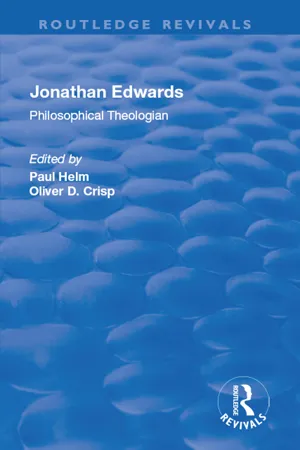
This title was first published in 2003. It has often been claimed that Jonathan Edwards (1703-1758) was America's greatest philosopher and theologian. From literary criticism of his sermons to philosophical assessments of his metaphysics, there has been a burgeoning industry in Edwardsian studies, but there has been no one place where an exploration of the theology and philosophy of Edwards has been brought together. 2003 marks the tercentenary date of the birth of Jonathan Edwards. This book draws together specially-commissioned contributions from philosophers and theologians from the USA and UK, to present new analytic philosophical and theological thinking on Edwards in a way that reflects Edwards' own concerns, as well as those current in the academy.
Chapter 1
Jonathan Edwards on Hell
Every religion offers both hope and fear. Each offers hope in virtue of the benefits promised to adherents, and fear in virtue of costs incurred by adversaries. In traditional Christianity, the costs incurred are expressed in terms of the doctrine of hell, according to which each person consigned to hell receives the same infinite punishment. This strong view of hell involves four distinct theses. First, it maintains that those in hell exist forever in that state (the Existence Thesis) and that at least some human persons will end up in hell (the Anti-Universalism Thesis). Once in hell, there is no possibility of escape (the No Escape Thesis), and the justification of and purpose for hell is to mete out punishment to those whose earthly lives and character deserve it (the Retribution Thesis).
There was a time when such a picture of hell engendered fear rather than a perceived need for defense, a time when traditional Christianity was more a cultural presupposition than it now is. The need for defense is felt much more strongly now than in the past, but the strong view of hell has always been in need of an adequate ground. For if reality is structured as traditional Christianity claims, some explanation is required for the strong view of hell in terms of God’s nature and character. The alternative is to treat Christian doctrine as some collage of literary motifs drawn from an ancient collection of stories and writings, elevated to the status of accurate information through the power of myth. Traditional Christianity places higher demands on itself, insisting that it forms a coherent and accurate picture of the nature of God and his relationship to the created universe. When Christianity is taken in this theoretically serious way, questions of justification and explanation become pressing. In particular, those aspects that appear to threaten theoretical unity require explanation, and the strong view of hell is surely among such aspects, given the centrality of God’s love in traditional Christianity and the lengths to which God will go in that gospel to redeem lost humanity.
Jonathan Edwards not only preached the doctrine of hell in astounding and disturbing ways, but also addressed these theoretical questions in as sound a way as can be found. I will argue for this claim by investigating how one might try to defend the strong view of hell, in order to show where Edwards’s discussion fits into this larger picture, and then will investigate more carefully his own contribution to the question of the acceptability of the strong view of hell.
Requirements of a Defense of the Strong View of Hell
The question which must be answered by a defender of the strong view of hell is why anyone would think it is true. It is, of course, one quite natural interpretation of the teachings of Scripture on the subject, but it is far from clear that it is unique in this regard. Furthermore, if the strong view fails on theoretical grounds, an appeal to Scripture in defense of the view will be inadequate. So the prior question that must be asked concerns the theoretical adequacy of the view, and since the strong view is intrinsically a retributive account, we can begin by investigating that aspect of the view.
Any justification for retribution requires wrongdoing, ordinarily in terms of harm caused or harm intended, and neither source provides an obvious defense of a view of hell on which every person is equally guilty and all deserve an infinite punishment. Some people cause more harm than others, thereby rendering ineffective an appeal to the principle of ‘an eye for an eye,’ and some people intend, or at least appear to intend, more harm than others. There is some moral presumption in favor of the view that willing evil is as bad as doing it, but even if we grant this principle, we would need some equality of intended harm in order to justify the claim that everyone deserves an equal, infinite punishment. Furthermore, one would need to claim that every person was guilty of such an egregious act or intention that an infinite punishment is warranted. Perhaps such actions or intentions are possible, on some account akin to that given by defenders of capital punishment, but it is hard to see how everyone is guilty of such actions or intentions.
One might argue here that we ought to attend more carefully to the darkness of the human heart, and the fact that even the best and wisest of us carry enormous capacities for evil within us. I have no doubt that these claims are true, that the heart of human beings is deeply corrupt and full of all kinds of evil thoughts, but even granting very dark views about human nature will not sustain the strong view of hell. For it is implausible to deny that some inflict more harm than others and some intend more harm than others.
These factors lead straightforwardly to a search for another source of justified retribution other than that arising out of actual or intended harm, and the traditional answer has been to find such a source in the status of the one wronged. On this viewpoint, the degree of guilt incurred by a wrong action is a function not only of harm caused and harm intended, but also a function of the status of the one against whom the wrong is done. We can call this principle the ‘status principle,’ for short.
A facile dismissal of this defense would attempt to tie the plausibility of such an appeal to status to the moral experience within nonegalitarian societies. The claim would be that such an appeal could only be plausible to those involved in such societies, where, for example, the moral experience of killing a prince would be quite different from that of killing a serf. I think, however, that this dismissal is too quick. For the concept of status need not be interpreted in such a sociological fashion. Consider, for example, the appeal to status central to humanism. Even in an age emphasizing the moral dimension of the rights of animals, it is too facile to dismiss the humanistic elements of our moral experience as entirely unfounded. Even if it is prima facie wrong to kill any animal, it is implausible to think that the forced choice between the death of a human and the death of, say, a lizard is an unresolvable moral dilemma. Furthermore, notice that the moral choice here is difficult to explain in terms only of harm caused or harm intended, unless one builds into the idea of harm caused the idea that human life has an intrinsic value beyond that of a lizard. Such a viewpoint, I suggest, is nothing more than a recognition of the intuitive plausibility of some type of status principle.
If we attempt to defend the traditional doctrine of hell by appeal to the status principle, however, two central tasks face us. First, we must identify that on which status depends. Some wholly implausible ideas can be rejected immediately, such as defining status in terms of fame, or fortune, or longevity, or wisdom. If these ideas are implausible, however, what more plausible account can be given? Second, we need to find some function of harm caused, harm intended, and status to yield the result that an infinite punishment can be justified given some combination of these three factors.
This second task is exacerbated by the need for the value of the function to be infinite for all (unregenerate) human beings, for the strong view of hell requires that every person deserves an infinite punishment. Since there are clear differences among human beings in terms of harm caused and harm intended, there must be something about the feature of status that swamps these differences to yield a justified infinite punishment in every case. Moreover, there are clear differences among human beings in terms of the status of the objects of their wrongdoing. Some are thieves while others are murderers; some torture only lower animals while others torture human beings.
So we will need to identify some special action or class of actions that every person performs which triggers justified infinite punishment in order to defend the strong view of hell. As we have seen, it is difficult to find such an action when we look for it in terms of harm caused or harm intended, and it is difficult to find such an action when we look at the things of ordinary life which suffer harm or which we attempt to harm. The only other place to look for an adequate defense of the strong view is in actions which wrong God. Only by bringing God into the picture is there any hope of finding a wronged party with sufficient status to swamp the differences that exist in terms of harm caused and harm intended.
In addition, because all such wrongs deserve the same punishment on the strong view, the appeal to wrongs against God must be sufficient in itself to justify the infinite punishment of the strong view, regardless of any differences in terms of harm caused and harm intended. Not only must there be some way to sin against God which deserves infinite punishment, but it must also be the case that any sin against God requires such punishment. Otherwise God’s presence in the moral story would be insufficient to justify an infinite punishment.
If sinning against God were not sufficient in itself to justify an infinite punishment, the strong view would have to be defended additionally in terms of the quality or quantity of wrongdoing that could justify an infinite punishment. Quality differences would have to trace to kinds or degrees of harm caused or harm intended, and we have already seen the failure of such appeals to justify an infinite punishment. So all that remains would be some appeal to quantity of wrongdoing against God. Such an account would be highly arbitrary, however. If one sin against God is insufficient to warrant infinite punishment, how could one deal with a larger number, say, fifteen, or five hundred? The only plausible, non-arbitrary answer would be that an infinite number of sins would make a difference, but it is hard to see how it is possible for finite beings to perform that many distinct sins, let alone something of which all humans are inevitably guilty. So, the best hope for a defense of the strong view of hell is to hold that God’s status is so overwhelmingly high that it renders irrelevant any other moral differences. No matter how insignificant a sin is in terms of harm caused and harm intended, if it is a sin against God, it automatically becomes so serious that it deserves an infinite punishment. No weaker account of God’s relationship to human sinfulness could give a theoretically satisfactory defense of the strong view of hell.
Once we have determined that any sin against God is sufficient to merit an infinite punishment, we must address the question of which of our wrongdoings count as sins against God and which do not. One might try to identify actions in which human beings make God the intentional object of their wrongdoing, aiming to harm him, or insult him in some way by their behavior. Yet it is not obvious that all people perform such actions, especially in an age of increasing atheism and agnosticism. For in such an age, it is a hard empirical claim to defend that atheists and agnostics affirm connatively what they refuse to endorse cognitively.
The difficulty of identifying some particular sin against God of which all are guilty suggests that a more egalitarian approach might provide more hope for success. On this egalitarian approach, all sins are equal, for all sins are against God, whether or not God is the intentional object of that sin. It is here that the work of Jonathan Edwards is most relevant, especially The Nature of True Virtue, for Edwards gives the most complete and detailed defense found in the literature of the claim that all sin is against God. It is this defense that I wish to examine and comment on here. I will argue, first, that though Edwards’s explicit arguments need some emendation, the changes required are small and sufficient to yield an adequate defense of the claim that all sin is against God.
Edwards’s Defense of All Sin Being Against God
Edwards classifies all behavior as either sinful or truly virtuous. True virtue, according to Edwards, consists primarily in ‘love to being in general,’1 and secondarily in a relish of, or delight in, the intrinsic excellence of benevolence.2 Edwards connects this conception of virtue to God by identifying God with being in general: ‘God is infinitely the greatest Being,’ ‘the foundation and fountain of all being and all beauty … the sum and comprehension of all existence and excellence.’3 God’s pre-eminent reality, in this sense, prevents one from displaying true virtue and yet insisting ‘on benevolence to the created system in such a manner as would naturally lead one to suppose’ that it is ‘by far the most important and essential thing.’4 According to Edwards, ‘a determination of mind to union and benevolence to a particular person, or private system, which is but a small part of the universal system of being … is not of the nature of true virtue’ unless it is ‘subordinate to benevolence to being in general.’5 So no person is truly virtuous who is not governed by a love of God and a delight in his beauty.
By contrast, then, sinful behavior is identified with attachment to private systems (such as individual persons or groups, special causes or concerns, including personal happiness, the well-being of all humans, and even the well-being of the entire created order) rather than benevolence to being in general. Edwards thus requires a proper motivation in order for one to avoid sin, and anything less than properly motivated behavior is sinful.
It is here that the relationship between God and being in general is central to Edwards’s thinking. Once we have granted the identification between God and being in general, or at least the claim that the two are inextricably linked, Edwards concludes that one can only be truly virtuous by being motivated in a way that makes God central to that motivation. Because God must be central to virtuous behavior in this way, the central failure in sinful behavior is a failure to involve God in one’s motivations, and hence to sin against God.
This argument requires as a premise the claim that any behavior aimed at something less than God himself constitutes an offense against God. One might wonder why this claim is true. After all, in the usual case we sin against a person by intentionally directing our actions toward that person. Mere failure to take the interests of a person into account when deciding on a course of action doesn’t imply that when things go wrong, one’s behavior constitutes an offense against that person. The decision to marry a certain person, for example, might harm some third party, but the marriage need not constitute an offense against that third party. So why are things different in the case of God?
There are two ways to try to answer this question, one ethical and the other metaphysical. Let us consider the ethical answer first. To do so, let us engage in the fictional project of reifying morality, allowing us to talk of offenses against morality. The question then is under what conditions one can commit an offense against morality. In particular, the question is whether it is ever possible to do something morally wrong and yet not commit an offense against morality.
Such a possibility could arise if there were a distinction between what is morally required of a person and what that person ought to do, all things considered (including the moral features of the situation). If there is such a distinction, then when deliberating about what to do, one first should determine what is religiously required, what is morally required, what is required in terms of self-interest, and so on. Each of these factors would then play some role in a function on all of these factors that yielded some overall obligatory course of action. The overall, obligatory course of action might, in any given case, be what is morally required, but it might also be what is religiously required, or required in terms of self-interest, or in terms of some other requirement (or maybe what is required is something different from what is required from each of these limited perspectives).
Suppose then that we are considering a situation in which what is obligatory, all things considered, is incompatible with what is morally required. In such a case, one ought to violate morality, because morality is just one factor to be taken into account when deciding what one ought to do. If one does as one should, one will have acted contrary to the demands of morality, but one will have committed no offense against morality. For on this theory of the relationship between morality and what one ought to do, there is a logical gap between honoring morality and doing the right thing, all things considered. Hence, one can fail to honor morality without offending against it. The explanation of this possibility is that one has an overriding reason to fail to honor morality, and it is the existence of this overriding reason that allows one to occupy the neutral position of failing to honor morality without committing an offense against it.
Suppose, however, (and much more plausibly) that there can’t be any difference between what one ought to do, all things considered, and what morality requires of one (though, of course, there can be a difference between what one ought to do, all things considered, and what conventional morality, the moral viewpoint of one’s culture, implies). In such a case, every wrong action constitutes an offense against morality. Morality always occupies the pre-eminent position in all matters of conduct on this view, so that even those who care not at all about morality and do not take its demands into account nonetheless offend against it when they act contrary to its demands. On this view of the relationship between what one ought to do, all things considered, and what morality requires of one, any deliberation that fails to honor the overriding nature of morality offends against it. Courses of action which show a weighing of reasons which does not grant pre-eminent position to moral reasons offend against morality for that very reason. For such courses of action betray a presupposition that the demands of morality might not be the same as what is required of us, all things considered, and that view is false and necessarily so.
Edwards’s position against the possibility of a neutral position with regard to God can be defended by adopting this same view of morality as necessarily overriding. Some people do...
Table of contents
- Cover
- Title Page
- Copyright Page
- Table of Contents
- Notes on the Contributors
- Introduction
- 1 Jonathan Edwards on Hell
- 2 Jonathan Edwards and the Doctrine of Hell
- 3 Edwards on Free Will
- 4 A Forensic Dilemma: John Locke and Jonathan Edwards on Personal Identity
- 5 How ‘Occasional’ was Edwards’s Occasionalism?
- 6 The Master Argument of The Nature of True Virtue
- 7 Does Jonathan Edwards Use a Dispositional Ontology? A Response to Sang Hyun Lee
- 8 One Alone Cannot be Excellent’: Edwards on Divine Simplicity
- 9 Jonathan Edwards, John Henry Newman and non-Christian Religions
- 10 Salvation as Divinization: Jonathan Edwards, Gregory Palamas and the Theological Uses of Neoplatonism
- Index
Trusted by 375,005 students
Access to over 1.5 million titles for a fair monthly price.
Study more efficiently using our study tools.
Frequently asked questions
Yes, you can cancel anytime from the Subscription tab in your account settings on the Perlego website. Your subscription will stay active until the end of your current billing period. Learn how to cancel your subscription
No, books cannot be downloaded as external files, such as PDFs, for use outside of Perlego. However, you can download books within the Perlego app for offline reading on mobile or tablet. Learn how to download books offline
Perlego offers two plans: Essential and Complete
- Essential is ideal for learners and professionals who enjoy exploring a wide range of subjects. Access the Essential Library with 800,000+ trusted titles and best-sellers across business, personal growth, and the humanities. Includes unlimited reading time and Standard Read Aloud voice.
- Complete: Perfect for advanced learners and researchers needing full, unrestricted access. Unlock 1.5M+ books across hundreds of subjects, including academic and specialized titles. The Complete Plan also includes advanced features like Premium Read Aloud and Research Assistant.
We are an online textbook subscription service, where you can get access to an entire online library for less than the price of a single book per month. With over 1.5 million books across 990+ topics, we’ve got you covered! Learn about our mission
Look out for the read-aloud symbol on your next book to see if you can listen to it. The read-aloud tool reads text aloud for you, highlighting the text as it is being read. You can pause it, speed it up and slow it down. Learn more about Read Aloud
Yes! You can use the Perlego app on both iOS and Android devices to read anytime, anywhere — even offline. Perfect for commutes or when you’re on the go.
Please note we cannot support devices running on iOS 13 and Android 7 or earlier. Learn more about using the app
Please note we cannot support devices running on iOS 13 and Android 7 or earlier. Learn more about using the app
Yes, you can access Jonathan Edwards by Oliver D. Crisp, Paul Helm in PDF and/or ePUB format, as well as other popular books in Business & Business General. We have over 1.5 million books available in our catalogue for you to explore.