eBook - ePub
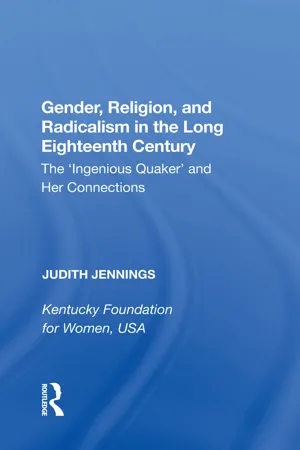
Gender, Religion, and Radicalism in the Long Eighteenth Century
The 'Ingenious Quaker' and Her Connections
- 204 pages
- English
- ePUB (mobile friendly)
- Available on iOS & Android
eBook - ePub
Gender, Religion, and Radicalism in the Long Eighteenth Century
The 'Ingenious Quaker' and Her Connections
About this book
Through analysis of the life and writings of eighteenth-century Quaker artist and author Mary Knowles, Judith Jennings uncovers concrete but complex examples of how gender functioned in family, social, and public contexts during the Georgian Age. Knowles's story, including her bold confrontation of Samuel Johnson and public dispute with James Boswell, serves as a lens through which to view larger connections, such as the social transformation of English Quakers, changing concepts of gender and the transmission of radical political ideology during the era of the American and French revolutions. Further, Jennings offers a more nuanced view of the participation of "middling" women in radical politics through an examination of Knowles's theological beliefs, social networks and political opinions at a time when the American and French Revolutions reshaped political ideology. By analyzing Mary Knowles's connections-both male and female-Jennings contributes new understanding about how sociability operated, encompassing women and men of various faiths and ethnic origins.
Trusted by 375,005 students
Access to over 1.5 million titles for a fair monthly price.
Study more efficiently using our study tools.
Information
Chapter 1
Radical Self-Representation
Religious convictions, gender expectations, and radical politics all played a part in the family history and early life of Mary Morris. Her ancestors embraced Quaker beliefs, and their descendants struggled to reconcile religious radicalism with social respectability, as tensions developed between Quakerism and Quakerliness. Living under limited toleration, Morris fused seventeenth-century religious ideals with the polite practices of the eighteenth century to fashion new forms of socially acceptable Quaker behavior. As a prosperous and educated provincial woman, she gained a regional reputation for her beauty and defended her beliefs in polished poetics. Furthermore, she described herself as an artist, resisted a Quaker authority, and wrote a satirical autobiography as a form of radical self-representation.
Family memoirs record how her ancestors suffered with the first Friends during the civil wars. William Sikes of Leeds, her earliest recorded relative, married Grace Jenkinson, and the two moved to Knottingly, in Yorkshire, where he worked as a merchant. Descendants described Sikes as a Puritan, noting that he refused to pay the required tithes to the Anglican Church. In 1652, local authorities imprisoned him, along with other dissidents, in York Castle. Sikes's cellmates included members of an emerging religious group who called themselves Friends but whom others derisively dubbed Quakers. Sikes died a prisoner in York Castle, leaving £5 to the Friends "as a sign of his love.'1
After her husband's death, Grace Jenkinson Sikes became a Friend. Guided by their visionary leader, George Fox, Friends believed that "every man was enlightened by the divine light of Christ." Fox taught that women had souls and experienced the saving power of Christ within, just as did men. Some women Friends became important organizational leaders, while others were recognized as ministers. Female converts like Grace Jenkinson Sikes contributed to the fast growing numbers of Friends, increasingly called Quakers, nationwide.2
After Parliament restored the Stuart monarchy and the Anglican Church, fears of treason prompted periodic Quaker arrests. Following the failure of a plot in 1684, local authorities arrested 240 Quakers in Yorkshire, including the aging Grace Sikes. In 1685, according to family records, Grace Jenkinson Sikes "Died a prisoner for her Testimony" in York Castle, where her husband had perished more than 30 years before.3
While William and Grace Sikes died for their beliefs, their descendants faced the challenges of living as Quakers. After the accession of William and Mary to the throne, Quakers achieved a measure of religious toleration, if not full social and political integration, in a series of Parliamentary Acts. The Toleration Act of 1689 recognized Quakers as Dissenters, allowing them to gather in registered meetings for worship and affirm their loyalty instead of swearing the oath, which violated their beliefs. The Test Act, however, prohibited Quakers from holding office or attending universities. Like other Dissenters, Quakers thus occupied an ambiguous place in the nation, legally tolerated but within limits.
Sarah Sikes, the daughter of William and Grace, became a Friend and married William Storrs, also a Quaker. The couple moved to Chesterfield, where he worked as a draper. Before toleration, Sarah Sikes Storrs and her husband, like her mother and father, were imprisoned for their beliefs. Yet, Sarah and William lived to raise their daughter, Esther Storrs, under limited toleration.4
By the late seventeenth century, as Esther Storrs and other Friends of her generation grew up, Quakers began developing survival tactics. Adopting such strategies, which included moderating their social and political activities, enabled many Quakers both to practice their beliefs and prosper under limited toleration. Yet this "metamorphosis," as described by Quaker scholar Rosemary Moore, also resulted in continuing and sometimes serious tensions between religious radicalism and social respectability.5
The potentially precarious relationship between revelation and reason constituted one source of these ongoing tensions. Faith in the guidance of the divine light within remained the bedrock of Quaker belief. Yet, Robert Barclay, in his influential Apology for the True Christian Divinity, as the same is held forth and preached by the people called, in scorn Quakers, first published in English in 1678, explained that "inward revelations do not contradict scripture or reason." Barclay wrote that, "God gave two great lights to rule the outward world." The sun, the greater of the two, represented divine light, while the moon, borrowing "her light from the sun," represented enlightened reason.6
Despite this balance proposed by Barclay, the stress on the primacy of individual revelation continued to cause schisms within the Quaker organization. George Fox articulated the concept of "unity" to underscore the importance of the collective whole, while his convert and later wife, Margaret Fell, helped develop the system of local, regional, and national meetings to consider matters of collective faith and governance. Local meetings also appointed "elders," charged with counseling wayward Friends to maintain unity.7
Esther Storrs also grew up during a time of increasing tensions concerning the roles of women within the Quaker organization. While Quakers continued to stress the spiritual equality of women and honor them as ministers, female Friends in England were not incorporated into two emerging national decision-making bodies. Most local groups included women's meetings for business, which served important functions in approving marriages and administering charity. However, the national Meeting for Sufferings and Yearly Meeting, formed in the late seventeenth century, included no women. Quakers in the colony of Pennsylvania and New Jersey had formed a Women's Yearly Meeting by 1681, and the lack of a similar body in the mother country constituted a continuing source of irritation for some English and American Friends for the next 100 years.8
Quaker precepts about plain living also became another source of tensions alter toleration as some Friends became more prosperous. Fox taught that Quakers should forsake "vain traditions" and social practices inimical to the guidance of their inward light. He warned Friends not to "use the world's salutations, nor fashions, nor customs."' The aristocratic Barclay further advised Quakers about suitable "Salutations and Recreations," but he allowed wealthy Friends some leeway in their dress and practices. "If a man dresses quietly and without unnecessary trimmings," he wrote, "we will not criticize him if he dresses better than his servants." In general, according to Barclay, "although by our principles the use of anything which is merely superfluous is unlawful, this does not deny the enjoyment of luxury for those who are accustomed to it."10
Esther Storrs sought to balance prosperity and the Quaker practices of her parents and grandparents when she married and moved to Staffordshire. She wed Richard Morris in 1699, and they settled in Rugeley,11 midway between Lichfield and Stafford. A resident later wrote that, "Rugeley was a small but exceedingly neat town with some good inns, and ... upon the whole it is as agreeable a little town as any in these parts."12 Registration records document Quaker meetings in 11 towns throughout Staffordshire in the early 1700s.13 Richard Morris noted that one such meeting was held at his and Esther's home in Rugeley.14
Richard Morris prospered as a surgeon, while he and Esther developed domestic practices suitable to their economic status and religious beliefs. He wrote a treatise on the importance of spiritual guidance in understanding the scriptures.15 She provided religious instruction to members of their household, which included more than one maid, and, when needed, a midwife and nurse. Richard later recalled that Esther wore plain apparel, favored simple furniture, and eschewed some popular customs, such as women "making presents, one to another (where it was no act of charity)."16
Richard and Esther raised four children, and their fourth, Moses Morris, became the father of Mary.17 Richard and Moses Morris played a role, although not an unfailing one, in upholding Quaker practices in Staffordshire. A contemporary later described going to a rented room in Stafford with a Friend who wished to declare his intention of marriage before the men's meeting, as required by Quaker practice. When the two arrived, they found "nobody there but the old woman who lives in the house." The man who accompanied the intended groom added, "Whether Richard and Moses Morris had forgot the appointment I can't tell." Undaunted, the determined groom declared his intention of marriage to his friend "and the old woman."18
Moses Morris married a Quaker named Alice, probably from Birmingham or Wigginshill, a nearby village in Warwickshire.19 By 1730, Moses and Alice Morris had settled in Rugeley. In the years following, they had three surviving children, Joseph, born in 1731, Mary in 1733, and Esther in 1737.20 Close and loving throughout their lives, the children became affectionately known as Joe, Molly, and Etty.
By the time of Mary Morris's birth, some prosperous young metropolitan Quakers had abandoned their beliefs to follow fashion, according to one famous observer. François Voltaire described London Friends in the first four of his Letters Concerning the English Nation, published in 1733. Noting increasing disparities between Quaker prosperity and precepts about plain living, he wrote, "The children made rich by the industry of their fathers, want to enjoy themselves, to acquire honors, buttons, and cuffs." According to Voltaire, "They are ashamed to be called Quakers, and are turning Anglican to be in style."21
Voltaire's observation illustrates the differences between Quakerism and Quakerliness. Following the distinctions described by religious scholar, Emma Lapsanksy, Quakerism denotes the basic religious beliefs of Friends, inspired by Fox and other early leaders and systematized by Barclay. Quakerliness refers to the behaviors and attitudes considered appropriate for Friends, or "ways of looking, behaving, being" a Quaker.22 While Quakerism is an unchanging set of beliefs, standards of Quakerliness have varied over time and place and often been contested by both Friends and observers, like Voltaire.
Growing up in a prosperous provincial family in the first half of the eighteenth century, Mary Morris experienced the tensions between Quakerism and Quakerliness. Her father died young but seems to have provid...
Table of contents
- Cover
- Half Title
- Dedication
- Title
- Copyright
- Contents
- List of Illustrations
- Acknowledgements
- Introduction
- 1 Radical Self-Representation
- 2 Matrimony, Monarchy, and Fame
- 3 Confronting Samuel Johnson
- 4 Revolutionary Politics and Literary Skirmishes
- 5 Defying James Boswell
- 6 The French Revolution and a New Note
- 7 "Help Me To Pray"
- Conclusion
- Bibliography
- Index
Frequently asked questions
Yes, you can cancel anytime from the Subscription tab in your account settings on the Perlego website. Your subscription will stay active until the end of your current billing period. Learn how to cancel your subscription
No, books cannot be downloaded as external files, such as PDFs, for use outside of Perlego. However, you can download books within the Perlego app for offline reading on mobile or tablet. Learn how to download books offline
Perlego offers two plans: Essential and Complete
- Essential is ideal for learners and professionals who enjoy exploring a wide range of subjects. Access the Essential Library with 800,000+ trusted titles and best-sellers across business, personal growth, and the humanities. Includes unlimited reading time and Standard Read Aloud voice.
- Complete: Perfect for advanced learners and researchers needing full, unrestricted access. Unlock 1.5M+ books across hundreds of subjects, including academic and specialized titles. The Complete Plan also includes advanced features like Premium Read Aloud and Research Assistant.
We are an online textbook subscription service, where you can get access to an entire online library for less than the price of a single book per month. With over 1.5 million books across 990+ topics, we’ve got you covered! Learn about our mission
Look out for the read-aloud symbol on your next book to see if you can listen to it. The read-aloud tool reads text aloud for you, highlighting the text as it is being read. You can pause it, speed it up and slow it down. Learn more about Read Aloud
Yes! You can use the Perlego app on both iOS and Android devices to read anytime, anywhere — even offline. Perfect for commutes or when you’re on the go.
Please note we cannot support devices running on iOS 13 and Android 7 or earlier. Learn more about using the app
Please note we cannot support devices running on iOS 13 and Android 7 or earlier. Learn more about using the app
Yes, you can access Gender, Religion, and Radicalism in the Long Eighteenth Century by Judith Jennings in PDF and/or ePUB format, as well as other popular books in History & World History. We have over 1.5 million books available in our catalogue for you to explore.