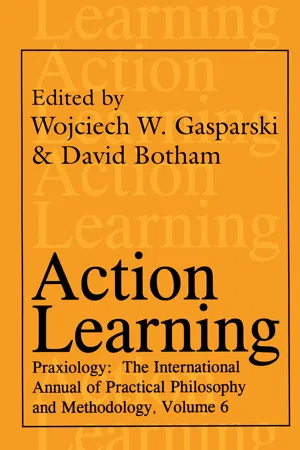
Praxiology is the study of working and doing from the point of view of effectiveness. It has three components: analysis of concepts involving purposive actions; critique of modes of action from the viewpoint of efficiency; and normative advisory aspects in recommen-dations for increasing human efficacy. This sixth volume of the Praxiology series fo-cuses on action learning. Learning from distinguishable action is surprisingly different than learning from a sub-ject expert in human or book form. For those who have worked with and in action learn-ing, the latest form is always distinguishably different from a former experience. Action learning programs are not, in general, intended to tackle puzzles, namely, questions to which an answer may be said to exist even if that answer is difficult to find; action learn-ing is intended to help to develop the ability to tackle problems or opportunities, of which different persons, all experienced, intelligent, and motivated, might well advocate differ-ent courses of action, all reasonable. The essentials of action learning, according to this volume, are: there can be no learning unless the participant receives feedback about his/her performance; partici-pants learn only of their own volition and never at the will of others; the volition to learn is most readily engendered by the lure of success or by the fear of calamity. Building upon these essentials, the authors view action learning as a process of inquiry begin-ning with the experience of not knowing what to do next, and finding that an answer is not available from current expertise. All chapters in this volume are sound contributions to the continuing debate on the processes of learning from distinguishable action. Action Learning is intriguing reading for sociologists, philosophers, managers, and research-ers of all disciplines.
- 221 pages
- English
- ePUB (mobile friendly)
- Available on iOS & Android
eBook - ePub
About this book
Information
Part One
The Elements of Action Learning
Fundamental Aspects of Action Learning
(with the Annex by Reginald W. Revans)
Albert Barker
Revans Centre for Action Learning and Research, University of Salford, Salford, UK
The “Necessity for Action” and the “Obligation to Respond” are fundamental precepts of genuine Action Learning. In the following pages they are contrasted with “Sham” and the consequences of listening to “Expert Imposters” – before finally we move on to ponder some implications of genuine Action Learning as we search for pathways to Wisdom and Understanding. Thus we set out to consider briefly five general topics:
- The Necessity for Action;
- The Obligation to Respond;
- Sham ... Manifestations of Deceit;
- The Legacy of “Expert” Imposters;
- Of Genuine Action Learning – Applied Praxeology.
1. The Necessity for Action
It is highly relevant that Revans called his work “Action Learning” and has insisted all along that ACTION was a key element in Action Learning. He tells us that we can’t learn of Action Learning without practising Action Learning. Praxeology similarly focuses upon ACTION and we should note that the 4th century Greek artist Praxiteles was not just a student of sculpture, but was a practising sculptor, becoming highly renowned and regarded as second only to Phidias.
Revans often quotes: “One action is worth a thousand words” (Mohammed).
In the ABC of Action Learning he reminds us:
To do a little good is better than to write difficult books. The perfect man is nothing if he does not diffuse benefits on others, if he does not console the lonely. The way of salvation is open to all, but know that a man deceives himself if he thinks he can escape his conscience by taking refuge in a monastery. The only remedy for evil is healthy reality. (Buddha; Benares Deer Park)
One must learn by doing the thing; for though you think you know it you have no certainty, until you try. (Sophocles; Trachiniae)
Be ye doers of the word, and not hearers of it, blinding yourselves with false ideas. Because if any man is a hearer of the word and not a doer, he is like a man looking at his natural face in a glass; for after looking at himself he goes away, and in a short time he has no memory of what he was like. But he who goes on looking into the true law which makes him free, being not a hearer without memory but a doer putting into effect, this man will have a blessing on his acts. (St. James; CH.1: v. 22–25)
It is not enough to know what is good; you must be able to do it. (Shaw; Back to Methuselah, IV)
All meaningful knowledge is for the sake of action, and all meaningful action for the sake of friendship. (John Macmurray; The Self as Agent)
Constantly we hear of the need for ACTION and DOING!
To these we could add a few others, such as:
What we have to learn to do, we learn to do by doing. (Aristotle; Nichomachean Ethics, Bk 2)
Don’t listen to their words, fix your attention upon their deeds! (Einstein; The World as I See It – on theoretical physicists)
Is not religion all deeds and reflection? (Kahlil Gibran; The Prophet)
... as for knowledge, it arises through experience only (Immanual Kant)
Doing is better than saying (Proverbs)
Apart from the above examples there is plenty of evidence from elsewhere too that the essential need to ACT has been advocated down through the ages in all manner of contexts from ethical to metaphysical (as the means of acquiring primary evidence) and in terms of practical application. Since we Learn With & From Each Other – and also from Doing, then it becomes clear that we need to DO TOGETHER in order to learn. Studying together, whilst useful, is not enough – it is necessary but not sufficient. Listening to the advice of others is also not enough, particularly if they too have not been “doing” anything themselves, but only amassing at second hand the second handed experience or theory of others who were also non-practising.
Revans was keen that the Heathrow Congress1 of 1995 included the words “mutual collaboration” in its title and the project was intended to pursue future practical action as a consequence. Unfortunately the original format, leading towards some kind of delegate determined outcome involving future action, was lost in the enthusiasm for academic analysis using truncated elements of Systems Alpha and Beta to arrive at flip chart resolutions. The attitude “It’s done; we’ve surveyed the problem (β1) and arrived at a viewpoint (β2),” seemed to be for many the natural end of the matter (a simple academic exercise involving an Action Learning experience) ... whereas without subsequent action, the exercise itself would remain sterile.
The clue lay in the use of the word “Collaboration” and we should note its Latin roots (collaborare/laborare, “to work” – together) indicating the need not merely to talk or consult together (confer/conference – from “conferre”), analyse and exchange, but to act together (involving the performance of deeds) to generate experience through application and experiment (β3), which could later be reviewed (β4), and then assimilated as learning (β5).
We have come to believe that the ability to describe a phenomenon, characteristic or manifestation, thereby renders an understanding of it. It does not. The ability to describe a clock in great detail down to the last measure of any significance at all, does not provide an understanding of the essence of Time. Nor does the ability to describe with great precision the last physical details of the human body bestow upon us a knowledge of Human Nature. We think that once we can describe a thing or have concocted a definition for it, that we then understand it too! Definitions and descriptions do not render understanding.
Sadly, the erroneous idea that understanding comes from the preparation of an identifying account of something, has in many academic minds superseded the need for experiment, experience, action, test or evaluation – indeed the need for any action of any kind whatsoever.
People prepare a definition for “management” (organisational or social, and the more complex, highly structured and jargon-ridden the better) and then presume to know what “management” is all about without any need to engage in it nor even to confer with or listen to those who endeavour to practise it – nor even to those who attempt to respond to it.
The full process of System Beta is too often curtailed. We go straight from β1 (Survey), through β2 (Decision) to assume β5 (Learning), in effect saying “I have looked at the problem and decided – so now we know.” The thought that the theory needs also to take account of the reality is anathema. Not all of them but nevertheless too many academics and others are too keen to keep well away from Reality.
Theoretical Economists read and write their books and expound their ideas without much reference at all to those business people, manufacturers, and ordinary folk (imbued with their “animal spirits”) who spend the whole of their time living in the day to day world of Applied Economics facing the inescapable realities of daily life; Keynes called the economic experts “madmen in authority.”
The Theorists are characterised by their complete disregard for the experiences of those who have to make economic systems work in practice in order to sustain society with the food and goods necessary to support an acceptable standard of living. In the UK, services (such as the NHS) are bedevilled by “experts” from outside who have no practical experience whatsoever of operational responsibility and who have even less inclination to listen to those who have!
Some Action Learning academics and consultants have fallen into the same trap. They can pontificate for hours, create charts and diagrams without end, complicating the simple and making complex the straightforward, without ever entertaining the slightest acknowledgement of the need to engage in that ACTION and DOING which Revans (and others) tell us is quintessential to the acquisition of Learning and Understanding.
We collect and disseminate Knowledge when really we need Understanding. We make a note of “What” happens as a result of pressing the switch – that the light goes on – and are content that this constitutes Knowledge. We stop right there, convinced that we now know about the process. But only when we recognise the “Why” of the light going on, appreciating the basic workings of an electrical circuit, can we begin to aspire to some measure of Understanding.
Our educational systems appear to be more geared to Knowledge than to Understanding. Our Knowledge is witnessed by the awareness that turning on the switch will result in illumination whilst our Understanding will only be demonstrated by creating an operational lighting circuit. Having the answers to “What” questions demonstrates Knowledge, but it is having the answers to “Why” questions which indicates Understanding.
Academe is generally more geared to providing what is believed to be useful knowledge, than to the development of practical Ability, hence the importance of Action Learning and Praxeology when so much emphasis is being placed upon data and theory; unless and until some practical Application is brought about, any Theory will remain a sterile intellectual excursion. An Action Learning based World University or Institution is being researched which will focus upon the pursuit of Ability (“doing”) in order to demonstrate Understanding and thus provide the grounds for further Research building upon, rather than simply adding to, the assimilation of information.
He who says “we need a bridge” and walks away, merely articulates an existing problem – this is “Cleverness.”
But he who BUILDS a bridge demonstrates ability and understanding, also giving service to his fellow beings – this is “Wisdom” ... and it stems from taking Action ... from “Doing.”
2. The Obligation to Respond
Simply recognising that something needs to be done and agreeing with Revans and others that people should take ACTION, is insufficient if we fail to realise the personal implications and the need to respond to our own individual moral obligation to undertake practical deeds. The OBLIGATION to act has long been recognised and various justifying circumstances have been suggested – sometimes with references to the consequences should we fail to react.
We are told that “The road to hell is paved with good intentions” indicating that the mere acknowledgement of the obligation is not enough. And what should drive those intentions? What should be the underlying object or motivation behind our endeavours to meet our obligations?
Advice down the ages has been plentiful; some obvious and less obvious examples might include –
The object of government in peace and in war is not the glory of rulers or of races, but the happiness of the common man. (William Beveridge)
Bonus populi suprema est lex. (Cicero)
Am I my brothers keeper – [Yes] (Genesis)
Just as it is wrong to withdraw from the individual and commit to a community what private enterprise can accomplish, so too is it an injustice, a grave evil and a disturbance of right order, for a larger and higher association to arrogate to itself functions which can be performed efficiently by smaller and lower societies. Of its very nature the true aim of all social activity should be to help members of the social body, but never to destroy or absorb them. (Principle of Subsidiary Function; Pope Pius X)
(So, “Experts” be warned! How far you encroach is a matter of moral consequence.)
I have striven not to laugh at human actions, not to weep at them, nor to hate them, but to understand them! (Spinoza)
(And to Understand human actions we must engage with them.)
Ethics does not treat of the world. Ethics must be a condition of the world, like logic. (Ludwig Wittgenstein; A Certain World)
(Hence the need to establish an ethos of moral responsibility.)
And what if we fail our moral obligations?
... we will suffer technological catastrophe unless we learn Morality. (Arthur C. Clarke)
A child becomes an adult...
Table of contents
- Cover
- Half Title
- Title Page
- Copyright Page
- Table of Contents
- Editorial
- Introduction
- PART ONE: The Elements of Action Learning
- PART TWO: Human Action and Learning
- PART THREE: Learning by Action: Applications, Techniques, and Case Studies
- Notes about the Authors
Trusted by 375,005 students
Access to over 1.5 million titles for a fair monthly price.
Study more efficiently using our study tools.
Frequently asked questions
Yes, you can cancel anytime from the Subscription tab in your account settings on the Perlego website. Your subscription will stay active until the end of your current billing period. Learn how to cancel your subscription
No, books cannot be downloaded as external files, such as PDFs, for use outside of Perlego. However, you can download books within the Perlego app for offline reading on mobile or tablet. Learn how to download books offline
Perlego offers two plans: Essential and Complete
- Essential is ideal for learners and professionals who enjoy exploring a wide range of subjects. Access the Essential Library with 800,000+ trusted titles and best-sellers across business, personal growth, and the humanities. Includes unlimited reading time and Standard Read Aloud voice.
- Complete: Perfect for advanced learners and researchers needing full, unrestricted access. Unlock 1.5M+ books across hundreds of subjects, including academic and specialized titles. The Complete Plan also includes advanced features like Premium Read Aloud and Research Assistant.
We are an online textbook subscription service, where you can get access to an entire online library for less than the price of a single book per month. With over 1.5 million books across 990+ topics, we’ve got you covered! Learn about our mission
Look out for the read-aloud symbol on your next book to see if you can listen to it. The read-aloud tool reads text aloud for you, highlighting the text as it is being read. You can pause it, speed it up and slow it down. Learn more about Read Aloud
Yes! You can use the Perlego app on both iOS and Android devices to read anytime, anywhere — even offline. Perfect for commutes or when you’re on the go.
Please note we cannot support devices running on iOS 13 and Android 7 or earlier. Learn more about using the app
Please note we cannot support devices running on iOS 13 and Android 7 or earlier. Learn more about using the app
Yes, you can access Action Learning by Wojciech W. Gasparski in PDF and/or ePUB format, as well as other popular books in Philosophy & Philosophy History & Theory. We have over 1.5 million books available in our catalogue for you to explore.