- 214 pages
- English
- ePUB (mobile friendly)
- Available on iOS & Android
eBook - ePub
About this book
In this truly one-of-a-kind book, Ascher introduces the mathematical ideas of people in traditional, or ""small-scale"", cultures often omitted from discussion of mathematics. Topics such as ""Numbers: Words and Symbols"", ""Tracing Graphs in the Sand"", ""The Logic of Kin Relations"", ""Chance and Strategy in Games and Puzzles"", and ""The Organization and Modeling of Space"" are traced in various cultures including the Inuit, Navajo, and Iroquois of North America; the Inca of South America; the Malekula, Warlpiri, Maori, and Caroline Islanders of Oceania, and the Tshokwe, Bushoong, and Kpelle of Africa.
As Ascher explores mathematical ideas involving numbers, logic, spatial configuration, and the organization of these into systems and structures, readers gain both a broader understanding and anappreciation for the idease of other peoples.
Information
chapter
Chance and Strategy in Games and Puzzles
four

To any game, however, there is more than just a formal statement of goals and rules. Consider in their entirety the games just cited from our culture. There are specific yet simple objects needed to play. But even the simple objects are sometimes quite elaborate and may become personally prized possessions. There are times and places that the play of each game is appropriate and other occasions when it is viewed as outrageous. Although played by pairs or groups of people, onlookers are frequently involved. Each of the games is usually associated with a particular social setting, which may even be typified by different foods, different smoking habits, or different haircuts—a bridge party, a crap game, and a chess match bring quite different images to mind. Each of the games can also be played with different levels of concentration; they can be elaborated into regional tournaments; or they can be surrounded by auxiliary rewards that are not specified in the rules.
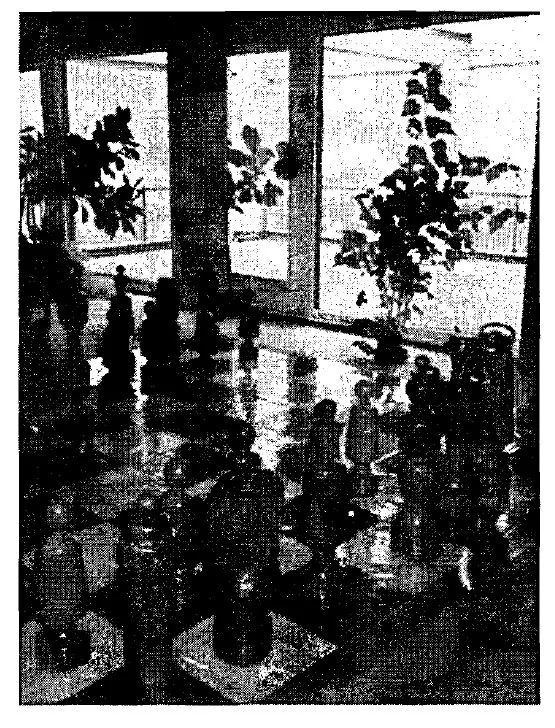
Figure 4.1. A chessboard at the Mathematisches Forschungs-Institut Oberwolfach. The pieces are about three feet high.
It is all such aspects taken together that make up a game. In all these ramifications, each game can be seen to be an expression of the culture. But the games are tied to their culture in a deeper way. In one cross-cultural study, games of strategy have been viewed as models of social interaction. A chessboard, for example, may be thought of as a field of battle on which two armies fight in defense of their royal leaders. The mobility and value of each piece depend on its social status. Another example, the Mancala game, popular throughout Africa, is sometimes used to demonstrate a chieftain’s strategic abilities or even to decide who will be chief. Quite different from chess, however, the Mancala onlookers (as well as the players) are expected to contribute to a noisy, distracting atmosphere. In contrast to games of strategy, games of chance have been deemed models of interaction with the supernatural and are often linked with religion. Just ask people today, in our culture, to what they attribute their good or bad luck of winning or losing games of chance, or why some think such games are sinful. Each culture, then, creates different games and embeds them differently. Nevertheless, games of strategy are evidence of the enjoyment of logical play and logical challenge, and in games of chance there is implicit involvement with concepts of probability.
Now we will look in detail at a simple but widespread Native American game of chance and then at a Maori game of strategy. To close the chapter we will discuss a ubiquitous logical puzzle found in Western mathematics recreation books, in Western folk culture, and in several variants in African culture.

There are two players. One of them places the disks in the dish and, by striking or shaking the dish, causes the disks to jump and resettle. The resulting assortment determines the number of points won and whether or not the player goes again or must pass the dish to his opponent. Just as the number of disks varies, so do the point values assigned. Quite often, an auxiliary set of sticks or beans serves as counters to keep track of the points won. We will concentrate on the version of this game found among some Iroquoian groups in what are now the northeastern United States and Ontario Province, Canada. Following some early European writings, we call it the game of Dish.
Among the Cayuga, the original inhabitants of the area in which I now live, the dish was a wooden bowl and the disks were six smoothed and flattened peach stones blackened by burning on one side. The auxiliary counters were beans. If the tossed peach stones landed with all six faces showing the same color (six black or six neutral), the player scored five points. For five faces of the same color (five black and one neutral or five neutral and one black), the player scored one point. In each of these cases, the player also earned another toss. For all other results, the player scored no points and had to pass the bowl to the opponent. Some prearranged total number of points, ranging from 40 to 100, determined the winner of the game.
Before describing the context of the game, let us look at some of the probabilistic implications of these scoring rules. When discussing probability, the focus is first on all possible outcomes and then on what fraction of them are of a particular type. For just one peach stone with two faces, there are only two possible outcomes: the black face (B) or the neutral face (N). Assuming no bias so that each face has the same chance of showing up, each has a probability of 1/2. Then, for two peach stones, there are four equally likely outcomes: both black (BB); a black followed by a neutral (BN); a neutral followed by a black (NB); or two neutral (NN). Two blacks are one possibility out of these four so its probability is 1/4; two neutral are one out of the four so its probability is 1/4. One of each color, however, is two out of the four (BN or NB) and so for that the probability is 2/4. Alternatively, we could arrive at the same measures of probability by saying that just one peach stone is B or N, each with the probability of 1/2, and the second is again B or N, each with a probability of 1/2 so: B followed by B has probability 1/2 of 1/2 or 1/4; N followed by N is 1/2 of 1/2 or 1/4; and, since one of each color can be arrived at two dif...
Table of contents
- Cover
- Half Title
- Title Page
- Copyright Page
- Dedication
- Table of Contents
- Introduction
- one Numbers: Words and Symbols
- two Tracing Graphs in the Sand
- three The Logic of Kin Relations
- four Chance and Strategy in Games and Puzzles
- five The Organization and Modeling of Space
- six Symmetric Strip Decorations
- seven In Conclusion: Ethnomathematics
- Index
Trusted by 375,005 students
Access to over 1.5 million titles for a fair monthly price.
Study more efficiently using our study tools.
Frequently asked questions
Yes, you can cancel anytime from the Subscription tab in your account settings on the Perlego website. Your subscription will stay active until the end of your current billing period. Learn how to cancel your subscription
No, books cannot be downloaded as external files, such as PDFs, for use outside of Perlego. However, you can download books within the Perlego app for offline reading on mobile or tablet. Learn how to download books offline
Perlego offers two plans: Essential and Complete
- Essential is ideal for learners and professionals who enjoy exploring a wide range of subjects. Access the Essential Library with 800,000+ trusted titles and best-sellers across business, personal growth, and the humanities. Includes unlimited reading time and Standard Read Aloud voice.
- Complete: Perfect for advanced learners and researchers needing full, unrestricted access. Unlock 1.5M+ books across hundreds of subjects, including academic and specialized titles. The Complete Plan also includes advanced features like Premium Read Aloud and Research Assistant.
We are an online textbook subscription service, where you can get access to an entire online library for less than the price of a single book per month. With over 1.5 million books across 990+ topics, we’ve got you covered! Learn about our mission
Look out for the read-aloud symbol on your next book to see if you can listen to it. The read-aloud tool reads text aloud for you, highlighting the text as it is being read. You can pause it, speed it up and slow it down. Learn more about Read Aloud
Yes! You can use the Perlego app on both iOS and Android devices to read anytime, anywhere — even offline. Perfect for commutes or when you’re on the go.
Please note we cannot support devices running on iOS 13 and Android 7 or earlier. Learn more about using the app
Please note we cannot support devices running on iOS 13 and Android 7 or earlier. Learn more about using the app
Yes, you can access Ethnomathematics by Marcia Ascher in PDF and/or ePUB format, as well as other popular books in Matemáticas & Matemáticas general. We have over 1.5 million books available in our catalogue for you to explore.