- 320 pages
- English
- ePUB (mobile friendly)
- Available on iOS & Android
eBook - ePub
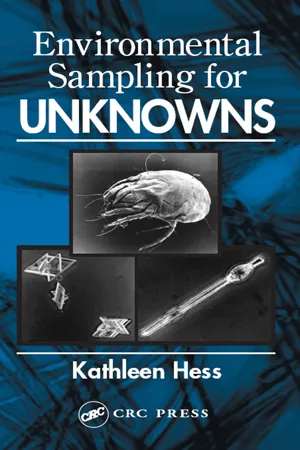
Environmental Sampling for Unknowns
About this book
Environmental Sampling for Unknowns covers modern approaches to indoor and outdoor environmental sampling, with an emphasis on identifying unknown substances.
Information
Chapter 1
THE SEA OF UNKNOWNS
Man’s environment is indeed a complex, ever-changing sea of chemical and biological confluences. Nature’s medley of allergens and natural poisons is contributed to by man’s ever-evolving creation of exotic substances. Yet, as more are added to the already overwhelming list of chemicals, identification of unknowns seems to have taken a back seat to progress.
Whereas the identity of an unknown must be suspect and its presence affirmed, many unknowns remain unknown; therefore, they do not exist. The frequency with which failed identification occurs within the environmental professions can only be speculative. It has been proclaimed, “The first person to cry wolf rules the consideration.”
In 1982, an event involving a titanium oxide spill on the Bay Bridge in San Francisco, California, serves as a red herring story. A white powder was deposited by a transporter on the Bay Bridge, setting off a comedy of errors. The bridge was closed. A sample was extracted by an environmental firm, fully attired for the worst in “moon suits.” Rumors culminated in the speculation that the material was an organophosphate. Several hours into the emergency, intensive analyses were being performed to identify an organophosphate. Still, the unknown remained “unknown.” Only after rumor and speculation were discarded could the true culprit be identified, some twelve hours after the event. By this time, there were several hundred angry commuters who had long since parked their cars on the bridge. Rumors and hysteria have been the driving force for “looking in all the wrong places.”
Allergies are typically associated with mold spores and pollen, and daily outdoor levels are typically provided by local news media. Yet, other substances may be implicated with allergies, and these are rarely addressed by the environmental professional. When allergies abound in an occupied office building where sampling has indicated low relative levels of mold spores and pollen, the complaints are often deferred as psychosomatic. Other allergens are frequently ignored or remain unknown.
Indoor air quality concerns have been nurtured by the news media, formaldehyde off-gassing is typically the ever-looming culprit. Subsequently, the environmental professional is obligated to address the formaldehyde levels even where symptoms and site history indicate otherwise. It is not uncommon for the environmental professional to be asked, in the same breath, to affirm that there are no “bad chemicals” present in the building when that which was sampled for was found not to be present. In one such instance, an environmental professional was told to sample for formaldehyde, carbon monoxide, carbon dioxide, and total organics in a building where the occupants were complaining of sewage odors. As the sampling strategy was driven by hearsay, not logic, the situation escalated into a political basketball with management attempting to block further sampling which may have addressed the “real issue.”
Air pollution studies are typically based on that which is known or anticipated to be present in a given environment. Around industrial activities, the anticipated stack emissions are based on a composite of substances known to be exhausted, not on the complex composite of the reactions/mixing which may occur in the exhaust system or when exposed to a chemically complex atmosphere. These unknowns are rarely identified.
Many of the tools for identification and sampling of unknowns are discussed within this and succeeding chapters. The intent herein is to provide a screening process as well as several means whereby the environmental professional might expand one’s technical tool box. This chapter deals with some basic screening approaches which are becoming widely accepted practices in limited niches while slowly becoming recognized in environmental hazardous waste management.
WASTE HAZARD CHARACTERIZATION AND BULK COMPONENT IDENTIFICATION1
Prior to disposal, a waste generator (e.g., manufacturer or property owner/recipient of midnight dumping) must characterize wastes either by performing expensive analytical procedures or applying knowledge of the waste due to known constituents and/or processes. Although the known components may undergo chemical alteration when mixed, some analyses may be eliminated (e.g., metals and pesticides would not be expected where solvents have been mixed).
On the other hand, without process information, identifying contents of containers with unknown constituents and no historic information may require full analytical consideration. To address unknown hazardous wastes, generalized background information is provided along with a discussion of a field test to characterize unknowns for initial management purposes.
Hazardous Waste Background
Under EPA Section 1004(5) Subtitle C of the Resource Conservation and Recovery Act (RCRA), a hazardous waste is defined as a solid waste (or combination of solid wastes) which because of its quantity, concentration, or physical/chemical/infectious characteristics may: (1) cause/significantly contribute to an increase in mortality or serious irreversible/incapacitating reversible illness; or (2) pose a substantial present/potential future hazard to human health or the environment (when the waste has been improperly treated, store, transported, disposed of, or mismanaged). Specific hazardous solid wastes are regulated, and their clarification/ identification is important.
“Solid waste” refers to any substance (solid, liquid, or contained gas) which is not excluded under 40 CFR 261.4 (e.g., some exclusions include domestic waste, sewage, and household wastes); material which has been abandoned (e.g., ...
Table of contents
- Cover
- Half Title
- Title Page
- Copyright Page
- Table of Contents
- Chapter 1 THE SEA OF UNKNOWNS
- Chapter 2 ALLERGENICITY, PLANT POLLEN, AND MOLD SPORES
- Chapter 3 VIABLE MICROBIAL ALLERGENS
- Chapter 4 AIRBORNE PATHOGENS/MICROBIAL TOXINS
- Chapter 5 ANIMAL ALLERGENIC DUST
- Chapter 6 RAPID MICROBIAL FINGERPRINTING
- Chapter 7 FORENSICS OF ENVIRONMENTAL DUST
- Chapter 8 VOLATILE ORGANIC COMPOUNDS
- Chapter 9 CARCINOGENS/MUTAGENS
- Chapter 10 PRODUCT EMISSIONS
- Glossary
- Appendix 1 ABBREVIATIONS/ACRONYMS
- Appendix 2 UNITS OF MEASUREMENT
- Appendix 3 POLLEN AIR SAMPLING EQUIPMENT
- Appendix 4 MICROBIAL SAMPLING EQUIPMENT
- Appendix 5 ALLERGENIC DUST SAMPLING EQUIPMENT
- Appendix 6 FORENSIC DUST SAMPLING EQUIPMENT
- Appendix 7 AMBIENT AIR SAMPLING EQUIPMENT
- General Index
- Symptom Index
Trusted by 375,005 students
Access to over 1.5 million titles for a fair monthly price.
Study more efficiently using our study tools.
Frequently asked questions
Yes, you can cancel anytime from the Subscription tab in your account settings on the Perlego website. Your subscription will stay active until the end of your current billing period. Learn how to cancel your subscription
No, books cannot be downloaded as external files, such as PDFs, for use outside of Perlego. However, you can download books within the Perlego app for offline reading on mobile or tablet. Learn how to download books offline
Perlego offers two plans: Essential and Complete
- Essential is ideal for learners and professionals who enjoy exploring a wide range of subjects. Access the Essential Library with 800,000+ trusted titles and best-sellers across business, personal growth, and the humanities. Includes unlimited reading time and Standard Read Aloud voice.
- Complete: Perfect for advanced learners and researchers needing full, unrestricted access. Unlock 1.5M+ books across hundreds of subjects, including academic and specialized titles. The Complete Plan also includes advanced features like Premium Read Aloud and Research Assistant.
We are an online textbook subscription service, where you can get access to an entire online library for less than the price of a single book per month. With over 1.5 million books across 990+ topics, we’ve got you covered! Learn about our mission
Look out for the read-aloud symbol on your next book to see if you can listen to it. The read-aloud tool reads text aloud for you, highlighting the text as it is being read. You can pause it, speed it up and slow it down. Learn more about Read Aloud
Yes! You can use the Perlego app on both iOS and Android devices to read anytime, anywhere — even offline. Perfect for commutes or when you’re on the go.
Please note we cannot support devices running on iOS 13 and Android 7 or earlier. Learn more about using the app
Please note we cannot support devices running on iOS 13 and Android 7 or earlier. Learn more about using the app
Yes, you can access Environmental Sampling for Unknowns by Kathleen Hess-Kosa in PDF and/or ePUB format, as well as other popular books in Biological Sciences & Environmental Science. We have over 1.5 million books available in our catalogue for you to explore.