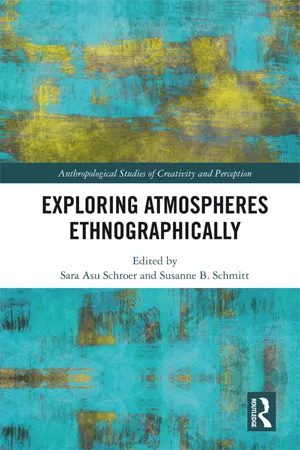
The notion of atmosphere has always been part of academic discourse, but often refers to something vague and diffuse - a phenomenon connected with our affective engagement with the world that is difficult to grasp. This volume develops and refines the concept of atmosphere, seeking to render it productive for anthropological and social scientific research by bringing together a range of original ethnographic studies in combination with investigation of the use of the term in language. The chapters examine dimensions of atmosphere through topics of interdisciplinary concern, such as learning and the acquisition of skills, the experience of place, affect and mood, multi-species relations and the perception of weather and environment - whether in natural landscapes, medical and educational settings, homes or creative contexts - Exploring Atmospheres Ethnographically analyses the relational and transformational processes through which people perceive, experience and live in a moving atmospheric world. As such, it will appeal to scholars of anthropology, sociology, geography and cultural studies with interests in space and place, sensory ethnography and affect.
- 192 pages
- English
- ePUB (mobile friendly)
- Available on iOS & Android
eBook - ePub
Exploring Atmospheres Ethnographically
About this book
Information
1 Introduction
Thinking through atmospheres
Introduction
Atmospheres. Like clouds in the sky they are ever forming and reforming, appearing and disappearing, never finished or at rest. Atmospheres can be sensed by a singular subject yet have collective affective qualities that evade the singular; they can be created but are also co-creating the ways through which we sense and perceive in the world. The notion of atmosphere has always been present as an undercurrent in social anthropology. It often occurs in texts and conversations, as part of ethnographic descriptions and personal field notes. In these instances, atmospheres seem to refer to a phenomenon that stems from our affective engagement with the world – evocative and difficult to grasp in terms of rational explanation. In this volume we are interested in questions of how atmospheres might be addressed ethnographically, leading us to further rethink the boundaries between the material and immaterial, presence and absence, individual and collective as well as body and place.
Academic interest in understanding atmospheres has gained momentum in recent years, particularly in philosophy (Böhme 1995; Schmitz et al. 2011; Griffero 2014; Schmitz 2014), affect and non-representational theory (Anderson 2009; Stewart 2011; Anderson and Ash 2015) and studies of urban and architectural contexts (Zumthor 2006; Böhme 2013; Bille and Sørensen 2016). Here atmospheres are usually understood as a crucial part of human life – both individual and collective – that influences identities, experiences and relationships. Most work to date, however, has focussed more on the philosophy of atmosphere as a concept, rather than on ethnographic enquiry into its various manifestations in social life. Exploring Atmospheres Ethnographically seeks to investigate the force and meaning of atmosphere in everyday life. Its contributions analyse the relational and transformational processes through which humans and other living beings perceive, experience and live together in a moving atmospheric world. The chapters, written from an ethnographic and anthropological perspective, examine dimensions of atmosphere through topics of interdisciplinary concern, such as learning and the acquisition of skills, the experience of place, affect and mood, and the perception of weather and environment – be it in landscapes, medical and educational settings, homes or creative contexts.
Most of the chapters were first presented at a panel at the 2014 conference of the Association of Social Anthropologist (ASA) in Edinburgh where we gathered to explore the notion of atmosphere and its potential for anthropological research, a call that was met with much interest and enthusiasm. Other contributions have found their way into the collection at a later stage. When we put together the contributions for the initial panel, it became obvious that although the notion of atmosphere was gaining momentum in anthropology – or maybe we should say it was “in the air” – it was also a field of ideas nourished from diverse sources: German phenomenology, affect studies and non-representational theory, as well as by a renewed interest in rethinking materiality in terms of its emergent and transformative qualities. These influences, however, as they figured in the contributions, converged on similar problems and questions: Are atmospheres media or objects of perception, metaphors or material phenomena? Are they representations, and are they representable? Can they be created, and what do they do? How can atmospheres be affects and effects at the same time? How can we think about atmospheres through air and other elements and substances?
These questions were tied to sites and situations across different ethnographic contexts, interactions and even species. The result is a variety of anthropological case studies that approach the phenomenon of atmospheres from the ground of ethnography. Each contributor shows in pivotal yet not always in consonant ways, how atmospheres matter in the social settings they studied. Retrospectively, we see the contributions gathering along three emerging threads. The first thread centres on an exploration of the atmospheres of institutions and places. Our authors explore the overwhelming feeling of boredom in schools for socio-economically disadvantaged students; look at how night-time economies in British cities use atmospheric strategies to create the ideal pub experience; and unearth the miasmic past and atmospheric present of Italian wetlands. A second thread running through the chapters is concerned with more-than-human atmospheres. Through the ethnographic lens of falconry, aquarium design, and the meaning of birdsong for place making in Britain, Australia and New Zealand, the authors trace how atmospheres are pivotal for conviviality with other living beings, whether they are mollusca or falcons. Following the third thread, chapters on art, music, and creative production discover atmosphere as a pedagogical design tool for fashion design students in Antwerp, explore the role of breath and air in experimental theatre, look at how artistic interventions create a hospital atmosphere through minimal gesture and shift our attention to the process of multisensory, atmospheric events aimed at audiences, whether they are in Gamelan music-making in Southern China or ethnographic filmmaking in the North Atlantic fishery.
Atmospheres and anthropology?
Whilst this volume is novel in explicitly foregrounding atmospheres in ethnographic research, the topic is by no means a novel one for anthropologists to write and think about, as we show below with brief examples from the writings of Emile Durkheim, Marcel Mauss and Clifford Geertz. In fact, phenomena of atmosphere – also addressed using related terms such as ambience, mood, presence, aura or tone – have from early on been crucial if not always central to the anthropological enterprise, as objects of study, as aspects of lived experience during fieldwork, and as creations of ethnographic writing, museum exhibitions and film.
In The Elementary Forms of the Religious Life ([1912] 2001), for instance, Durkheim observes the powerful effect of collective feelings in religious life, co-created through the execution of religious rituals and ceremonies. He argues that participants experience the atmosphere of religious events as an “electricity” that induces collective emotional excitement and “delirium”. In these moments of “collective effervescence”, every participant is supposed to experience an extraordinary and impersonal force or energy that has the power to raise them to an ideal realm (Durkheim 1912: 162, 171). This for him is a central unifying force that enables individuals to identify strongly and feel solidarity with their social group (Morris 2003: 120). Durkheim, then, identified atmosphere as central to the workings of society (Debaene 2014), comprising a domain of affectivity at once created by individuals, whilst yet experienced as lying beyond them, something powerful yet without clear-cut contours. This double-edged nature of the atmosphere as at once interior and exterior to the individual also pervades Durkheim’s understanding of what he called social facts, “manners of acting, thinking, and feeling external to the individual, which are invested with a coercive power by virtue of which they exercise control over him” (Durkheim 2001: 21).
Whilst for Durkheim social facts could be studied objectively as objects of scientific research, his student Marcel Mauss, in his essay The Gift ([1925] 2002), introduced an important innovation which was to link the study of the total social fact to the lived experience of the ethnographer (Debaene 2014). In so doing he acknowledged ethnographic immersion and personal experience as a central aspect of anthropological knowledge production. Mauss actually characterised the gift – the total social fact par excellence – as an ‘atmosphere’ permeating social life: “a considerable part of our morality and our lives themselves are still permeated with this same atmosphere of the gift, where obligation and liberty intermingle” (Mauss 2002: 83). An even more explicit use of the term can be found in his Manual of Ethnography ([1926] 2007) in which he highlights the centrality of lived experience to anthropological research: “one will be able to define the moral tone of the society under study, making an effort to remain within the ethos [atmosphère] of the society: It is good to practice the vendetta, it is good to be able to offer a human head to your fiancée” (Mauss, cited in Debaene 2014: 73).
Atmosphere in Mauss’ conception is more than an aspect of aesthetic style that, as ornamentation, could be easily foregone. Rather the ethnographer’s grasp of the atmosphere of the people she is working with is evidence of her holistic understanding of their lives. To grasp the atmosphere of a ritual, gathering or economic exchange means achieving a holistic understanding of the phenomenon, rather than robbing it of its liveliness. It is with this in mind that we are alerted to how “Mauss’s famous remark ‘We touch upon fundamentals’ occurs at the moment when a society stops being perceived in abstract terms and appears instead as ‘the feeling of men, in their minds and in flesh and blood’ ”. Here atmosphere, as a total social fact, becomes the object of study in itself, which for Mauss can be recognised “in the way it ‘permeates’ individual behaviours” (Debaene 2014: 73).
The notion of atmospheric permeation is also evident in Anglophone literature, often described with the term ‘ethos’ first introduced to anthropology by Ruth Benedict (1934), and developed by Gregory Bateson (1936) and Clifford Geertz (1973) (see also Nuckolls 1995). In The Interpretation of Cultures, for example, Geertz states: “A people’s ethos is the tone, character, and quality of their life, its moral and aesthetic style and mood. It is the underlying attitude towards themselves and their world” (1973: 127). It is constituted as a set of moods and motivations; indeed Geertz describes moods in atmospheric terms: springing “from certain circumstances … they are responsive to no ends. Like fogs, they just settle and lift; like scents, suffuse and evaporate” (1973: 97).
Evidently, the phenomena of atmosphere have long been recognised as central to understanding human life and meaning-making. However, atmosphere has not become a focus of anthropological inquiry until now. As Vincent Debaene suggests with regard to Mauss, the reason might be that the term was considered at the time too vague and general to be worth pursuing (Debaene 2014: 75–76). The experience of atmosphere in the field seemed to conflict with the positivist conventions of scientific writing and was difficult to fit into modern categories. Current critiques of earlier conceptions have however led to increased interest in relational and process-oriented approaches, and in many research fields these approaches have become commonplace. In this changed climate a refocusing on atmosphere, understood as lying at the intersection of spatial, sensory, material and affective dimensions of social life, seems pertinent. It requires us to rethink the relationships between subject and object, self and world, perceiver and the perceived.
Current interest in atmospheres
Whilst most of the literature to date has been on the philosophy of atmosphere and aesthetic discourse (Böhme 1993; Griffero 2014), fewer studies look at atmospheres as they are socially and materially produced (Bille 2015; Pink and Leder Mackley 2016, are two exceptions). Bille and his co-authors, for instance, look at how public and private spaces also entail the possibility of staging atmospheres deliberately. Amongst other topics they investigate the co-production of football game atmospheres in stadia by fans and clubs, the sensory and emotional production of urban territories, the making of hygge (cosy) atmospheres in Denmark and the possibilities for approaching atmosphere in the remote past. In another collection Edensor and Sumartojo (2015) explore, in a similar vein, the possibilities of designing atmospheres purposefully through the arrangement and orchestration of materials, things, people and places.
Current discourse on atmosphere in the Anglophone literature draws heavily on the little that has been translated of the work of German philosopher Gernot Böhme. For Böhme atmospheres are intermediate phenomena that lie at the intersection of the subjective and the objective:
Atmospheres are indeterminate above all as regards their ontological status. We are not sure whether we should attribute them to the objects or environments from which they proceed or to the subjects who experience them. We are also unsure where they are. They seem to fill the space with a certain tone or feeling like a haze.
(Böhme 1993: 114)
Atmospheres, for Böhme, are neither to be attributed to the experiencing subject alone, nor to be regarded as belonging to the physical environment. He understands them as both experientially and conceptually ambiguous, at once material and immaterial, subjective and objective. Key to Böhme’s conception of atmosphere are what he terms the ecstasies of things, that is the ways in which things are sensuously and qualitatively present in particular situations. Atmospheres arise out of the constellation of things and people and are understood as the perceived quality of a certain situation (for a critique of Böhme and an elaboration on the work of phenomenologist Hermann Schmitz, see Riedel 2015 and this volume). Böhme’s approach represents the legacy of philosophical thinking on atmosphere, and of related concepts such as ambience and Stimmung, that has come down to us from Franco-German phenomenology, and that conceives of the atmospheric as both an intermediary of human experience and pre-reflexive (Heidegger [1927] 1996; Merleau-Ponty [1964] 1968; see also Throop 2014).
Aside from phenomenological sources the notion of atmosphere is often linked to the study of affect. This emphasis is particularly evident in human geography and non-representational theory (Anderson and Ash 2015). For Anderson, for instance, atmosphere helps him investigate the differences between affect and emotion (Anderson 2009). One dominant approach to affect in the social sciences has been in the work of philosopher Brian Massumi (2002), who suggests that affect lies beyond individual consciousness and discourse as well as beyond emotional and bodily responses. Following Deleuze, affect is understood in terms of “intensities”, understood as a “set of flows moving through the bodies of human and other beings” (Thrift, cited in Bille et al. 2014: 34). As Bille and his colleagues suggest, within these discourses the notion of atmosphere itself is often taken for granted and used synonymously with affect (Bille et al. 2014: 35). This, however, risks silencing several other dimensions of how atmospheres are constituted, the affective dimension being only one of them. This is especially challenging for studies interested in the social and material creation of the atmospheric as it would suggest that atmospheres pre-exist the people who experience them, hence portraying people and other living beings as passively moved rather than as also actively involved in constituting atmospheres (see also Edensor and Sumartojo 2015)
Moving beyond a narrow focus on the affective constitution of the atmospheric, several authors have drawn attention to apparently intangible aspects of life such as lights, colours, odours, temperature, air quality and more generally the weather, in and through which people perceive the world. Thibaud, for instance, emphasises that to understand the social fabric of urban environments it is crucial to focus on elements rather than on objects (Thibaud 2015). This interest is reflected in a variety of publications, across many disciplines, aimed at rethinking materiality and its ontological status; shifting from a dichotomous understanding of matter and life to a more dynamic understanding in which materiality is seen to be in a continuous process of emergence (for an overview see Harvey 2013). Matter, in this understanding, is not contained by boundaries that render it inert but rather surfaces between states of being assumed to be porous, allowing for variability and transformation from states of fixity to suspension (Ingold 2007; Anderson and Wylie 2009). In this material reading, atmosphere becomes more than a metaphor and instead part of the fabric of human and nonhuman ways of living. In anthropology this aspect has recently been approached by Tim Ingold (2012) who is interested in bringing together the aesthetic notion of atmosphere with the atmospheric phenomenon of weather. His main point is to show that atmospheres are not, as often described, vague affective phenomena, but are i...
Table of contents
- Cover
- Title
- Copyright
- Contents
- List of figures
- Notes on contributors
- Acknowledgements
- 1 Introduction: thinking through atmospheres
- 2 Hauptschule: atmospheres of boredom and ruination
- 3 The making of pub atmospheres and George Orwell’s Moon Under Water
- 4 Vapours in the sphere: malaria, atmosphere and landscape in wet lands of Agro Pontino, Italy
- 5 Senses of being: the atmospheres of listening to birds in Britain, Australia and New Zealand
- 6 “A feeling for birds”: tuning into more-than-human atmospheres
- 7 Making charismatic ecologies: aquarium atmospheres
- 8 Waves of experience: atmosphere and Leviathan
- 9 From affective encounters to wearable forms: fashion design pedagogy and the creation of atmosphere
- 10 Living atmospheres: air, breath, song and mutual constitution in experimental theatre
- 11 The harsh smell of scentless art: on the synaesthetic gesture of hospital atmosphere
- 12 On the dynamic and duration of atmosphere: sounding out New Phenomenology through music at China’s margins
- Index
Trusted by 375,005 students
Access to over 1.5 million titles for a fair monthly price.
Study more efficiently using our study tools.
Frequently asked questions
Yes, you can cancel anytime from the Subscription tab in your account settings on the Perlego website. Your subscription will stay active until the end of your current billing period. Learn how to cancel your subscription
No, books cannot be downloaded as external files, such as PDFs, for use outside of Perlego. However, you can download books within the Perlego app for offline reading on mobile or tablet. Learn how to download books offline
We are an online textbook subscription service, where you can get access to an entire online library for less than the price of a single book per month. With over 1.5 million books across 990+ topics, we’ve got you covered! Learn about our mission
Look out for the read-aloud symbol on your next book to see if you can listen to it. The read-aloud tool reads text aloud for you, highlighting the text as it is being read. You can pause it, speed it up and slow it down. Learn more about Read Aloud
Yes! You can use the Perlego app on both iOS and Android devices to read anytime, anywhere — even offline. Perfect for commutes or when you’re on the go.
Please note we cannot support devices running on iOS 13 and Android 7 or earlier. Learn more about using the app
Please note we cannot support devices running on iOS 13 and Android 7 or earlier. Learn more about using the app
Yes, you can access Exploring Atmospheres Ethnographically by Sara Asu Schroer,Susanne Schmitt in PDF and/or ePUB format, as well as other popular books in Social Sciences & Anthropology. We have over 1.5 million books available in our catalogue for you to explore.