This title was first published in 2000. This text addresses concerns about regional trade agreements. From a variety of political and economic angles, it explains the emergence of trade blocs, their internal policies and politics, and their effects on global trade. It does not provide sequential descriptions and analyses of each of the world's major trading blocs. The focus here is on a number of causal factors that help explain the emergence of trading blocs and the development of their relations to and effects on the multilateral trading system. In each chapter, attempts have been made to draw theoretical and case-based generalizations that may apply to other trade blocs than the used in the empirical analyses.

- 288 pages
- English
- ePUB (mobile friendly)
- Available on iOS & Android
eBook - ePub
The Political Importance of Regional Trading Blocs
About this book
Information
1
Introduction
Bart Kerremans and Bob Switky
The Importance of Regional Trade Agreements
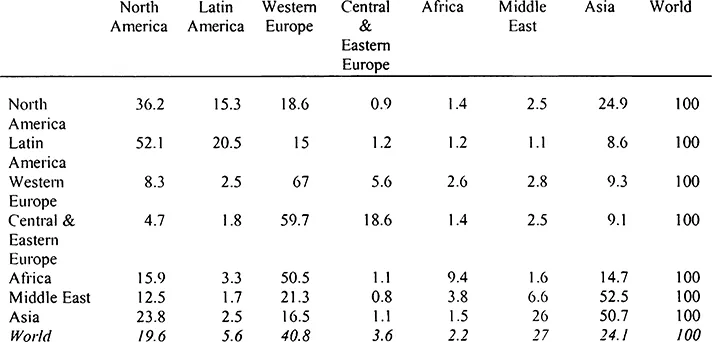
For an increasing number of countries, it is difficult to resist the attraction of regional trading arrangements. It seems as if one of the first consequences of globalization is the regionalization of trading patterns. This is visible in both trade statistics and in formal regional trade agreements. Indeed, the patterns of trade and investment in the multilateral trading system have been regional for some time (Thomsen, 1994: 111-122; Lawrence, 1996: 17-19). Countries tend to trade overwhelmingly – and ever more – with their neighbors. As Table 1 shows, this is by far and foremost the case for the industrialized countries (cf. Anderson and Blackhurst, 1993: 5 & Appendix; Anderson and Norheim, 1993: 19). More and more countries are concluding trade agreements with their same neighbors and investing in a deepening of such agreements; this trend contrasts with trade agreements concluded on a multilateral scale (Wallace, 1990; Thomsen, 1994). As a matter of fact, of the current 134 members of the World Trade Organization, only three are not parties to at least one regional trade agreement: Japan, Hong Kong, and South Korea (see Table 1.1).
Despite (or maybe because of) the overwhelming presence of regional trade agreements (RTAs), economists have been challenged by the question of whether RTAs are beneficial or harmful in the long run (cf. Srinivasan et al., 1993; Smith, 1994; Deardorff and Stern, 1994; Proff and Proff, 1996; Wei and Frankel, 1998). The effect of RTAs on the multilateral trading system is also a major concern for lawyers, political scientists, and practitioners alike. Whereas lawyers have been debating the meaning of the relevant WTO provisions on regional trade agreements, political scientists and political-economists have been focussing on the effects of regional trade agreements on the willingness of political leaders to continue to support multilateral trade liberalization. Do such agreements reduce the willingness to support multilateralism because RTAs make multilateral trade liberalization less necessary, as Bhagwati has claimed; or do RTAs enhance support of multilateralism because they pave the way for further liberalization on a wider geographical basis (Baldwin, 1997: 865) or because they ‘lock in’ policies of liberalization (cf. WTO, 1998a: 29; see also Sapir, 1993: 432)?1
The answers to these questions remain controversial. That is why the literature on regional trade agreements has proliferated during the last decade or so. This has partly been a response to the renewed or new interest of many countries in such agreements.2 One-third of all the currently existing regional agreements have been concluded since 1990. Factors such as the dissolution of the former communist bloc and the renewed interest in regional trade agreements in the Western Hemisphere have played an important role in this. A country like the United States, for instance, didn’t show a lot of interest for such agreements before the end of the 1980s, but it started to develop a regional trade agenda from 1985 on, first with Israel and Canada (the 1988 CUSFTA), later with Mexico (NAFTA), and since then with the other countries of the Western Hemisphere (Pomfret, 1997: 110-111). Attempts at extending NAFTA (to Chile for instance) or to conclude a hemisphere-wide agreement (the FTAA) have absorbed a lot of political and administrative resources since the first half of the 1990s.
Table 1.1 Share of intra-and inter-regional trade flows in each region’s total merchandise exports (1997)3
On the European side of the Atlantic we see a similar development. The European Union reacted to the fall of the Berlin Wall by trying to support the countries of Central and Eastern Europe through, inter alia, the conclusion of regional trade agreements (the Europe Agreements). In the meantime, the integration of the countries of the European Free Trade Agreement (EFTA) in the EU through the European Economic Area Agreement was concluded as well as a Customs Union Agreement with Turkey. Trade agreements – as part of the negotiating agenda of the Cooperation and Partnership Agreements – with some of the republics of the former Soviet-Union are in the pipeline. But the European Union has a longer tradition in conducting its trade relations through regional trade agreements. What could be seen after 1990 was an intensification of this approach in response to the new political situation in Central and Eastern Europe.
In other parts of the world, regional trade agreements have recently gained in importance as well. In Asia, the idea of a ASEAN Free Trade Area (AFTA) was launched (Anderson and Blackhurst, 1993: 2). In Latin America, new such agreements were concluded (e.g. Mercosur) or old ones were revitalized (e.g. the Andes Community, the Central American Common Market). In Northern Africa, Morocco, Algeria, Tunisia, and Mauritania launched the Maghreb Union, and in both East and West Africa ideas about the creation of economic and monetary unions have been launched as well (cf. the WAEMU, the COMESA, and the EAC). Although these plans and initiatives still have a long way to go, it is a first step in the direction of regional trade liberalization for these countries. On the other extreme of the African continent, largely because of the democratic reforms in South Africa since 1994, the Southern African Development Community (SADC) is being renewed and reinvigorated.
Thus, despite the confusion on the welfare effects of regional trade agreements, it is difficult to ignore them and their obvious attraction to many – if not most – governments. It is equally difficult to ignore the increasingly important role of such agreements in the multilateral trading system in general and in the World Trade Organization (WTO) in particular. This is recognized by the WTO itself. But it is equally important to note the concerns that exist about the effects – economic, legal, and political-economic – on international trade and the international trading system. As former WTO director-general Ruggiero phrased it in his speech before the Institute for International Economics:
No doubt regional agreements can be helpful to the integration process – providing an impetus to greater liberalization – especially for the developing countries. But in a world where the reality of global integration is calling for global solutions across a whole range of policies and issues, regionalism cannot provide an alternative to the multilateral system.4
In the World Trade Organization’s 1998 Annual Report (WTO, 1998a: 22-23) a similar approach towards regional trade agreements can be found:
Trade policy reform works best under a number of clearly defined conditions, including (..) a mutually supportive process of unilateral, regional and multilateral liberalization and deregulation.
This book addresses these concerns about regional trade agreements. From a variety of political and economic angles, it explains the emergence of trade blocs, their internal policies and politics, and their effects on global trade. Unlike most books on regional trade blocs, this volume will not provide sequential descriptions and analyses of each of the world’s major trading blocs. The focus here is on a number of causal factors that help explain the emergence of trading blocs and the development of their relations to and effects on the multilateral trading system. In each chapter, attempts have been made to draw theoretical and case-based generalizations that may apply to other trade blocs than the ones used in the empirical analyses. There, of course, limits to this approach. Regional trading blocs are a relatively recent phenomenon. That should make us very careful about generalizing about existing ones, especially as far as their impact on the global trading system is concerned.
Definitions
Before looking deeper into the dynamics of regional trade agreements, it is important to clarify some basic definitions. In many cases, terms such as ‘regional trade agreements’, ‘free trade associations’, and ‘regional trading blocs’ are used interchangeably. From the perspective of GATT-based rules, the ‘regional’ aspect of a regional trade agreement only becomes relevant to the extent that such an agreement provides exceptions to the MFN principle by granting trade preferences to a limited number of countries. It is the discrimination between those that are parties to the agreement and the ‘others’ that is the decisive criterion to talk about regional trade agreements. The reference to ‘regional’ may be misleading since that assumes that all the parties involved have to belong to one particular geographical area. Though this is the case for most such agreements, there are agreements for which it is not, and as Lawrence (1996: 9) has put it, ‘geographic proximity is not necessarily the most important determinant of participation in “regional” agreements.’ The EU’s Association Agreement between with seventy so-called ACP countries – better known as the Fourth Lomé Convention – is an example of a preferential trade agreement, though not a reciprocal one, among parties that are not geographically close. But the defining characteristic of a ‘regional trade agreement’ is precisely that it grants preferential, and therefore discriminatory, treatment to a specified group of countries. This notion is reflected in Fishlow and Haggard’s (1992) distinction between regionalization (which refers to regional concentration of economic flows) and regionalism (which involves a political process characterized by economic policy coordination among the cooperating countries).
This brings us to another point of clarification. The above definition of ‘regional trade agreement’ does not mean that the definition only refers to agreements covered by article XXIV GATT and article V GATS. In two ways, it does not. First, these articles basically only refer to two kinds of such agreements: free trade agreements and agreements that establish customs unions. Such agreements are far-reaching, and for some of the agreements that are considered to be regional trade agreements, it is unclear whether they would comply with one of these two possibilities. Second, a number of preferential trade agreements are not covered by article XXIV GATT and article V (and Vbis) GATS, since they are covered by the Enabling Clause (cf. Pomfret, 1997: 103). This clause allows developing countries to conclude non-reciprocal preferential trade agreements among themselves. The clause does not extend to agreements between the developing and the developed countries.5 But since such agreements are preferential in nature, they can be considered regional trade agreements or the equivalent.
Therefore, in empirical terms, regional trade agreements can be considered agreements concluded among members of the WTO and that the RTAs have to be reported to the WTO which scrutinizes their compliance either with article XXIV GATT (as interpreted through the Understanding on article XXIV), article V and Vbis GATS, or point 2 c) of the Enabling Clause. Such agreements create preferential access to particular markets and, therefore, discriminate among the WTO members.
The term ‘regional trade agreement’ could, to a certain extent, be used interchangeably with the term ‘trading bloc’, although the latter often has negative connotations. The term ‘bloc’ suggests both exclusiveness and power. Exclusiveness refers to the fact that blocs exclude as much as possible non-members from their markets. In addition, the term ‘bloc’ emphasizes the power of the regional grouping as a whole. It also asserts the existence of a collectivity that is capable to act as a unitary actor (cf. Henderson, 1994: 181). But such a collectivity only exists when the trade agreement that creates the ‘bloc’ includes provisions for the ‘bloc’ to act as a single actor in the multilateral trading system (cf. Rollo, 1994: 35). At the moment, only one of the existing regional trade agreements provides for this – Mercosur. If one also considers the European Union as a regional trade agreement although - it is much more than that – then there are just two of them. To conclude, the term ‘trading bloc’ used in the literature is an ill-defined concept, sometime creating more confusion than that it does clarity (Cable, 1994: 1). Since there does not seem to be an over-riding need to establish air-tight definitions – scholars use the terms loosely – this volume will, therefore, use the term interchangeably with regional trade agreement (RTA) and ‘preferential trade agreement.’
Organization of the Book
This book attempts to combine and integrate the often insulated literatures on trade blocs, particularly from economics and political science. In Chapter 2, Bob Switky deals with the theoretical foundations of the study of regional bloc. He reviews the dominant analytical approaches to the study of trade blocs in addition to evaluating the potential for some approaches that have received less attention. The purpose of the chapter is to describe the analytical angles by which trade blocs are studied and to explore the possibilities for compatibility across academic disciplines. He also frames the critical questions raised by trade bloc scholars and the contributors to this volume.
In Chapter 3, Raphael Reuveny and William R. Thompson will explore the effects of the creation and existence of regional trading blocs on protectionism. The question they try to answer refers to the widely held assumption that regional bloc formation leads to rising protectionism, especially when a traditional leader in the multilateral trading system – such as Britain in the nineteenth century and the US since World War II – starts to engage itself in concluding RTAs. Their analysis starts by looking at the domestic political and economic consequences of NAFTA and proceeds by considering whether US trade regionalization necessarily implies a movement toward protectionism and trade closure. In doing so, the authors focus on Krasner’s trinity of tariff levels, trade proportions (trade openness), and regional trade encapsulation (Krasner, 1996). The authors reject empirically the widely shared notion that regional trading blocs and protectionism necessarily go hand in hand.
In Chapter 4, Quan Li analyses the impact of regional trade agreements on bilateral trade. His focus is on the role of institutional rules. He argues that the degree of intra-bloc trade bias is causally related to the institutional rules of a bloc in three important ways; first in its coverage, second regarding implementation, and third in its dispute resolution mechanisms. Such rules affect the credibility of the RTAs. Li also shows this by comparing the institutional arrangements of seven differe...
Table of contents
- Cover
- Half Title
- Title Page
- Copyright Page
- Contents
- List of Figures and Tables
- List of Contributors
- Abbreviations
- 1 Introduction
- 2 The Importance of Trading Blocs: Theoretical Foundations
- 3 Trade, Regionalization, and Tariffs: The Correlates of Openness in the American Long Run
- 4 Institutional Rules of Regional Trade Blocs and their Impact on Trade
- 5 The Links between Domestic Political Forces, Inter-Bloc Dynamics and the Multilateral Trading System
- 6 Competition and Cooperation between Blocs: The Case of North America and Europe
- 7 The Politics of Domestic Ratification Across Democratic Institutions
- 8 Negotiating with Goliath: Cross-national and Cross-level Interactions in NAFTA’s Auto and Textile Sectors
Trusted by 375,005 students
Access to over 1.5 million titles for a fair monthly price.
Study more efficiently using our study tools.
Frequently asked questions
Yes, you can cancel anytime from the Subscription tab in your account settings on the Perlego website. Your subscription will stay active until the end of your current billing period. Learn how to cancel your subscription
No, books cannot be downloaded as external files, such as PDFs, for use outside of Perlego. However, you can download books within the Perlego app for offline reading on mobile or tablet. Learn how to download books offline
Perlego offers two plans: Essential and Complete
- Essential is ideal for learners and professionals who enjoy exploring a wide range of subjects. Access the Essential Library with 800,000+ trusted titles and best-sellers across business, personal growth, and the humanities. Includes unlimited reading time and Standard Read Aloud voice.
- Complete: Perfect for advanced learners and researchers needing full, unrestricted access. Unlock 1.5M+ books across hundreds of subjects, including academic and specialized titles. The Complete Plan also includes advanced features like Premium Read Aloud and Research Assistant.
We are an online textbook subscription service, where you can get access to an entire online library for less than the price of a single book per month. With over 1.5 million books across 990+ topics, we’ve got you covered! Learn about our mission
Look out for the read-aloud symbol on your next book to see if you can listen to it. The read-aloud tool reads text aloud for you, highlighting the text as it is being read. You can pause it, speed it up and slow it down. Learn more about Read Aloud
Yes! You can use the Perlego app on both iOS and Android devices to read anytime, anywhere — even offline. Perfect for commutes or when you’re on the go.
Please note we cannot support devices running on iOS 13 and Android 7 or earlier. Learn more about using the app
Please note we cannot support devices running on iOS 13 and Android 7 or earlier. Learn more about using the app
Yes, you can access The Political Importance of Regional Trading Blocs by Bart Kerremans,Bob Switky in PDF and/or ePUB format, as well as other popular books in Politics & International Relations & Politics. We have over 1.5 million books available in our catalogue for you to explore.