- 256 pages
- English
- ePUB (mobile friendly)
- Available on iOS & Android
eBook - ePub
About this book
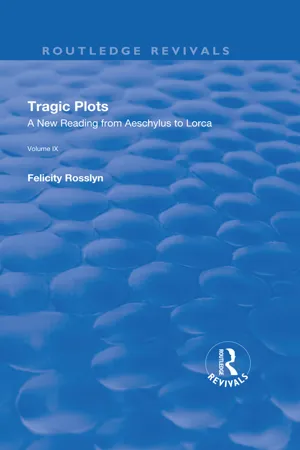
This title was first published in 2000. This book offers a wide-ranging account of tragic drama from the Greeks to Arthur Miller. It puts forward a bold and vigorously developed argument about the recurrent concerns of tragedy, and proposes to uncover the archetypal tragic plot that emerges at key points of historical transition. It traces this plot through fascinatingly diverse formations on Athens, Renaissance England and the modern world, and offers detailed analysis of over twenty plays. The needs of the first-time reader are not forgotten, while challenging new light is thrown on each period. There is substantial discussion of Aeschylus, Sophocles, Euripedes, Marlowe, Shakespeare, Ibsen, Strindberg, Chekhov, Lorca and Miller, along with briefer consideration of the Senecan tradition, Yeats, Synge, O'Neill and T.S. Eliot. Felicity Rosslyn asks why tragic plays get written when they do, and why they so often dramatise the struggle to break the ties of blood for the bonds of law.
Information
Part One
Greek Tragedy
Chapter 1
Aeschylus
Greek tragedy, scholars are increasingly willing to grant, is not an accidental accompaniment to democracy, but in some sense what democracy needed to help it function. The drama seems to show ‘a social body carrying out quite publicly the maintenance and development of its mental infrastructure’, as one classicist has recently phrased it; and ‘the mental underpinning of such a daring society can certainly have been no simple matter’.1 Before scrutinizing the plays themselves for what they tell us about this from the inside, we may note some of the external features of the situation, which might help explain the extraordinary level of creativity reached by the Greeks of the fifth century BCE. Who were the playwrights and the audience, and what was their democracy like?
All our plays were written by Athenians, for Athenians. There were many other city-states (poleis) in what we loosely term ‘Greece’, but Athens was the only site of what at the time seemed a radical and dangerous political experiment - the sharing of power (kratos) among the people (demos). Athens had arrived at this point after trying the more usual forms of government, rule by a small elite (oligarchy) and rule by one strong leader (tyranny). But in 507 an inspired reform was instituted to distribute power to individual Athenians and encourage them to define themselves, not as members of a family, class or clan, but as citizens with equal rights before the law. The energy and intelligence thus mobilized from the population as a whole (though citizenship, of course, was an entirely male affair - the polis did not acknowledge women or slaves) helped create the Athens that beat back the Persian empire at Marathon (490) and began to acquire power over the Greek world as a whole. Our plays date from the optimistic high point of the Athenian experiment, when Persia had just been defeated, through the decades of expansion that followed, and end with the disastrous close of the Peloponnesian War which Athens lost to Sparta (431-404).
‘Citizenship’ and ‘the democratic vote’ are not terms to make the pulse beat faster now, but that is because the power an individual wields in the modern state is largely talismanic. If a state can be compared to a ship, the modern version has a small, highly trained crew, but carries innumerable passengers. The polis-ship of Athens, however, had, apart from the non-citizens, only sailors.2 All its decisions were taken by majority vote. The decision-making body was the Assembly, which every citizen had the right to attend, and when the debate began with the formula, ‘Who wishes to speak?’, his voice and vote were the equal of every other. The Athenian was both amateur and professional: if he voted for a law, he might well find himself on the first jury that had to apply it, and if he supported a belligerent foreign policy, he might be part of the army that had to carry it through. Democratic power meant democratic responsibility, and utilizing an individual vote meant living with the consequences; the polis was so small that political life was a kind of theatre, in which men took their key decisions in full view of one another.
But the polis also supported the real theatre - paid for by the public purse, and organized with great solemnity. The tragedians and actors were citizens, not low-caste professionals as in most theatres subsequently: men who in their other lives fought Athenian wars and held public offices. The plays of three writers survive, though there were many more: they are Aeschylus (525/4-456 BCE), Sophocles (c.496-406 BCE) and Euripides (c.485-406 BCE), and they presented their plays to the assembled citizens as part of the great annual festival of the Great Dionysia. The structure of this event shows how far the Greek sense of theatre was from an entertainment: the festival began with a great procession, animal sacrifices and choral singing, and then, on three subsequent days, the three invited tragedians would stage a tragic trilogy (or three separate plays) and a comedy. The setting was a huge amphitheatre holding perhaps 16,000 people, whose attention was funnelled down towards a small, distant stage on which four actors and a chorus spoke metrical verse through naturalistic masks. The relative rank of the playwrights’ work would then be determined by ten judges, chosen by lot from the city as a whole.
The subject matter of these tragedies is to all appearances traditional: they tell stories about gods (like the god presiding over the festival, Dionysus) or mythical heroes like Hercules or Prometheus or characters from the Trojan War. On closer scrutiny, however, their apparent conventionality is only the starting point: the Athenian audience is invited to watch a familiar story being treated in a new way, and the challenge issued by the playwright is to see what new perspectives follow from each change of emphasis. There are, for instance, numerous versions of the Oedipus story, beginning with the one narrated in the Odyssey, in which the hero’s mother hangs herself, but he continues to be king after the revelation about his birth. When Sophocles dramatizes the story, he makes Oedipus blind himself in remorse; while Euripides conceives of the blinding as being done by the servants, which quite alters its meaning. (We wish we knew what happened in Aeschylus’ version of Oedipus, too, but this is completely lost.) In the same way, there are at least three versions of how Orestes and Electra punish their mother for murdering their father: the Oresteia of Aeschylus, which concentrates on Orestes’ point of view, Sophocles’, which concentrates on Electra’s, and the sharply realistic play by Euripides, which seems to be a satirical comment on both. The traditionalism of the plots is best understood as a kind of shorthand, by which the playwright quickly focuses the audience on a complex situation, and teases out the implications that concern him.
One other issue needs to be glanced at before we turn to the plays. This is the status of the Greek gods, in whose name the plays are performed, and who themselves often figure in the drama. We are not well adjusted to polytheism as inheritors (however passive) of a monotheistic tradition; but to the Greek mind ‘theology’ did not mean truth, dogma or moral teaching but simply stories (logoi) about the gods (theoi). The fact that the gods were viewed as having human shape meant that the sense in which they were really the embodiment of human qualities was an open secret, from Homer onwards. Not everyone trod the sceptical path, but even the most conventional believer allowed playwrights the freedom to represent the gods (within recognizable limits) in the way that suited them. So the god Apollo, traditionally associated with the sun, enlightenment, reason and poetry, is represented by Aeschylus as a young god with some things still to learn, by Sophocles as the unquestioned voice of age-old authority, and by Euripides as a callous automaton, all without ceasing to be Apollo. The gods are part of the Athenian vocabulary, and they make it possible to discuss immense issues in a small compass - as when Aphrodite, goddess of love, and Artemis, goddess of chastity, contemptuously repudiate one another in their tug-of-war over the beautiful youth, Hippolytus; or Apollo in his radiant youth and rationality confronts the oldest and most irrational goddesses, the Furies, in the first trilogy we shall examine, the Oresteia.
The Oresteia (458 BCE)
This play dates from the most confident period of Athenian democracy and we cannot doubt that it is a play about Athens. It begins in the mistily heroic past, with the arrival home of Agamemnon after the Trojan War, but it ends in the city of Athens itself. The question the play poses is one only the city can resolve, and the solution requires the involvement of the city’s guardian goddess Athena and its familiar institutions. To feel the audacity of this we might imagine a version of Hamlet where the hero travels to the English court and has his problems somehow alleviated by Elizabeth I and English law. Clearly, Aeschylus is not working at a level of simple realism, but supplying his city with a founding myth about its origins; in this complex and thick-textured trilogy he is showing the momentous decisions that went into creating the life contemporary Athenians enjoy. What also emerges is the delicacy of the balancing act that both he and his audience must practise to keep it going.
To emphasize how deeply Athenian the Oresteia is, however, risks implying that it is less than universal. The materials are certainly local, but the implications Aeschylus uncovers have resonance for any society moving out of tribalism; and because the experiment is so new he can analyse what is at stake with revelatory clarity. (It may not be irrelevant that Aeschylus himself fought at Marathon: he has in himself the multifaceted energy and sense of living at a turning point that marks Athenian culture as a whole.) Thus the story he takes for his plot is, as we have noted, the Oedipal one that has some claim to be the wrplot of tragedy. But unlike his successors, Aeschylus conceives of the fundamental family drama as only making sense inside society as a whole: beyond the family threshold is the polis. This is what his audience of citizens knows for themselves: that although everyone is born inside a family, to grow to full maturity it is necessary to leave it. We are born in blood and darkness, says Aeschylus, but our true humanity develops in the light of reason, with the freedom to act as citizens, not sons. The dilemma the trilogy sets out to answer is how to do justice to the primacy of the dark, our Dionysiac origins in a mother’s body, while journeying always towards the light: the realm of consciousness that belongs to Apollo.
Aeschylus carefully shapes the story of Agamemnon’s homecoming from the Trojan War to illuminate why this dilemma is so painful - why there is so much to say on both sides. The story was familiar to his audience from the Odyssey (Book 3), where Agamemnon is said to have wearily returned by sea to his own country, only to be treacherously slain at a feast by his wife’s secret lover, Aegisthus. Eight years later his son Orestes returned from exile and ‘killed the snake that killed his father. / He gave his hateful mother and her soft man / a tomb together’.3 For Homer there was no problem: justice was done for a villainous crime. But Aeschylus complicates things by giving Clytaemnestra a motive for destroying her husband. He borrows from a story that puts Agamemnon in a more ambiguous light: before he sailed to Troy, Agamemnon’s fleet was becalmed and for the sake of a wind he sacrificed his and Clytaemnestra’s daughter, Iphigenia. In Aeschylus’ version, the murder of Agamemnon is now carried out by Clytaemnestra, who has waited ten long years for her opportunity. Thus the first play of the trilogy, the Agamemnon, pits the warrior king against the mother, and brings male and female values into the sharpest conflict. In the second play, the Libation Bearers, the conflict is expressed in the confrontation of Orestes with his guilty mother, and the tug-of-war between all the reasons for punishing her and for letting her go; and in the last play, the Eumenides, the conflict is expressed in the open debate between Apollo, who defends Orestes, and the Furies of Clytaemnestra, who want to eat him alive. The wonderful comprehensiveness of the trilogy comes from these parallel structures, which represent the struggle as happening at the same time at a family level, a psychological level, and a political level. It is also implied that somehow they are linked; and if a solution can be found at one level, it will yield a clue to all three - liberating not only Orestes, but Athens, and ourselves, from a dilemma in which there is a perplexing amount of truth on both sides.
The trilogy is so dense and dramatic that teasing out its full meaning would demand a book-length study. Here we must confine ourselves to the main lines of argument implied in each of these three confrontations, beginning with the Agamemnon. Aeschylus shows Agamemnon arriving home triumphantly at the end of ten years’ war. We watch him enter on a chariot (with part of his royal booty, a new concubine, beside him) and we hear him salute his city and the ‘just gods’4 who helped him to victory. He is immovably secure that Troy’s punishment was deserved, and therefore its defeat is the end of the matter: ‘For their mad outrage of a queen we raped their city - we were right’ (F 133). Whatever horrors were perpetrated in that act of punishment, it is clear that he does not intend to think about them, and anything that preceded the war - like the sacrifice of Iphigenia - has entirely slid from view. His task now is to pick up the reins of government in Argos, nurturing whatever is healthy in the state, and taking the surgeon’s knife to what is not.
This portrait of heroic self-sufficiency, simple to the point of stupidity, is brilliantly contrasted with that of Clytaemnestra, silently waiting onstage. It does not occur to Agamemnon that others can also define what is healthy and unhealthy and perform surgical operations, or that the hero of Troy might appear to his wife a mere infanticide. But the ten intervening years have hardened Clytaemnestra into a child-avenger, and whatever respect she once felt for her husband has been consumed by maternal fury. When he lifted the sacrificial knife to his own child, he ripped the family structure apart, and when she looks at the hero in his chariot she sees only a body to be disposed of physically, as she has already disposed of him mentally. With fathomless irony, she expresses her relief at finally having him home, and what she says of his role as her lord and master sounds so properly in his ears, he does not question that he is all these things to her:
… the watchdog of the fold and hall;
the stay that keeps the ship alive; the post to grip
groundward the towering roof; a father’s single child;
land seen by sailors after all their hope was gone.5
the stay that keeps the ship alive; the post to grip
groundward the towering roof; a father’s single child;
land seen by sailors after all their hope was gone.5
This is how a subordinate wife should sound; but Clytaemnestra’s real relation to Agamemnon is expressed in another way, in an invitation to walk triumphantly into the palace on purple tapestries and express his hubris openly before the city. Agamemnon instinctively shrinks from such self-assertion (it is the sort of thing Asian kings do, not Greeks) but because he does not grasp the contemptuous subtext of her action, he does not exert himself to resist. ‘I tell you, as a man, not god, to reverence me’ (L 925), he says, modestly; but she makes it seem an act of graciousness to give in (‘Oh yield! The power is yours. Give way of your free will’; L 943). He allows himself to be persuaded, and utters the pious hope that he will not pay for this act of sel...
Table of contents
- Cover
- Half Title
- Dedication
- Title
- Copyright
- Contents
- General Editors’ Preface
- Preface
- Acknowledgements
- Introduction
- Part One: Greek Tragedy
- Part Two: Renaissance Tragedy
- Part Three: Modern Tragedy
- Part Four: Conclusion
- Bibliography
- Index
Trusted by 375,005 students
Access to over 1.5 million titles for a fair monthly price.
Study more efficiently using our study tools.
Frequently asked questions
Yes, you can cancel anytime from the Subscription tab in your account settings on the Perlego website. Your subscription will stay active until the end of your current billing period. Learn how to cancel your subscription
No, books cannot be downloaded as external files, such as PDFs, for use outside of Perlego. However, you can download books within the Perlego app for offline reading on mobile or tablet. Learn how to download books offline
We are an online textbook subscription service, where you can get access to an entire online library for less than the price of a single book per month. With over 1.5 million books across 990+ topics, we’ve got you covered! Learn about our mission
Look out for the read-aloud symbol on your next book to see if you can listen to it. The read-aloud tool reads text aloud for you, highlighting the text as it is being read. You can pause it, speed it up and slow it down. Learn more about Read Aloud
Yes! You can use the Perlego app on both iOS and Android devices to read anytime, anywhere — even offline. Perfect for commutes or when you’re on the go.
Please note we cannot support devices running on iOS 13 and Android 7 or earlier. Learn more about using the app
Please note we cannot support devices running on iOS 13 and Android 7 or earlier. Learn more about using the app
Yes, you can access Tragic Plots by Felicity Rosslyn in PDF and/or ePUB format, as well as other popular books in Literature & Literary Criticism. We have over 1.5 million books available in our catalogue for you to explore.