- 356 pages
- English
- ePUB (mobile friendly)
- Available on iOS & Android
eBook - ePub
About this book
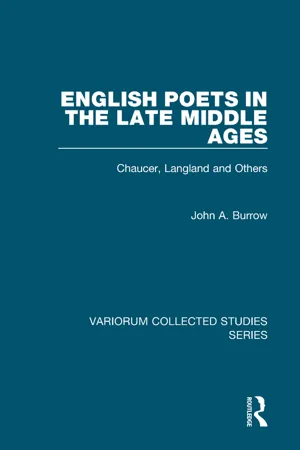
This volume brings together a selection of lectures and essays in which J.A. Burrow discusses the work of English poets of the late fourteenth and early fifteenth centuries: Chaucer, Gower, Langland, and Hoccleve, as well as the anonymous authors of Pearl, Saint Erkenwald, and a pair of metrical romances. Six of the pieces address general issues, with some reference to French and Italian writings ('Autobiographical Poetry in the Middle Ages', for example, or 'The Poet and the Book'); but most of them concentrate on particular English poems, such as Chaucer's Envoy to Scogan, Gower's Confessio Amantis, Langland's Piers Plowman, and Hoccleve's Series. Although some of the essays take account of the poet's life and times ('Chaucer as Petitioner', 'Hoccleve and the 'Court''), most are mainly concerned with the meaning and structure of the poems. What, for example, does the hero of Ipomadon hope to achieve by fighting, as he always does, incognito? Why do the stories in Piers Plowman all peter out so inconclusively? And how can it be that the narrator in Chaucer's Book of the Duchess so persistently fails to understand what he is told?
Information
IV
The Languages of Medieval England
Before the Norman Conquest
It is possible to derive from pre-Conquest writings the outlines of a scheme ranking languages according to their dignity, as that would have been understood by many writers of the time. The highest ranks in this hierarchy are occupied by the original biblical languages: the Hebrew of the Old Testament and the Greek of the New—Greek being also the language of the first translation of the Old Testament, the Septuagint. Latin comes below Hebrew and Greek; but it counts with them as a third lingua sacra, since Anglo-Saxons read both testaments mostly in Jerome’s Latin version, the Vulgate. It was also noticed that, according to St Luke (23: 38), the inscription set above Christ as he hung on the Cross was written in Latin as well as Greek and Hebrew. Yet Latin is the least elevated of the three. In the Second Series of his Catholic Homilies (990–5), Ælfric explains why the Church, during the penitential season of Septuagesima, replaces the Hebrew word Alleluia with the Latin Laus tibi domine: Hebrew, he says, is the highest of all languages, so it is more appropriate at a time of such sorrow that we should use only the humble Latin tongue (‘admodan ledenspræce’, Ælfric 1979: 51). Latin, however, counts as ‘humble’ only in relation to the two higher linguae sacrae. Below it lie the vernacular languages of these islands, four of them according to Bede in his Ecclesiastical History (731): British (that is, Welsh), Pictish, Irish, and English (Bede 1969: 230), a list to which Scandinavian languages would need to be added later in the period.
Knowledge of the two highest languages, Hebrew and Greek, was extremely restricted before the Conquest (see Gneuss 1993: 118–25). No one knew enough to translate texts from Hebrew (Jewish settlements hardly began before 1066). The monk Byrhtferth was able, following Bede, to explain in his Enchiridion (c. 1010) a play upon four Hebrew words in Isaiah; and the same writer also gives the names of the letters of the Hebrew alphabet, set out in parallel with the letters of Latin and Greek (Byrhtferth 1995: 166, 188). Such fragmentary knowledge mostly went back, directly or indirectly, to St Jerome, a Father described by Ælfric as ‘the foremost translator between the Hebrew, Greek, and Latin peoples’. Knowledge of Greek was less limited, certainly in the seventh and early eighth centuries. Archbishop Theodore and Abbot Hadrian, who came to Canterbury in 669 and 670, were both familiar with Greek, Theodore as a native speaker; and according to Bede, who himself could read Greek, there were still in his day students of theirs ‘who knew Latin and Greek just as well as their native tongue’ (Bede 1969: 335). In the centuries after Bede, however, knowledge of Greek appears to have been largely confined to what could be gleaned from the glossing of individual words. So Byrhtferth, referring to his learned work by the Greek title Enchiridion, adds that this is equivalent to manualis in Latin and handboc in English; and Ælfric is able to explain that paraclitus means the same as froforgæst [helping spirit] in English (Byrhtferth 1995: 120; Ælfric 1997: 360–1). So in practice neither Greek nor Hebrew could challenge Latin as, for Anglo-Saxons, the authoritative language of religion and learning, from which alone translations into the vernacular might be made.
The Latin which returned to England with the Christian missions of the early seventh century was the Latin of the Church, and throughout the Anglo-Saxon period it remained an ecclesiastical language, spoken, chanted, read, and written by monks, nuns, and priests. Evidence for substantial knowledge of Latin outside ecclesiastical circles is hard to come by. Some members of royal families evidently achieved competence: King Alfred, as is well known, translated several Latin works for the benefit of his subjects; and Æthelweard, an ealdorman of royal descent who died c. 998, produced a Latin translation of the Anglo-Saxon Chronicle (ed. 1962) for Matilda, Abbess of Essen in Germany—a very rare and early example, both of an English layman writing extensively in Latin, and also of the translating of an English text for an overseas reader (Matilda was of English descent, but her vernacular was probably Old Saxon). In his life of King Alfred (893), Asser gives a rather indistinct account of how the King, no longer young, came to acquire his reading knowledge of Latin. Alfred learned from Bishop Asser himself and from other scholars at his court; but Asser also invokes ‘divine inspiration’ to explain his success (Keynes and Lapidge 1983: 75, 99). More commonly, instruction in the language was provided by the ecclesiastical schools attached to cathedrals or monasteries. As early as c. 700 grammar books were composed, written in Latin but designed for English-speaking students (Lapidge et al. 1999: 216–18); glosses added between the lines or in margins, often in English, helped with the understanding of Latin vocabulary; and separate Latin — English glossaries were also compiled (Lapidge et al. 1999: 207–10). Towards the end of the period, Ælfric produced one such glossary, appended to a more remarkable work of his: the first grammar of Latin written in English (c. 998).
Knowledge of Latin suffered a severe setback in the ninth century, when Viking assaults nearly put an end to the organized monastic life that had flourished in the seventh and eighth centuries. So Alfred, in the preface to his translation of Gregory’s Cura Pastoralis, laments the decline of learning in England: ‘there were very few men on this side of the Humber who could understand their divine services in English, or even translate a single letter from Latin into English; and I suppose that there were not many beyond the Humber either’ (Keynes and Lapidge 1983: 125). In the course of Alfred’s reign, however, the recovery began, and this was confirmed after c. 940 in the Benedictine reform movement led by Dunstan, Æthelwold, and Oswald, a movement with which many Latin writings are associated. Accordingly, the history of Anglo-Latin writings falls into two periods, separated by the ninth-century interval (for general accounts, see Lapidge 1986, 1993, 1996). The two chief writers of the earlier time are Aldhelm (d. 709) and Bede (d. 735). Their works, which continued to be studied and imitated throughout the Anglo-Saxon period, illustrate the range of purposes to which Latin was put. Both Aldhelm and Bede wrote verse, mostly in classical metres, as did their tenth-century successors, and both composed treatises on poetic metre, Aldhelm’s forming part of a long Latin letter addressed to King Aldfrith of Northumbria (the Epistola ad Acircium) which also included his verse riddles or Enigmata (on Aldhelm, see Lapidge et al. 1999: 25–7). As well as his De Arte Metrica, Bede wrote textbooks on orthography, rhetoric, and the ecclesiastical computus, and also a series of influential commentaries on many books of the Old and New Testaments. The narrative writings of Aldhelm and Bede mostly concern the lives of saints and other exemplary persons. Examples are Bede’s Vita Sancti Cuthberti and the De Virginitate of Aldhelm—the latter an extraordinary work in two versions, prose and verse, both composed in an obscure and mannered style (now known as ‘hermeneutic’) which was much imitated by writers such as Bishop JEthelwold in the later period. Bede’s Latin style is quite different—it has been described as ‘classical’—as can be seen in his magnum opus, the Ecclesiastical History of the English People. Here the narrative of exemplary lives, including many saints, takes its place in a larger historical story.
What about English? As a vernacular, maternal tongue, of course, it could not pretend to rival the dignity of Latin in the linguistic hierarchy; but the evidence suggests that English came to be held in higher esteem than any other West European vernacular of the time. Little written evidence of the language survives from the early centuries, but already at that time one finds so learned a Latinist as Bede paying respectful attention to the poetry of his own native language, as in his account of the Northumbrian poet Cædmon. Cædmon’s hymn has to be represented in the Ecclesiastical History by a Latin prose rendering; but Bede speaks highly of the sweetness (suavitas) of the original English verse, and apologizes for having to represent it in translation: ‘for it is not possible to translate verse, however well composed, literally from one language to another without some loss of beauty and dignity’ (Bede 1969: 417). Bede’s treatise on metre, again, though chiefly concerned with metrum or quantitative verse, has a brief discussion of rithmus in which he notices not only Latin rhythmical writings but also the songs of vernacular poets (‘carmina vulgarium poetarum’). Although rithmus is, Bede says, less governed by rational principles than metrum, yet one can see in it a certain ratio, ‘which vernacular poets achieve necessarily without benefit of schooling (rustice), while the learned do so by virtue of their learning’ (Bede 1975: 138–9). A later tradition records that Aldhelm composed English verses and that King Alfred particularly admired them, but these are lost. Bede himself is said to have been ‘doctus in nostris carminibus’ [well versed in our poetic traditions] by one of his disciples, who recorded a short alliterative poem in Northumbrian English which the master recited on his deathbed (Bede 1969: 580–3). Not long after Bede’s death, and again in Northumbria, the stone cross at Ruthwell admitted a copy of English verses, from The Dream of the Rood, cut in runic letters alongside Latin inscriptions on its carved surfaces; and later on, the young Alfred is said by Asser to have been attracted by the beauty of a book of English verse shown him by his mother. This volume has been lost, no doubt along with others of the kind; but from a later period, c. 1000, we have the four codices which preserve most of the native poetry now known to survive. These substantial collections testify to the willingness of copyists in scriptoria of the learned world to devote time, effort, and parchment to the works of vulgares poetae, secular as well as religious. Nothing comparable survives from other West European societies of the time.
In the same account of his last days that preserves his five lines of alliterative verse, Bede is said to have been working at translations from St John’s Gospel and also from a Latin treatise by Isidore of Seville (Bede 1969: 582). These renderings ‘in nostram linguam’, into OE, were presumably in prose, but they have not survived. Indeed, the only considerable prose texts to have been preserved from the early period (in later copies) are the law codes, beginning with the code of Æthelbert of Kent, ‘written in English’, as Bede reports, as early as c. 605. The later laws of the West Saxon king Ine (c. 690) were incorporated by King Alfred in his domboc or law book, and this was followed by a series of other vernacular royal codes up to nearly the time of the Conquest (Lapidge et al. 1999: 279–80). The use of English in these documents, as in the royal writs of the time, testifies to a standing in royal and official circles which the vernacular was to lose only under the post-Conquest kings. The codes continued to be copied and studied for a time thereafter; but the translation of many of them into Latin about the year 1114, in the Quadripartitus, was a sign of things to come.
The dying Bede is said to have explained his desire to translate from the Latin of Isidore and St John with the words, ‘I cannot have my children learning what is not true’ (Bede 1969: 583). These words sum up the prime motive of later translators from Latin: to unlock the authoritative truths available in that language—religious, historical, or scientific—and so make them available to the young or the unschooled. But no English translations survive until the time of Alfred, 150 years after Bede’s death. (On Alfred, see further §§3.2, 5.6 below.) Alfred certainly knew of none, for in the preface to his englishing of Gregory’s Cura Pastoralis he asks himself why wise men of the past had made no attempts to render Latin texts into ‘their own language’. The reason, he supposes, is that they never imagined it might become necessary to do so. But nowadays, although ‘many people can read English writings’ (whatever they may have been), knowledge of Latin has so sadly declined that the time has come to render ‘certain books most necessary for all men to know’ from that language into the vernacular, following the precedent, which Alfred invokes, of the translation of biblical writings from Hebrew through Greek into Latin. So Alfred proposes that, if conditions permit, ‘all the youth now in England, born of freemen who have the means that they can apply to it’, should learn to read English well—further instruction in Latin being reserved to those destined for a ‘higher order’, that is, in the Church (Keynes and Lapidge 1983: 125–6).
In this preface, Alfred is concerned to encourage, not practical literacy, but wisdom and learning (‘wisdom and lare’), and the list of texts translated by him and his clerical collaborators bears out that lofty intention: books of history (Bede’s Historia, the Historia of Orosius) and of philosophy (Boethius’ De Consolatione Philosophiae, Augustine’s Soliloquia), a treatise for bishops and other rulers (Gregory’s Cura Pastoralis), a collection of improving miracle stories (Gregory’s Dialogi), and the first fifty psalms from the Bible. These writings established a tradition of vernacular prose which was followed in the last years of the Anglo-Saxon period mainly by monks of the Benedictine Revival: notably Bishop Æthelwold, translator of the Benedictine Rule (on IEthelwold, see Lapidge et al. 1999: 19; cf. Gretsch 1999); Byrhtferth, author of the computistical Enchiridion; Abbot Ælfric; and Archbishop Wulfstan. These men all wrote in Latin as well as in English, and when they turned to the vernacular it was chiefly for the benefit of those who could not read, or could not comfortably read, the Latin originals. Such people, referred to as the idiotae or ungekerede [uneducated], formed a very large and varied class of potential readers, male and female, noble and common. Nor was it confined to laypeople: Æthelwold’s English Benedictine Rule survives in versions directed at novices and newly professed monks and also at nuns, and Byrhtferth addressed his Enchiridion to young monks and country priests.
Such vernacular writings presented, of course, no challenge to the primacy of Latin. Typically, when Ælfric wished to put a matter beyond doubt or contradiction, he might switch to Latin ‘so that we may be believed’ (Ælfric 1967–8: 728). Yet these writers did confer upon English something of the dignity of a learned language, for they brought to it some of the disciplines to which Latin had accustomed them (on the status of English, see Godden 1992; Stanton 2002). As Dante observed, mother tongues are acquired ‘sine omni regula’, without any conscious learning of rules (De Vulgari Eloquentia I, i); but for learned monks language was a matter of regulae; so it is not surprising that they set about looking for order in, or imposing order on, the English that they wrote. In his Grammar accordingly Ælfric is primarily concerned with teaching Latin to young students; but he writes in English, and both his...
Table of contents
- Cover
- Half Title
- Title Page
- Copyright Page
- Table of Contents
- Publisher’s Note
- Introduction
- Acknowledgements
- Abbreviations
- I Thinking in poetry: three medieval examples I: Pearl and Piers Plowman II: St Erkenwald The William Matthews Lectures, Birkbeck College, London (pamphlet, Birkbeck College, 1993)
- II The poet and the book Genres, Themes, and Images in English Literature: From the Fourteenth to the Fifteenth Century, eds P. Boitani and A. Torti (J. A.W. Bennett Memorial Lectures, Perugia, 1986). Tübingen: Gunter Narr, 1988
- III The sinking island and the dying author: R.W. Chambers fifty years on Essays in Criticism 40 (R. W. Chambers Memorial Lecture, University College, London), 1990
- IV The languages of medieval England The Oxford History of Literary Translation in English, Volume I: To 1550, ed. R. Ellis. Oxford: Oxford University Press, 2008
- V Autobiographical poetry in the Middle Ages: the case of Thomas Hoccleve Middle English Literature: British Academy Gollancz Lectures, ed. J.A. Burrow. Oxford: Oxford University Press for the British Academy, 1989
- VI Poems without endings (Biennial Chaucer Lecture), Studies in the Age of Chaucer 13, 1991
- VII Politeness and privacy: Chaucer’s Book of the Duchess Studies in Late Medieval and Early Renaissance Texts in Honour of John Scattergood, eds A.M. D’Arcy and A.J. Fletcher. Dublin: Four Courts Press, 2005
- VIII Vituperations in Chaucer’s poetry Essays in Criticism 59, 2009
- IX Chaucer’s Sir Thopas and La Prise de Nuevile The Yearbook of English Studies 14 (Satire Special Number: Essays in Memory of Robert C Elliott), 1984
- X Chaucer as petitioner: three poems The Chaucer Review 45, 2011
- XI The portrayal of Amans in Confessio Amantis Gower’s ‘Confessio Amantis’: Responses and Reassessments, ed. A.J. Minnis. Cambridge: D.S. Brewer, 1983
- XII Gower’s poetic styles A Companion to Gower, ed. S. Echard. Cambridge: D.S. Brewer, 2005
- XIII The endings of stories in Piers Plowman Essays in Criticism 61, 2011
- XIV Lady Meed and the power of money Medium Aevum 74, 2005
- XV God and the fullness of time in Piers Plowman Medium Aevum 79, 2010
- XVI The old and new ploughs in Piers Plowman Expanded from a note in Notes and Queries 252, 2007, pp. 123–124
- XVII Hoccleve and the ‘Court’ Nation, Court and Culture: New Essays on Fifteenth-Century English Poetry, ed. H. Cooney. Dublin: Four Courts Press, 2001
- XVIII Hoccleve and the Middle French poets The Long Fifteenth Century: Essays for Douglas Gray, eds H. Cooper and S. Maps tone. Oxford: Clarendon Press, 1997
- XIX An eighteenth-century edition of Hoccleve Chaucer in Perspective: Middle English Essays in Honour of Norman Blake, ed. G. Lester. Sheffield: Sheffield Academic Press, 1999
- XX Hoccleve’s questions: intonation and punctuation Notes and Queries 247, 2002, pp. 184–188. This essay has been slightly revised for the purposes of this volume.
- XXI The fourteenth-century Arthur The Cambridge Companion to the Arthurian Legend, eds E. Archibald and A. Putter. Cambridge: Cambridge University Press, 2009
- XXII The Avowing of King Arthur Medieval Literature and Antiquities: Studies in Honour of Basil Cottle, eds M. Stokes and T.L. Burton. Cambridge: D.S. Brewer, 1987
- XXIII The uses of incognito: Lpomadon A Readings in Medieval English Romance, ed. C.M. Meale. Cambridge: D.S. Brewer, 1994
- Index
Trusted by 375,005 students
Access to over 1.5 million titles for a fair monthly price.
Study more efficiently using our study tools.
Frequently asked questions
Yes, you can cancel anytime from the Subscription tab in your account settings on the Perlego website. Your subscription will stay active until the end of your current billing period. Learn how to cancel your subscription
No, books cannot be downloaded as external files, such as PDFs, for use outside of Perlego. However, you can download books within the Perlego app for offline reading on mobile or tablet. Learn how to download books offline
Perlego offers two plans: Essential and Complete
- Essential is ideal for learners and professionals who enjoy exploring a wide range of subjects. Access the Essential Library with 800,000+ trusted titles and best-sellers across business, personal growth, and the humanities. Includes unlimited reading time and Standard Read Aloud voice.
- Complete: Perfect for advanced learners and researchers needing full, unrestricted access. Unlock 1.5M+ books across hundreds of subjects, including academic and specialized titles. The Complete Plan also includes advanced features like Premium Read Aloud and Research Assistant.
We are an online textbook subscription service, where you can get access to an entire online library for less than the price of a single book per month. With over 1.5 million books across 990+ topics, we’ve got you covered! Learn about our mission
Look out for the read-aloud symbol on your next book to see if you can listen to it. The read-aloud tool reads text aloud for you, highlighting the text as it is being read. You can pause it, speed it up and slow it down. Learn more about Read Aloud
Yes! You can use the Perlego app on both iOS and Android devices to read anytime, anywhere — even offline. Perfect for commutes or when you’re on the go.
Please note we cannot support devices running on iOS 13 and Android 7 or earlier. Learn more about using the app
Please note we cannot support devices running on iOS 13 and Android 7 or earlier. Learn more about using the app
Yes, you can access English Poets in the Late Middle Ages by John A. Burrow in PDF and/or ePUB format, as well as other popular books in Literature & World History. We have over 1.5 million books available in our catalogue for you to explore.