- 278 pages
- English
- ePUB (mobile friendly)
- Available on iOS & Android
eBook - ePub
Chopin in Britain
About this book
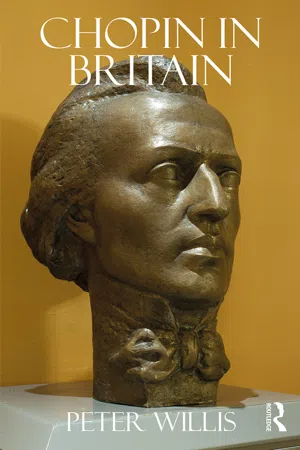
In 1848, the penultimate year of his life, Chopin visited England and Scotland at the instigation of his aristocratic Scots pupil, Jane Stirling. In the autumn of that year, he returned to Paris. The following autumn he was dead. Despite the fascination the composer continues to hold for scholars, this brief but important period, and his previous visit to London in 1837, remain little known. In this richly illustrated study, Peter Willis draws on extensive original documentary evidence, as well as cultural artefacts, to tell the story of these two visits and to place them into aristocratic and artistic life in mid-nineteenth-century England and Scotland. In addition to filling a significant hole in our knowledge of the composer's life, the book adds to our understanding of a number of important figures, including Jane Stirling and the painter Ary Scheffer. The social and artistic milieux of London, Manchester, Glasgow and Edinburgh are brought to vivid life.
Information
1 London
Summer 1837
The year 1837 marked a significant stage in Chopin’s life. Professionally, he had established himself in Paris as both composer and performer; personally, his friendship with the teenage Maria Wodzińska, whose brothers had stayed with the Chopins in Warsaw, was coming to an end. Moreover, the previous autumn he had been introduced by Liszt to George Sand. Bovy’s bronze portrait medallion of 1837, with its idealized profile and flowing locks, encapsulates Chopin’s status in Parisian musical life at this moment (see Figure 1.1). Yet all was not well with him.
In Dresden, in 1835, Chopin had taken further his friendship with Maria, and his hopes of hearing from the Wodziński family that they agreed to his marriage to their daughter must have been a constant strain. In 1837, as mid-year approached, and Parisian society evacuated to the country or abroad, Chopin declined several invitations for the summer months, including one from Nohant. Any hopes of seeing Maria and her parents, and extracting a final response from them, were dashed. With such emotional stresses, Chopin must surely have regarded the opportunity to spend two weeks in London as a welcome relief.1

Figure 1.1 Chopin. Bronze medal, by Jean François Antoine Bovy, 1837. Mary Evans Picture Library/SZ Photo/Scherl
Chopin’s passport, issued on 7 July 1837 by the French police,2 describes his physical characteristics: he was 5 ft 7 in (1.70 cm) tall, with fair hair, clear skin, and blue-grey eyes.3 On 10 July Chopin and Pleyel left Paris for London.4 In the 1830s, travellers between the two cities still had to make their journies to and from the Channel ports of Dover and Calais by horse-drawn stagecoach: you could travel within a day between Paris and Calais, or Dover and London, but the roads were poor, and there was always the danger of being robbed by highwaymen. Equally perilous was crossing the English Channel itself. Boats were small, and were tossed about in the waves. Passengers, often seasick, travelled on deck with little shelter. Landing could be difficult, as harbours on both sides of the Channel were shallow and ill protected against storms. Ships frequently had to wait offshore at Dover or Calais until the tide was high enough for them to enter the harbour; alternatively, rather than be delayed, some passengers preferred to pay local boatmen to ferry them to the nearest beach (see Plate 2).5 Chopin and Pleyel survived this hazardous journey, but not entirely happily. ‘I will tell you later’, Chopin wrote to Fontana when he reached London, ‘what agreeable thoughts and disagreeable sensations the sea gave me, and also the impression made on my nose by this sooty Italian sky.’6 It is likely that Chopin and Pleyel stayed overnight in Dover, perhaps in Wright’s Hotel, or in one of the coaching-inns which preceded the hotels in Dover, Folkestone, and Newhaven built later by railway companies for cross-Channel travellers (see Figure 1.2).7
Camille Pleyel had separated from his wife, the pianist Marie Moke, two years previously. His friendship with Chopin was important on several counts. We have seen already that Chopin’s first concert in Paris in 1832 had taken place at ‘Les Salons de MM. Pleyel et Cie’, and that his preferred piano was a Pleyel. For his part, Pleyel had already established connections with the Broadwood firm in Paris, and must have wished to take them further by visiting Broadwoods’ in London.8 London musical life was a draw in itself: Camille Pleyel had already experienced it in 1815, when he performed as a pianist before royalty and at the London Philharmonic Society, and in a two-piano recital with Kalkbrenner. Pleyel also gave piano lessons, examined pianos produced by other manufacturers, and reported back to his father, Ignace Pleyel, on their construction.9 And he linked up, among piano makers, with Thomas Tomkison, as well as the Broadwoods.10
Architecturally, London had just experienced the dramatic changes brought about by the great architects and speculators of the Georgian period: Shepherd’s engraved views, in his Metropolitan improvements of 1829, demonstrate the character of recent building. Whereas in the City of London, for instance, St Paul’s Cathedral still towered over Ludgate Hill and Fleet Street, to the north-west Nash’s Regent Street cascaded south to Piccadilly Circus, Waterloo Place, and the Embankment (see Figure 1.3). Here, and in the churches, civic buildings, squares, and terraces which formed part of the great expansion of London, it was urban classicism which held sway, as it did in the centres of Bath and Edinburgh and, later, Newcastle. This was the area north of the Thames in which Chopin was to stay in 1837, safely away from the poverty of much London life elsewhere.

Figure 1.2 Quay at Dover, Kent, showing Wright’s Hotel in the centre. Drawn by George Sidney Shepherd, engraved by Thomas Garner, circa 1830. Private collection
Chopin and Pleyel were in London from 11 to 22 July.11 Once they arrived, the composer was looked after by a friend from Warsaw, Stanisław Egbert Koźmian, poet and Polish patriot who, with his younger brother Jan (John) Koźmian, had fled Poland after the insurrection of 1831.12 Jan settled in France, Stanisław in England. (Stanisłaus’s translations from English into Polish included works by Shakespeare, and poems by Byron, Cowper, Shelley, Southey, and the Irish writer Thomas Moore. In addition, Stanisłaus translated passages on Poland written by the Scottish poet and journalist Thomas Campbell, and later, in 1862, published in Poznań a two-volume collection of his own essays about England and Poland, entitled Anglia i Polska.) Koźmian was Secretary of the Literary Association of the Friends of Poland, founded in London by Campbell in March 1832, and described by a biographer of Campbell as ‘one of the proudest monuments of British philanthropy’.13 Later, the association was led by another acquaintance of Chopin, Lord Dudley Coutts Stuart, ‘after Campbell, the most constant and devoted friend of the Poles in England’ (see Figure 1.4).14

Figure 1.3 Part of the West Side of Regent Street, London. Drawn by Thomas H. Shepherd, engraved by W. Watkins, 1828. Private collection
The purpose of this association, according to its first prospectus, was ‘collecting and diffusing all such information as may tend to interest the public mind in respect to Poland, and also the collecting and distribution of funds for the relief of Polish refugees’ forced into exile by the tyranny of Czar Nicholas I of Russia.15 Through the influence of Coutts Stuart, a Parliamentary grant of £10,000 was twice obtained ‘for the relief of Polish political exiles’. Julian Ursya Niemcewicz, Polish patriot and man of letters, provided the initial drive for the foundation of the association, whose first presidents were successively the poet Thomas Campbell, Thomas Wentworth Beaumont, and Lord Dudley Coutts Stuart.16 The most distinguished Polish supporter of the association was Prince Adam Jerzy Czartoryski, now exiled in Paris. The association’s rooms in London were in Sussex Chambers, No. 10 Duke Street, St James’s, and there were branches in Warwick, Birmingham, and Aberdeen. It published its own periodical. According to Teresa Ostrowska, most members of the association were Englishmen. ‘Among them’, she notes, ‘were aristocrats, Members of Parliament, men of letters and arts, and industrialists. The Association provided relief to the refugees and furthered the Polish cause at the international forum.’ As Koźmian observed, it promoted Polish interests among Englishmen, both ‘in the most select drawing rooms and at popular gatherings.’17 Among the ‘popular gatherings’, held to raise money, was the Annual Grand Dress and Fancy Ball at Guildhall in 1848, at which Chopin played.

Figure 1.4 Lord Dudley Coutts Stuart (1803–54). Engraved portrait. Illustrated London News, 1843, left of page 325. Mary Evans Picture Library
On 3 July, a week before Chopin left Paris, his friend Julian Fontana (see Fig. 1.5), who was staying with the composer at No. 38 rue de la Chaussée d’Antin, wrote to Koźmian in London:
Guess who is going to London on Saturday the 8th of this month? Before I tell you I must urge you to keep it a secret and not to divulge it to anyone. It is Chopin. He will stay in London for a week or ten days at most. He will be sightseeing and will want to see no one. He will be travelling in absolute secrecy and I ask you again to keep this news to yourself. You should have the will to keep a secret for two whole weeks if this letter reaches you early enough. I am writing to you about it only because I talked to him ...
Table of contents
- Cover
- Title
- Copyright
- Dedication
- Contents
- List of figures
- List of colour plates
- Preface
- Acknowledgements
- Introduction: Paris 1830s: prologue
- 1 London: summer 1837
- 2 Paris 1840s: interlude
- 3 London 1848: Chopin in London
- 4 London 1848: recitals
- 5 Edinburgh
- 6 Scottish Country Seats
- 7 Manchester: concert in Gentlemen’s Concert Hall, Monday 28 August 1848
- 8 Glasgow: concert in Merchants’ Hall, Wednesday 27 September 1848
- 9 Edinburgh: concert in Hopetoun Rooms, Wednesday 4 October 1848
- 10 London: concert in Guildhall, Thursday 16 November 1848
- Conclusion: Paris 1849: Epilogue
- Bibliography
- Index
Trusted by 375,005 students
Access to over 1.5 million titles for a fair monthly price.
Study more efficiently using our study tools.
Frequently asked questions
Yes, you can cancel anytime from the Subscription tab in your account settings on the Perlego website. Your subscription will stay active until the end of your current billing period. Learn how to cancel your subscription
No, books cannot be downloaded as external files, such as PDFs, for use outside of Perlego. However, you can download books within the Perlego app for offline reading on mobile or tablet. Learn how to download books offline
Perlego offers two plans: Essential and Complete
- Essential is ideal for learners and professionals who enjoy exploring a wide range of subjects. Access the Essential Library with 800,000+ trusted titles and best-sellers across business, personal growth, and the humanities. Includes unlimited reading time and Standard Read Aloud voice.
- Complete: Perfect for advanced learners and researchers needing full, unrestricted access. Unlock 1.5M+ books across hundreds of subjects, including academic and specialized titles. The Complete Plan also includes advanced features like Premium Read Aloud and Research Assistant.
We are an online textbook subscription service, where you can get access to an entire online library for less than the price of a single book per month. With over 1.5 million books across 990+ topics, we’ve got you covered! Learn about our mission
Look out for the read-aloud symbol on your next book to see if you can listen to it. The read-aloud tool reads text aloud for you, highlighting the text as it is being read. You can pause it, speed it up and slow it down. Learn more about Read Aloud
Yes! You can use the Perlego app on both iOS and Android devices to read anytime, anywhere — even offline. Perfect for commutes or when you’re on the go.
Please note we cannot support devices running on iOS 13 and Android 7 or earlier. Learn more about using the app
Please note we cannot support devices running on iOS 13 and Android 7 or earlier. Learn more about using the app
Yes, you can access Chopin in Britain by Peter Willis in PDF and/or ePUB format, as well as other popular books in Media & Performing Arts & Music. We have over 1.5 million books available in our catalogue for you to explore.