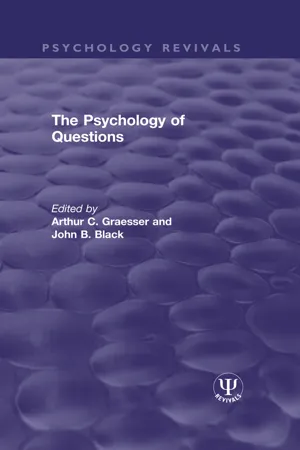
Originally published in 1985, the chapters in this volume collectively approach the phenomenon of questioning from many perspectives. There are studies on question comprehension, question answering, question asking and the influence of adjunct questions on text comprehension and memory. The chapters cover different theories, models, methods, and practical applications. Some contributors focus exclusively on adult subjects, whereas other examine cognitive development in children. The earlier chapters in the book have a "pure science" emphasis, whereas the later chapters have an "applied" emphasis. Of course, the distinction between science and application had, in the editors' words, become "very fuzzy" in the years prior to publication.
eBook - ePub
The Psychology of Questions
- 394 pages
- English
- ePUB (mobile friendly)
- Available on iOS & Android
eBook - ePub
The Psychology of Questions
About this book
Information
1
An Introduction to the Study of Questioning
Introduction
J. T. Dillon recently reviewed 15 books on the topic of questioning (Dillon, 1982). The books were published during the last decade and spanned many different fields: philosophy, logic, linguistics, semantics, cognitive psychology, anthropology, sociolinguistics, survey research, education, counseling, personnel interviewing, psychotherapy, library science, and cross-examination techniques. Dillon had several informative observations after completing this broad survey. Listed below are three of the more general observations.
1. When considering the different fields collectively, there is a growing and widening interest in the study of questioning. Obviously, questioning has attracted the attention of scholars since Aristotle (or before). However, serious studies of questioning have escalated during the last decade.
2. The different fields are rather isolated from one another. Multidisciplinary approaches are rare even though each field would benefit from the contributions of other Helds. As usual, there is a natural tendency for fields to be insulated (if not encapsulated).
3. A multidisciplinary study of questioning seems imminent. There are some common interests, unresolved issues, and contradictory conclusions among the fields. The stage has been set for some multidisciplinary efforts.
Dillon’s survey included Lehnert’s book, The Process of Question Answering (1978), as the representative contribution from cognitive psychology. Lehnert’s book introduced a detailed model that specified symbolic procedures for 13 categories of questions (e.g., causal antecedent questions, goal orientation questions, concept completion questions, requests). The model (called QUALM) has been implemented in the form of a computer program. Lehnert’s work has had a profound impact on the question-answer research that I have conducted in recent years (Graesser, 1981). The fact that Lehnert’s book was selected to represent cognitive psychology is appropriate because her goal was to capture the mechanisms that humans invoke when they answer questions. At the same time, however, it is informative to note that Lehnert is not a prototypical cognitive psychologist; her background and primary research interests are in computer science and artificial intelligence.
Cognitive psychology has never really treated questioning as a primary object of inquiry. Questioning has always had a secondary status. Researchers have usually collected answers to questions as a data base for investigating and testing some other, more “primary” cognitive component or mechanism (e.g., memory organization, memory retrieval, natural language comprehension, problem solving, social attribution). The mechanisms that underly question comprehension, question answering, and question asking have rarely been under direct scrutiny. Consequently, cognitive psychology’s image is rather fuzzy in the multidisciplinary arena.
In light of this historical context, John Black and I thought that it would be useful to edit a book on the psychology of questions. The contributors to this volume are cognitive psychologists who have investigated question comprehension, question answering, and question asking either directly or indirectly. It is hoped that this volume will create a more salient impression of cognitive psychology’s contributions and will stimulate more focused efforts in the study of questioning. The time is ripe for cognitive psychologists to develop serious, well-articulated theories.
How do other fields approach the study of questioning? A complete answer to this question would require several books because there are many fields with quite different theoretical frameworks and methodologies. Nevertheless, I thought that it would be helpful to summarize briefly some of the highlights. The next few sections describe major objectives, perspectives, and contributions in other fields. The coverage is selective rather than exhaustive. For most of the fields, I have cited some recent references for curious readers who want to reconstruct the literature.
Rational Approaches to the Study of Questioning
The “rational” approaches to the study of questioning are pursued in philosophy, logic, and linguistics. The critical issues in these fields involve language events, i.e., the nature, structure, and meaning of sentences. There is a special logic called erotetic logic which applies to all sentences that call for a reply (Harrah, in press). Scholars who pursue these rational approaches worry about (a) expressing questions and responses in a formal manner; (b) elucidating well-formed relationships between questions and responses; and (c) solving problems of truth, reference, presupposition, and other traditional problems as they apply to questioning.
An erotetic logic must somehow deal with the fact that expressions in a logical theory have a truth value, yet questions do not seem to have a truth value. For example, it would be silly to assign a truth value to the following questions:
- Is the number of trees that border Canada and the United States even?
- Why did that professor write that paper?
- When did you stop beating your spouse?
An early solution to this problem was the set-of-answers methodology (see Harrah, in press; Kiefer, 1983). According to this methodology, the logical meaning of a question is the set of all possible answers to the question (or alternatively, the set of all true answers). Truth values were assigned to questions by virtue of the truth values assigned to answers.
The set-of-answers methodology suffers from a number of shortcomings (Kiefer, 1983). Two major problems involve context and pragmatics. A complete theory of questioning requires a contextually restricted notion of possible answers (or true answers). The meaning of a question and the possible answers to it depend critically on the relevant context or world under consideration. A complete theory of questioning must also incorporate the pragmatic level of language usage, i.e., properties of the social interaction between the questioner and answerer. This pragmatic component would specify the questioner’s knowledge, the answerer’s knowledge, the intentions of the questioner and answerer, and perhaps other properties of the speech participants. In other words, a theory of questioning is a special case of a more general theory of conversation (Hobbs & Robinson, 1979). An inappropriate answer or question involves a lack of cooperation between the questioner and answerer. Specifically, inappropriate speech acts violate some implicit conversational maxim or rule for achieving a smooth conversation, e.g., be sincere, be truthful, be informative, be relevant, be clear (see Grice, 1975). The problem of generating a pragmatically significant answer to a question cannot be satisfactorily solved by appealing to the set-of-answers methodology (Grewendorf, 1983).
More recent rational approaches to the study of questioning have indeed acknowledged the pragmatic level of conversational interaction (see Harrah, in press). In fact, researchers in this field have identified many of the alternative pragmatic modes. One pragmatic mode is called “Tell Me Truly.” In this mode the speech participants may or may not know the answers to questions, but there is a ground rule that the questioner expects the answerer to supply true, sincere answers. A second pragmatic mode is called “Make it the Case that I Know.” In this mode there is the expectation that (a) the answerer is more knowledgable than the questioner about the information referenced in the question and (b) the questioner wants the answer to supply the needed information. This second mode is appropriate when the questioner has a problem to solve and needs critical information. A third pragmatic mode is called “Make Me Know that You Know.” In this mode it is expected that (a) the questioner is more knowledgable than the answerer about the information referenced in the question and (b) the questioner wants the answerer to demonstrate that the answerer knows the information. A good example of this third mode is in a teacher-student dialogue where the teacher asks the student questions even though the teacher already knows the answers to the questions. A fourth pragmatic mode is called “Give Me an Answer and Claim that it is True.” This mode would occur in a cross-examination context. It is expected that both the questioner (policeman, judge, lawyer) and the answerer (witness, client) know the answer to a question, but the speech acts are performed to satisfy certain legal objectives. Other pragmatic modes include rhetorical questions, indirect requests, and gripes (see Bach & Harnish, 1979). In these modes, speech acts are questions syntactically, but functionally they are not questions because replies are not expected. A different erotetic logic would apply to each of the pragmatic modes and it is the task of the researcher to uncover their logical properties.
Kaplan (1983) has pointed out that a pragmatically cooperative answer may not be a direct answer to a question, but rather an indirect answer that corrects a misconception on the part of the questioner. Consider the question and the set of answers below.
How many beers did Jack have at Bill’s party?
- (a) zero
- (b) Jack did not have any beers at Bill’s party
- (c) There was no beer at the party
The question presupposes that Jack had beer at the party and it presumes that beer was available at the party (see Kaplan for the distinction between presuppositions and presumptions). It is quite possible, however, that Jack never had beer at the party and that there was no beer available. How would the answerer reply if no beer was available at the party? All three answers (a, b, and c) would be acceptable, technically speaking, but answer c would be the only pragmatically cooperative answer. Answer a would involve stone-walling. Stonewalling occurs when the answerer gives an uncooperative and often misleading answer that is nevertheless direct and technically correct. Pragmatically cooperative answers should correct erroneous presuppositions and presumptions that the questioner believes are true. A complete theory of questioning must address not only the explicit information in the questions and answers, but also the implicit knowledge that underlies the social interaction.
Artificial Intelligence Approaches to the Study of Questioning
Researchers in artifical intelligence (AI) have developed computer systems that answer questions that users type into the system. Generally speaking, a question answering (Q/A) mechanism displays intelligence to the extent that it can search efficiently through a large data base, derive answers that are not directly stored in the data base, and formulate responses both quickly and accurately. Of course, developing an intelligent Q/A mechanism is no small task. Part of the key to achieving this goal is to organize and represent data base knowledge in a manner that caters to the constraints of the proposed Q/A mechanism. In other words, the data base and the Q/A mechanism work together in producing replies to questions. Just as it makes sense to evaluate the intelligence of a Q/A mechanism, it also makes sense to evaluate the intelligence of a data base.
There are three basic strategies to developing intelligent data bases and Q/A procedures. The first strategy is strictly analytical. The AI researcher uses proofs, algorithms, formulas, and other computational/mathematical tools for determining a system design that minimizes retrieval time and maximizes the accuracy of responses to queries. The second strategy capitalizes on what is known about human intelligence. The AI researcher incorporates the data base organization that humans allegedly possess and the Q/A heuristics that humans allegedly use. The belief underlying this second strategy is that AI should mimic human intelligence because it seems to be the most flexible and effective system available. Cognitive psychologists have had the most direct contact with AI researchers who adopt this second strategy (Lehnert, Dyer, Johnson, Yang, & Harley, 1983; Schank & Riesbeck, 1981; Williams, Hollan, & Stevens, 1983). The third and most recent strategy is to develop an expert system (Hayes-Roth, Waterman, & Lenat, 1983). The AI reseacher incorporates data base knowledge and retrieval heuristics of experts in a specific area (e.g., medicine, law, engineering). The expert systems presumably capitalize on the advantages of both machine intelligence and expert human intelligence.
The most successful AI systems have had restricted semantic domains (see Waltz, 1982, for a review). Thus, the properties of the data base and the Q/A procedures have depended on the semantic domain under investigation. AI researchers have collectively covered a broad range of semantic domains, including simple stories, arches, blocks (with different sizes, shapes, and colors), scientific information about moonrocks, aircraft flight and maintenance data, the operation of a steam engine, medical diagnosis and treatment, South American geography, and psychological problems (paranoia). AI reseachers have found it feasible to develop a Q/A system that is customized to the unique constraints of a specific semantic domain. There presently is no “portable” Q/A module that can be successfully integrated wth any semantic domain (although see Kaplan, 1983).
Available AI systems are not developed to the point where the computer can comprehend and formulate good answers to any question that a user happens to type into the system. Virtually all of the systems handle a restricted set of inputs which must be entered in a syntactically rigid way. Alternatively, there is a preliminary dialogue between the user and the computer, which eventually converges on the true question that the user intends to ask. Researchers in AI acknowledge that natural language is very complex, varied, and dependent on the pragmatic goals of the user-computer dialogue. Moreover, solutions to these problems will require decades of research.
There are several lessons that I have learned from the research projects in AI. One lesson is that a key to developing an intelligent Q/A procedure is to organize the data base in an intelligent way. A second lesson is that there is not a single way to organize a data base. There should be several organizational schemes that can be used at different times for different purposes. A third lesson is that it is important to study how different components, structural levels, and representations interact symbolically. Finally, AI has introduced important formalisms and system architectures that cognitive psychologists might consider when they develop their own theories of questioning.
Practical Approaches to the Study of Questioning
If a complete theory of questioning were ever achieved, there would be a staggering number of practical applications. On the other side of the coin, practical approaches to the study of questioning have had an impact on many of the theoretical approaches. The practical approaches have sometimes provided a refreshing perspective to t...
Table of contents
- Cover
- Title
- Copyright
- Original Title
- Original Copyright
- Contents
- Chapter 1 An Introduction to the Study of Questioning
- Chapter 2 Symbolic Procedures of Question Answering
- Chapter 3 Answering Some Questions About a Model of Question Answering
- Chapter 4 Mental Processes of Question Answering
- Chapter 5 Using Knowledge of Activities to Understand and Answer Questions
- Chapter 6 Misleading Question Effects as Evidence for Integrated Question Understanding and Memory Search
- Chapter 7 Question-Asking as a Component of Text Comprehension
- Chapter 8 Questions of Facts and Questions of Inferences
- Chapter 9 Inferential Reasoning In and About Narrative Texts
- Chapter 10 Questions and Children’s Cognitive Processing
- Chapter 11 Notes on the Efficacy of Questioning
- Chapter 12 Classroom Questioning Strategies: Directions for Applied Research
- Chapter 13 Data Base Querying by Computer
- Author Index
- Subject Index
Trusted by 375,005 students
Access to over 1.5 million titles for a fair monthly price.
Study more efficiently using our study tools.
Frequently asked questions
Yes, you can cancel anytime from the Subscription tab in your account settings on the Perlego website. Your subscription will stay active until the end of your current billing period. Learn how to cancel your subscription
No, books cannot be downloaded as external files, such as PDFs, for use outside of Perlego. However, you can download books within the Perlego app for offline reading on mobile or tablet. Learn how to download books offline
Perlego offers two plans: Essential and Complete
- Essential is ideal for learners and professionals who enjoy exploring a wide range of subjects. Access the Essential Library with 800,000+ trusted titles and best-sellers across business, personal growth, and the humanities. Includes unlimited reading time and Standard Read Aloud voice.
- Complete: Perfect for advanced learners and researchers needing full, unrestricted access. Unlock 1.5M+ books across hundreds of subjects, including academic and specialized titles. The Complete Plan also includes advanced features like Premium Read Aloud and Research Assistant.
We are an online textbook subscription service, where you can get access to an entire online library for less than the price of a single book per month. With over 1.5 million books across 990+ topics, we’ve got you covered! Learn about our mission
Look out for the read-aloud symbol on your next book to see if you can listen to it. The read-aloud tool reads text aloud for you, highlighting the text as it is being read. You can pause it, speed it up and slow it down. Learn more about Read Aloud
Yes! You can use the Perlego app on both iOS and Android devices to read anytime, anywhere — even offline. Perfect for commutes or when you’re on the go.
Please note we cannot support devices running on iOS 13 and Android 7 or earlier. Learn more about using the app
Please note we cannot support devices running on iOS 13 and Android 7 or earlier. Learn more about using the app
Yes, you can access The Psychology of Questions by Arthur C. Graesser, John B. Black, Arthur C. Graesser,John B. Black in PDF and/or ePUB format, as well as other popular books in Psychology & Cognitive Psychology & Cognition. We have over 1.5 million books available in our catalogue for you to explore.