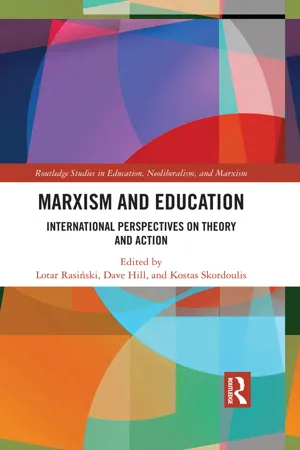
Marxism and Education offers contemporary Marxist analyses of recent and current education policy, and develops Marxist-based practices of resistance from a series of national and international perspectives. Part I identifies and critiques pressure points, impacts of, and developments in capitalism and education, as these pertain to education policy, teacher education, and assessment. In Part II, chapter authors develop Marxist praxis, critical education practices, and resistance against the intensification of neoliberalism and authoritarian conservatism. With contributions from leading, globally-recognized Marxist theoreticians, this book addresses the impacts and developments of neoliberal and authoritarian-conservative education policies across the UK, USA, Greece, Turkey, Poland, and Hungary.
eBook - ePub
Marxism and Education
International Perspectives on Theory and Action
- 192 pages
- English
- ePUB (mobile friendly)
- Available on iOS & Android
eBook - ePub
Marxism and Education
International Perspectives on Theory and Action
About this book
Information
1
Introduction
We live in such times! ‘There are decades when nothing happens, there are weeks when decades happen’.1 We live in such times. The elections and governments of Trump in the US, Erdogan and the AKP party in Turkey, the successes of the openly Nazi Golden Dawn in Greece, the Law and Justice Party government led by Kaczyński in Poland, Orban and the Fidesz party in Hungary, the votes for UKIP in the UK and for Marine Le Pen in France, the vote for far-right parties in Austria and the Czech Republic in elections in 2017, and the influence of openly Nazi and Fascist in Ukraine,—we live in times of savage neoliberalism and its enforcer, conservative authoritarianism that is xenophobic and racist. We live in these times. And we try to contest them, for example, in Radical Left conferences, publications, mobilisations, political parties and groups, social and community organisation and movements.
The current economic, social, and political crisis is manifested more deeply in education on a global scale. The crisis—part of, and resulting from dominant neoliberal and neoconservative politics that are implemented and promoted internationally as ‘the only solution’, under the slogan ‘there is no alternative’ (TINA—have substantially redefined the sociopolitical, economic, pedagogic, and ideological roles of education. Public education is shrinking). It loses its status as a social right. It is projected as a mere commodity for sale while it becomes less democratic, de-theorised, de-critiqued.
Understanding the causes of the crisis, the particular forms it takes in different countries and the multiple ways in which it influences education, constitute important questions for all those who do not limit their perspectives to the horizon of neoconservative, neoliberal, and technocratic dogmas. Moreover, the critical education movement has the responsibility to rethink its views and practices in light of the crisis, and in the light of social, political, and educational resistance in different countries—the paths that this crisis opens for challenging and overthrowing capitalist domination worldwide.
One such mobilisation, conference, is the annual International Conference on Critical Education, the ICCE Conference, held in Athens at the National and Kapodistrian University of Athens (2011, 2012), the University of Ankara (2013), the Aristotle University of Thessaloniki (2014), the University of Lower Silesia in Wroclaw (2015), Middlesex University in London (2016), and the National and Kapodistrian University of Athens (2017). It is a forum for scholars, educators, and social movement, trade union and political activists committed to social and economic justice. The International Conference on Critical Education (ICCE) regularly brings together between 250 and 400 participants, provides a vibrant and egalitarian, non-elitist platform for scholars, educators, activists, students, and others interested in critical education and in contesting the current neoliberal/neoconservative/nationalist hegemony, to come together and engage in a free, democratic, non-sectarian and productive dialogue.
The 5th ICCE: ‘Analyze, Educate, Organize—Critical Education for Social and Economic Justice’ took place at the University of Lower Silesia in the Polish city of Wroclaw from June 15–18, 2015. It is from contributions at that conference that this book has arisen, arising from and developing on and updating plenary papers given at that conference. The updating is important, living as we are in ‘weeks when decades happen’.
In this book, we bring Marxist theoreticians and activists and their analyses from the UK, US, Greece, Turkey, Poland, and Hungary.
The volume includes perspectives from the Anglo-Saxon world, from post-Soviet countries, from the European country most hit by neoliberalism (Greece) and from Turkey, whose politics and education policy are exemplified by intensive neoliberalism accompanied by an Islamicising neo-conservatism—and accompanied, since the July 2016 coup attempt, by the dismissal of tens of thousands of socialist, communist, Marxist teachers and academics who had nothing to do with the coup, but were targeted solely because of their Left activism and/or their Kurdish ethnicity. A number of those dismissed from their posts, their passports withdrawn, many facing prosecution and imprisonment, are regular participants in the ICCE conferences. The repressive neoliberal/neoconservative right-wing nationalist anti-minority policies, ideology, and actions of the Erdogan government in Turkey serve as a warning to many countries and populations. It is therefore fitting that the book includes a number of chapters from writers/activists working in the context of Turkey.
Methodologically the chapters of this volume are varied, ranging from empirical studies, through political and policy analyses, to theoretical papers, and even a narrative interview. This rich variety of approaches reflects the special interdisciplinary character of the network of scholars and practitioners who regularly meet and work within the community that has formed around the annual International Conference on Critical Education, and the Journal for Critical Education Policy Studies. Similarly to the journal and conferences, the authors of papers that you find here talk across traditional disciplinary boundaries in an effort to find meaningful ways of understanding Marxist thought in the present times. Therefore, in the first half of the book, chapters 2 through 8, you will find empirical case studies that take a critical approach to neoconservative and neoliberal trends in different parts of Europe (Grollios, Edwards, Yildiz, Özmen, Chrysochou, Karakul, Mészáros). The second part of the book, chapters 9 through 13, on the other hand, includes theoretical (and historical) studies that try to find ways of bringing Marxist and critical theory to inspire the analysis of current educational problems (McLaren and Ford, Skordoulis, Rasiński, Dziemianowicz-Bąk, Hill).
Because the writers are activists in various arenas such as political parties, trade unions, social movements, as well as in academia, the media and publications, the unifying theory behind the chapters in the book is Marxist analysis and theories of resistance. The book represents work by leading Marxist theoreticians, in many cases, globally recognised. This is indeed a state of the art, up to date/contemporary collection.
It is widely understood in academia nowadays that Marxism is returning as the most effective theoretical body of ideas providing the most accurate analysis of the current crisis of the capitalist system, a crisis that is not only economic but is also cultural, social, political, ecological and in the last analysis, a crisis that affects all aspects of human life.
The theoretical superiority of Marxism is attributed to the superiority of its method i.e. to the philosophy of dialectical materialism. Dialectical materialism provides us with a scientific and comprehensive worldview. It is the method on which Marxism is founded. According to Engels, dialectics was “our best working tool and our sharpest weapon”. And at the same time, it is a guide for action and for our activities for the emancipation of the working class and the toiling masses.
Ernest Mandel, in his The Place of Marxism in History2 (Mandel 1986), defends the view that Marx transformed the idealist dialectics of Hegel into materialist dialectics. The basic premises of Materialist Dialectics are as follows:
- Material reality (nature and society) exists independently of the desires, passions, intentions, and ideas of those who try to interpret it. It is an objective reality, which thought seeks to explain. Naturally, the processes of cognition, of mastering knowledge are themselves objective processes, potential objects of critical scientific examination.
- Thought can never identify totally with objective reality, if only because the latter is in perpetual transformation and the transformation of reality always precedes in time the progress of thought. But it can get closer and closer to it. Reality is therefore intelligible. Thought can progress (though not necessarily in a linear and permanent manner), and this can be verified concretely and practically, in human history by the consequences (verified predictions, successful applications) that are the practical results of these advances. The ultimate criterion of the veracity of thought is therefore practical.
- Thought is effective (scientific) insofar as its explanation of the real processes is not only coherent to explain what already exists, but can also be used to predict what does not yet exist, to integrate this prediction into the interpretation of the real process considered as a whole, and to alter and transform reality in line with a pre-established goal. In the last analysis, knowledge is a tool of survival for humankind, a means by which this species can change its place in nature and, thereby, increase its viability.
This general methodology of effective, scientific thought, of thought advancing through successive approximations towards understanding the whole of reality, constitutes an enormous step forward compared with the purely analytical method of fragmentary knowledge.
The method of Marxism requires a critical appropriation of the data produced by the most advanced academic research combined with a critical analysis of the emancipation movement of the working class.
Marxism does not believe in innate knowledge. Nor does it behave as the “educator” of the proletariat, or the “judge” of history. It constantly learns from the continuously changing reality. It understands that the educators themselves need to be educated, that only a collective revolutionary praxis, rooted on the one hand in scientific praxis, and on the other in the real praxis of the proletariat, can produce this self-education of the revolutionaries and all toiling humanity.
The moment is ripe for such Marxist analyses/proposals, the moment being a crisis of Capitalism (since 2008) with its accompanying austerity, social dislocation and activism and political polarisation to the Left and the Right.
Contents
In the first half of this volume, writers from England, Greece, Turkey, and Hungary use Marxist theory to analyse and critique neoliberal and neoconservative education in their different countries. The theories they develop and apply, the critique they make—and resistance proposals they make—while situated within specific national contexts have a wider significance and resonance, beyond the borders from within which they write.
It commences with, as Chapter 2 (following this Introduction) European Education Policy and Critical Education, by George Grollios, who analyses the main concepts and directions of European education policy. More specifically, he shows how the historic development of the European Union as an alliance of the dominant capitalist social classes of its members-states has shaped a neoliberal European education policy. This policy imposes particular educational goals and standards on the educational system of each member-state in order to empower the European Union in the economic and political international competition. Grollios suggests that educators in Europe need to be aware of the main concepts and directions of the European education policy if they are serious about building an international community fostering economic, social, and political change towards socialism.
Chapter 3, The Schooling of Teachers in England: Rescuing Pedagogy, is by Gail Edwards. She writes that pedagogy is a progressive force for social transformation and, though European countries have had a strong pedagogic tradition historically, the English education system has been overwhelmingly concerned with character formation as part of the reproduction of classed social relations. Pedagogic advance represents a threat to the social order and has been blocked by government legislation, particularly during times of capitalist crisis. In this chapter however, Edwards argues that this is not a full explanation and that pedagogic neglect is further explained by the success of educational movements which pose as progressive but which are in reality profoundly pessimistic. In the context of class struggle, they are a conservative force. The analysis is therefore instructive for critical teacher educators aiming to understand the interplay between ideology, class consciousness, and structural forces. The research presented here relates to England, the author having worked as a teacher educator in England for many years. But the analysis has wider relevance.
In Chapter 4, Transformation in the Teaching Profession in Turkey: From the Idealist Teacher to the Exam-Oriented Technician, Ahmet Yildiz writes that, as in all other professions, the practices and social status of teaching is shaped by the social, economic, and political conditions of a given era. As a result, each era gives rise to its own unique teacher typology. He argues that it is, therefore, essential to know the historical background of the issue in order to deepen our understanding of the new teacher type imposed by the neoliberal project, to show that this new teacher is not normal-natural or universal, and that a different teaching practice is possible. Yildiz considers the changing teacher typology in Turkey in four traditional political stages.
Yildiz is followed, in Chapter 5, Education, Secularism, and Secular Education in a Muslim Community, by Ünal Özmen, who examines the policies against secularism, the basic principle of democracy, developed by the Middle East monarchs, who became annoyed at the “Arab Spring” revolts and became annoyed, especially, at the invasion of Iraq for the purpose of exporting “democracy”. In this context, Turkey’s participation in this process as a model country and the transformation of its schools, which play an important role in building a secular society, are analysed.
The purpose of Chapter 6, Assessing the Effects of the Economic Crisis on Public Education: A Preliminary Data Analysis from Greece, by Polina Chrysochou, is to investigate the effects of the economic crisis in Greece on the working lives and experiences of teacher professional communities. Her chapter is based on qualitative research, involving 24 semi-structured focus group interviews and a total of 24 public primary schools in the Attica region and in the city of Volos and its suburbs. The interviews with teachers covered themes such as teaching/learning conditions, school resources, employment issues, household income, effects on students and teachers’ initiatives, collective activity and coping strategies in the face of the current neoliberal crisis and its impacts. Based on interviews with 102 primary teachers of various teaching disciplines, Chrysochou considers their constant referring to changes in the larger social and political environment, such as unemployment, changes in family, poverty, racism, and authoritarian government policies, along with their fears and anxieties of the potential implications of those changes to both the professional/interpersonal relationships within the school and the nature and purpose of public education. In making a preliminary assessment of the situation, Chrysochou explicates the complex, numerous, and significant impacts, affecting not only teachers, but also students and parents.
In Chapter 7, The Endpoint of Anticipation from Education and Starting Point of Struggle: The Unemployment of White-Collar Workers, Aygulen Kayahan Karakul critically examines important changes in the vocational structure with advanced capitalism. White-collar workers, that is, educated labour power, are prepared for work in qualified, high-paying jobs that require intellectual effort, with job security and good working conditions. White-collar, middle-class workers have gained privileges by using their level of education, along with the developing needs of capital, during recent decades of capitalism. But with the huge changes in labour markets under neoliberalism, white-collar workers have lost their privilege and are, in some cases, started to revolt, seeking new conditions. This chapter illuminates the changed nature of working conditions for white-collar workers and questions this new starting point of struggle, acting together with all those oppressed by capitalism.
Chapter 8 is by György Mészáros and examines The Position of Educational Researchers in a Semi-Peripheral Region and the Rise of Neoliberal Policies in the Academia: The Case of Hungary from a historical materialist and dialectical perspective. The capitalist modes of production and the wider context of global capitalism determine the position, yet leaving place for agency. Wallerstein’s concept of the world system theory offers a useful framework to identify some specificities of this position in a semi-peripheral region such as Hungary. The chapter focuses particularly on the rise of neoliberal policies influencing the position, role, and life of educational academics. Mészáros claims that neoliberal policy tendencies have entered the academia in Hungary, only recently bringing devastating consequences. Standardisation, high expectations towards researchers, pressure followed by the lack of resources, and economic constrains in higher education have made the situation of academics more and more difficult and exploited. This chapter...
Table of contents
- Cover
- Title
- Copyright
- Contents
- Author Biographies
- 1 Introduction
- 2 European Education Policy and Critical Education
- 3 The Schooling of Teachers in England: Rescuing Pedagogy
- 4 Transformation in the Teaching Profession in Turkey: From Socialist-Idealist Teacher to Exam-Oriented Technician
- 5 Education, Secularism, and Secular Education in Turkey
- 6 Assessing the Effects of the Economic Crisis on Public Education in Greece
- 7 The Endpoint of Expectation From Education, the Starting Point of Struggle: A Critical Approach to White-Collar Unemployment
- 8 The Position of an Educational Researcher in a Semi-Peripheral Region: Critical Autoethnography of an Academic Subject in Hungary
- 9 Revolutionary Critical Pedagogy and the Struggle Against Capital Today
- 10 Considerations on a Marxist Pedagogy of Science
- 11 “A Picture Held Us Captive….” Marx, Wittgenstein and the “Paradox of Ideology”
- 12 Empowerment in Education—A New Logic of Emancipation or a New Logic of Power?
- 13 Marxist Education Against Capitalism in Neoliberal/Neoconservative Times
- Name Index
- Subject Index
Trusted by 375,005 students
Access to over 1.5 million titles for a fair monthly price.
Study more efficiently using our study tools.
Frequently asked questions
Yes, you can cancel anytime from the Subscription tab in your account settings on the Perlego website. Your subscription will stay active until the end of your current billing period. Learn how to cancel your subscription
No, books cannot be downloaded as external files, such as PDFs, for use outside of Perlego. However, you can download books within the Perlego app for offline reading on mobile or tablet. Learn how to download books offline
Perlego offers two plans: Essential and Complete
- Essential is ideal for learners and professionals who enjoy exploring a wide range of subjects. Access the Essential Library with 800,000+ trusted titles and best-sellers across business, personal growth, and the humanities. Includes unlimited reading time and Standard Read Aloud voice.
- Complete: Perfect for advanced learners and researchers needing full, unrestricted access. Unlock 1.5M+ books across hundreds of subjects, including academic and specialized titles. The Complete Plan also includes advanced features like Premium Read Aloud and Research Assistant.
We are an online textbook subscription service, where you can get access to an entire online library for less than the price of a single book per month. With over 1.5 million books across 990+ topics, we’ve got you covered! Learn about our mission
Look out for the read-aloud symbol on your next book to see if you can listen to it. The read-aloud tool reads text aloud for you, highlighting the text as it is being read. You can pause it, speed it up and slow it down. Learn more about Read Aloud
Yes! You can use the Perlego app on both iOS and Android devices to read anytime, anywhere — even offline. Perfect for commutes or when you’re on the go.
Please note we cannot support devices running on iOS 13 and Android 7 or earlier. Learn more about using the app
Please note we cannot support devices running on iOS 13 and Android 7 or earlier. Learn more about using the app
Yes, you can access Marxism and Education by Lotar Rasinski,Dave Hill,Kostas Skordoulis in PDF and/or ePUB format, as well as other popular books in Education & Comparative Education. We have over 1.5 million books available in our catalogue for you to explore.