1.1 Methods of Investigations
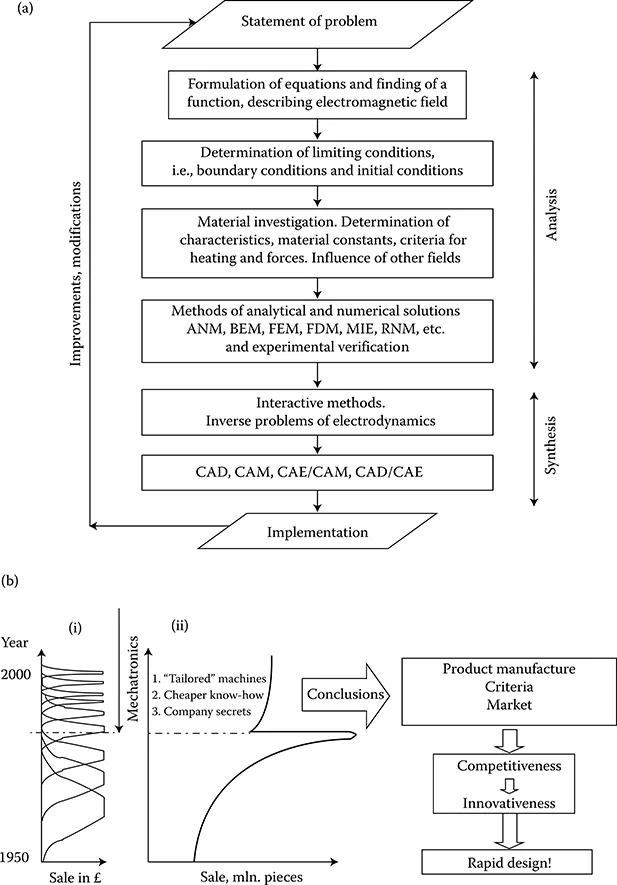
The solutions to engineering tasks by applying the methods of industrial electrodynamics can be divided into several stages (Figure 1.1a):
Formulating mathematical equations and finding a function, which describes the electromagnetic field and its properties in the investigated region, considering the constant or variable characteristics of media (air, copper, steel, etc.) in this region
Determining the limiting conditions, that is, boundary conditions and initial conditions on the surface of the investigated region, imposed by the type and configuration of sources in the investigated field (configuration of conductors, coils or magnetic cores, type of current, etc.) and the border surfaces of adjacent media
Selecting constants and parameters of equations in such a way that satisfies the boundary and initial conditions, that is, finding a final mathematical solution
Experimental verification of the assumptions, adequacy of a computation models, intermediate simplifications, and final results
Demonstrating the obtained results in a form of simple formulae, user-friendly programs, tables, and/or diagrams, facilitating optimal use of the results of the object being investigated
Formulating adequate, that is, being in agreement with reality, equations (stage 1) that correctly describe an object, its phenomena, and solution is a difficult task. Often, we have to limit the calculation to simplified mathematical models, based on one of the laws or group of laws of physics and ignore others. Examples of formulation and solutions of mathematical equations based on the fundamental equations of electrodynamics are given in Chapter 2. Stages 1 through 4 (Figure 1.1a) belong to the analysis of the problem, in which investigations of the physical properties of materials play an important role. This is discussed in Section 1.2.
The objective of industrial or engineering electrodynamics, after all, is the design, that is, the creation of new structures, (the synthesis). Therefore, the stage of analysis should be limited to a minimum to avoid making the design process too long and too expensive. An absolutely necessary element of a full solution is the experimental verification of the results of calculations (stage 4). It is especially important today when field problems are resolved with the help of sophisticated commercial computer programs. Oftentimes, authors are the only ones who know the structure of such programs and applied assumptions.
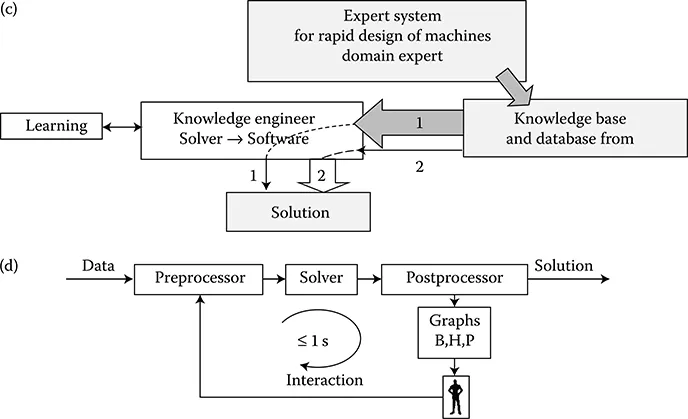
Figure 1.1 (a) Classification of modeling, computational, and research tasks in engineering electrodynamics and electromechanics. Process of design—see (b) through (d). (b) Impact of mechatronics upon (i) “time to market” and (ii) sale of small catalog machines in the United Kingdom (W. Wood 1990) [1.20]. (c) Block diagram of an expert system for designing machines: 1—large portion of introduced knowledge and experience = simple, inexpensive and rapid solution, for example, 1 s; 2—small portion of knowledge and experience = difficult, expensive, labor-consuming solution. (Adapted from Turowski J.: Fundamentals of Mechatronics (in Polish). AHE-Lodz, 2008.) (d) RNM-3D interactive design in less than 1 s design cycle for one constructional variant (Adapted from Turowski J.: Fundamentals of Mechatronics (in Polish). AHE-Lodz, 2008.)
Synthesis, that is, assembling elements of the analysis into a new product, based earlier on the trial-and-error method, has recently gained the following tools:
Interactive methods of design, which are a higher-level and faster trial-and-error method [1.20]
CAD and Auto-CAD (computer-aided design), mainly for design and graphics
CAM (computer-aided manufacturing) systems, to assist the production process
CAE (computer-aided engineering), which is a combination of the systems mentioned above, where a physical model (prototype) is substituted by a computer model and its characteristics are evaluated and improved by the computer simulation, including the manufacturing process itself
Automated CAD/CAE systems revolutionize the design and manufacturing processes of many electromagnetic devices and machines, but will never obviate the necessity of human control and physical insight into phenomena.
Therefore, it is impossible to resolve an electrodynamic problem without at least a simplified consideration of the structure and physical properties of the materials.
The new discipline of mechatronics (J. Turowski [1.20]), which emerged in 1970s–1980s, as the synergistic combination of the mechanical engineering, electronic control, engineering electromagnetics, and system thinking, exerts serious impact on the modern design of products and manufacturing processes.*
The principles of mechatronics can be listed as (1) system approach, (2) rapid design (Figure 1.1b), (3) employment of artificial intelligence, (4) substitution of concurrent engineering by mechatronic engineering, (5) collective work, (6) simple methods based on comprehensive fundamental research, (...