- 320 pages
- English
- ePUB (mobile friendly)
- Available on iOS & Android
Cloud Computing with e-Science Applications
About this book
The amount of data in everyday life has been exploding. This data increase has been especially significant in scientific fields, where substantial amounts of data must be captured, communicated, aggregated, stored, and analyzed. Cloud Computing with e-Science Applications explains how cloud computing can improve data management in data-heavy fields such as bioinformatics, earth science, and computer science.
The book begins with an overview of cloud models supplied by the National Institute of Standards and Technology (NIST), and then:
- Discusses the challenges imposed by big data on scientific data infrastructures, including security and trust issues
- Covers vulnerabilities such as data theft or loss, privacy concerns, infected applications, threats in virtualization, and cross-virtual machine attack
- Describes the implementation of workflows in clouds, proposing an architecture composed of two layers—platform and application
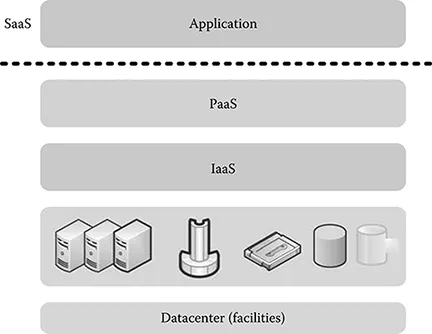
- Details infrastructure-as-a-service (IaaS), platform-as-a-service (PaaS), and software-as-a-service (SaaS) solutions based on public, private, and hybrid cloud computing models
- Demonstrates how cloud computing aids in resource control, vertical and horizontal scalability, interoperability, and adaptive scheduling
Featuring significant contributions from research centers, universities, and industries worldwide, Cloud Computing with e-Science Applications presents innovative cloud migration methodologies applicable to a variety of fields where large data sets are produced. The book provides the scientific community with an essential reference for moving applications to the cloud.
Frequently asked questions
- Essential is ideal for learners and professionals who enjoy exploring a wide range of subjects. Access the Essential Library with 800,000+ trusted titles and best-sellers across business, personal growth, and the humanities. Includes unlimited reading time and Standard Read Aloud voice.
- Complete: Perfect for advanced learners and researchers needing full, unrestricted access. Unlock 1.4M+ books across hundreds of subjects, including academic and specialized titles. The Complete Plan also includes advanced features like Premium Read Aloud and Research Assistant.
Please note we cannot support devices running on iOS 13 and Android 7 or earlier. Learn more about using the app.
Information
1
Evaluation Criteria to Run Scientific
Applications in the Cloud
Contents
- Summary
- 1.1 Introduction
- 1.2 Cloud Service Models
- 1.2.1 Software as a Service
- 1.2.2 Platform as a Service
- 1.2.3 Infrastructure as a Service
- 1.3 Cloud Implementation Models
- 1.3.1 Private Cloud
- 1.3.2 Community Cloud
- 1.3.3 Public Cloud
- 1.3.4 Hybrid Cloud
- 1.3.5 Summary of the Implementation Models
- 1.4 Considerations about Public Providers
- 1.4.1 Data Confidentiality
- 1.4.2 Administrative Concerns
- 1.4.3 Performance
- 1.5 Evaluation Criteria
- 1.6 Analysis of Cloud Providers
- 1.6.1 Amazon Web Services
- 1.6.2 Rackspace
- 1.6.3 Microsoft Windows Azure
- 1.6.4 Google App Engine
- 1.7 Cost Efficiency Evaluation
- 1.7.1 Cost Efficiency Factor
- 1.7.2 Break-Even Point
- 1.8 Evaluation of Providers: A Practical Example
- 1.9 Conclusions
- References
Summary
1.1 Introduction
1.2 Cloud Service Models

1.2.1 Software as a Service
1.2.2 Platform as a Service
1.2.3 Infrastructure as a Service
1.3 Cloud Implementation Models
1.3.1 Private Cloud
1.3.2 Community Cloud
Table of contents
- Cover Page
- Half title
- Title Page
- Contents
- Preface
- Acknowledgments
- About the Editors
- List of Contributors
- 1 Evaluation Criteria to Run Scientific Applications in the Cloud
- 2 Cloud-Based Infrastructure for Data-Intensive e-Science Applications: Requirements and Architecture
- 3 Securing Cloud Data
- 4 Adaptive Execution of Scientific Workflow Applications on Clouds
- 5 Migrating e-Science Applications to the Cloud: Methodology and Evaluation
- 6 Closing the Gap between Cloud Providers and Scientific Users
- 7 Assembling Cloud-Based Geographic Information Systems
- 8 HCloud, a Healthcare-Oriented Cloud System with Improved Efficiency in Biomedical Data Processing
- 9 RPig: Concise Programming Framework by Integrating R with Pig for Big Data Analytics
- 10 AutoDock Gateway for Molecular Docking Simulations in Cloud Systems
- 11 SaaS Clouds Supporting Biology and Medicine
- 12 Energy-Aware Policies in Ubiquitous Computing Facilities
- Index