eBook - ePub
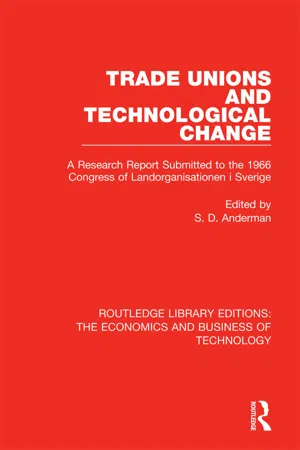
Trade Unions and Technological Change
A Research Report Submitted to the 1966 Congress of Landsorganistionen i Sverige
- 254 pages
- English
- ePUB (mobile friendly)
- Available on iOS & Android
eBook - ePub
Trade Unions and Technological Change
A Research Report Submitted to the 1966 Congress of Landsorganistionen i Sverige
About this book
When this book was first published in 1967, it was one of the first pieces of research to systematically examine the manpower problems associated with rapidly changing technology. It discusses issues such as technological change and unemployment, changes in the structure of employment, the mobility of labour, occupational structure and adjustment, hours of work, and labour-management relations. Its findings suggest that structural unemployment and redundancy are only two of a host of difficulties accompanying technical progress. Although the book originated in Sweden its relevance is clear to other Western european countries and researchers and policy-makers in the USA.
CHAPTER 1
Introduction
The strength of the Swedish trade union movement and its ability to play an important rôle not only as an interest group but also as an initiating force in the process of overall social change in Sweden are currently widely recognized. This has understandably led to some speculation about the reasons why the trade union movement has attained such a position in Swedish society, a position which is almost unique by international standards. The answer is neither simple nor clear-cut. The usual explanations put forward are Sweden’s long, uninterrupted period of peace, its homogeneous population, the favourable rise in its living standards and the traditional intimate co-operation between the political and trade union branches of the labour movement which in turn has provided one of the foundations for its lengthy possession of political power, as well as enabling the successful implementation of a welfare policy programme of full employment and social equality.
Yet, to us it seems plain that a major source of the growth of the power and influence of the trade union movement has been its will and ability to adapt its organization and activities to social changes. An interest group that restricts itself to the promotion of its narrow self-interests runs the risk that its traditions may ‘fossilize’ and cause it to lose its influence over the course of events. However, to the extent that an organization is able to accept change and integrate its group interests with wider interests in adjusting to developments, its aims will be regarded as progressive and it will be afforded the opportunity to participate actively in the formulation of future public policies.
FROM The Trade Union Movement and Modern Society TO Economic Expansion and Structural Change
At a fairly early stage in its development, the Swedish trade union movement chose the latter route. One expression of this choice has been the numerous studies presented and discussed in LO quinquennial congresses over the past decades. In the first of these studies, The Trade Union Movement and Modern Society (1941), the LO charted its position in the welfare society.1 This report significantly modified the trade union movement’s earlier position that the labour market must be completely independent of government regulation. By increasing LO’S power to co-ordinate wage policy and changing its statutes accordingly, it was thought that the process of collective bargaining could be preserved from governmental regulation. The report also contained perhaps the first clear recognition of the fact that technical rationalization was a pre-condition of continued economic and social progress.
Ten years later, the centre of gravity had shifted to the problems of wage policy in a full employment society. Broadly speaking it can be said that whereas The Trade Union Movement and Modern Society struggled with the problem of drawing the line between the area of free and untrammelled collective bargaining, i.e. the area where the trade union and employer organizations could act freely, and the appropriate area for state regulation, the report Trade Unions and Full Employment dealt with the issue of the division of responsibility between government and trade unions for the maintenance of overall economic balance in a full employment economy threatened by inflation.2 It was now proposed that the State was essentially responsible for maintaining an overall economic balance, and that this was a pre-condition of an acceptable wage development through wage negotiations between trade unions and employer organizations. Along with the proposed programme of stabilization measures, in which a new feature was an active labour market policy, an attempt was made to find new institutional forms for a viable wage policy within the framework of the overall economic policy constraints. It soon emerged that the form thought to be most suitable for wage policy, i.e. centralized wage bargaining, did not require any formal changes in the statutes of the central trade union confederation, LO’S moral authority and increased technical resources were estimated to be sufficient to allow wages policy to be centrally co-ordinated, and this view has been confirmed by the practical experience since the mid-1950s.
With the passing of another decade, one dominated by the problems of stabilization and income distribution policy, an attempt was made to come to grips with the problem of the structural transformation of industry as a necessary condition for economic growth and a rising standard of living. Economic Expansion and Structural Change (1962) adhered closely to the declarations in favour of technical rationalization that had been made two decades earlier by a representative group of trade union leaders, in The Trade Union Movement and Modern Society.1 What at the start of the 1940s appeared to be an acceptance of an apparently inevitable development, ripened twenty years later into a programme for a more active policy for structural change. With reference to the stiffening of international competition as well as Sweden’s obligation to provide aid to the developing countries, the trade union movement examined various structural problems and proposed a programme of measures for more active industrial and labour market policies.
There was yet another basic theme in the 1961 report. In the 1951 LO congress, the wages policy of solidarity had been reaffirmed as the guide line for trade union wages policy. Yet this policy had been thwarted by the highly uneven wage development and incidence of wage drift throughout Swedish industries during the 1950s. It became increasingly clear that an active industrial policy in conjunction with an intensified labour market policy was not only a pre-condition of more rapid economic growth; it was also essential to the realization of trade union aspirations for greater wage equality among different worker groups. To a far greater extent than earlier LO reports, Economic Expansion and Structural Change was directed to the Government and thus became as much a contribution to the national economic debate as to the internal trade union debate.
At the 1961 LO Congress, another trade union report of interest in this context was also discussed, notably Trade Unions and Industrial Democracy.2 There is a natural link between this study and Economic Expansion and Structural Change. A more active industrial policy which will result in a more rapid structural transformation requiring greater capital mobility and labour mobility will create greater problems of worker adjustment. In the event, problems of the workplace will loom larger and the question of how to expand and channel the influence of workers in the management of their firm in order best to further their own interests as well as those of the firm and society will become more urgent. Moreover, the security of the individual in a changing economy must be safeguarded, and aspects of this problem were given great attention in Trade Unions and Industrial Democracy. There it was suggested that the problems that arise in a highly mobile labour market could not be solved by employers alone but must be dealt with by close co-operation and consultation between employers and employee organizations.
The reasoning in Trade Unions and Industrial Democracy provided the foundation for later negotiations between LO and the Swedish Employers’ Confederation, SAF, which in turn led to changes in the Basic Agreement, a comprehensive revision of the agreement on works councils and the agreements on redundancy payments and supplementary unemployment benefits.
In this way, it has been possible to provide a greater measure of employment security for the individual and improved income security for those persons made redundant by economic and technological change. New opportunities too have been opened for closer labour-management co-operation at the place of work.
FOCUSING ON THE ADJUSTMENT PROBLEMS OF THE INDIVIDUAL
The positive approach of the Swedish trade unions to rationalization is thus well-documented and requires no further elaboration. The underpinning for this attitude has been the full employment policy which has been pursued conscientiously and successfully in Sweden for decades. In countries undergoing rapid technical change at a lower level of employment, fears have occasionally arisen that the increased utilization of advanced technological processes would constitute a threat to employment and create adverse social conditions. In Sweden, where a favourable employment situation has been experienced for almost the whole of the post-war period and manpower shortages have widely prevailed, such apprehensions have been less frequently felt. The most commonly feared consequence of rationalization, ‘structural’ unemployment, has not evidenced itself to any appreciable extent in Sweden. Moreover, relatively little attention has been directed to other adverse effects of new techniques and even less to the opportunities to apply timely measures to neutralize or prevent such effects.
The LO report on industrial policy in 1961 threw some light on the relationship between the rate of introduction and diffusion of technical improvements, structural rationalization, and the required scale of public measures designed to facilitate the attendant manpower adjustment.
In the current report, we have allotted ourselves the task of treating these adjustment problems in greater detail, and isolating and identifying some of the consequences of technological change for the individual worker. At the start of the 1940s there was a need to determine the part that the trade union movement should play in a welfare society whose outlines were distinguishable in spite of the threat of war. Ten years later a viable form for a wages policy in a full employment economy was the problem that thrust itself to the foreground. After yet another decade, a trade union programme was presented for the co-ordination of all attempts to improve the overall efficiency of industry and the expansion of worker influence in the enterprise. During these two decades, three different aspects of the problems of contending with change were tackled: the institutional, wages policy, and the structural. The individual worker had not been neglected in these studies, but he was not given undue attention as long as the key task was to determine the place of the trade union movement in a new society and to formulate trade union demands for welfare policies. It is now necessary and timely to direct greater attention to the conditions of the individual in a changing society. We shall thus complement and develop our earlier discussion in Trade Unions and Industrial Democracy. Our task is to determine how attempts to increase overall industrial efficiency can be made compatible with successful manpower adaptation in working life; how change in the modern industrialized society can be pursued without creating excessive insecurity for individual workers. We shall also put forward proposals for a programme of measures to cope with problems of manpower redeployment.
TECHNOLOGY IS ONLY ONE FACTOR IN THE PROCESS OF CHANGE
Many different forces underly the changes that have occurred in our society in recent decades. Great difficulties attend any attempt to single out one factor, such as technology, and discuss its rôle in isolation from its wider setting. This problem arises fairly early at the theoretical level when an attempt is made suitably to define these forces and describe their characteristic and conconceivable inter-relationships. And when the effort is made to apply these theoretical concepts to the practical world, the difficulties perceptibly increase. Only in exceptional cases is it possible to distinguish in a given course of events the purely ‘technological’ factor from other types of factors. The same is true when attempts are made to derive different types of consequences from an initiating cause. In practice, therefore, it is almost pointless to attempt to isolate the consequences flowing from a given ‘technological change’ from the results of other simultaneously reinforcing or counteracting forces. The same is true of the measures that can be applied to mitigate the possible adverse effects of technological change. These have rarely been so formed that they can be applied to the specific consequences of a new technique; rather they have tended to be more general in form and application.
These difficulties, while considerable, are not so great as to make a discussion of the consequences of technological change for manpower an entirely meaningless or impossible exercise. We feel, however, that it is not suitable to limit the perspective to the direct consequences of purely technological changes and restrict this discussion solely to the obvious cases of such consequences. We have chosen, rather, to treat a number of problems which we think significant for the labour force as a whole and particular groups of workers regardless of whether or not such problems are created solely or predominantly by ‘the new technology’.
Underlying this decision is our interest as a group not merely in ‘technology’ as such but rather in its diverse and far-flung consequences. It has not been our intention to describe with particularity the components of productive technology and technological research, nor to discuss how these can be further developed, but rather to examine the problems of neutralizing or preventing the adverse effects of changes in general as well as realizing more fully their potentialities.
In the second chapter we present our values and premises. Chapter 3 contains a survey of several major features of changing technology in general and in particular sectors of industry. In Chapter 4 we examine the question of administrative innovations in managerial organization including not only those changes flowing from changing technology but also those occurring independently of technology.
In Chapter 5, the relationship between technological change, employment and unemployment is discussed with special reference to conditions in the USA; Swedish material is also presented. In the two succeeding chapters, which focus especially on conditions in Sweden, the relationship between productivity and employment in different industries and shifts in the occupational structure are described. This leads to a discussion of labour mobility—both inter-firm and intra-firm—as an adjustment phenomenon in Chapter 8. Then, in Chapter 9, the adjustment of the individual worker to a changed work environment is discussed. Technology also affects the number of hours of work as well as their disposition, shifts in the mix of systems of payment, and job and income security. These issues are taken up respectively in Chapters 10–12. Chapter 13 treats the income and wealth distribution aspects of technical progress and economic growth and discusses alternative solutions to the conflict between the demand for increased capital formation and the desire for a more even distribution of income and wealth. Chapter 14 focuses on the management of changes in the enterprise and the need for increased consultation between employers and trade unions as well as worker participation. The book concludes with specific recommendations for a programme of measures to facilit...
Table of contents
- Cover
- Half Title
- Title Page
- Copyright Page
- FOREWORD
- Table of Contents
- FIGURES
- TABLES
- 1. INTRODUCTION
- 2. VALUES AND PREMISES
- 3. TECHNOLOGICAL CHANGE
- 4. MANAGERIAL ORGANIZATION, ADMINISTRATIVE SYSTEMS AND TECHNOLOGICAL CHANGE
- 5. TECHNOLOGICAL CHANGE, EMPLOYMENT AND UNEMPLOYMENT
- 6. CHANGES IN THE STRUCTURE OF EMPLOYMENT
- 7. THE IMPACT OF CHANGING TECHNOLOGY ON THE OCCUPATIONAL STRUCTURE
- 8. LABOUR MOBILITY
- 9. WORKER ADJUSTMENT AND TECHNOLOGICAL CHANGE
- 10. HOURS OF WORK
- 11. SYSTEMS OF WAGE PAYMENT
- 12. INCOME SECURITY AND TECHNOLOGICAL CHANGE
- 13. THE DISTRIBUTION OF INCOME AND WEALTH
- 14. TECHNOLOGICAL CHANGE AND LABOUR-MANAGEMENT CO-OPERATION IN THE PLANT
- 15. CONCLUSIONS AND RECOMMENDATIONS
Trusted by 375,005 students
Access to over 1.5 million titles for a fair monthly price.
Study more efficiently using our study tools.
Frequently asked questions
Yes, you can cancel anytime from the Subscription tab in your account settings on the Perlego website. Your subscription will stay active until the end of your current billing period. Learn how to cancel your subscription
No, books cannot be downloaded as external files, such as PDFs, for use outside of Perlego. However, you can download books within the Perlego app for offline reading on mobile or tablet. Learn how to download books offline
Perlego offers two plans: Essential and Complete
- Essential is ideal for learners and professionals who enjoy exploring a wide range of subjects. Access the Essential Library with 800,000+ trusted titles and best-sellers across business, personal growth, and the humanities. Includes unlimited reading time and Standard Read Aloud voice.
- Complete: Perfect for advanced learners and researchers needing full, unrestricted access. Unlock 1.5M+ books across hundreds of subjects, including academic and specialized titles. The Complete Plan also includes advanced features like Premium Read Aloud and Research Assistant.
We are an online textbook subscription service, where you can get access to an entire online library for less than the price of a single book per month. With over 1.5 million books across 990+ topics, we’ve got you covered! Learn about our mission
Look out for the read-aloud symbol on your next book to see if you can listen to it. The read-aloud tool reads text aloud for you, highlighting the text as it is being read. You can pause it, speed it up and slow it down. Learn more about Read Aloud
Yes! You can use the Perlego app on both iOS and Android devices to read anytime, anywhere — even offline. Perfect for commutes or when you’re on the go.
Please note we cannot support devices running on iOS 13 and Android 7 or earlier. Learn more about using the app
Please note we cannot support devices running on iOS 13 and Android 7 or earlier. Learn more about using the app
Yes, you can access Trade Unions and Technological Change by Steven Anderman in PDF and/or ePUB format, as well as other popular books in Economics & Business General. We have over 1.5 million books available in our catalogue for you to explore.