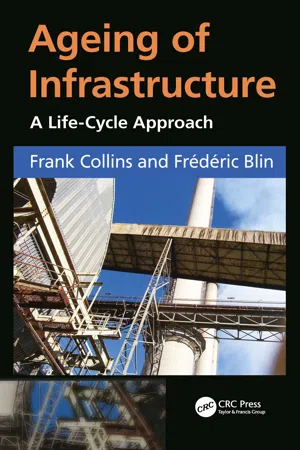
The book addresses the problem of ageing infrastructure and how ageing can reduce the service life below expected levels. The rate of ageing is affected by the type of construction material, environmental exposure, function of the infrastructure, and loading: each of these factors is considered in the assessment of ageing. How do international design codes address ageing? Predictive models of ageing behaviour are available and the different types (empirical, deterministic, and probabilistic) are discussed in a whole-of-life context. Life cycle plans, initiated at the design stage, can ensure that the design life is met, while optimising the management of the asset: reducing life cycle costs and reducing the environmental footprint due to less maintenance/remediation interventions and fewer unplanned stoppages and delays. Health monitoring of infrastructure can be conducted via implanted probes (wired or wireless) or by non-destructive testing that can routinely measure the durability, loading, and exposure environments at key locations around the facility. Routine monitoring can trigger preventative maintenance that can extend the life of the infrastructure and minimise unplanned and reactive remediation, while also providing ongoing data that can be utilised towards more durable future construction. Future infrastructure will need to be safe and durable, financially and environmentally sustainable over the lifecycle, thereby raising socio-economic wellbeing. The book concludes by discussing the key impacting factors that will need to be addressed. The author brings a strong academic and industry background to present a resource for academics and practitioners wishing to address the ageing of built infrastructure.
- 142 pages
- English
- ePUB (mobile friendly)
- Available on iOS & Android
eBook - ePub
About this book
Trusted by 375,005 students
Access to over 1.5 million titles for a fair monthly price.
Study more efficiently using our study tools.
Information
Chapter 1
Introduction
WHAT IS BUILT INFRASTRUCTURE?
View the world around you. Built infrastructure is vast. It sustains our quality of life: homes provide shelter; buildings accommodate a multitude of activities; transport infrastructure connects us via our roads, bridges, airports, railways and ports; built services provide for our well-being (energy generation and distribution, communication nodes and transmission, water and wastewater storage, treatment and reticulation). The management of our ageing infrastructure assets throughout the lifecycle (from planning, construction and utilisation to demolition) has had, and will continue to have, important social, economic and environmental impacts. It is within this framework that greatly influences our relationships within social, commercial and environmental contexts. As a result, it is essential to understand how these assets were designed and built, including the materials utilised during construction (Figure 1.1).
CONSTRUCTION MATERIALS AND METHODS OF CONSTRUCTION
The range of construction materials used to build our infrastructure is large, as choices are often influenced by availability and economy. The most utilised material is concrete, with 25 gigatonnes per year consumed globally (Gursel et al., 2014) on the construction of built infrastructure. Infrastructure is also comprised of a range of steel and alloyed metals utilised as structural frames, pipelines, cladding, fixtures, organic solids (e.g. polymers – including plastics, composites and sealants), masonry, timber and glass. Each has unique properties and each has different levels of resilience depending on exposure conditions and service loadings.

Figure 1.1 Built infrastructure is vast and varied, comprising transportation, maritime, buildings, industrial, energy, water and wastewater needs – all exposed to different loading and exposure conditions.
AGEING
The broad range of materials utilised to construct and maintain infrastructure is exposed to specific environments during the asset’s life. Depending on location and function, the exposure environment imposes chemical and physical actions – both in terms of the overall geography (climate and service loadings) and microclimates (localised exposures and functionality). All materials wish to return to a lower energy state, and manufactured construction materials have locked-in energy that through the laws of nature will return eventually to the original state: metals corrode, timber rots, concrete deteriorates and polymers become brittle. Ageing can be subtle and not easily recognised, and the impacts of deterioration may involve the critical-built components that could lead to premature failure. The rate of ageing is affected by the type of construction material, environmental exposure, deterioration mechanism (also referred to as failure modes) and loading. Population increases have led to greater demands and higher loadings and more frequent use, causing greater impact on ageing. Modern infrastructure is built to last a desired Design Life before they are upgraded, renewed or replaced. If premature ageing occurs, then this could have significant consequences for their users and societies as a whole.
HISTORICAL CONTEXT
Historically, built infrastructure has played a key role since ancient times. Most noticeable are the pyramids of Giza (Nell and Ruggles, 2014), arched bridges, elevated roads and aqueducts across valleys. Roman aqueducts carried water over long distances in order to provide a crowded urban population with relatively safe, potable water and sewers (Wolfram and Lorenz, 2016); transport networks (Carreras and de Soto, 2013) and ancient Mediterranean harbours (Marriner and Morhange, 2007). All infrastructure ages, although in the ancient context it must be born in mind that historic infrastructure is currently maintained with considerable conservation effort and cost (Figure 1.2).
The overarching aim of modern infrastructure is to strike a balance between the lifecycle risks and costs of these assets and the services they provide over time. The large population growth over the last century coupled with changing climatic conditions has put a significant stress on our infrastructure. This has resulted in the need to adapt these assets to current and future demands as well as develop adaptable and resilient new infrastructure solutions.

Figure 1.2 Aqueduct arcade in the Vallon des Arcs on the Barbegal System in Southern France. Construction of the arches is primarily of rubble, mass concrete, with a brick-and-mortar skin. (From Wolfram, P.J., and Lorenz, W.F., Int. J. Hist. Eng. Technol., 86, 56–69, 2016. Taylor & Francis Group.)
BUILT FOR A FINITE LIFE
Built infrastructure is typically designed for a defined life. In Australia, steel and reinforced concrete structures are designed for fifty-year life (Standards Australia, 2009) or, in the case of bridges, one hundred years (Standards Australia, 2004). Design standards vary globally depending on local needs and exposure conditions and functionality. However, the reality is that significant portions of railway infrastructure in many cities is over one hundred years old – is it realistic to replace this infrastructure because one hundred years has expired? Demolition and reconstruction is energy intensive, generates pollution and noise, causes disconnections/delays to public services, and associated costs, whereas simpler methods of restoration may be available.
IMPACT OF AGEING
Impact of ageing on built infrastructure and on the social and economic fabric is significant. There have been examples where the rapid and unpredicted ageing of infrastructure elements led to structural failure resulting in the loss of lives, injuries and environmental damage as well as major reconstruction costs. A key case relates to the Minneapolis bridge collapse in 2007 where 13 people were killed, 145 injured, causing major disruption to a key transportation system, and the cost of a replacement bridge costing over $300 million (Nunnally, 2011). The cost of maintaining and rehabilitating built infrastructure is significant, expending approximately 3.8 percent of global GDP (Gursel et al., 2014). In 2017, the American Society of Civil Engineers Infrastructure Report Card provided a cumulative rating of D+, ‘poor or at risk’, and an estimated $206 billion each year is needed to rehabilitate US infrastructure from ‘poor’ to ‘adequate’ condition (ASCE, 2017). The direct impacts of ageing infrastructure are often very visible through rectification/replacement and the resources needed to undertake remedial work (e.g. the premature reconstruction of a deteriorated bridge that has not achieved the full Design Life). Another example relates to the environmental cost arising from oil seepage in oilfields due to corroded pipelines. Nevertheless, the effects of ageing of buried, underwater and difficult-to-access infrastructure are less visible, and the problems can be insidious.
As shown in Figure 1.3, the outcomes from aged infrastructure are far-reaching and can affect a broad range of industry and public sectors. Deteriorating infrastructure reduces functionality, safety and efficiency of existing buildings (domestic, commercial, industrial and heritage), transportation infrastructure, mining, defence, energy, communications and water/wastewater infrastructure. However, the flow-on economic/environmental/social effects of ageing are less understood. Research on the degradation of engineering materials has received most attention over many years, driven by the science of materials behaviour and modelling of deterioration rather than consideration of the impacts on our quality of life. It is difficult to quantify the societal effects of delays, shutdowns, congestion, energy risk and social dislocation caused by failed infrastructure. Similarly, the flow-on economic effects to, say, an aged port structure, could lead to reduced capacity, productivity, integrity, serviceability and associated reduced road/rail clearances from/to the port. The economic costs due to delayed imports and exports of goods, delivery of services and dependant businesses is substantial. The follow-on effects to the environment are also difficult to quantify but can be affected by road congestion leading to poorer air quality, contamination of ground, waterways and air by leaking containments and pipelines, and the carbon dioxide emissions associated with the energy expended during rehabilitation and premature reconstruction of deteriorated infrastructure. Flow-on social impacts relate to the aforementioned factors as well as dislocation due to transportation delays, reduced safety, impaired health from leakages of contaminants and impacts of delays and shutdowns of energy, communications and water/wastewater services to homes and public facilities.

Figure 1.3 Ageing of built infrastructure showing the broad types of infrastructure that are utilised by the public, industry and government as well as the direct and flow-on impacts. (Courtesy of F. Collins.)
KEY ISSUES TO BE ADDRESSED IN THIS BOOK
New methodologies for the design as well as forensic examination and rectification for infrastructure are moving rapidly with the advent of new technologies. The later chapters of this book will deal with these items, while the important basics will be covered in Chapters 1 through 4. Chapter 2 will deal with the common argument; the comparison between Design Life with Service Life and where ageing impacts on both. The mechanisms of ageing are covered comprehensively in Chapter 3. The exposure environment, covered in Chapter 4, plays a significant role in the deterioration of construction materials and therefore impacts on ageing. In Chapter 5, predictive modelling of ageing is critical during the design stage and also during the Service Life to enable streamlining of maintenance. Whole-of-life Engineering for Ageing Infrastructure is addressed in Chapter 6 and follows the life of the infrastructure from concept design, detailed design, construction phase, through to post-construction Service Life. Health monitoring of built infrastructure has changed enormously from virtual and hand-held nondestructive testing to wireless, noncontact methods of harnessing large volumes of data and decision-making related to many properties and attributes of the infrastructure, including ageing. Much of this is presented in Chapter 7. Chapter 8 provides a review of future materials, methods, the impacts and future means of dealing with ageing infrastructure.
REFERENCES
ASCE (2017). American society of civil engineers report card. https://www.infrastructurereportcard.org.
Carreras, C. and de Soto, P. (2013). The Roman transport network: A precedent for the integration of the European mobility, Historical Methods, 46(3): 117–133.
Gursel, P. A., Masane, T. E., Horvath, A., and Stadel, A. (2014). Life-cycle inventory analysis of concrete production: A critical review, Cement and Concrete Composites, 51: 38–48.
Marriner, N. and Morhange, C. (2007). Geoscience of ancient Mediterranean harbours, Earth Science Reviews, 80: 137–194.
Nell, E. and Ruggles, C. (2014). The orientations of the Giza pyramids and associated structures, Journal for the History of Astronomy, 45(3): 304–360.
Nunnally. (2011). The City, the River, the Bridge: Before and after the Minneapolis Bridge Collapse. Minneapolis, MN: University of Minnesota Press, 216p.
Standards Australia. (2004). AS5100 Bridge Design, Part 1: Scope and General Principles. Sydney, Australia: SAI Global, 49p.
Standards Australia. (2009). AS3600 Concrete Structures. Sydney. Australia: SAI Global, 213p.
Wolfram, P. J. and Lorenz, W. F. (2016). Longstanding design: Roman engineering of aqueduct arcades, International Journal for the History of Engineering and Technology, 86(1): 56–69.
Chapter 2
Contrasting Design Life with Service Life – effects of ageing
INTRODUCTION
When considering the life of built infrastructure, the terms Design Life and Service Life are commonly used and incorrectly exchanged for the same meaning. Both terms refer to the length of time that the built item will perform for its intended pur...
Table of contents
- Cover
- Half Title
- Title Page
- Copyright Page
- Table of Contents
- Preface
- About the authors
- 1 Introduction
- 2 Contrasting Design Life with Service Life – effects of ageing
- 3 Mechanisms of ageing
- 4 Environmental exposure
- 5 Predictive modelling of ageing
- 6 Whole-of-life engineering for ageing infrastructure
- 7 Health monitoring and intervention strategies
- 8 The future
- Index
Frequently asked questions
Yes, you can cancel anytime from the Subscription tab in your account settings on the Perlego website. Your subscription will stay active until the end of your current billing period. Learn how to cancel your subscription
No, books cannot be downloaded as external files, such as PDFs, for use outside of Perlego. However, you can download books within the Perlego app for offline reading on mobile or tablet. Learn how to download books offline
Perlego offers two plans: Essential and Complete
- Essential is ideal for learners and professionals who enjoy exploring a wide range of subjects. Access the Essential Library with 800,000+ trusted titles and best-sellers across business, personal growth, and the humanities. Includes unlimited reading time and Standard Read Aloud voice.
- Complete: Perfect for advanced learners and researchers needing full, unrestricted access. Unlock 1.5M+ books across hundreds of subjects, including academic and specialized titles. The Complete Plan also includes advanced features like Premium Read Aloud and Research Assistant.
We are an online textbook subscription service, where you can get access to an entire online library for less than the price of a single book per month. With over 1.5 million books across 990+ topics, we’ve got you covered! Learn about our mission
Look out for the read-aloud symbol on your next book to see if you can listen to it. The read-aloud tool reads text aloud for you, highlighting the text as it is being read. You can pause it, speed it up and slow it down. Learn more about Read Aloud
Yes! You can use the Perlego app on both iOS and Android devices to read anytime, anywhere — even offline. Perfect for commutes or when you’re on the go.
Please note we cannot support devices running on iOS 13 and Android 7 or earlier. Learn more about using the app
Please note we cannot support devices running on iOS 13 and Android 7 or earlier. Learn more about using the app
Yes, you can access Ageing of Infrastructure by Frank Collins,Frédéric Blin in PDF and/or ePUB format, as well as other popular books in Technology & Engineering & Civil Engineering. We have over 1.5 million books available in our catalogue for you to explore.