This book examines the extent to which a space has opened up in recent years for the so-called "rising powers" of the global South to offer an alternative to contemporary global economic and political governance through emergent forms of South-South cooperation. In contrast to the Third Worldism of the past, the contemporary rising powers share in common the fact that their recent growth owes much to their extensive and increasingly international engagement, rather than partial withdrawal from the global economy. However, they are nonetheless openly critical of the perceived bias towards the global North in the dominant institutions of global governance, and seek to alter the global status quo to enhance the influence of the global South. Contributions to this volume address the question of whether such engagement, particularly on a "South-South" basis, can be categorised as a "win-win" relationship, or whether we are already seeing the emergence of new forms of competitive rivalry and neo-dependency in action. What kind of theoretical approaches and conceptual tools do we need to best answer such questions? To what extent do new groupings such as BRICS suggest a real alternative to the dominance of the West and of the neoliberal economic globalization paradigm? What possible alternatives exist within contemporary forms of South-South cooperation? This book was originally published as a special edition of Third World Quarterly.
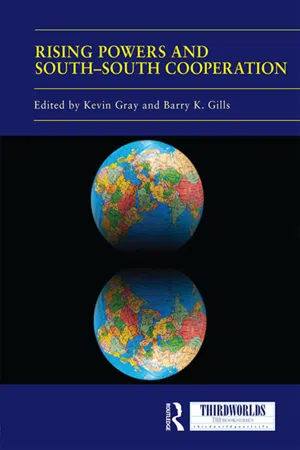
- 204 pages
- English
- ePUB (mobile friendly)
- Available on iOS & Android
eBook - ePub
Rising Powers and South-South Cooperation
About this book
Information
South–South cooperation and the rise of the Global South
Kevin Graya and Barry K. Gillsb
aDepartment of International Relations, School of Global Studies, University of Sussex, UK; bDepartment of Political and Economic Studies, University of Helsinki, Finland
ABSTRACT
In this introductory article we examine the recent resurgence of South–South cooperation, which has moved once again onto the centre stage of world politics and economics, leading to a renewed interest in its historic promise to transform world order. We provide an overview of contemporary debates surrounding this resurgence, noting in particular the division between those who are optimistic with regard to the potential of Southern economic development and the project of liberation from Northern domination, and the more pessimistic critics, who see this very success of the South as being subsumed within the existing global capitalist development paradigm.
In this introductory article we examine the recent resurgence of South–South cooperation, which has moved once again onto the centre stage of world politics and economics, leading to a renewed interest in its historic promise to transform world order. We provide an overview of contemporary debates surrounding this resurgence, noting in particular the division between those who are optimistic with regard to the potential of Southern economic development and the project of liberation from Northern domination, and the more pessimistic critics, who see this very success of the South as being subsumed within the existing global capitalist development paradigm.
Countries…which, for reasons of their own, are opposed to the status quo, would be quick to discover the weaknesses of the existing institutional order and to anticipate the creation of institutions better adapted to their interests. Such groups are pushing that which is falling and holding onto that which, under its own steam, is moving their way. It may seem as if they had originated the process of social change, while actually they were merely its beneficiaries, and may even be perverting the trend to make it serve their own aims. (Karl Polanyi, The Great Transformation)1
Development is a concept that attempts to encompass a vast complexity of processes of social transformation. It conveys meanings of great promise and hope to billions of human beings concerning human betterment, and refers to a long-term historical project of the liberation of peoples and nations from the vestiges of colonialism, poverty, oppression and underdevelopment. South–South cooperation (SSC) has been a key organising concept and a set of practices in pursuit of these historical changes through a vision of mutual benefit and solidarity among the disadvantaged of the world system. It conveys the hope that development may be achieved by the poor themselves through their mutual assistance to one another, and the whole world order transformed to reflect their mutual interests vis-à-vis the dominant global North.
It has now been 60 years since the historic Bandung Conference of 1955, rightly regarded as a milestone in the formation of SSC as a global political movement. SSC as a movement intended to challenge the Northern-dominated political and economic system and, from the 1950s to the present, has been through a series of starts and stops, surges and retreats. As expressed at the Asian–African Conference held in Bandung in 1955, the newly decolonised countries of the global South emphasised economic and cultural cooperation, human rights and the promotion of world peace.2 This emergent movement of Third World solidarity thereby sought to challenge the vertical relations between colony and metropole that were serving to inhibit relations between countries of the global South. The ‘Bandung Spirit’ henceforth came to encapsulate policies of non-interference and non-alignment, with the Non-Aligned Movement (NAM) further developing this solidarity to challenge the deepening global inequality while lessening the Third World’s economic and political dependence on the global North.3 While Bandung and the NAM embodied the political dimensions of an emergent SSC, the Group of 77, named after the number of countries present at the founding of the United Nations Conference on Trade and Development (UNCTAD), called for the establishment of a New International Economic Order (NIEO). The NIEO was to be achieved through tackling structural unequal exchange through ‘a just and equitable relationship’ between the goods exported by developing countries and the goods imported,4 with an emphasis on sovereignty over natural resources and the right to nationalise key industries.5 These demands were rooted in the failure of the emerging postwar international order to tackle the legacies of colonialism and to provide adequate space for postcolonial states to establish their own national approaches to development.6
For a time calls for the NIEO were successful in provoking a considerable degree of debate in the global North, producing a vast literature debating the various pros and cons of the NIEO proposals.7 By the 1980s, however, the Third World debt crisis and the rise of neoliberalism had served to eclipse the NIEO project. The retreat of Third World solidarity was given no clearer indication than at the 1992 UNCTAD summit in Cartagena, when UNCTAD dropped its demands for the adjustment of the international patent system to the developmental needs of the global South, and adopted a statement expressing the belief that the adoption of adequate and effective International Patent Protections and related efforts in the World Intellectual Property Organization and the General Agreement on Tariffs and Trade (GATT) would facilitate technological transfers to developing countries.8 Henceforth, UNCTAD became increasingly eclipsed by GATT, and its successor, the World Trade Organization (WTO). Thus, while UNCTAD had previously acted as a counter-hegemonic organisation resisting the dominance of the Bretton Woods institutions, the restructuring of the organisation gave it a less confrontational role in North–South dialogue.9
There is a widespread sense today, however, that the time is ripe for moving SSC once again onto the centre stage of world politics and economics, and a renewed interest in its historic promise to transform world order. The recent economic and diplomatic achievements of several key countries of the global South, and especially of China and the BRICS group more broadly, has given impetus to increasing debate and consideration of the potentialities (and pitfalls) of a new phase of challenge or construction of alternatives to the hegemonic and neo-colonial politics of the global North. There has been a historically significant global shift in production and manufacturing from global North to global South, altering the economic geography of the world. The tendency over the past several decades to greatly intensify the globalisation of production, trade and financial flows was advocated primarily as a systemic solution to underlying structural problems of Northern capital in the global political economy, including growth, productivity and profitability. But these same globalising tendencies have also enhanced the historical potential of economic growth and industrialisation in the global South, and the possibilities for renewed SSC to loosen the strictures imposed during the colonial era and transcend the boundaries of postwar political and economic geography.
The (hyper)globalisation policies of the pre-2008 global financial and economic crisis era, which was also the historic high water mark of the ideology of ‘neoliberal economic globalisation’, reflected a deeply embedded faith in linear material progress, through innovation and the application of modern science and technology, with the presumed capacity to create unlimited increases in production and consumption. However, this optimistic paradigm of globalised economic development for all has both created, and left yet unresolved numerous severe distributional, socio-political and increasingly ecological and climate change problems and crises that accompany this paradigm of global developmental economic expansionism. In the present era of ‘multiple crises’,10 and the overarching context of global climate change and intensifying ecological stress, the debate over ‘development’ in the global South and the nature and direction of SSC assumes a different character. Elites and citizens alike, the world over, now struggle to manage the tension between global capital expansion, global market competition, competing legal and political orders, and the protection of the rights and welfare of people and the environment. The dawning era of the Anthropocene heralds many profound realisations concerning the future of development on a planetary scale.11 The comprehensiveness of the interventions of humanity upon the web of life, the truly global extent of impacts of our specific historical forms of social, economic and political organisation, now compel deep philosophical reflection on the meaning of development and the search for alternative ways of life and human relations with nature.
The debate
In this context debate over the ‘decline of the West’ and the ‘rise of the rest’,12 and accompanying debate over the historic role of ‘rising powers’, take on new meaning. Positions by academics and activists currently range from a refusal to act as uncritical ‘cheerleaders’ for the new transnationalist capitalism of the South,13 which is denounced as a reproduction of existing capitalist developmental practices of the dominant global North, to those who indeed ‘cheer’ loudly for the continued economic and political successes of the global South, and its potential to transform world order.14 The field is polarised: between those who hold a (conventional) hope in the potential of Southern economic development and the project of liberation from Northern domination, reflecting a kind of contemporary neo-Third Worldism, and those radical critics who see this very success of the South as being far too profoundly subsumed within the existing global capitalist development paradigm, which, however, is currently heading for a possible global environmental catastrophe if not dramatically challenged and altered.15
Much controversy currently surrounds the question of whether elites of the global South and ‘rising powers’ genuinely have the intention to challenge the dominant structures of global capitalist development, or seek to support and reproduce these structures, while altering their global position in the system and enhancing their influence within the existing structures. Some may see a third option (reflecting the quotation from Karl Polanyi above), wherein the present trajectory of increasing economic growth, industrialisation and financial capacity by many countries across the global South will be a step or a stage on the path to an eventual restructuring of global power relations and the reform of global governance institutions and of the norms and rules of the global economy. There may be signs of this strategy following the wake of the global financial and economic crisis, and also of effective Northern counter-strategies, including co-optation of the global South into (cosmetically?) reformed institutions of global governance.16 The direction here is one towards the consolidation of a global elite consensus on development, providing a kind of ‘fictional unity’ around the idea of a globalised and ‘open’ world economy. This possibility raises again the question of whether there is genuine substance to a Southern ‘challenge’ vis-à-vis the dominant global North and its prevailing practices of development, or only superficiality, the recourse of governing elites to mere rhetorical and symbolic solidarity.
The terrain of this debate reflects the fact that, while the new SSC has continued the NIEO’s calls for a fairer gl...
Table of contents
- Cover
- Half Title
- Series
- Title Page
- Copyright
- Contents
- Citation Information
- Notes on Contributors
- 1. Introduction: South–South cooperation and the rise of the Global South
- 2. BRICS, developing countries and global governance
- 3. Emerging Southern powers and new forms of South–South cooperation: Ethiopia’s strategic engagement with China and India
- 4. BRICS banking and the debate over sub-imperialism
- 5. Beyond ‘BRICS’: ten theses on South–South cooperation in the twenty-first century
- 6. Overseas development aid as spatial fix? Examining South Korea’s Africa policy
- 7. Repositioning in global governance: horizontal and vertical shifts amid pliable neoliberalism
- 8. Ethno-territorial rights and the resource extraction boom in Latin America: do constitutions matter?
- 9. The prospects for transnational advocacy across the IBSA bloc – a view from Brazil
- 10. Beyond varieties of development: disputes and alternatives
- 11. Viewpoint: The resurgence of South–South cooperation
- 12. Symposium Interview with Boris Kagarlitsky
- Index
Trusted by 375,005 students
Access to over 1.5 million titles for a fair monthly price.
Study more efficiently using our study tools.
Frequently asked questions
Yes, you can cancel anytime from the Subscription tab in your account settings on the Perlego website. Your subscription will stay active until the end of your current billing period. Learn how to cancel your subscription
No, books cannot be downloaded as external files, such as PDFs, for use outside of Perlego. However, you can download books within the Perlego app for offline reading on mobile or tablet. Learn how to download books offline
Perlego offers two plans: Essential and Complete
- Essential is ideal for learners and professionals who enjoy exploring a wide range of subjects. Access the Essential Library with 800,000+ trusted titles and best-sellers across business, personal growth, and the humanities. Includes unlimited reading time and Standard Read Aloud voice.
- Complete: Perfect for advanced learners and researchers needing full, unrestricted access. Unlock 1.5M+ books across hundreds of subjects, including academic and specialized titles. The Complete Plan also includes advanced features like Premium Read Aloud and Research Assistant.
We are an online textbook subscription service, where you can get access to an entire online library for less than the price of a single book per month. With over 1.5 million books across 990+ topics, we’ve got you covered! Learn about our mission
Look out for the read-aloud symbol on your next book to see if you can listen to it. The read-aloud tool reads text aloud for you, highlighting the text as it is being read. You can pause it, speed it up and slow it down. Learn more about Read Aloud
Yes! You can use the Perlego app on both iOS and Android devices to read anytime, anywhere — even offline. Perfect for commutes or when you’re on the go.
Please note we cannot support devices running on iOS 13 and Android 7 or earlier. Learn more about using the app
Please note we cannot support devices running on iOS 13 and Android 7 or earlier. Learn more about using the app
Yes, you can access Rising Powers and South-South Cooperation by Kevin Gray,Barry Gills in PDF and/or ePUB format, as well as other popular books in Politics & International Relations & Politics. We have over 1.5 million books available in our catalogue for you to explore.