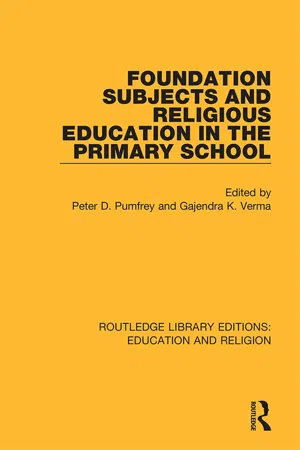
First published in 1993. This volume brings together writings of specialists in the key components of both the whole and the basic curriculum. It sets out to describe and discuss cultural diversity and the whole curriculum from a variety of perspectives and to consider how the concerns of ethnic groups may be addressed within the framework of the national curriculum. To this end, specialists in areas of the curriculum consider some of the challenges and describe promising practices in the secondary school. Much remains undecided concerning the structure, content, pedagogy and assessment of many components of the primary-school curriculum. Despite these considerations, the multicultural nature of the population and of schools will develop. These developments and their educational implications must be considered if the educational system is to respond adequately. Although the 'rules of the curricular game' are still being negotiated in relation to a number of aspects of the curriculum, the editors have deliberately ventured into this controversial field. They do so because of the increasing importance of ethnic diversity of the school population and of the country.
eBook - ePub
Foundation Subjects and Religious Education in the Primary School
- 272 pages
- English
- ePUB (mobile friendly)
- Available on iOS & Android
eBook - ePub
Foundation Subjects and Religious Education in the Primary School
About this book
Information
Part 1
Towards Cultural Pluralism through the Curriculum in Primary Education
Chapter 1
Cultural Diversity and the Curriculum: Context, Challenges and Responses
Context
What type of society do you wish your family, friends and fellow citizens to live in? How can the younger generation be prepared for life in an increasingly multicultural society? What role can education play in such preparation?
In any contemporary society and its educational system, the one constant on which we can depend is change. In the UK, how valid is the assertion that ideological and pedagogical ‘Winds of Change’ typically blow from West to East? Are not equally strong forces ‘blowing’ from the opposite (and other) directions? Or are both such assertions no more than direct consequences of the current uncertainties increasingly experienced within all countries and cultures? Are these uncertainties themselves, in part, an almost inevitable consequence of the onward marches of the mass media, of materialism and the mobility of individuals and groups?
The ‘Good Life’ is increasingly construed in materialist terms by the world’s human population. It would be unwise not to acknowledge the tensions between countries, consequent on competition for finite material resources. Within a given country, region, town and locality, individuals, and groups, also compete for limited resources that are seen as desirable and beneficial. These include housing, health care, education and educational and occupational opportunities. This is the case even when there is no cultural diversity in the population under consideration. Ambitious individuals and pressure groups are facts of life, even in ethnically homogeneous societies (if such societies exist). When clearly identifiable subgroups based on, for example, ethnic group, religion, politics, class, sex or age form, either to protect and/or advance their particular interests, a perennial power struggle is exacerbated. The implicit tensions become explicit.
Across the world, large conurbations have been characterized as ‘concrete jungles’. Within them, the law of the jungle can be observed in operation. Social Darwinism identifies territorial ambitions, pecking orders and competition for space and resources as processes inherent in the human condition. They are exacerbated as population densities increase. In combination, and over time, it has been argued that these processes result in the survival of the fittest with the weakest going to the wall. Might is right. Or is it?
Fortunately, social animals such as homo sapiens also manifest the ability to cooperate, to be concerned with the common good, to subsume short-term material benefits to the individual to those of the group, and to be altruistic. The ‘down-sides’ of this are the tensions between alienated minorities and a mainstream society that is perceived by minorities as failing to acknowledge and respond to their legitimate aspirations. Current gang warfare in cities is but one manifestation of a long-standing phenomenon. Can the individual and collective intelligence, energies, organization, motivation and alienation clearly manifest in, for example, Manchester’s Moss Side and other socio-economically deprived areas, be channelled more constructively? Strategies for constructive change have been developed, are known and have been used successfully (Pumfrey and Verma, 1990).
There are advocates of less concilliatory action. ‘All thinking people who have been oppressed are revolutionary. Any time you find somebody today who’s afraid of the word “revolution” get them out of your way, they are living in the wrong era, they are behind the times. They haven’t awakened yet. This is the era of revolution …’ This call by the late Malcolm X has been taken up by members of Revolution Youth, an active organization of young black and white individuals who intend to change society. Revolution Youth is associated with Socialist Challenge, a weekly paper sponsored by the International Marxist Group (Hercules, Sen and Haddad, 1992).
Other somewhat less extreme and larger organizations involved in addressing the multifaceted concerns of both minority and majority cultural and ethnic groups are listed in Table 1.1.
What positive role can education play in fostering a tolerant and just multicultural society? If education merely mirrors society, the answer is ‘Nothing’. Fortunately, there are alternatives. Early interventions can reduce the probability of later alienating social consequences for pupils of all groups. Schools within the educational system can provide the ethos and experiences that encourage tolerance. The value of primary school-linked work with the parents of pre-school children is increasingly recognized. Primary schools matter (Mortimore, et al., 1988; Alexander et al., 1991).
Education is a highly political issue. The content, teaching and assessment of a National Curriculum cannot be politically neutral. In tune with the market economy philosophy of the current British government, those employed in education are seen as providers of services. As the service is funded on the basis of taxation, pupils and their parents are encouraged to consider themselves purchasers having important rights and responsibilities. Increasingly, every educational resource is costed financially. The Local Management of Schools (LMS) and of Special Schools (LMSS) ensures schools’ growing financial independence of LEAs. Increasingly, the governors and headteachers of schools are determining school policies and priorities. With this financial autonomy comes greater financial accountability. Critics argue that there is an escalating danger that we will shortly know the price of everything and the value of nothing. What priority and price will be put on ensuring that a school curriculum adequately addresses multicultural concerns?
Table 1.1: Sources of Information and Advice
Access to Information on Multicultural Education Resources (AIMER),
Faculty of Education and Community Studies,
The University of Reading,
Bulmershe Court,
Earley,
Reading, RG6 1HV.
Commission for Racial Equality,
Elliot House,
10–2 Allington Street,
London, SW1E 5EH.
Commonwealth Institute: Centre for Commonwealth Education and Culture in Britain,
Kensington High Street,
London, W8 6QN.
Institute of Race Relations,
2–6 Leeke Street,
King’s Cross Road,
London, WC1X 9HS.
Joint Council for the Welfare of Immigrants,
115 Old Street,
London, EC1V 9JR.
National Association of Racial Equality Councils,
8–2 Coronet Street,
London, N1 6HD.
National Council for Civil Liberties,
21 Tabard Street,
London, SE1 4LA.
National Educational Resources Information Service,
Maryland College,
Leighton Street,
Woburn,
Milton Keynes
MK17 9JD.
The Refugee Council,
Bondway House,
3–2 Bondway,
London, SW8 1SJ.
The Runnymede Trust,
11 Princelet Street,
London, E1 6QH.
Standing Conference on Racial Equality in Europe,
Unit 303,
Brixton Enterprise Centre,
444 Brixton Road,
London, SW1 8EJ.
One recent development in the USA may well affect the UK in the fulness of time. South Carolina is a State in which the black/white, ‘haves’ versus ‘have nots’, divisions in education have been, and still remain, significant. Whilst Governor of South Carolina from 1979–2, Mr Riley earned a national reputation as a leading education reform governor. He achieved this distinction by constructing a detailed package of sixty-two educational reforms required to address some of the system’s manifest weaknesses. Then came the extremely difficult task of obtaining the support of elected representatives. This was, in part, achieved by a concerted political campaign. This campaign ensured that the law-makers became aware of a constituency of concerned voters that they would ignore at their political peril. The proposals required the raising of an extra 240 million US dollars per year (160 millions pounds sterling). This was to be raised by an increase of one cent on the state’s sales tax. To British readers, the proposal appears minimalist. Indeed, a much more radical financial policy of adding one penny to the standard rate of income tax in order to fund educational development in the UK was proposed by the Social Democratic Party during the 1992 General Election. As is currently the case in the UK, increasing taxes for public services in the American context is also politically dangerous. Despite this, Riley’s proposals to increase taxes were accepted. The Dean of Columbia Teachers’ College, Michael Timpane, is reported as saying that Riley’s achievement was a pure political tour de force. The links between politics and education are important. Mr Riley has been nominated as Education Secretary in President Clinton’s Administration.
The strength of an elected democracy rests on an educated citizenry capable of informed reflection about the nature of the society they wish to support. To this end, its teachers must be similarly reflective and they must educate their pupils likewise (see Volume 4, Chapter 15).
Challenges
Does the following quotation ring bells? Is it of relevance to societies and their educational systems across the world? Does it bear on life in general and education in particular in an ethnically, culturally and religiously diverse UK?
This is our basic conclusion: Our nation is moving towards two societies, one black, one white — separate and unequal… This deepening racial division is not inevitable. The movement apart can be reversed. Choice is still possible. Our principle task is to define that choice and to press for a national resolution.
In May, 1992, one again, the sociological tinder box of Los Angeles exploded literally and metaphorically. The idealistic concept of the USA as a ‘melting pot’, in which differing groups establish mutually acceptable modus vivendi, was once more challenged. The feelings aroused amongst black communities, following the verdict in the first Rodney King trial, can well be understood. The broadcasting of a video recording of King’s arrest, during which he was hit fifty-six times in eighty-one seconds by the four police officers involved, led to their being charged and tried. The acquittal of Stacey Koon and his three colleagues employed by the Los Angeles Police Department was the spark that led to race riots in which fifty-eight people were killed and more than a billion dollars of damage to property took place. The reactions were not limited to the USA, but spread to other countries and continents. A re-trial of the accused began in 1993. Was the rioting, looting, arson, mayhem and murder that followed the first trial justified? Was nothing learned from the Watts riots of twenty-seven years before? Apparently not. The quotation with which this section began was taken from the Report of the USA National Advisory Commission on Civil Disorders. It was published in 1968!
Can groups with differing cultural histories, religions, belief systems and often conflicting aspirations learn to coexist peacefully within the same country? Is the objective a realistic aspiration? Or is it merely another manifestation of the perennial triumph of hope over experience? The fatalism expressed in Kipling’s poem ‘The Gods of the Copybook Headings’ mocks any endeavour at ‘Social Progress’. His ideological descendants survive today. (Readers are asked to accept the anachronistic use of gender by the author. It was of its time).
As it will be in the future, so it was at the birth of Man -There are only four things certain since Social Progress began: — That the Dog will return to his Vomit and the Sow returns to her Mire,
And the burnt Fool’s bandaged finger goes wobbling back to the fire; And that after this is accomplished, and the brave new world begins, When all men are paid for existing and no man must pay for his sins, As surely as Water will wet us, As surely as Fire will burn,
The Gods of the Copybook Headings with terror and slaughter return!
Does the re-emergence in many countries, including the UK, of xenophobia, religious ...
Table of contents
- Cover
- Half Title
- Title Page
- Copyright Page
- Original Title Page
- Original Copyright Page
- Contents
- Preface
- Acknowledgments
- List of Tables and Figures
- List of Abbreviations
- Part 1 Towards Cultural Pluralism through the Curriculum in Primary Education
- Part 2 Practice in Content Fields
- Appendix 1 The Race Relations Act and Education
- Appendix 2 Lists of ERA-related Publications
- Appendix 3 Section 11 of the Local Government Act 1966: Background and Current Administrative Arrangements
- Notes on Contributors
- Name Index
- Subject Index
Trusted by 375,005 students
Access to over 1.5 million titles for a fair monthly price.
Study more efficiently using our study tools.
Frequently asked questions
Yes, you can cancel anytime from the Subscription tab in your account settings on the Perlego website. Your subscription will stay active until the end of your current billing period. Learn how to cancel your subscription
No, books cannot be downloaded as external files, such as PDFs, for use outside of Perlego. However, you can download books within the Perlego app for offline reading on mobile or tablet. Learn how to download books offline
Perlego offers two plans: Essential and Complete
- Essential is ideal for learners and professionals who enjoy exploring a wide range of subjects. Access the Essential Library with 800,000+ trusted titles and best-sellers across business, personal growth, and the humanities. Includes unlimited reading time and Standard Read Aloud voice.
- Complete: Perfect for advanced learners and researchers needing full, unrestricted access. Unlock 1.5M+ books across hundreds of subjects, including academic and specialized titles. The Complete Plan also includes advanced features like Premium Read Aloud and Research Assistant.
We are an online textbook subscription service, where you can get access to an entire online library for less than the price of a single book per month. With over 1.5 million books across 990+ topics, we’ve got you covered! Learn about our mission
Look out for the read-aloud symbol on your next book to see if you can listen to it. The read-aloud tool reads text aloud for you, highlighting the text as it is being read. You can pause it, speed it up and slow it down. Learn more about Read Aloud
Yes! You can use the Perlego app on both iOS and Android devices to read anytime, anywhere — even offline. Perfect for commutes or when you’re on the go.
Please note we cannot support devices running on iOS 13 and Android 7 or earlier. Learn more about using the app
Please note we cannot support devices running on iOS 13 and Android 7 or earlier. Learn more about using the app
Yes, you can access Foundation Subjects and Religious Education in the Primary School by Peter D. Pumfrey,Gajendra K. Verma in PDF and/or ePUB format, as well as other popular books in Education & Education General. We have over 1.5 million books available in our catalogue for you to explore.