Published in 1997, the is the report of a study commissioned by the Department of Social Security (UK). The aim of the study was to provide detailed information about the social assistance systems of four European countries which, to a greater or lesser extent, are delegated to local levels of government. The study distinguished between policy-making, finances, delivery and accountability. The strengths and weaknesses of each system were evaluated and common and divergent trends noted. There is growing interest in social assistance schemes internationally and this publication provides original information about European schemes. It follows an earlier study, also commissioned by the DSS, on social assistance schemes in 24 OECD countries.
eBook - ePub
Comparative Social Assistance
Localisation and Discretion
- 98 pages
- English
- ePUB (mobile friendly)
- Available on iOS & Android
eBook - ePub
Comparative Social Assistance
Localisation and Discretion
About this book
Information
1 Introduction
The Department of Social Security received the final reports from a major study of Social Assistance arrangements in the 24 OECD countries in October 1995 (Eardley et al, 1996). Although this research was comprehensive a number of important questions remained to be investigated in more detail. Specifically there is interest in the policy context, organisational structures and procedures, strengths and weaknesses of Social Assistance systems in those countries where a degree of sub-national variation exists in respect of policy, financing, administration or application of discretion. A further study was commissioned (November 1995) to examine the strengths and weaknesses of these arrangements in four European countries: Germany, the Netherlands, Sweden and Switzerland. This is the report of that review.
The objectives for the study were agreed as being to:
1. Assess, according to agreed criteria, how local control of Social Assistance schemes works in practice.
2. Examine the relationship between central, regional and local authorities in the financing and administration of Social Assistance.
3. Identify financial and political pressure points and emerging policy options.
These objectives were subsequently elaborated, following discussion between the research team and policy customers, to specify a list of criteria around which more detailed questions have been formulated. The criteria and questions (presented in full in Appendix A) related to the following dimensions: the contexts within which Social Assistance developed and is required to function; the structure of centre-local relations: financial responsibility; the sensitivity of Social Assistance to the circumstances of recipients and the dynamics of local economies; the extent of peer pressure and the control of fraud; the strengths and weaknesses of Social Assistance schemes and policy options for change.
Methods
The following methods have been used to address these questions:
1. Re-examination of data submitted by officials and experts as part of the previous study of Social Assistance (Eardley et al, 1996).
2. A meeting between the research team, policy customers and DSS research staff at which evaluative criteria and detailed research questions were identified. (See Appendix A.)
3. Preparation of questionnaires which were sent to officials and experts in each of the four countries. The questionnaires presented the questions which are outlined in Appendix A.
4. Observations of Social Assistance schemes in operation and personal interviews with officials and experts in each of the countries. (See acknowledgements for names and institutional affiliations.)
5. A review of recent research reports and literature.
The timescale for the study, from commission in early November to draft final report in mid-January, required that the research was conducted expeditiously. Respondents, from each of the countries, were required to prepare statements on the operation of the Social Assistance schemes and to provide answers to specific questions. The respondents also arranged for observational visits and face to face interviews; on the basis of their responses (both written and oral) the following report has been prepared.
2 Social Assistance and centre-local relations
Schemes of Social Assistance are available in almost all countries, where they seek to make statutory provision to meet the needs of residents or citizens. However, the scope of these arrangements, their coverage and diversity, their value to recipients and their interaction with other parts of social security systems and structures of governance have received little systematic attention. There are no internationally agreed or consistent definitions of Social Assistance and responsibility for policy, financing and delivery can be held by either national, regional or local authorities; indeed, in some countries, there is a significant role for non-governmental organisations.
This chapter provides a double context (social security and governance structures) within which it is possible to describe and evaluate the structure, strengths and weaknesses of Social Assistance. First, the status and role of means and asset tested benefits in relation to insurance and categorical benefits is described. This, in turn, leads to a disaggregation of the key types of Social Assistance benefit and the elaboration criteria used to create regimes which have certain aspects of structure and effectiveness in common. Each of the four countries in the study is assigned to a different regime, however there is a common thread running between the Social Assistance schemes in each of the four countries: they all, more-or-less, have structures and delivery systems which operate at a sub-national level. The structures of governance, and the traditional emphasis on federalism, decentralisation and subsidiarity are the subject of the second context discussed in this chapter. Arrangements for the financing and administration of social security, and of Social Assistance in particular, cannot be understood other than against the background of constitutional provision and political practices in each country.
Although all countries are experiencing similar demographic and economic pressures, options for the reform of Social Assistance reflect the diverse political structures and values of each state. Policies and delivery structures are particular to a national context: what works in one context may not work in another.
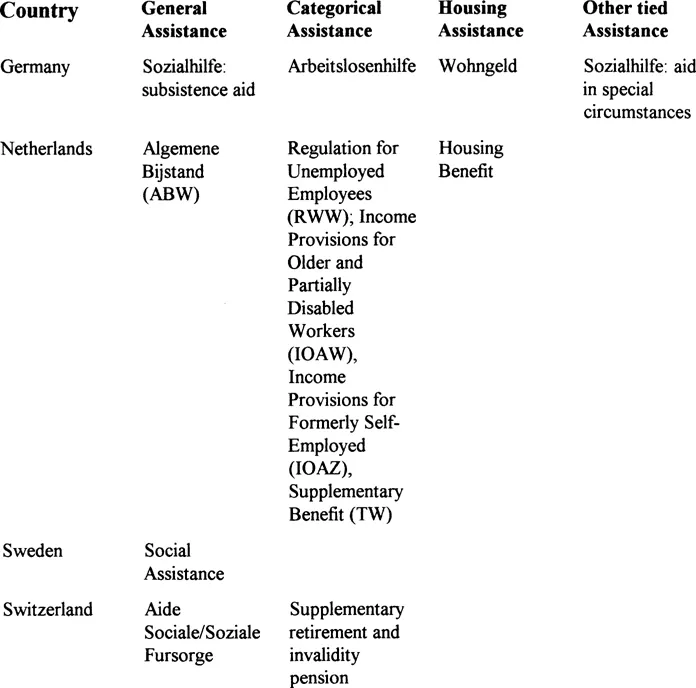
In this chapter, Social Assistance will also be placed within a wider context of the methods by which statutory authorities can allocate resources, either in cash or kind, to individuals or households. Two channels other than Social Assistance are available: first, there are universal or categorical benefits, which are related neither to income nor employment status, but made available to citizens who fall within prescribed social categories, such as being a mother with a dependent child or children. The second category include the full range of social insurance benefits which are related to both employment status and contributions record. Social Assistance benefits, the third channel, are related to neither category nor contributions, but are income or asset tested. However, within this broad definition there are three distinctive types of Social Assistance.(See Table 2.1) First, all countries within the OECD (with the exception of Greece and Portugal) have general assistance schemes which provide cash assistance for all (or virtually all) people falling below a specified minimum income standard. Such schemes include Income Support in the United Kingdom and Minimex in Belgium. Second, there are categorical Social Assistance schemes which provide assistance for specified groups. In the UK such benefits include Family Credit and Disability Working Allowance; in Germany and the Netherlands it includes unemployment assistance. Finally, there is tied assistance which may provide either cash, goods or services to those defined as being in need. Because housing costs can represent such a large proportion of individual or household expenditure, support for housing can be a large component of Social Assistance. Housing benefits therefore make up a dominant part of tied assistance with other benefits taking account of local taxes (Council Tax Benefit in the UK), free school meals or Medicaid (in the USA).
For the four countries included in this study the following taxonomy applies:
Table 2.1 Social Assistance Benefits
In the previous study (Eardley, et al 1996) the Social Assistance systems of the OECD countries were grouped into 7 categories, each of which emphasised characteristics held in common (ibid. pp.244–246). The frameworks were indicative and schematic but were a useful way of aligning common characteristics. However they took account of dominant factors, and in particular the following dimensions:
- extent, cost and coverage of Social Assistance
- extent to which schemes are general or categorical
- relative value of benefits
- extent of local dimension in financing, regulation and administration
- operation of means test
- extent of officials’ discretion
It should be noted that the resulting categories no more imply that countries within a given category are similar in every respect than they imply that countries assigned to different categories have nothing in common. Germany, the Netherlands, Sweden and Switzerland are cases in point. They were assigned to different regimes:
Table 2.2 Four countries as examples
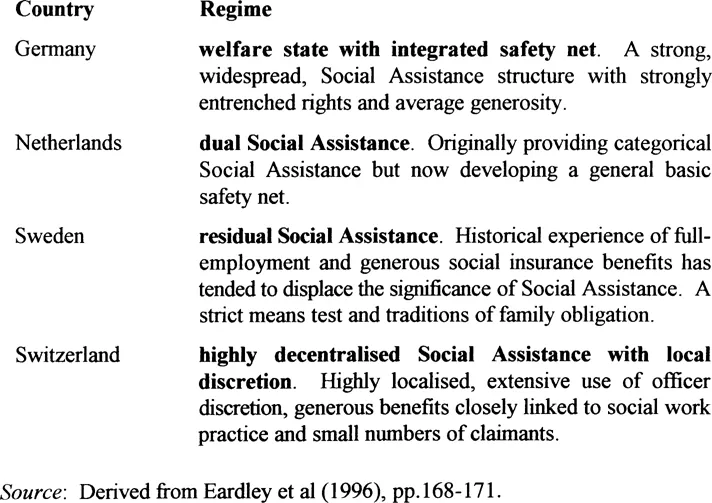
Despite being assigned to different models, as already noted, each of these countries shares a dimension in common: to a greater or lesser extent they operate within a framework which allows for sub-national variation in respect of, policy, financing or the delivery of Social Assistance. Before considering the operation of each scheme separately and in some detail, it is necessary to briefly elaborate some of the key dimensions of centre-local relations within the framework of studies of European governance and public policy. Such a review seeks to distinguish between forms and levels of governance and to explain significant differences between key terms.
Forms of devolution: federalism, deconcentration and decentralisation
Constitutional principles, political structures and the day-to-day dynamics of centre-local relations all impact on the extent to which responsibility for the development of policy, the financing of schemes and the delivery of benefits is devolved to sub-national authorities. Of the four countries in the study, Switzerland is a federal state with a relatively weak centre and Germany is a federal state with a strong centre; the Netherlands is a decentralised unitary state, composed of seven provinces which are declining in political significance; Sweden is a unitary state with a strong tradition of local government.
Federalism is a form of constitutional and political arrangement whereby the governance of a country is divided between a central (federal) authority and smaller, relatively autonomous, political authorities. Each of the smaller authorities is legally independent in respect of a range of policy areas. In Switzerland, a federal state par excellence, the cantons are responsible for policy, finance and delivery of Social Assistance. In this context the relationship between federal (national) authority and individual cantons ...
Table of contents
- Cover
- Half Title
- Title Page
- Copyright Page
- Table of Contents
- Acknowledgements
- Chapter 1 Introduction
- Chapter 2 Social Assistance and centre-local relations
- Chapter 3 Germany
- Chapter 4 The Netherlands
- Chapter 5 Sweden
- Chapter 6 Switzerland
- Chapter 7 Conclusions
- References
- Appendix
Trusted by 375,005 students
Access to over 1.5 million titles for a fair monthly price.
Study more efficiently using our study tools.
Frequently asked questions
Yes, you can cancel anytime from the Subscription tab in your account settings on the Perlego website. Your subscription will stay active until the end of your current billing period. Learn how to cancel your subscription
No, books cannot be downloaded as external files, such as PDFs, for use outside of Perlego. However, you can download books within the Perlego app for offline reading on mobile or tablet. Learn how to download books offline
Perlego offers two plans: Essential and Complete
- Essential is ideal for learners and professionals who enjoy exploring a wide range of subjects. Access the Essential Library with 800,000+ trusted titles and best-sellers across business, personal growth, and the humanities. Includes unlimited reading time and Standard Read Aloud voice.
- Complete: Perfect for advanced learners and researchers needing full, unrestricted access. Unlock 1.5M+ books across hundreds of subjects, including academic and specialized titles. The Complete Plan also includes advanced features like Premium Read Aloud and Research Assistant.
We are an online textbook subscription service, where you can get access to an entire online library for less than the price of a single book per month. With over 1.5 million books across 990+ topics, we’ve got you covered! Learn about our mission
Look out for the read-aloud symbol on your next book to see if you can listen to it. The read-aloud tool reads text aloud for you, highlighting the text as it is being read. You can pause it, speed it up and slow it down. Learn more about Read Aloud
Yes! You can use the Perlego app on both iOS and Android devices to read anytime, anywhere — even offline. Perfect for commutes or when you’re on the go.
Please note we cannot support devices running on iOS 13 and Android 7 or earlier. Learn more about using the app
Please note we cannot support devices running on iOS 13 and Android 7 or earlier. Learn more about using the app
Yes, you can access Comparative Social Assistance by John Ditch,Jonathan Bradshaw,Jochen Clasen,Meg Huby,Margaret Moodie in PDF and/or ePUB format, as well as other popular books in Politics & International Relations & Social Policy. We have over 1.5 million books available in our catalogue for you to explore.