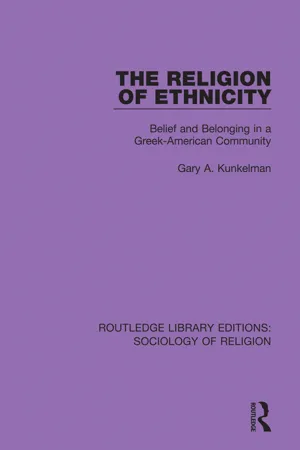
The integrative role of religion has been a recurrent theme of sociological and anthropological theory. This role is apparent in the Greek-American community; religion functions as a cement of the social fabric. Indeed, it would be hard to overestimate the role of Greek Orthodoxy in joining people of Greek ancestry into a community and reinforcing their sense of ethnic identity. The nature of ethnic identity and the church's role in fostering and sustaining it are subjects of this study, first published in 1990. In ultimately focusing on the interplay between church, community and individual, the book suggests that understanding the relation of these people to their church is to understand them as a people.
eBook - ePub
The Religion of Ethnicity
Belief and Belonging in a Greek-American Community
- 208 pages
- English
- ePUB (mobile friendly)
- Available on iOS & Android
eBook - ePub
About this book
Trusted by 375,005 students
Access to over 1.5 million titles for a fair monthly price.
Study more efficiently using our study tools.
Information
Chapter One
BACKGROUND CONSIDERATIONS: PRIOR RESEARCH, ASSUMPTIONS AND APPROACH
Review of Literature
While much research on Greeks in America is a product of the renewed ethnic consciousness that began in the late 1960’s, the original era of Greek immigration in the early twentieth century also produced a significant body of literature.
In the pre-World War II popular press the Greeks had a strong anecdotal appeal. “Quaintness” and “strangeness” were frequent characterizations in writings that portrayed Greeks in the stereotyped role of the peasant immigrant; typical were such titles as “Life of a Pushcart Peddler” or “Greek Bootblack.” Although patronizing, the popular press was generally favorable in its treatment. The willingness to work hard and to sacrifice for success were recurrent themes, and articles frequently alluded to the immigrants’ classical heritage and democratic traditions- implicit endorsements of suitability for membership in the American community.
The body of literature representing serious investigation of the lives of the immigrants dates to a 1909 article by Grace Abbott on Chicago’s Greeks. Abbott was an associate of Jane Addams, whose Hull House was adjacent to Chicago’s Greektown; her article was only the first of many to reflect the influence of the emerging field of social welfare and of various Christian charity and church unity groups. Also in 1909, anthropologist Henry Pratt Fairchild published an analysis of causes of Greek emigration; like most subsequent researchers, he found its basis in economic motives. Two years later, Fairchild’s Greek Immigration to the United States— the first book on the Greeks in America- was published. Opinionated and uniformly critical, it depicted these newcomers as clannish, untrustworthy and generally undesirable as stock for Fairchild’s vision of the American melting pot.
More evenhanded was Thomas Burgess’ 1913 Greeks in America. An Episcopal prelate, the author was a member of the Anglican and Greek Orthodox Churches Union, which sought to strengthen ties between the two religions. Burgess drew heavily on information from the immigrants themselves for source material. Similarly sympathetic was J.P. Xenides’ The Greeks in America (1922). Xenides, also a Protestant clergyman, was secretary of the Greek Relief Committee; his book was produced under auspices of the Inter-Church World Movement and reflects that organization’s emphasis on Christian charity and global unity.
Xenides’ was the last major published work on Hellenic immigration for more than 40 years. Several theses, dissertations and monographs- largely community studies— were produced in the ensuing decades. Representative subjects included welfare work among Los Angeles Greeks (Antoniou, 1939); assimilation of first generation Greeks in Cincinnati (Weinberger, 1942); Greek settlement in a New England mill town (Stycos, 1948); social adjustment of immigrants in a South Carolina city (Boyd, 1949); formal agencies and value transmission in Boston (Treudley, 1949); immigrant associations and marriage patterns in Chicago (Yecaris, 1950; Mistraras, 1950); settlement in the San Francisco Bay area (Georgas, 1951); and the Greek colony in Tarpon Springs (Lovejoy, 1938; Hailey, 1953). Helen Hailey’s Tarpon Springs study, like Mary Treudley’s work on Boston Greeks, placed particular emphasis on the Orthodox Church. While Treudley saw a democratization of the Greek Church in America, Hailey argued such change had not occurred; instead, she points to cultural overlappings with patterns similarly found among American Protestant groups. The period also saw one of the earlier studies across three generations (Lauquier, 1961). Comprehensiveness argues for mention of the celebrated “Yankee City” study (Warner and Srole, 1945), which examined Greek and other ethnic groups in exploring social change in a New England industrial community; it adds little, however, to an understanding of the Greeks.
Since the 1960’s there has been a steady steam of material on the Greek-American experience. Of seminal importance was Theodore Saloutos’ The Greeks in the United States (1964), which has been hailed as a model for historical researchers of ethnic groups. This work is particularly strong in examining early immigration and its European background. A valuable social history is Greek Americans: Struggle and Success, by Charles C. Moskos (1980). His is the first effort to integrate the historical narrative with the broad body of social research. Of particular value to those concerned with change is The Greek American Community in Transition (Psomiades and Scourby,1982), based on papers presented at a conference of the Center for Byzantine and Modern Greek Studies at Queens College. The role of the church is among the topics considered.
The same period has also seen numerous dissertations and other studies of Greek-Americans. Like predecessor studies, they tend to focus on a single community. But also like more recent ethnic studies in general, they emphasize integration of anthropological or sociological (or less commonly, psychological) constructs; given such theoretical grounding, this body of work goes far toward establishing a meaningful context for analyzing and understanding experience. Topics have included demographics, and particularly marriage patterns (Kourvetaris, 1971, 1976, 1977); Tavuchis, 1972; Monos, 1976; Reimer, 1977; Schultz, 1977); language and education (Seaman, 1972; Kopan, 1974; Bardis, 1976; Lagios, 1977; Flouris, 1978); social and political attitudes and involvement (Petropoulos, 1973; Humphrey and Louis, 1973; Stephanides, 1975; Hicks, 1979); folklore (Georges, 1964; Gizelis, 1974); personality and behavior (Seder, 1966; Dunkas and Nikelly, 1972, 1975; Papajohn and Spiegel, 1975); and of particular interest to the present work, ethnic and religious identification, often in the context of acculturation or assimilation (Buxbaum, 1964, 1967; Kiriazis, 1967; Vlachos, 1968; Stellos, 1968; Chock, 1969; Theodoratus, 1971; Costantakos, 1971; Kourvetaris, 1971; Collins, 1976; Simon, 1977; Scourby, 1980).
Certain of these works traversed territory also traveled in this effort. Scourby’s 1967 study of third generation religious attitudes looks at the interrelationship between ethnic identity and Greek Orthodox affiliation, and points to the central role of church in ethnic identification. She found the two so inextricably intertwined that either of two scenarios was supportable: a religious revival or an upsurge in ethnic identification with religion providing the context for both self-identification and social location. A work containing parallels to the present study is Judith Simon’s “The Sacred Sect and the Secular Church: Symbols of Ethnicity in Astoria’s Greek Community.” Indeed, the priestly styles and social make-up at the two churches she describes are remarkably parallel to those at Bellevue’s two churches. Like those in Bellevue, Astoria’s churches reflect distinctive social boundaries and definitions of ethnicity. And each, she suggests, expresses the needs of its respective constituency; particularly at the “upscale” church, institutional transformation is ongoing. In his 1971 study of Chicago Greeks, Kourvetaris stressed the central role of Orthodoxy in ethnic identification; he posited a shift from language to Orthodoxy as the focus of ethnic attachment. Conceptually, the current study draws on several leads suggested by Donna Collins (1976). This study of Houston’s Greeks stresses the importance of self-identification as Greek and of attachment to the Greek community as fundamental to ethnic identification. Collins also applied Barth’s idea of ethnic boundaries to Greek ethnicity.
While there is a growing body of work by Orthodox theologians, the broader literature of Greek Orthodoxy in the United States remains quite slim; most works are long on advocacy and short on criticism or serious discussion. A succinct history of the American church, in the context of an autobiography of Athenagoras I, former patriarch of North and South America, is From Mars Hill to Manhattan (1976). A thin and highly selective work is The Evolution of the Greek Orthodox Church in America and its Present Problems (1959); despite its title, this pamphlet devotes little consideration to the problems confronting the church.
Valuable to gaining an understanding of Orthodox theology is Frank Gavin’s Some Aspects of Contemporary Greek Orthodox Thought (1972), first published in 1923. Two more general works on Orthodoxy are The Orthodox Way (Ware, 1979), and Understanding The Greek Orthodox Church (Constantelos, 1982). Father Constantelos also provides a collection of primary works reflecting the church’s changing concerns in Encyclicals and Documents of the Greek Orthodox Church of North and South America (1976). Writings on Orthodoxy in America can also occasionally be found in the Greek Orthodox Theological Review and the theological journals Logos and Diakonia, as well as in The Orthodox Observer, a newspaper published by the Greek Orthodox Archdiocese of North and South America.
Religion and Society: Some Recent Models
Researchers have taken varied approaches and posited numerous models in analyzing the cultural or social role of religion. This section examines several to define a theoretical basis for studying the Bellevue community. It looks briefly at the secularization, Protestant ethic, and social class models; at the Parsonian or personal meaning conceptualization; and at two variations of Parsons’ approach, drawing on theories of Clifford Geertz and Thomas Luckmann. Lastly it moves to religion as “a belonging-providing ethnic group.” It is facets of Luckmann’s model and Andrew Greeley’s ethnic characterization of religion that provide a conceptual basis for this study.
Into the mid-1970’s the secularization approach was frequently reflected in studies of religion in western industrial society. The decline of religion (and/or the corresponding increase in secular influences) was often the implicit emphasis; methodologically, the survey was a favored tool, and studies tended to be transgenerational or otherwise offered comparisons with earlier periods. The invariable conclusion was that secular influences (education was often cited) were beating out religion in the competition for men’s minds and souls. Representative is the work of Charles Y. Glock. Subsequent trends such as the upsurge in fundamentalism and growth of the more traditional denominations have not encouraged vigorous application of this model in recent years. It also has been criticized for a tendency to equate religiousness with such narrowly-based indicators as church attendance or membership, and for suggesting increasing secularization (and decreasing religiosity) over time when comparative data for previous periods was lacking.
The Protestant ethic model grows, of course, from Max Weber’s classic work. In the Weberian tradition, researchers have attempted to relate Protestant church affiliation (as an indicator or the Calvinistic tenets of industry, thrift and piety) to economic achievement. Applying this approach to contemporary American culture has proven less compelling as the economic achievements of American Protestants nave been equalled or surpassed by Japanese, Jews, Irish-Catholics, Greeks and assorted other non-Protestants. Whether or not economic achievement of these groups reflects their “Protestantization” in American society, as some would argue, this approach does emphasize religion’s role as a conveyor of cultural norms. As McCready and Greeley (1976) suggest, high achievement may well be but one of these norms, and is probably more strongly linked with certain other traditions- including the Greek Orthodox— than with British Protestantism.
The class model, which draws heavily from Marx and Weber, focuses on correlating religious behavior with social class. Religious behavior frequently is defined as church affiliation. A common conclusion- or, at times, preconception- is that church affiliation and attendance represent middle class cultural or social roles. The growth of fundamentalist groups, the charismatic movement and the broadcast evangelist phenomenon in the late 1970’s and 1980’s shifted some attention to the lower and lower middle classes, and on religion as a “need deprivation” response. A variant of the class conception, and frequently an outgrowth of it, is the church-sect model. The formal churches with their ecclesiastical bureaucracies and liturgical services are seen as reflecting their constituents’ demands for limited commitment and easy fulfillment of the mandated social role; conversely, the charismatic churches, sects and evangelists stress active participation and personal involvement, positioning themselves as objects of total commitment.
In contrast to these constructs, Parsons’ approach emphasizes the “meaning” rather than “belonging” function of religion. Parsons sees religion as a meaning-providing system that has its greatest relevance at “points of maximum strain and tension” in life; it is a mechanism for endowing meaning to such cataclysmic events as death or natural disaster. Parsons’ affirmation of religion as a system of ideas for human action and as one that provides meaning for the inexplicable events of life is reflected in the work of several subsequent theorists.
The “ultimate values” or “ultimate questions” approach applies Cliffod Geertz’s semiotic concept of culture to the study of religion. Geertz believes man needs a system of meaning to serve as a sort of road map through life. Meaning becomes particularly vital at critical moments of pain, suffering and moral bafflement. Growing from this is the view of religion as both model of and model for reality- as a way of dealing with and interpreting ultimate questions of pain, suffering and injustice (obviously reflecting Geertz’s characterization of religion as the modest assurance that God isn’t mad). This functional approach attempts to overcome the limitations inherent in equating religiousness with church membership or doctrinal conformity; rather, it focuses on religion as an organized system of cultural convictions about transcendent reality. Yet there is compelling argument that this approach may have overcompensated in its drawing attention to previous models’ neglect of religion’s meaning-giving role. As Greeley stresses, religion provides not merely meaning in the lives of its adherents, but also- and critically important- a sense of belonging.
Thomas Luckmann places somewhat more emphasis on the belonging function. Nonetheless, his approach is Parsonian in several fundamental respects. Luckmann believes a person becomes conscious of himself as an individual through interaction with others. The sense of one’s individuality vis-a-vis others forces the individual to build interpretive schemes. The ultimate interpretive scheme is religion. This conception, then, moves from confrontation with others to self-awareness, which in turn generates a need for explanation and development of an interpretive scheme; this leads to a differentiated interpretive scheme with religion- “the sacred cosmos”- at its apex. But in modern society there are numerous institutions- economic, political, social-- that provide their own meaning systems and do not require religious interpretation. As a result, modern religion largely has become delimited to the private sphere— the sphere of family or the interstices of society. Essentially, the private sphere is that which remains outside the meaning system of the extra-religious institutions. This, in Luckmann’s view, is in contrast to historically earlier organizational forms in which the sacred cosmos was diffused through much of the institutional structure of society.
So while religion provides a model, Luckmann holds that in a contemporary world it isn’t the only model. Other institutions, too, hold powerful sway. The result is an assortment of ultimate meanings. The individual becomes the artificer of his own personal religious structure, drawing from the various interpretive schemes at his disposal. It is, to use Luckmann’s words, a process of “consumer preference.” As he explains (1967:105–106):
In the absence of an “official” model the individual may select from a variety of themes of “ultimate” significance. The selection is based on consumer preference… Given the assortment of religious representations available to potential consumers and…absence of an “official” model it is possible, in principle, that the “autonomous” individual will not only select certain themes but will construct with them a well-articulated private system of “ultimate” significance…. Unless we postulate a high degree of reflection and conscious deliberation, however, it is more likely that individuals will legitimate the situation-bound (primarily emotional and affective) priorities arising in their “private spheres” by deriving, ad hoc, more or less appropriate rhetorical elements from the sacred cosmos. The assumption seems justified, therefore, that the prevalent individual systems of “ultimate” significance will consist of a loose and rather unstable hierarchy of opinions legitimating the affectively determined priorities of private life.
Luckmann also suggests that the “ultimate concerns” or “ultimate questions” need not be transcendental questions of death, ultimate reality or the nature of God (1967:114ff). In fact, he finds that death “does not even appear as a subordinate topic in the sacred cosmos of modern industrial society.” Rather, the interpretive schemes in contemporary society focus on the major themes of individual autonomy, self-expression, self-realization, the mobility ethos, sexuality and familism. Luckmann maintains that, ultimately, what has resulted is a “new social form of religion” that “legitimates the retreat of the individual into the ‘private sphere’ and sanctifies his subjective ‘autonomy.’ Thus it inevitably reinforces the autonomous functioning of the autonomous institutions.”
As a conside...
Table of contents
- Cover
- Half Title
- Title Page
- Copyright Page
- Original Title Page
- Original Copyright Page
- Table of Contents
- Dedication
- Acknowledgments
- Foreword
- Introduction
- Chapter One: Background Considerations: Prior Research, Assumptions and Approach
- Chapter Two: The Community’s Early Years
- Chapter Three: Right and Wrong: Pride and Shame
- Chapter Four: Family: Marriage and Kin Relationships
- Chapter Five: Parent-Child Relationships
- Chapter Six: Education, Occupation, and Success
- Chapter Seven: The Ethnic Church
- Chapter Eight: Contrasting Priestly Styles
- Chapter Nine: Orthodoxy: Dogma and Cognitive Forms
- Chapter Ten: The Concept of Ethnicity: Summary and Observations
- Chapter Eleven: The Religion of Ethnicity: Summary and Observations
- Bibliography
Frequently asked questions
Yes, you can cancel anytime from the Subscription tab in your account settings on the Perlego website. Your subscription will stay active until the end of your current billing period. Learn how to cancel your subscription
No, books cannot be downloaded as external files, such as PDFs, for use outside of Perlego. However, you can download books within the Perlego app for offline reading on mobile or tablet. Learn how to download books offline
Perlego offers two plans: Essential and Complete
- Essential is ideal for learners and professionals who enjoy exploring a wide range of subjects. Access the Essential Library with 800,000+ trusted titles and best-sellers across business, personal growth, and the humanities. Includes unlimited reading time and Standard Read Aloud voice.
- Complete: Perfect for advanced learners and researchers needing full, unrestricted access. Unlock 1.5M+ books across hundreds of subjects, including academic and specialized titles. The Complete Plan also includes advanced features like Premium Read Aloud and Research Assistant.
We are an online textbook subscription service, where you can get access to an entire online library for less than the price of a single book per month. With over 1.5 million books across 990+ topics, we’ve got you covered! Learn about our mission
Look out for the read-aloud symbol on your next book to see if you can listen to it. The read-aloud tool reads text aloud for you, highlighting the text as it is being read. You can pause it, speed it up and slow it down. Learn more about Read Aloud
Yes! You can use the Perlego app on both iOS and Android devices to read anytime, anywhere — even offline. Perfect for commutes or when you’re on the go.
Please note we cannot support devices running on iOS 13 and Android 7 or earlier. Learn more about using the app
Please note we cannot support devices running on iOS 13 and Android 7 or earlier. Learn more about using the app
Yes, you can access The Religion of Ethnicity by Gary A. Kunkelman in PDF and/or ePUB format, as well as other popular books in Social Sciences & Sociology. We have over 1.5 million books available in our catalogue for you to explore.