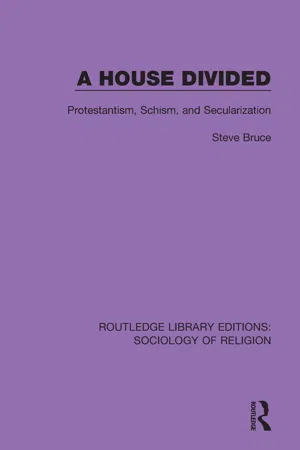
The main concern of this study, first published in 1990, is the part played by Protestantism in the complex of social processes of 'secularization'. The book deals with the way in which Protestant schism and dissent paved the way for the rise of religious pluralism and toleration; and it also looks at the fragility of the two major responses to religious pluralism – the accommodation of liberal Protestantism and the sectarian rejection of the conservative alternative. It examines the part played by social, economic and political changes in undermining the plausibility of religion in western Europe, and puts forward the argument that core Reformation ideas must not be overlooked, particularly the repercussions of different beliefs about authority in competing Christian traditions.
- 264 pages
- English
- ePUB (mobile friendly)
- Available on iOS & Android
eBook - ePub
About this book
Information
Chapter One
Secularization
The Reality of Secularization
This book is concerned with the part played by Protestantism in hastening secularization in most western European countries and with Protestant responses to a discouraging environment. Before embarking on an explanation of secularization, it is worth establishing that something which can sensibly be called by that name has actually occurred.
At first sight there would seem to be no problem in establishing the fact of ‘secularization’, if that term is taken to refer to (a) a decline in the economic, social, and political influence of the Protestant Churches, (b) a decline in the popularity of Christian beliefs, and (c) a decline in the proportion of the population who take any active part in the activities of the Protestant churches. The last three centuries have seen a considerable decline in the power and influence of the latter, which can now be said to have little authority over even their own members, let alone the population at large. The Christian Church in England has gone from being the civil service and judiciary to being a small and easily ignored opposition to the Tory government. Active membership of most Protestant churches has fallen drastically. There is considerable evidence, from sources as varied as diaries, novels, and attitude surveys, that there has been a decline in the plausibility of religious beliefs. One only has to read the literature of the seventeenth century, for example, to be struck by the constant references to the supernatural. As G. N. Clark has demonstrated, this cannot be dismissed ‘merely as common form’:
On the contrary, it is more often necessary to remind ourselves that these words were then seldom used without their accompaniment of meaning, and that their use did generally imply a heightened intensity of feeling. This sense of the closeness of God and the Devil to every act and fact of daily life is an integral part of the century.
(Quoted in Merton 1973: 233)
Even the most optimistic Christian would not assert that the inhabitants of twentieth-century Britain live in a world where God and the Devil are close to every act and fact of life.
However, it would be a mistake to suppose that changes in the popularity and power of religious organizations and beliefs have been so directly related that they can be treated as immediately linked, or as having one cause. As Peter Berger put it: ‘we would regard it as axiomatic that a historical phenomenon of such scope will not be amenable to any monocausal explanation’ (Berger 1973:116). Only the most mechanical and simplistic secularization account would suppose anything else. Thus we may concede the first point to those who have argued that many secularization theories are naive and ahistorical. There is no single social process which links the three elements which are normally mentioned in discussion of the decline of religion. Although there is some heuristic value in constructing evolutionary models of social change, such models invariably collapse in the face of the historical record.
We may also concede that the early sociological discussions of secularization owed a great deal to a desire to promote a particular philosophical position. Many of those who argued for the inevitability of secularization were at least partly motivated to do so by a desire to see humanity ‘evolve’ out of its need for superstitions. Secular society would be society ‘come of age\ Comte’s model of social development, with its replacement of religion by the science of positivism, was obviously founded on the author’s desire to see the world move in that direction (Fletcher 1971: 165–96). However, that early models of secularization were prompted by a utopianism which we do not share, does not itself seem like sufficient reason for following the ‘young’ David Martin when he argued that ‘secularization should be erased from the sociological dictionary’ (Martin 1969: 22). Despite what the more praxiological Marxists seem to think, why someone believes something is not the only criteria for judging the accuracy of such views. Anyway, a belief that something which can be called secularization has occurred is not confined to those who like the results. Two of the most articulate documentors of secularization clearly regret the process. Both Berger and Wilson, one a Christian, the other not, hold to the Weberian view that the disappearance of a shared religious world-view has a delegitimating and hence destabilizing effect on modern societies. Neither could be described as an enthusiast for secularization and yet neither doubts the reality of the process.1
Importantly for my defence of the value of talking of secularization, Martin failed to follow his own advice and, a decade later, produced one of the most sophisticated and sensitive treatments of the topic (Martin 1978a). The moral of Martin’s own scholarship is that we need better, not fewer, discussions of secularization. If we can abandon simplistic evolutionary perspectives and keep our minds focused on the complexity of the historical record, we need not, as Glasner would have us do, reject secularization as a social myth (Glasner 1977).
The logically initial objection to secularization is that it exaggerates the religiosity of whatever period is chosen for the starting point of the process. This is often a good point. It is tempting to follow Laslett when he says that ‘All our ancestors were literal Christian believers, all of the time’ and not notice the qualification that follows:
Not everyone was equally devout, of course, and it would be simple-minded to suppose that none of these villagers ever had their doubts. Much of their devotion must have been formal, and some of it mere conformity. But their world was a Christian world and their religious activity was spontaneous, not forced on them from above.
(Laslett 1971:74)
It has to be said that there are considerable problems in assessing the religious lives of the common people in such societies as Elizabethan England or Jacobean Scotland. Much of what we know comes from the complaints of the godly about the poor church attendance, ignorance, and indifference of others, and from the records of ecclesiastical courts. We might expect that both sorts of source would give an unflattering picture of religious life. We would be wary of accepting as complete a view of undergraduate student capacity and diligence based on the routine grousing of staff and on the records of student progress committees. But even allowing for that, Thomas presents considerable evidence to support the view that ‘not all Tudor or Stuart Englishmen went to some kind of church, that many of those who did went with considerable reluctance, and that a certain proportion remained throughout their lives utterly ignorant of the elementary tenets of Christian dogma’ (Thomas 1971:189). Not surprisingly, people in those areas, where the provision of religious offices was poor, had little knowledge of, or interest in, Christian doctrine. Even when there was an active ministry, some clerics were hopelessly incompetent and could barely preach at all, while others preached far over the heads of their audience. But if we are to doubt the representativeness of the village of Goodnestone, where almost half the population took communion at Eastertide and most of the others promised to make amends at Whitsun (Laslett 1971: 74), we should be cautious of going to the other extreme. Peter Collinson (1982, 1983) argues that most inhabitants of Elizabethan and Jacobean England were active in support of the Church, even if they were sometimes poorly informed about their faith. It seems beyond doubt that the ‘godly people’, as Collinson calls them, then made up a greater proportion of the British population than they do now, that even among the ungodly a fundamental supernaturalism was considerably more widespread than it is now, and that ‘Christian’ beliefs, if one takes the notion broadly, were widespread then in a way that they are no longer.
The second objection to talk of secularization is located at this end of the process. It can be argued that secularization theorists have underestimated the religiosity of the present as much as they have exaggerated that of the past. Those scholars who are interested in ‘implicit’, ‘common, or ‘popular’ religion would insist that the decline in church membership and attendance should not be taken as evidence of a decline in the popularity of religious beliefs. After all, it might be the case that the collapse of the Christian Church in Britain reflects only a lack of satisfaction with particular organizational expressions of Christianity and not with the belief system itself. Or, if evidence of a lack of faith in Christianity among those people who are not church members and attenders can be produced, their religion can be made even more ‘implicit’. One could argue that interest in horoscopes, ouija boards, spiritualism, astrology, and other varieties of snake oil are evidence for a religiosity which endures despite a decline in interest in the Christianity which has been the dominant religion in the West.
There are two areas of difficulty with the implicit religion counter to the secularization thesis. The first concerns evidence for, and the significance of, implicit religion. One piece of evidence often deployed in these debates is the very small proportion of the population who are willing to describe themselves as atheists (Forster 1972: 153–68). But before we take this as proof of popular religion outside the churches, we should recall the general tendency of people to moderate their response to attitude surveys in order to appear decent or to avoid giving offence. People who do not describe themselves to survey researchers as atheists can no more be taken to be believers in a deity than most soldiers or hospital patients can be taken to be committed members of the denominations they name when asked their religion. We should also note that self-conscious atheism or agnosticism tends to be a particular feature of a religious culture! Only when there is a considerable interest in religion does one have people who feel moved to be irreligious. The highpoint for organized ‘unbelief in Britain coincides with the peak of Victorian evangelicalism (Budd 1967, 1977). In a secular culture, massive indifference is the dominant posture and committed atheists are as unusual as committed Christians.
What the implicit religion evidence shows is that a lot of people believe odd things and have strange experiences which they attribute to the supernatural. A lot of people suspect that there is ‘something more to life than meets the eye’. One study of implicit religion which took the trouble to follow up those people who claimed some sort of religious experience produced a wide variety of stories, from reports of second sight, to a man who regarded surviving a serious car accident as evidence for the supernatural. By the ‘normal’ laws of mechanics, he should have been crushed. He wasn’t. He concluded that he had had a religious experience (Hay and Morisey 1981).
Such experiences are important for the individuals involved. They are also interesting for social scientists because they show that many ordinary people are unwilling to confine themselves to the rational, law-governed universe of the natural scientist. But to deploy them as evidence against all versions of the secularization account is either careless or fanciful.
Those secularization approaches which suppose that religion declines as men become wiser might be undermined by evidence of implicit religion. The more enthusiastic Comtian and Huxleyite notions of religion as something which people abandon once they come to know better (and the related explanation: that religion is in decline because people are better educated) would be troubled by evidence that the beneficiaries of television, high technology, and eleven years of compulsory schooling could still believe that Granny spoke to them from beyond the grave. However, most reasonable secularization accounts would have no difficulty in accepting the limited evidence of widespread implicit religion and, indeed, would expect it. A decline in the popularity and influence of the dominant religious establishment allows people greater freedom to indulge their private fantasies and petty heresies. Only if one of these heresies became widely shared or if more than a handful of people took them seriously, would there be a challenge to a secularization thesis.
It is this final point which is often forgotten in the discussion of implicit religion. The important questions are not ‘Do people read horoscopes?’ but ‘Do people who read horoscopes significantly alter their actions as a result?’; not ‘How many people read horoscopes?’ but ‘To what extent does horoscope reading produce a shared world-view and common action?’. Does horoscope reading make any difference either to the lives of the readers or to the nature of their society? Let us just remind ourselves of the behaviour of people in religious cultures. In the early years of this century, a resident of the Isle of Lewis walked (because ‘driving work be a form of work’) twenty miles to church in Stornoway and back. On Monday morning he repeated the journey to collect his pension. He could have stayed overnight with friends in Stornoway and saved himself twenty miles. He refused to do so because that would mean that his Sunday walk to church had become an act of commerce and hence a violation of the Lord’s Day.
The religious conversion of whole communities produced dramatic results in the closing of gin palaces and the return of stolen property.2 Explicit religion mattered and it mattered at the level of the social system. It had social consequences. Implicit religion matters far less. Hence explicit and implicit religion are different. Why a culture moves from one to the other thus calls for explanation, and the process might as well be called ‘secularization ‘ as anything else.
Another important refinement of secularization requires that we eschew any notion of a regular and uniform decline in religiosity. When Berger asserts that the irreversibility of secularization is one of the safest sociological predictions, he is not suggesting that an increase in religiosity has been impossible for all individuals, social classes, or societies since the seventeenth century. Religious revivals are a social reality: the first and second great awakenings in America, the Cambuslang revival in lowland Scotland in the late eighteenth century, the revival in the Scottish highlands in the early nineteenth century; these things happened. My treatment of secularization does not require steady decline. There is no problem in recognizing that the fragmentation of a dominant religious culture may produce an increase in religiosity. Such fracturing may be accompanied by an increase in commitment as social groups, previously alienated from the dominant culture, produce a religious variant better suited to their interests and concerns. Dissent has ‘supply-side’ consequences. Unable to rely on income from taxation, the founders of dissenting movements have to evangelize and convert in order not only to justify their schism but also to eat. The model supposed by this book, which will be presented in more detail in the closing chapter, is one of cycles of increasing and decreasing religiosity. The reason for describing this process as one of secularization is that each wave of revival has been smaller than the one which preceded it. The process is not circular; it is a decreasing spiral. The tide comes in and the tide goes out but our low tide-mark is further down the shore than that of pre-industrial society.
The functionalist alternative
Although they need not be, implicit religionists are sometimes also functionalists. If we suppose that religious belief-systems perform some vital social function, then secularization is impossible, unless it is accompanied by the collapse of the society which experiences it. The weaknesses of functionalist explanations generally, and functionalist views of religion in particular, have been well explored elsewhere (Cohen 1972) and need only brief revision here.
A lot of the strength of functional explanations of religion is derived from the starting assumption that religious beliefs are false. If dancing round in a circle actually caused the gods to make it rain, then the desire for rain would have been a sufficient explanation for the rain dance and anthropologists need not have troubled themselves further. If one supposes that rain dances do not work, then one has to find an alternative explanation for the persistence of them and similar religious ceremonies. If such ceremonies produce a sense of communal well-being and social solidarity, and especially if they are accompanied by rules such as ‘You cannot take part in the rain dance until you have settled all your disputes’, then one may suppose that it is the desire for these consequences (rather than a desire for rain) which led to the creation of the ceremony and which explains continued commitment to the religious belief-system which makes the dance a source of rain.
The problem with this approach, of course, is that there is very little evidence that ‘social cohesion’ was an intended consequence of the rain dance, and good reason to suppose the opposite: that the rain dance produces social cohesion precisely because it is not designed to do so. That is, activities generally only have ‘latent’ functions so long as they remain latent. Once they become ‘manifest’ one has a very different kind of activity. The rain dance is replaced by a ‘secular’ party. And if the latent function is not consciously intended, then how can the desire for it be a cause of the action or the belief? To put it simply, the functionalist account of the rain dance may explain social cohesion but it does not explain why the rain dance takes place.
Functionalists generally deal with the evidential problem by paying scant attention to the accounts which actors give for their own actions. The question of how ‘system needs’ might have been translated into individual motivations is rarely addressed.
Stark and Bainbridge (1985) have recently elaborated an interesting theory of religion which might be regarded as a ‘functional for the individual’ approach. In their view, religious belief systems perform the essential functions of explaining to people why they have problems and why they are not getting what they expect out of life. People who fail to secure ‘rewards’ will be in the market for ‘compensators’. It is, after all, a great comfort to the meek to know that they shall inherit the earth. Mundane and this-worldly compensators are available but it is only by invoking the supernatural – rewards in the next life, for example – that one is able to offer compensators big enough to bridge the gap between many people’s desires and actual circumstances. Thus religion is essential for personal well-being. And, if we suppose that the presence of lots of unfulfilled, frustrated, and deprived people whose pain has not been eased by satisfactory ‘compensators’ will disrupt a whole society, then religion is essential for the health of a culture.
Both the traditional social functionalism and the more modern Stark and Bainbridge version lead one to suppose that secularization is not possible without the end of civilization as we know it. Durkheim himself explained the Dreyfus affa...
Table of contents
- Cover
- Half Title
- Title Page
- Copyright Page
- Original Title Page
- Original Copyright Page
- Table of Contents
- Acknowledgments
- Introduction
- 1 Secularization
- 2 The Fragmentation of Protestantism
- 3 Dissent and Toleration
- 4 Establishments and Toleration
- 5 The Rise of Liberal Protestantism
- 6 The Decline of Liberal Protestantism
- 7 The Conservative Response to Pluralism
- 8 American Protestantism
- 9 The Spiral of Decline
- Conclusion
- Note
- Bibliography
- Index
Trusted by 375,005 students
Access to over 1.5 million titles for a fair monthly price.
Study more efficiently using our study tools.
Frequently asked questions
Yes, you can cancel anytime from the Subscription tab in your account settings on the Perlego website. Your subscription will stay active until the end of your current billing period. Learn how to cancel your subscription
No, books cannot be downloaded as external files, such as PDFs, for use outside of Perlego. However, you can download books within the Perlego app for offline reading on mobile or tablet. Learn how to download books offline
Perlego offers two plans: Essential and Complete
- Essential is ideal for learners and professionals who enjoy exploring a wide range of subjects. Access the Essential Library with 800,000+ trusted titles and best-sellers across business, personal growth, and the humanities. Includes unlimited reading time and Standard Read Aloud voice.
- Complete: Perfect for advanced learners and researchers needing full, unrestricted access. Unlock 1.5M+ books across hundreds of subjects, including academic and specialized titles. The Complete Plan also includes advanced features like Premium Read Aloud and Research Assistant.
We are an online textbook subscription service, where you can get access to an entire online library for less than the price of a single book per month. With over 1.5 million books across 990+ topics, we’ve got you covered! Learn about our mission
Look out for the read-aloud symbol on your next book to see if you can listen to it. The read-aloud tool reads text aloud for you, highlighting the text as it is being read. You can pause it, speed it up and slow it down. Learn more about Read Aloud
Yes! You can use the Perlego app on both iOS and Android devices to read anytime, anywhere — even offline. Perfect for commutes or when you’re on the go.
Please note we cannot support devices running on iOS 13 and Android 7 or earlier. Learn more about using the app
Please note we cannot support devices running on iOS 13 and Android 7 or earlier. Learn more about using the app
Yes, you can access A House Divided by Steve Bruce in PDF and/or ePUB format, as well as other popular books in Social Sciences & Sociology. We have over 1.5 million books available in our catalogue for you to explore.