This new book deals with recent advanced research on natural products and health-promoting foods that work to reduce the risk of diseases while enhancing overall well-being. Plant-based functional foods are known to contain compounds (also referred to as phytochemicals) in the leaves, stems, flowers, and fruits of certain plants. These plant products are drawing the attention of researchers because of their demonstrated beneficial effects against disease, particularly diabetes, hypertension, cancer, neurodegenerative diseases, among others. The medicinal and nutritional use of plant secondary metabolites is a hot topic and has been receiving extensive attention from both health professionals and the public. This book presents new information on the extraction of bioactive compounds from plants, plant-based drugs, and the innovative use of plant-based drugs for human health.
eBook - ePub
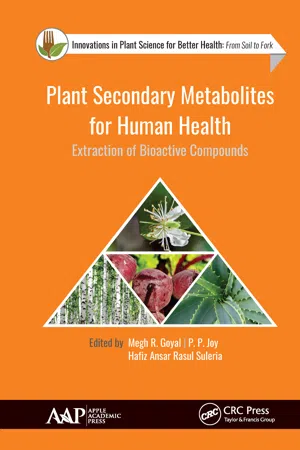
Plant Secondary Metabolites for Human Health
Extraction of Bioactive Compounds
- 308 pages
- English
- ePUB (mobile friendly)
- Available on iOS & Android
eBook - ePub
Plant Secondary Metabolites for Human Health
Extraction of Bioactive Compounds
About this book
Information
Topic
MedicinePreface 1
25 grams of soy protein a day, as part of a diet low in saturated fat and cholesterol, may reduce the risk of heart disease, [USFDA 21CFR101.82].
—Ramabhau Patil, PhD
To be healthy, it is our moral responsibility, towards Almighty God, ourselves, and our family; Eating fruits and vegetables makes us healthy, Believe and have faith; Reduction of food waste can reduce world hunger, and can make our planet eco-friendly.
—Megh R. Goyal, PhD
We introduce this book volume under book series Innovations in Plant Science for Better Health: From Soil to Fork. This book mainly covers the current scenario of the research and case studies, and covers the importance of phytochemicals from plant-based sources in therapeutics, under three parts: Part I–Extraction of Bioactive Compounds from Plants; Part II–Plant Based Drugs; and Part III–Innovative Use of Plant-Based Drugs for Human Health.
This book volume sheds light on the potential of plants for human health from different technological aspects, and it contributes to the ocean of knowledge on food science and technology. We hope that this compendium will be useful for students and researchers of academia as well as for those working with the food, nutraceuticals, and herbal industries.
The contributions by the contributing authors to this book volume have been most valuable in the compilation. Their names are mentioned in each chapter and in the list of contributors. We appreciate you all for having patience with our editorial skills. This book would not have been written without the valuable cooperation of these investigators, many of whom are renowned scientists who have worked in the field of plant science and food science throughout their professional careers.
I am glad to introduce my new editors, Dr. P. P. Joy and Dr. Hafiz Ansar Rasul Suleria, who bring their expertise and innovative ideas on pharmaceutical sciences in this book.
The goal of this book volume is to guide the world science community on how plant-based secondary metabolites can alleviate us from various conditions and diseases.
We request that readers offer their constructive suggestions that may help to improve the next edition.
We express our admiration to our families and colleagues for understanding and collaboration during the preparation of this book volume.
As an educator, there is a piece of advice to one and all in the world: “Permit that our almighty God, our Creator, provider of all and an excellent Teacher, feed our life with Healthy Food Products and His Grace; and Get married to your profession.”
—Megh R. Goyal, PhD, PE,
Senior Editor-in-Chief
Preface 2
If wealth is lost, nothing is lost, If health is lost, something is lost, and If character is lost, everything is lost.
—P. P. Joy, PhD https://www.researchgate.net/profile/Pp_Joy
The tenet “Let food be thy medicine and medicine be thy food,” espoused by Hippocrates nearly 2500 years ago, is receiving renewed interest in terms of functional foods, which are processed foods containing ingredients that aid specific bodily functions in addition to being nutritious. Functional food is a food containing health-giving additives. Functional foods can be considered to be those whole, fortified, enriched or enhanced foods that provide health benefits beyond the provision of essential nutrients (e.g., vitamins and minerals) when they are consumed at efficacious levels as part of a varied diet on a regular basis. Use of dietary supplements, functional foods, and nutraceuticals is increasing as the industry is responding to consumers’ demands.
This book volume, Plant Secondary Metabolites for Human Health: Extraction of Bioactive Compounds, deals with recently advanced research in medical and nutrition sciences, natural products, and health-promoting foods that could possibly reduce the risk of diseases while enhancing overall well-being. Nowadays, this topic has been receiving extensive attention from both health professionals and the public.
Part I: Extraction of Bioactive Compounds from Plants describes the advances in the extraction of bioactive-compounds from plants. Advanced extraction techniques such as enzyme assisted, microwave-assisted, ultrasound-assisted, pressurized liquid extraction, and supercritical extraction techniques were used for the purpose that is described in detail. These compounds have been utilized for the production of pharmaceutical supplements and, more recently, as food additives to increase the functionality of foods. This section describes the therapeutic activities of natural resources. It discusses functional foods and plant extracts in human health, the vitality of phytochemicals in cell signaling and biological assays. Plants are inevitably the largest suppliers of drugs or compounds that can serve as lead compounds for the manufacture of drugs.
Part II: Plant-Based Drugs covers plant products, their health-promoting potential, and natural remedies for lifestyle diseases. These natural products and secondary metabolites are increasingly becoming significant in preventive and therapeutic medication. The incorporation of any functional plant food in the daily diet is a better endeavor to prevent the progression of chronic disorders. It also provides Eugenia uniflora’s botany, physical characteristics, uniqueness, uses, distribution, importance, phytochemistry, traditional importance, nutritional importance, bioactivities, and future trends. It also discusses plant biotechnological interventions for bioactive secondary metabolites, epigenetics, and functional foods. Epigenetics involves the heritable changes in gene expression without any change in the underlying DNA sequence. Functional foods, beyond providing basic nutrition, may offer a potentially positive effect on health by acting as epigenetic modulators that cure various disease conditions, such as metabolic disorders, cancer, and chronic inflammatory reactions.
Part III: Innovative Use of Plant-Based Drugs for Human Health is about therapeutic activities of natural resources as xylitol and aldose reductase inhibitors. The potential of xylitol as an immunomodulator is discussed. Xylitol is found to be beneficial in the treatment of diabetes, pulmonary infection, otitis media, and osteoporosis. The role of aldose reductase inhibitors in combating hyperglycemia and glycation, oxidative stress and immune functions, ROS production, extracellular trap formation, etc. are discussed with reference to outcomes from different experimental studies.
This book volume is a treasure house of information and an excellent reference for researchers, scientists, students, growers, traders, processors, industries, dieticians, medical practitioners, and others.
—P. P. Joy, PhD
Editor
Preface 3
In the recent era, along with technological advancement and food-based strategies, changes in dietary patterns and nutritional awareness are becoming a foremost topic of concern. Globally, the consumption of therapeutic foods, including functional foods, is rising, as they are a vital component of dietary interventions for health promotion and disease management. Presently, due to the increased burden of diseases, people are more inclined towards the consumption of foods that provide additional health benefits along with fulfillment of nutritional requirements. Functional foods encompass physiologically active components, which may or may not have been modified to enhance their bioactivity and provide health benefits, in addition to basic nutrition. These foods may help to decrease the risk of diseases, prevent disease development, and enhance an individual’s health. Owing to increased demand, the functional food market is growing and expanding at a strange level.
Plant-based functional foods are known to contain compounds (also referred to as phytochemicals) in the leaves, stems, flowers, and fruits that can help to promote human health. Therefore, plant products are drawing the attention of researchers and policymakers because of their demonstrated beneficial effects against diseases with high global burdens, such as diabetes, hypertension, cancer, and neurodegenerative diseases. The side effects associated with conventional medicine have awakened the interest of researchers to explore these plants as an alternative or complementary medicine. Various plants like onion, garlic, ginger, citrus, flaxseed, broccoli and other cruciferous vegetables, and green and black tea are utilized to develop functional foods that are effectively used to improve human nutrition. These plants were discovered by traditional healers to have activities against certain diseases mostly by chance or by testimonies from other users. Hence, there is a need for substantial scientific evidence in terms of efficacy, dosage, and safety in order for traditional herbs to have a place in modern medicine.
This book presents scientific reports on the therapeutic values of different plants against diseases. It aims to further encourage the need for the development of plant-based drugs through innovative and groundbreaking research studies and, thus, will help to promote the health and economic well-being of people around the world. The understanding of the therapeutic values of these plants will also help to improve their sustainability, as people and governments will be encouraged to preserve and conserve the plants for future generations. The book covers the phytochemistry and health-promoting potentials of plants against different ailments.
I thank our mentor, Dr. Megh R. Goyal, for his leadership qualities for inviting us to join his team; and for motivating us to get in love with our profession.
—Hafiz Ansar Rasul Suleria, PhD
Editor
PART I
Extraction of Bioactive Compounds from Plants
CHAPTER 1
Extraction Methods for Bioactive Compounds from Plants: An overview
A. SANGAMITHRA*, V. CHANDRASEKAR, and SWAMY GABRIELA JOHN
* Corresponding author. E-mail: [email protected]
ABSTRACT
Consumer’s increased awareness on health is fueling the industry to make an alteration on the processing and food products. Bioactive compounds are secondary metabolites that are produced within the plants. These bioactive compounds may produce either toxicological or pharmacological effects in man and animals based on their concentrations and purity. Such compounds have been used as a part of traditional medicines to cure many ailments and diseases. Thus, the efficient production and purification of plant-based extracts is a challenging task to the industry and academia. This chapter discusses conventional and advanced methods to extract bioactive compounds.
1.1Introduction
The consumption of unbalanced food contributes to energy excess, over-weight, obesity, and pave the way to many chronic diseases. However, at the same time, consumer’s pursuit for health-enhancing food products has raised a remarkable progress in the food process industries towards the expansion and production of plant-based functional food products. According to the World Health Organization (WHO), around 80% of the global population depends on traditional medicine systems for their health needs [88]. Numerous epidemiological studies have shown a reduced risk of cancer in people consuming fruits and ...
Table of contents
- Cover
- Half Title
- Title Page
- Copyright Page
- Innovations in Plant Science for Better Health: From Soil to Fork Book Series
- About the Senior Editor-in-Chief
- About the Editors
- Table of Contents
- Contributors
- Abbreviations
- Preface 1
- Preface 2
- Preface 3
- Part I: Extraction of Bioactive Compounds from Plants
- Part II: Plant-Based Drugs
- Part III: Innovative Use of Plant-Based Drugs for Human Health
- Index
Trusted by 375,005 students
Access to over 1.5 million titles for a fair monthly price.
Study more efficiently using our study tools.
Frequently asked questions
Yes, you can cancel anytime from the Subscription tab in your account settings on the Perlego website. Your subscription will stay active until the end of your current billing period. Learn how to cancel your subscription
No, books cannot be downloaded as external files, such as PDFs, for use outside of Perlego. However, you can download books within the Perlego app for offline reading on mobile or tablet. Learn how to download books offline
Perlego offers two plans: Essential and Complete
- Essential is ideal for learners and professionals who enjoy exploring a wide range of subjects. Access the Essential Library with 800,000+ trusted titles and best-sellers across business, personal growth, and the humanities. Includes unlimited reading time and Standard Read Aloud voice.
- Complete: Perfect for advanced learners and researchers needing full, unrestricted access. Unlock 1.5M+ books across hundreds of subjects, including academic and specialized titles. The Complete Plan also includes advanced features like Premium Read Aloud and Research Assistant.
We are an online textbook subscription service, where you can get access to an entire online library for less than the price of a single book per month. With over 1.5 million books across 990+ topics, we’ve got you covered! Learn about our mission
Look out for the read-aloud symbol on your next book to see if you can listen to it. The read-aloud tool reads text aloud for you, highlighting the text as it is being read. You can pause it, speed it up and slow it down. Learn more about Read Aloud
Yes! You can use the Perlego app on both iOS and Android devices to read anytime, anywhere — even offline. Perfect for commutes or when you’re on the go.
Please note we cannot support devices running on iOS 13 and Android 7 or earlier. Learn more about using the app
Please note we cannot support devices running on iOS 13 and Android 7 or earlier. Learn more about using the app
Yes, you can access Plant Secondary Metabolites for Human Health by Megh R. Goyal, P. P. Joy, Hafiz Ansar Rasul Suleria, Megh R. Goyal,P. P. Joy,Hafiz Ansar Rasul Suleria in PDF and/or ePUB format, as well as other popular books in Medicine & Alternative & Complementary Medicine. We have over 1.5 million books available in our catalogue for you to explore.