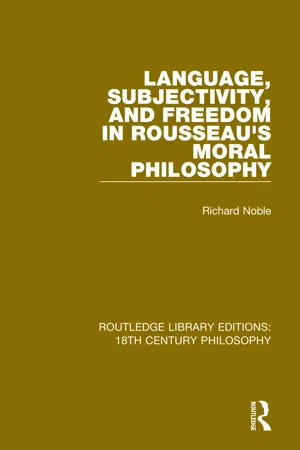
This book, first published in 1991, has two related goals. The first is to explicate Rousseau's conception of subjectivity; the second is to trace the influence of that conception on his theory of freedom. It argues that Rousseau's conception of subjectivity provides us with a basis for understanding both his analysis of the 'social problem' of advanced civil societies, and the solutions he proposes to this problem.
- 248 pages
- English
- ePUB (mobile friendly)
- Available on iOS & Android
eBook - ePub
Language, Subjectivity, and Freedom in Rousseau's Moral Philosophy
About this book
Information
Introduction
This book has two related goals. The first is to explicate Rousseau’s conception of subjectivity; the second is to trace the influence of that conception on his theory of freedom. I want to argue that Rousseau’s conception of subjectivity provides us with a basis for understanding both his analysis of the “social problem” of advanced civil societies, and the solutions he proposes to this problem. The work is therefore largely expository. The first part attempts to recover the often implicit assumptions informing Rousseau’s conception of the subject, from his philosophical anthropology and his philosophy of language. I argue here that Rousseau maintained a consistent theory of the subject that can be understood to provide the groundwork for his moral theory. The second part of the work involves a discussion of Rousseau’s conception of freedom. This follows from my exposition of his theory of the subject, which shows that for Rousseau, human beings were defined in virtue of their capacity for freedom. In Rousseau’s view, our nature as subjects provides us with the potential to be free, but our existence in advanced civil societies has so distorted our nature that freedom seems to have vanished from our moral landscape. His theory of the subject provides us with a way of understanding his view of how the potential inherent in our original nature could be reconstituted in society. For Rousseau, freedom represented the recovery of nature because it consists in the full realization of our potential as human beings. An important part of what I want to claim then, is that Rousseau’s theory of the subject shows us why freedom is the centrepiece of his moral theory. It represents for him the linchpin of any solution to the alienation and oppression endemic to contemporary societies, because it represents the only condition he believed to be consistent with a fully human life.
My interest in Rousseau’s conception of the subject arose from what appeared to me a fundamental contradiction in his philosophical anthropology. This involved the assertion on the one hand that humans are naturally free, and on the other that human nature is formed in and through our experience the natural and social worlds. The view that we are naturally free and defined as human in terms of that freedom, is central to Rousseau’s moral theory. It gives moral significance to his insistence that as social beings we are alienated from our original nature, and that this alienation constitutes the central problem of our social life. If human beings were not free by nature, the claim that we have lost our freedom under the influence of society would be entirely vacuous. It would preclude Rousseau’s use of nature as the standard against which to judge the extent of the corruption and dependence engendered by our social institutions. Yet to claim that we are naturally free is to assert that we have an essential character which exists independent of the press of environmental contingency, and this seems to stand at odds with Rousseau’s attempt to explain human consciousness and motivation in terms of the structure of civil societies.
The first part of what I want to claim about Rousseau’s conception of subjectivity is that it derives from his attempt to overcome this contradiction in his philosophical anthropology. I argue that his theory of the subject attempts to reconcile elements of both Cartesian rationalism and Lockean sensationalism, in order to meet the conflicting requirements set for him by his account of the species’ evolution. His anthropological interests led him to the conviction that as a species, humans had acquired most of the characteristics that define them, such as language, rationality, and social life, over the course of a long evolution. This entailed the assumption that human consciousness was constituted by the subject’s experience of the world, a view that was most adequately explained in terms of empiricist epistemology. Yet at the same time Rousseau also wanted to argue that there was a reason specific to the species itself that had led to its acquisition of a consciousness suited to morality and freedom, (and that this is what we had lost in the course of our evolution). In order to argue this, Rousseau attempted to graft onto the empiricist account of the subject the Cartesian principle of the self as a simple subject of experience, defined by essential characteristics, and unaffected in its essence by its experience of the world. The result, I want to claim, is a theory of subjectivity which is unique in the context of the mid-eighteenth century, and in some respects important for our own understanding of the relation between subjectivity and morality.
My account of the epistemological basis of Rousseau’s moral theory is in the very broadest sense “neo-Kantian”, at least insofar as it attempts to explain Rousseau’s theory of freedom in terms of his conception of the subject. It demonstrates that in some respects Rousseau’s account of the subject rather strikingly anticipates Kant, and therefore strengthens the claim made by Cassirer and others that Rousseau’s conception of moral freedom should be conceived in broadly Kantian terms, as a form of self-legislating autonomy.1
However, my reading of Rousseau also shows that neither his account of the subject nor his theory of freedom can be assimilated to Kant’s philosophy. There are crucial differences, and these account for the enduring importance and influence of Rousseau’s moral theory. More specifically, the “neo-Kantian” reading of Rousseau has overplayed the importance of reason in his conception of freedom. By viewing Rousseau’s theory of the subject as an attempted synthesis of Cartesian rationalism and Lockean sensationalism, we are able to see how Rousseau attempted to integrate reason and the passions into his moral psychology of freedom, and why, beyond this, the possibility of freedom depends for him upon our living a certain kind of communal life. Neither of these positions is consistent with the Kantian conception of autonomy. For Rousseau, the self is not conceived in transcendental terms. If it is ever independent of the contingencies of experience, it is so only as potential. Reason can therefore only ever be exercised under the influence of the passions, and the central problem of his moral theory was to find a way of integrating the two in a conception of freedom.
In arguing that we should read Rousseau conception of the subject as an attempt to reconcile Descartes and Locke, I am also attempting to offer an antidote to a number of interpretations which rest on the view that Rousseau was a radical empiricist, or even a materialist.2 This position is typically argued by political theorists who have been influenced by the writings of Leo Strauss. Regarding Rousseau as a radical empiricist enables them to portray his moral theory as a strategy for managing the passions in order to bring about moral and civic virtue. For the Straussians, it is virtue, rather than freedom, which is the central moral value in Rousseau’s writings. A being whose consciousness is wholly dominated by sensation is one whose actions are determined by emotive or passionate responses to those sensations. Consequently, it becomes possible to regulate human behaviour by means of controlling human passions.3 As a radical empiricist, Rousseau can be accommodated to the Straussian view of politics as an activity directed at imposing order upon the unruly and anti-civil passions of the masses. If my reading of Rousseau is correct, this places too much emphasis to the role of the passions in Rousseau’s moral psychology. In doing so it fails to account for the interdependence of passion and reason in Rousseau’s conception of moral freedom, and because of this leaves us with a false opposition between freedom and virtue in Rousseau’s thought. I want to argue that for Rousseau, freedom and virtue are synonymous: that it is impossible in the context of his moral theory to conceive of one without the other. They represent for him the fullest realization of our natural potential as subjects. As a consequence, his prescriptions for reversing the moral and political decay he saw around him were aimed at creating the social conditions under which human potential could be maximized.
It will be evident then, that I think Rousseau’s conception of the subject has important implications for his moral theory. My discussion of these implications attempts to show why Rousseau conceived the opposition between nature and culture as the fundamental problem of civil society. It then attempts to demonstrate why he conceived moral freedom as the solution to this problem, and finally to discuss what I take to be the problems inherent in the solution he proposes. These problems are by no means negligible. In viewing the subject as something defined by its innate potential for freedom, but which nevertheless acquires the constituent features of its consciousness from its social experience, Rousseau left himself the task of explaining how that innate potential could be realized within a social milieu that was both its condition and what made it impossible. This was certainly no small task. My claim is that his solution to the paradox is a conception of moral freedom conceived as self-legislating autonomy, in which reason, natural passion, and free will are said to be fully integrated into the motivational structure of the subject’s moral psychology. This conception of freedom is not without difficulties, as we shall see, but I want to claim that it sheds important light on the problem of how we should think about the relation between our notions of what it means to be a subject, and the possibility of freedom.
No work of this nature and length could be written without the generous support of both friends and institutions. I owe my greatest debt of thanks to Maurice Cranston, for asking me to submit this work to Garland’s series on political theory and philosophy. I would also like to thank John Charvet for his unfailingly acute criticism and advice, and George Feaver and Bill Buxton for their intelligence and their friendship. I am also grateful to the University of Winnipeg for its support.
Endnotes
1. Ernst Cassirer, The Question of Jean-Jacques Rousseau, Peter Gay trans., (Bloomington: Indiana University Press, 1976).
2. See for example, Joel Schwartz, The Sexual Politics of Jean-Jacques Rousseau, (Chicago: The University of Chicago Press, 1984); Marc Plattner, Rousseau’s State of Nature, (Dekalb: Northern Illinois University Press, 1979); Peter Emberley, “Rousseau and the Management of the Passions” in Interpretation, May 1985, vol. 13, #2.
3. Emberley, “Management”, pp. 159-60.
1
Speaking Apes
1.1 Introduction
In the preface to the Discours sur l’inégalité Rousseau makes a radical assertion: if we want to understand the origins of inequality between human beings, we must first discover their original nature. We must distinguish what was original in our nature from what has been added by our development through time and circumstance, before we can hope to discern the origins of the differences that now distinguish us.1 Rousseau assumes that we were by nature equal, and claims that to find the source of our present inequality we must look to the successive changes in both our environment and our nature over the course of our species’ evolution. This was a radical, if not entirely original proposition in the context of the eighteenth century, because it shifted the inquiry into human nature away from the theological presumption of original sin, towards an entirely secular anthropology of human evolution.2 Rousseau’s inquiry carries with it the implication that humans are not properly understood as beings whose nature is fixed according to immutable and defining characteristics. Rather, we are beings who have evolved in and through our environmental circumstances, and whose present nature is radically removed from our original one.
This methodological proposition posits an opposition between nature and culture which remains a constant and often paradoxical theme throughout Rousseau’s writings. In the context of the Discours sur l’inégalité, nature represents man in his original form: a hypothesized beginning point against which his present condition must be both understood and judged. The claim is that if we can trace man back to his origin, “tel qu’il a du sortir des mains de la nature”, we can then retrace his development from a condition of equality and freedom to his present one of inequality and oppression. The explanation of our present condition lies in this development, and most crucially in the point at which we began to transform ourselves from natural to social beings. But there is a tremendous distance between our existence in nature and our existence in society. What we have become as social beings simply precludes our return to the state of nature, and in this sense nature and culture are opposed to each other. They represent two fundamentally different modes of human experience.
The opposition gives rise to a paradox, because the prescriptive dimension of Rousseau’s thought demands that they be reconciled. Rousseau’s analysis of the social condition depends upon an image of nature as society’s other; a way of life completely opposed to and therefore exclusive of our present condition, which enables us to distinguish between the real and the artificial in our nature. Yet, as we shall see, this analysis yields a moral imperative to recover that lost other. As Rousseau conceived it, the social problem lay in our complete alienation from nature, and while a solution to it could not involve a return to that original condition, it had to entail of recovery of certain aspects of it. But if nature is society’s other, if the two are mutually exclusive, how is this possible? This question remains a constant source of difficulty in Rousseau’s thought which I hope, in the course of this work, to shed some light upon.
In Rousseau’s philosophical anthropology then, the causes of our present condition lie in the course of our species’ evolution from nature to culture. The most obvious starting point for such an anthropology is man as he exists according to nature. But such an account, as Rousseau readily admits, while being necessary can be at best conjectural,3 and this raises another question of importance for the entire enterprise. How can Rousseau hope to make accurate conjectures about man in the state of nature, when there is no reliable way of verifying them? The question is fundamentally important because, as we noted, Rousseau’s account of natural man is to serve as the other against which social man is to understand himself: the standard against which we can distinguish between the natural and the artificial in our present nature, and on this basis attempt to rejuvenate our moral and political life. His account of our original nature is central to both his analysis of our present social condition and the solutions he proposes to it. In what follows I offer an account of the sources of Rousseau’s portrait of natural man, which I want to claim find their basis in his conception of human subjectivity.
Jean Starobinski has suggested that Rousseau’s portrait of natural man is the product of an “anthropologie negative”. This is to say that Rousseau defined natural man as the absence of all those “artificial” (or acquired) characteristics that define civilized man; a being who lacks language, rational...
Table of contents
- Cover
- Half Title
- Title Page
- Copyright Page
- Original Title Page
- Original Copyright Page
- Table of Contents
- 1. Introduction
- 2. Speaking Apes
- 2. The Problem of Language Origin
- 3. Original Nature
- 4. Rousseau’s Arcadian Ideal
- 5. The Metaphysics of Freedom
- 6. An Education According to Nature
- 7. A Moral Education
- 8. Bibiliography
Trusted by 375,005 students
Access to over 1.5 million titles for a fair monthly price.
Study more efficiently using our study tools.
Frequently asked questions
Yes, you can cancel anytime from the Subscription tab in your account settings on the Perlego website. Your subscription will stay active until the end of your current billing period. Learn how to cancel your subscription
No, books cannot be downloaded as external files, such as PDFs, for use outside of Perlego. However, you can download books within the Perlego app for offline reading on mobile or tablet. Learn how to download books offline
Perlego offers two plans: Essential and Complete
- Essential is ideal for learners and professionals who enjoy exploring a wide range of subjects. Access the Essential Library with 800,000+ trusted titles and best-sellers across business, personal growth, and the humanities. Includes unlimited reading time and Standard Read Aloud voice.
- Complete: Perfect for advanced learners and researchers needing full, unrestricted access. Unlock 1.5M+ books across hundreds of subjects, including academic and specialized titles. The Complete Plan also includes advanced features like Premium Read Aloud and Research Assistant.
We are an online textbook subscription service, where you can get access to an entire online library for less than the price of a single book per month. With over 1.5 million books across 990+ topics, we’ve got you covered! Learn about our mission
Look out for the read-aloud symbol on your next book to see if you can listen to it. The read-aloud tool reads text aloud for you, highlighting the text as it is being read. You can pause it, speed it up and slow it down. Learn more about Read Aloud
Yes! You can use the Perlego app on both iOS and Android devices to read anytime, anywhere — even offline. Perfect for commutes or when you’re on the go.
Please note we cannot support devices running on iOS 13 and Android 7 or earlier. Learn more about using the app
Please note we cannot support devices running on iOS 13 and Android 7 or earlier. Learn more about using the app
Yes, you can access Language, Subjectivity, and Freedom in Rousseau's Moral Philosophy by Richard Noble in PDF and/or ePUB format, as well as other popular books in Filosofia & Storia e teoria della filosofia. We have over 1.5 million books available in our catalogue for you to explore.