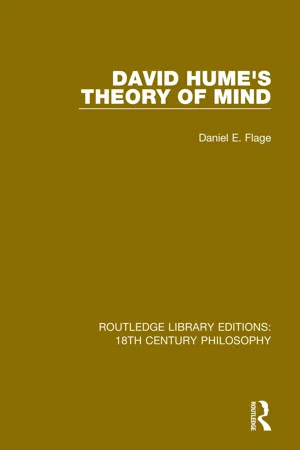
This book, first published in 1990, is a detailed examination of David Hume's Treatise of Human Nature. It shows that the theory of mind developed in the Trestise is a thread which ties together many of the seemingly unrelated philosophical issues discussed in the work. Hume's primary objective was to defend a 'bundle theory' of mind, and, through a close examination of the texts, this book provides a thorough account of how Hume understood this theory and the problems he discovered with it.
- 208 pages
- English
- ePUB (mobile friendly)
- Available on iOS & Android
eBook - ePub
David Hume's Theory of Mind
About this book
Information
1
Hume’s Method
Hume tells us that the Treatise of Human Nature is ‘an Attempt to introduce the experimental Method of Reasoning into Moral Subjects’ (T xi), yet he devoted little space to the meta-theoretical constraints he assumed in constructing a theory. In this chapter I attempt to reconstruct Hume’s account of the adequacy of theories. I begin by examining those passages in which Hume alludes to the meta-theoretical constraints he uses in constructing a theory. Next I examine Hume’s discussion of ‘realities’ and argue that he considered it a normal human activity to construct ‘theories’ in the sense of schemes for interpreting empirical data. Finally, I briefly examine the strategy Hume used in defending his theory of mind. If my argument is sound, it shows that Hume accepted whichever theory in a particular subject area provides the ‘best explanation’ of a certain range of phenomena, and he provides various normative strictures for determining which explanation is ‘best’.1
Meta-Theory
Hume’s meta-theoretical principles are of three kinds: principles governing the acceptability of theoretical terms, a principle of parsimony, and a principle of explanatory completeness. As we shall see, each of these kinds of principle is relevant to considerations of the acceptability and epistemic status of scientific theories.
It is clear that Hume accepted an empiricist theory of meaning, and, therefore, that any theoretical term one employs in a scientific or philosophical theory must have its meaning assigned on the basis of experience (cf. T 17-25 and EHU 21-2).2 This is a minimal condition for the intelligibility of a theory. Although a commitment to an empiricist theory of meaning does not entail that one must be directly acquainted with theoretical objects, it does place several constraints upon the theoretical terms one uses. In his discussion of Spinozism Hume spelled out some of these constraints. In his words:
I say then, that since we may suppose, but never conceive a specific difference betwixt an object and impression; any conclusion we form concerning the connexion and repugnance of impressions, will not be known certainly to be applicable to objects; but that on the other hand, whatever conclusions of this kind we form concerning objects will, most certainly be applicable to impressions. The reason is not difficult. As an object is suppos’d to be different from an impression, we cannot be sure, that the circumstance, upon which we found our reasoning, is common to both, supposing we form the reasoning upon the impression. ’Tis still possible, that the object may differ from it in that particular. But when we first form our reasoning concerning the object, ’tis beyond doubt, that the same reasoning must extend to the impression: And that because the quality of the object, upon which the argument is founded, must at least be conceiv’d by the mind; and cou’d not be conceiv’d, unless it were common to the impression; since we have no idea but what is deriv’d from that origin. Thus we may establish it as a certain maxim, that we can never, by any principle, but by an irregular kind of reasoning from experience, discover a connection or repugnance betwixt objects, which extends not to impressions; tho’ the inverse proposition may not be equally true, that all the discoverable relations of impressions are common to objects. (T 241-2; cf. T 29)
Hume’s empiricist theory of meaning places constraints upon the descriptions one can offer of theoretical objects. Although the objects in one’s theory need not be immediately observable, they cannot be ‘specifically different’ (different in kind) from impressions, that is, the characteristics assignable to theoretical objects must be characteristics of the same species or kind as one assigns to impressions.3 Thus, properties such as motion or spin can be applied to theoretical objects, since such terms obtain their meaning in the domain of impressions. On the other hand, terms allegedly denoting nonempirical properties are unintelligible. But the passage is not concerned solely with the delimitation of the properties of theoretical objects to the empirically observable. It also raises issues regarding the construction and evaluation of a theory.
Hume claimed that, in constructing a theory, one cannot simply draw inferences from the properties of impressions to the properties of objects, since ‘’Tis still possible, that the object may differ from it in that particular.’ On the other hand, ‘when we first form our reasoning concerning the object, ‘tis beyond doubt, that the same reasoning must extend to the impression’ (T 242), that is, if one begins by constructing a theoretical description of objects, one’s reasonings regarding objects must extend to one’s reasonings concerning impressions, since it is on the basis of impressions that one assigns meanings to theoretical terms. Given an empiricist theory of meaning, an intelligible, and therefore minimally plausible, theory must (1) draw all its concepts from experience and (2) reach conclusions that are consistent with those empirical concepts. What I shall call ‘Hume’s principle of theoretical objects’ allows one to examine the consistency of one’s theoretical descriptions: if a claim is absurd with respect to the domain of impressions, the same claim is absurd with respect to the domain of theoretical objects, since the meaning of a theoretical term is derived from the domain of impressions.4
Finally, the passage suggests that Hume, like Locke and Bacon (Locke, Essay 4.12.13; Bacon 1960: 121-272; cf. Urbach 1987), recognized a distinction between three phases of a theoretical investigation. Although one might begin with observation, at a certain point one constructs an explanatory theory (hypothesis), and one then proceeds to examine the evidence in an attempt to confirm or refute that theory.
In addition to his principle of theoretical objects, Hume accepted a version of the principle of parsimony, contending that ‘it is an inviolable maxim in philosophy, that where any particular cause is sufficient for an effect, we ought to rest satisfied with it, and ought not multiply causes without necessity’ (T 578). Thus, in one’s theory, one should attempt to discover the smallest number of different kinds of theoretical entities and natural laws that are sufficient to explain a certain domain of phenomena.
Finally, Hume held that a theory must be explanatorily complete. The search for natural laws occurs at the level of observable phenomena: it follows the inductive principles sketched in the ‘Rules by which to Judge of Causes and Effects’ (T 173-6). But if the theory is complete, it must explain all phenomena of a particular kind, and, as we shall see, particularly the problematic cases. Since Hume took Newtonian mechanics as a paradigm of a theory that is explanatorily complete (EHU 14-15), an adequate theory of mind must provide a similarly complete explanation of mental phenomena.5
Evidence that Hume actually considered these the proper grounds for accepting a theory can be drawn from the Natural History of Religion. Commenting on the origins of polytheism, Hume indicates that primitive peoples posited a multiplicity of gods as the unknown causes of events. Contrasting this with the corpuscular hypothesis, he wrote:
Could men anatomize nature, according to the most probable, at least the most intelligible philosophy, they would find, that these causes are nothing but the particular fabric and structure of the minute parts of their own bodies and of external objects; and that, by a regular and constant machinery, all the events are produced, about which they are so much concerned. But this philosophy exceeds the comprehension of the ignorant multitude, who can only conceive the unknown causes in a general and confused manner; though their imagination, perpetually employed on the same subject, must labour to form some particular and distinct idea of them. The more they consider these causes themselves, and the uncertainty of their operation, the less satisfaction do they meet with in their researches; and, however unwilling, they must at last have abandoned so arduous an attempt, were it not for a propensity in human nature, which leads into a system, and gives them some satisfaction. (NHR 29)
There are four reasons why the corpuscular hypothesis is superior to polytheism. (1) The theoretical entities (corpuscles) are wholly describable on the basis of the properties of impressions. The corpuscular hypothesis is consistent with both an empiricist theory of meaning and Hume’s principle of theoretical objects. (2) The corpuscular hypothesis is simpler than the religious hypothesis, since it allows one to explain physical events solely on the basis of objects that are themselves physical. (3) The movements of the corpuscles can be explained on the basis of a limited number of natural laws, namely, the principles of Newtonian mechanics. (4) Assuming that the thesis of determinism is true (cf. T 406, EHU 92-3, and 108-16), such theoretical explanations would be complete.
One point should be noted regarding the passage from the Natural History of Religion. Although Hume suggested that the corpuscular hypothesis is ‘the most probable, at least the most intelligible philosophy’ (NHR 29), he did not claim that the theory could be known to be true. But, as he indicates in his letter to John Stewart, the absence of intuitive or demonstrative certainty does not detract from either the truth of a belief (theory) or its certainty, although the kind of certainty differs from that of intuition or demonstration (Letters, 1:187). This suggests that the most Hume would claim in favor of a theory is moral certainty,6 that, in accordance with his meta-theoretical strictures, the theory in question provides the best explanation of a certain domain of phenomena and it is, therefore, the most plausible theory.7
While an adequate theory must provide the best explanation of all phenomena within a certain domain, does this imply that all explanations are of equal value in providing evidence for the acceptability of a theory? Hume’s answer seems to be negative, and he seems to be in agreement with some recent proponents of theoretical justification on the basis of the best explanation who suggest that acceptability of a theory rests primarily upon its ability to explain puzzling phenomena or anomalies.8 The Hume of the Enquiries alludes to the ‘experimentum crucis, or that experiment which points out the right way in any doubt or ambiguity’ (EPM 219). But which are these crucial experiments or crucial explanations? As we shall see when we turn to the theory of mind in the Treatise, the anomalous cases seem to be those in which one has a belief that is shown to be unwarranted by various sceptical arguments, and yet the belief remains.9 How can there be such an unwarranted belief? If Hume’s psychological theory can explain how such unwarranted beliefs are generated, and if, consistent with his own meta-theoretical constraints, his theory provides a better explanation than any known alternative theory, he has good grounds for accepting his theory until such a time as some alternative theory provides an even better explanation.
If my suggestion is correct, Hume’s sceptical arguments are presented neither for their own sake nor, as in the case of the classical sceptics, to obtain mental tranquillity (cf. Sextus Empiricus 1985: 41). While convinced that the sceptical arguments are sound, the Hume of the Treatise sets them forth merely as a starting point for an explanatory program. I shall call Hume’s two-stage discussion of beliefs, that is, his sceptical objections to a particular belief followed by an explanation of why one holds the belief in spite of its lack of evidential foundations, ‘doxastic pathology’, and we shall see that doxastic pathology is Hume’s fundamental approach to philosophical problems in the first book of the Treatise. Further, and consistent with this objective, most of Hume’s sceptical arguments are anything but original: many are anticipated in the works of both the classical and the sixteenth- and seventeenth-century sceptics.
If my sketch of Hume’s method is correct, then judgements of theoretical adequacy are based primarily on questions of intelligibility and coherence. In turning to Hume’s discussion of ‘realities’, that is, the informal interpretive schema all persons construct, we shall see that it is questions of evidential coherence that play a primary role in even the lowest forms of theoretical inquiry.
Realities
There can be little question that Hume deemed the coherence and consistency of one’s claims (beliefs) to be of primary importance in both one’s theoretical undertakings and in common life. Hume the sceptic was never willing to assume that one’s impressions of sensation are caused by or resemble external objects (T 84). Hence, the question of the ‘truth’ of one’s impressions, ideas or theoretical claims, that is, their correspondence with external objects (cf. T 448 and 458), was an issue he generally left open as indeterminable (cf. T 272; cf. T 121). Nonetheless, he held that ‘We may draw inferences from the coherence of our perceptions, whether they be true or false; whether they represent nature justly or be mere illusions of the senses’ (T 84).10 As we shall see, Hume’s notion of coherence involves considerations of (1) causal relations, (2) relations of resemblance, (3) relations of contiguity, and (4) logical consistency.11 It is on the basis of coherence that human beings construct ‘realities’.
Hume’s discussion of realities in Treatise I.iii.9 is a res...
Table of contents
- Cover
- Half Title
- Title Page
- Copyright Page
- Original Title Page
- Original Copyright Page
- Dedication
- Table of Contents
- Acknowledgements
- A Note on Abbreviations
- Introduction
- 1. Hume’s Method
- 2. Fundamentals
- 3. Thought
- 4. Substance
- 5. Necessary Connection
- 6. Bodies and Bundles
- 7. Personal Identit
- 8. The Enquiries
- Appendix: Force and Vivacity
- Bibliography
- Index
Trusted by 375,005 students
Access to over 1.5 million titles for a fair monthly price.
Study more efficiently using our study tools.
Frequently asked questions
Yes, you can cancel anytime from the Subscription tab in your account settings on the Perlego website. Your subscription will stay active until the end of your current billing period. Learn how to cancel your subscription
No, books cannot be downloaded as external files, such as PDFs, for use outside of Perlego. However, you can download books within the Perlego app for offline reading on mobile or tablet. Learn how to download books offline
Perlego offers two plans: Essential and Complete
- Essential is ideal for learners and professionals who enjoy exploring a wide range of subjects. Access the Essential Library with 800,000+ trusted titles and best-sellers across business, personal growth, and the humanities. Includes unlimited reading time and Standard Read Aloud voice.
- Complete: Perfect for advanced learners and researchers needing full, unrestricted access. Unlock 1.5M+ books across hundreds of subjects, including academic and specialized titles. The Complete Plan also includes advanced features like Premium Read Aloud and Research Assistant.
We are an online textbook subscription service, where you can get access to an entire online library for less than the price of a single book per month. With over 1.5 million books across 990+ topics, we’ve got you covered! Learn about our mission
Look out for the read-aloud symbol on your next book to see if you can listen to it. The read-aloud tool reads text aloud for you, highlighting the text as it is being read. You can pause it, speed it up and slow it down. Learn more about Read Aloud
Yes! You can use the Perlego app on both iOS and Android devices to read anytime, anywhere — even offline. Perfect for commutes or when you’re on the go.
Please note we cannot support devices running on iOS 13 and Android 7 or earlier. Learn more about using the app
Please note we cannot support devices running on iOS 13 and Android 7 or earlier. Learn more about using the app
Yes, you can access David Hume's Theory of Mind by Daniel E. Flage in PDF and/or ePUB format, as well as other popular books in Philosophy & Philosophy History & Theory. We have over 1.5 million books available in our catalogue for you to explore.