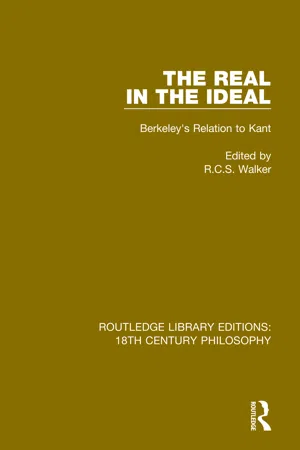
This book, first published in 1989, presents sixteen articles on Kant and Berkeley, examining their attitude to the physical world. They were both idealists, regarding the physical world as being in some way a product of perceptions and thought. At the same time they both held it to be no mere illusion, but real and objective: it was in a sense ideal, but in a different sense also real.
- 352 pages
- English
- ePUB (mobile friendly)
- Available on iOS & Android
eBook - ePub
About this book
Information
III. (Second Part) B 70.—Kant urges that his doctrine of the ideality of space and time, so far from reducing objects to mere illusion, is the sole means of defending their genuine reality. If space and time had an independent existence, they would have to be regarded as more real than the bodies which occupy them. For on this view space and time would continue to exist even if all their contents were removed ; they would be antecedent necessary conditions of all other existences. But space and time thus interpreted are impossible conceptions.1 The reality of bodies is thereby made to depend upon Undinge. If this were the sole alternative, “ the good Bishop Berkeley [could] not be blamed for degrading bodies to mere illusion.” We should, Kant maintains, have to proceed still further, denying even our own existence. For had Berkeley taken account of time as well as of space, a similar argument, consistently developed in regard to time, would have constrained him to reduce the self to the level of mere illusion. Belief in the reality of things in themselves, whether spiritual or material, is defensible only if space and time be viewed as subjective. In other words, Berkeley’s idealism is an inevitable consequence of a realist view of space. But it is also its reductio ad absurdum.
[“ Berkeley in his dogmatic idealism] maintains that space, with all the things of which it is the inseparable condition, is something impossible in itself, and he therefore regards the things in space as merely imaginary entities (Einbildungen). Dogmatic idealism is inevitable if space be interpreted as a property which belongs to things in themselves. For, when so regarded, space, and everything to which it serves as condition, is a non-entity (Unding). The ground upon which this idealism rests we have removed in the Transcendental Aesthetic.”2
The term Schein is not employed throughout this passage in either of the two meanings of the appended note, but in that of the main text It signifies a representation, to which no existence corresponds.
KANT’S RELATION TO BERKELEY
By idealism1 Kant means any and every system which maintains that the sensible world does not exist in the form in which it presents itself to us. The position is typified in Kant’s mind by the Eleatics, by Plato, and by Descartes, all of whom are rationalists. With the denial of reality tc sense-appearances they combine a belief in the possibility of rationally comprehending its supersensible basis. Failing to appreciate the true nature of the sensible, they misunderstand the character of geometrical science, and falsely ascribe to pure understanding a power of intellectual intuition. Kant’s criticisms of Berkeley show very clearly that it is this more general position which he has chiefly in view. To Berkeley Kant objects that only in sense-experience is there truth, that it is sensibility, not understanding, which possesses the power of a priori intuition, and that through pure understanding, acting .in independence of sensibility, no knowledge of any kind can be acquired. In other words, Kant classes Berkeley with the rationalists. And, as we have already seen, he even goes the length of regarding Berkeley’s position as the reductio ad absurdum of the realist view of space. Kant does, indeed, recognise2 that Berkeley differs from the other idealists, in holding an empirical view of space, and consequently of geometry, but this does not prevent Kant from maintaining that Berkeley’s thinking is influenced by certain fundamental implications of the realist position. Berkeley’s insight—such would seem to be Kant’s line of argument—is perverted by the very view which he is attacking. Berkeley appreciates only what is false in the Cartesian view of space; he is blind to the important element of truth which it contains. Empiricist though he be, he has no wider conception of the function and powers of sensibility than have the realists from whom he separates himself off; and in order to comprehend those existences to which alone he is willing to allow true reality, he has therefore, like the rationalists, to fall back upon pure reason.3
That Kant’s criticism of Berkeley should be extremely external is not, therefore, surprising. He is interested in Berkeley’s positive teaching only in so far as it enables him to illustrate the evil tendencies of a mistaken idealism, which starts from a false view of the functions of sensibility and of understanding, and of the nature of space and time. The key to the true idealism lies, he claims, in the Critical problem, how a priori synthetic judgments can be possible. This is the fundamental problem of metaphysics, and until it has been formulated and answered no advance can be made.
“My so-called (Critical) idealism is thus quite peculiar in that it overthrows ordinary idealism, and that through it alone a priori cognition, even that of geometry, attains objective reality, a thing which even the keenest realist could not assert till I had proved the ideality of space and time.”1
In order to make Kant’s account of Berkeley’s teaching really comprehensible, we seem compelled to assume that he had never himself actually read any of Berkeley’s own writings. Kant’s acquaintance with the English language was most imperfect, and we have no evidence that he had ever read a single English book.2 When he quotes Pope and Addison, he does so from German translations.3 Subsequent to 1781 he could, indeed, have had access to Berkeley’s Dialogues between Hylas and Philonous4 in a German translation ; but in view of the account which he continues to give of Berkeley’s teaching, it does not seem likely5 that he had availed himself of this opportunity. As to what the indirect sources of Kant’s knowledge of Berkeley may have been, we cannot decide with any certainty, but amongst them must undoubtedly be reckoned Hume’s statements in regard to Berkeley in the Enquiry,6 and very probably also the references to Berkeley in Beattie’s Nature of Truth.7 From the former Kant would learn of Berkeley’s empirical view of space and also of the sceptical tendencies of his idealisl teaching. From it he might also very naturally infer that Berkeley denies all reality to objects. By Beattie Kant would be confirmed in this latter view, and also in his contention that Berkeley is unable to supply a criterion for distinguishing between reality and dreams. Kant may also have received some impressions regarding Berkeley from Hamann.
To take Kant’s criticisms of Berkeley more in detail. In the first edition of the Critique1 Kant passes two criticisms, without, however, mentioning Berkeley by name: first, that he overlooks the problem of time, and, like Descartes, ascribes complete reality to the objects of inner sense’. This is the cause of a second error, namely, that he views the objects of outer sense as mere illusion (blosser Schein). Proceeding, Kant argues that inner and outer sense are really in the same position. Though they yield only appearances, these appearances are conditioned by things in themselves. Through this relation to things in themselves they are distinguished from all merely subjective images. Berkeley is again referred to in the fourth Paralogism2. His idealism is distinguished from that of Descartes. The one is dogmatic; the other is sceptical. The one denies the existence of matter; the other only doubts whether it is possible to prove it Berkeley claims, indeed, that there are contradictions in the very conception of matter; and Kant remarks that this is an objection which he will have to deal with in the section on the Antinomies. But this promise Kant does not fulfil; and doubtless for the reason that, however unwilling he may be to make the admission, on this point his own teaching, especially in the Dialectic, frequently coincides with that of Berkeley. So little, indeed, is Kant concerned in the first edition to defend his position against the accusation of subjectivism, that in this same section he praises the sceptical idealist as a “benefactor of human reason.”
“ He compels us, even in the smallest advances of ordinary experience, to keep on the watch, lest we consider as a well-earned possession what we perhaps obtain only in an illegitimate manner. We are now in a position to appreciate the value of the objections of the idealist They drive us by main force, unless we mean to contradict ourselves in our commonest assertions, to view all our perceptions, whether we call them inner or outer, as a consciousness only of what is dependent on our sensibility. They also compel us to regard the outer objects of these perceptions not as things in themselves, but only as representations, of which, as of every other representation, we can become immediately conscious, and which are entitled outer because they depend on what we call ‘outer sense’ whose intuition is space. Space itself, however, is nothing but an inner mode of representation in which certain perceptions are connected with one another.”1
These criticisms are restated in A 491–2 = B 519–20, with the further addition that in denying the existence of extended beings “the empirical idealist” removes the possibility of distinguishing between reality and dreams. This is a new criticism. Kant is no longer referring to the denial of unknowable things in themselves. He is now maintaining that only the Critical standpoint can supply an immanent criterion whereby real experiences may be distinguished from merely subjective happenings. This point is further insisted upon in the Prolegomena2 but is nowhere developed with any direct reference to Berkeley’s own personal teaching. Kant assumes as established that any such criterion must rest upon the a priori ; and in this connection Berkeley is conveniently made to figure as a thoroughgoing empiricist.
The Critique, on its publication, was at once attacked, especially in the Garve-Feder review, as presenting an idealism similar to that of Berkeley. As Erdmann has shown, the original plan of the Prolegomena was largely modified in order to afford opportunity for reply to this “unpardonable and almost intentional misconception.”3 Kant’s references to Berkeley, direct and indirect, now for the first time manifest a polemical tone, exaggerating in every possible way the difference between their points of view. Only the transcendental philosophy can establish the possibility of a priori knowledge, and so it alone can afford a criterion for distinguishing between realities and dreams. It alone will account for the possibility of geometrical science; Berkeley’s idealism would render the claims of that science wholly illusory. The Critical idealism transcends experience only so far as is required to discover the conditions which make empirical cognition possible ; Berkeley’s idealism is ‘visionary’ and ‘mystical.’4 Even sceptical idealism now comes in for severe handling. It may be called “ dreaming idealism “ ; it makes things out of mere representations, and like idealism in its dogmatic form it virtually denies the existence of the only true reality, that of things in themselves. Sceptical idealism misinterprets space by maicing it empirical, dogmatic idealism by regarding it as an attribute of the real. Both entirely Ignore the problem of time. For these reasons they underestimate the powers of sensibility (to which space and time belong as a priori forms), and exaggerate those of pure understanding.
“ The position of all genuine idealists from the Eleatics to Berkeley is contained in this formula : ‘All cognition through the senses and experience is nothing but mere illusion, and only in the ideas of pure understanding and Reason is there truth.’ The fundamental principle ruling all my idealism, on the contrary, is this: ‘All cognition of things solely from pure understanding or pure Reason is nothing but mere illusion and only in experience is there truth.’”1
This is an extremely inadequate statement of the Critical standpoint, but it excellently illustrates Kant’s perverse interpretation of Berkeley’s teaching.
To these criticisms Kant gives less heated but none the less explicit expression in the second edition of the Critique. He is now much more careful to avoid subjectivist modes of statement. His phenomenalist tendencies are reinforced, and come to clearer expression of all that they involve. The fourth Paralogism with its sympathetic treatment of empirical idealism is omitted, and in addition to the above passage Kant inserts a new section, entitled Refutation of Idealism, in which he states his position in a much more adequate manner.
THE DISTINCTION BETWEEN PHENOMENALISM AND SUBJECTIVISM
A wider set of considerations than we ...
Table of contents
- Cover
- Half Title
- Title Page
- Copyright Page
- Original Title Page
- Original Copyright Page
- Acknowledgments
- Introduction
- Bibliography
- Table of Contents
- 1. Norman Kemp Smith, excerpts from A Commentary to Kant’s Critique of Pure Reason (Macmillan,London, 2nd. ed. 1923), 154–159,270–284, 298–321 (Ed. Note: This excerpt gives the essence of Kemp Smith’s view of Kant’s relationship to Berkeley. References to further discussion in other parts of the book have been left unchanged.)
- 2. H.W.B. Joseph, “A Comparison of Kant’s Idealism With That of Berkeley,” Proceedings of the British Academy (1929), 213–234
- 3. Colin M. Turbayne, “Kant’s Refutation of Dogmatic Idealism,” Philosophical Quarterly, 5 (1955), 225–244 (Ed. Note: This article was reprinted in L. W. Beck, ed., Kant Studies Today (Open Court, La Salle, 1969, with the altered title “Kant’s Relation to Berkeley.)
- 4. George P. Adams, “Berkeley and Kant,” George Berkeley, S. C. Pepper, K. Aschenbrenner, and B. Mates, eds. (University of California Publications in Philosophy 29,1957), 189–206
- 5. Margaret D. Wilson, “Kant and The Dogmatic Idealism of Berkeley’,” Journal of the History of Philosophy, 9 (1971), 459–475
- 6. George Miller, “Kant and Berkeley: The Alternative Theories,” Kant-Studien, 64 (1973), 315–335
- 7. Henry E. Allison, “Kanf s Critique of Berkeley,” Journal of the History of Philosophy, 11 (1973), 43–63
- 8. Gale D. Justin, “On Kant’s Analysis of Berkeley,” Kant-Studien, 65 (1974), 20–32
- 9. Myron Gochnauer, “Kant’s Refutation of Idealism,” Journal of the History of Philosophy, 12 (1974), 195–206
- 10. Wilfrid Sellars, “Kant’s Trancendental Idealism,” Proceedings of the Ottawa Congress on Kant, Laberge, Duchesneau, and Morrisey, eds. (University of Ottawa Press, 1974), 165–181
- 11. Richard E. Aquila, “Kant’s Phenomenalism,” Idealistic Studies, 5 (1975), 108–126
- 12. Gale D. Justin, “Re-Relating Kant and Berkeley,” Kant-Studien, 68 (1977), 77–89
- 13. M. R. Ayers, “Berkeley’s Immaterialism and Kant’s Trancendental Idealism,” Idealism Past and Present, Godfrey Vesey, ed. (Royal Institute of Philosophy, 1981), 51–69
- 14. G. J. Mattey, “Kant’s Conception of Berkeley’s Idealism,” Kant-Studien, 74 (1983), 161–175
- 15. Margaret D. Wilson, “The Thenomenalisms’ of Berkeley and Kant,” Self and Nature in Kant’s Philosophy, Allen W. Wood, ed. (Cornell University Press, 1984), 157–173
- 16. R.C.S. Walker, “Idealism: Kant and Berkeley,” Essays on Berkeley, J. Foster and H. Robinson, eds. (Oxford University Press, 1985), 109–129
Trusted by 375,005 students
Access to over 1.5 million titles for a fair monthly price.
Study more efficiently using our study tools.
Frequently asked questions
Yes, you can cancel anytime from the Subscription tab in your account settings on the Perlego website. Your subscription will stay active until the end of your current billing period. Learn how to cancel your subscription
No, books cannot be downloaded as external files, such as PDFs, for use outside of Perlego. However, you can download books within the Perlego app for offline reading on mobile or tablet. Learn how to download books offline
Perlego offers two plans: Essential and Complete
- Essential is ideal for learners and professionals who enjoy exploring a wide range of subjects. Access the Essential Library with 800,000+ trusted titles and best-sellers across business, personal growth, and the humanities. Includes unlimited reading time and Standard Read Aloud voice.
- Complete: Perfect for advanced learners and researchers needing full, unrestricted access. Unlock 1.5M+ books across hundreds of subjects, including academic and specialized titles. The Complete Plan also includes advanced features like Premium Read Aloud and Research Assistant.
We are an online textbook subscription service, where you can get access to an entire online library for less than the price of a single book per month. With over 1.5 million books across 990+ topics, we’ve got you covered! Learn about our mission
Look out for the read-aloud symbol on your next book to see if you can listen to it. The read-aloud tool reads text aloud for you, highlighting the text as it is being read. You can pause it, speed it up and slow it down. Learn more about Read Aloud
Yes! You can use the Perlego app on both iOS and Android devices to read anytime, anywhere — even offline. Perfect for commutes or when you’re on the go.
Please note we cannot support devices running on iOS 13 and Android 7 or earlier. Learn more about using the app
Please note we cannot support devices running on iOS 13 and Android 7 or earlier. Learn more about using the app
Yes, you can access The Real in the Ideal by R.C.S. Walker in PDF and/or ePUB format, as well as other popular books in Philosophy & Philosophy History & Theory. We have over 1.5 million books available in our catalogue for you to explore.