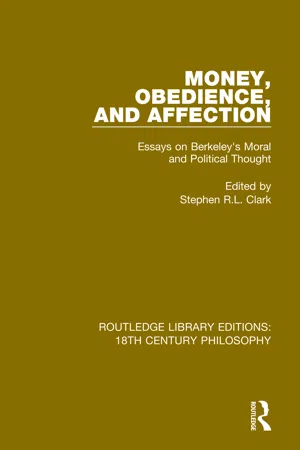
This book, first published in 1985, presents a key collection of essays on Berkeley's moral and political philosophy. They form an introduction to, and analysis of, Berkeley's immaterialist arguments, part of his consciously adopted strategy to subvert Enlightenment thought, which he saw as a danger to civil society.
eBook - ePub
Money, Obedience, and Affection
Essays on Berkeley's Moral and Political Thought
- 228 pages
- English
- ePUB (mobile friendly)
- Available on iOS & Android
eBook - ePub
About this book
Information
Berkeley’s Theory of Morals
C. D. Broad
Berkeley had intended to treat ethics systematically in Part II of the Principles, but the manuscript of this was lost and he never re-wrote it. The main source now available for his views on this topic is the Discourse on Passive Obedience. This can be supplemented in certain minor respects by statements in some parts of the Alciphron and in some of Berkeley’s essays in the Guardian. Here I shall confine myself entirely to the Discourse.
The contents of this were originally delivered as sermons in the chapel of Trinity College, Dublin, Berkeley published them first in 1712. The subject was a delicate and exciting one at the time and for long afterwards. Queen Anne’s reign was nearing its end; she was to die in the late summer of 1714. In accordance with (he Act of Settlement of 1701 she was to be succeded by George, Elector of Hanover. In the end this change took place fairly smoothly, because the leaders of the Whigs were better prepared and more united than those of the Tories. But it was touch-and-go when it happened, and for years beforehand the question of who would succede Queen Anne had been a matter of controversy and political intrigue. Now the doctrine of passive obedience was regarded as a typically Tory and ‘Jacobite principle; though it would, on certain interpretations of it, favour any government that was once firmly in the saddle. Berkeley was suspected at the time of Jacobitism in consequence of his support of this doctrine.
Berkeley’s political conclusion is that rebellion of a subject against the supreme authority of the country of which he is a citizen is, in all circumstances, wrong. He carefully defines his terms; but I am not here concerned directly with the political question, and shall therefore not consider the precise meaning of the principle. Here I am concerned with the doctrine only as an introduction to Berkeley’s general view of ethics.
In order to prove that rebellion is unconditionally wrong Berkeley thinks it necessary and sufficient to show that it is a breach of what he calls a negative ‘ moral rule or law of nature and that all such rules are rigidly binding on everyone at all times and places and under all conditions. Now, in order to show this, he has to discuss such general questions as the essential features and the sanctions of ‘ laws of nature ‘ in this technical sense, the criterion by which to determine whether a proposed moral precept is or is not a ‘ law of nature and so on. It is his answers to these general questions which constitute his theory of ethics. But some important points in his general theory emerge only in the replies which lie makes to plausible objections to his doctrine that rebellion is a breach of the law of nature. I propose now to try to state the general theory in isolation from its particular political applications.
FUNDAMENTAL MORAL PRECEPTS
Berkeley conducts his discussion in terms of what he calls ‘laws of nature’ He is aware that this phrase is ambiguous, and says that he uses it to mean : ‘A rule or precept for the direction of the voluntary actions of reasonable agents’. In the other sense, which is much the more usual nowadays, it means: ‘Any general rule which we observe to obtain in the works of nature independent of the wills of men’. I shall substitute for the phrase ‘law of nature when used in the ethical sense in which Berkeley uses it, the phrase ‘fundamental moral precept’
(1,1) The criterion for such precepts
Berkeley says that it is generally agreed that there are certain fundamental moral precepts which are unconditionally binding upon all men. But there arc great differences of opinion about the criterion by which we are to judge whether a proposed moral precept is of this kind or not. He mentions various criteria which have been suggested, e.g., innateness and universal consent. Before considering his own criterion it will be worth while to note what he says about innateness in this connexion.
He does indeed assert that the fundamental moral precepts are ‘stamped on the mind’. But he is careful to qualify this. All that he will admit is that there are innate antipathies to some kinds of action which are in fact wrong. But antipathies to certain kinds of action are often due simply to early training, and it is difficult or impossible to distinguish these from genuinely innate antipathies. Berkeley’s conclusion is as follows. It is a mistake to assume that, when a strong antipathy is felt towards an act, the act must therefore be a breach of a fundamental moral precept. It is equally a mistake to assume that, where no such antipathy is felt, the act is not a breach of auch a precept. In all cases, he says, we must decide what is and what is not a fundamental moral precept ‘not by any emotion in our blood and spirits, but by ... sober and impartial reason ‘. This brings us to Berkeley’s own criterion.
In the first place, we must remember that he held that the following factual propositions can be established by reason without appeal to revelation. (1) That human beings survive the death of their present bodies and thereafter exist for ever. (2) That God exists, that he is perfectly good, that he enjoys eternally all possible perfections, and that he alone can make a man eternally happy or miserable. (3) That the only rational creatures whom a man can affect for good or ill by his actions are himself and other human beings. These three factual propositions are essential premisses in Berkeley’s argument.
The argument from them may be put as follows. Suppose that a man had reason to believe that God commands him to act in a certain way in all situations of a certain kind. Then there would be two quite independent reasons for acting in that way in such situations. (1) It is self-evident that the relationship of God as creator to men as his creatures imposes on them a moral duty to obey God’s orders to them. (2) It must also in the long run be to his interest to obey. Our welfare and illfare throughout eternity are in the hands of God, and it is reasonable to suppose that he will reward obedience and punish disobedience to his commands.
So far the argument is purely hypothetical. The next question is this. Have we any ground, independent of revelation, to believe that God has commanded or forbidden men to act in certain ways in all situations of a certain kind? And, if so, how can we tell in detail what he has commanded or forbidden?
The next stage of the argument is as follows. Berkeley says that we must proceed by investigating two questions, viz. (1) What is the general purpose of God with regard to mankind ? And (2) what methods would be best fitted to accomplish that end? An intelligent and good being would not issue orders to others arbitrarily. He would do so only in so far as he had an end in view, which he desired to be achieved by their voluntary actions, and because he knew that that end would be most effectively attained by their always acting in accordance with certain rules in all situations of certain kinds.
As regards the end which God desires that human voluntary actions shall bring about, Berkeley’s conclusion is as follows. That end is the general well-being of the whole human race throughout the whole of its life on earth. His argument for this may be put as follows:—
(1) Since God is perfectly good, the end which he desires to be achieved by human action must be some kind of good state of affairs somewhere. Since God’s own state is automatically one of eternal bliss, this good state of affairs must be a state of some finite created being or beings. Since human action can affect only human beings, any good result attainable by human action must be a state of some one man, or some class of men, or the whole human race.
(2) Berkeley now argues that we must accept the third of these alternatives. He states clearly the premisses of his argument, but the argument itself is very condensed and I do not find it easy to follow. The explicit premisses are these, (i) God, being perfectly just, would not favour one individual or one class of men over the rest of mankind on any other ground than the superior moral desert of that individual or of the members of that class, (ii) Moral desert arises entirely from conformity to the commands of God. It is therefore logically impossible that any human being should have any moral desert prior to the issue of commands by God to men. Therefore, unless and until God had issued commands to men, and they had had opportunities to obey or to flout them, it is logically impossible that any individual or class of men should have deserved better or worse treatment from God than any other.
(3) So far the position is quite clear. I suggest that the argument would continue somewhat as follows, if the steps were made explicit. (i) God could not have desired that one individual or class should become better off than another until after he had issued commands and some men had obeyed and others had disobeyed them, (ii) But before God issued any commands to men he must have had some end in view to be attained by human action. For, otherwise, he would have had no motive for issuing commands. Therefore the end, in view of which God issued commands to men, cannot have had any reference to the welfare of any individual or class of men rather than any other. It must have been the welfare of the whole human race without regard to person or race or period.
Granted that this must be the end which God desires to be attained by human action, we now come to the second question. What means would God adopt? Berkeley says that there are prima facie two alternative ways in which the well-being of mankind as a whole might be promoted by issuing general injunctions to all individuals. These might be called the direct and the indirect method. The direct method would be to command everyone to act on each occasion in such a way as he then judges to be most likely to maximise human welfare. The indirect method is described as follows by Berkeley. It would consist in enjoining upon everyone ‘the observation of certain determinate established laws, which, if universally practised, have, from the nature of things, an essential fitness to promote the well-being of mankind’.
The objection to the indirect method is that obedience to such determinate rules may, in particular cases, lead to great suffering on the part of many innocent persons. To the direct method there are at least two serious objections. One is its extreme vagueness. Even the wisest and the best of men would often be completely at a loss to know what to do and what to avoid doing, if he had nothing but the principle of universal beneficence to guide him. The second objection is that no-one could make a reasonably certain judgment about the rightness or wrongness of another person’s action on any occasion. However ill the action may look, the agent could always say that he judged it to be the most benefic act open to him in the situation. Berkeley considers that the objections to the direct method are overwhelmingly greater than the objections to the indirect method. He therefore holds that we can safely conclude that God would adopt the indirect method.
If this argument be accepted, we can conclude that there must be various specific fundamental moral precepts, and we can give a criterion for deciding whether a proposed moral rule is or is not one of them. A fundamental moral precept is any rule of conduct which is enjoined by God upon all men in all situations of a certain assigned kind. It is a law binding upon men because enjoined upon them by God, who has a moral right to command his creatures. Now we can take as enjoined upon us by the will of God any rule of conduct with regard to which we can see that the general well-being of mankind would be promoted by all men acting in accordance with it on all relevant occasions.
Later on Berkeley restates this criterion more guardedly. Since all the fundamental moral precepts are enjoined by God with a single end in view, they will form a coherent system. Berkeley describes this as ‘a system of rules or precepts, such that, if they be all of them at all times and places by all men observed, they will necessarily promote the well-being of mankind, so far as that is attainable by human action ‘. Presumably what he means is this. Any single rule of conduct, e.g., ‘Never give a false answer to a question might still be a fundamental moral precept, even if acting upon it in all relevant circumstances would not necessarily promote the well-being of mankind in a society in which certain other fundamental moral precepts, e.g., ‘Thou shalt do no murder ‘, were habitually flouted. Berkeley thinks it plain that such maxims as ‘Thou shalt not forswear thyself ‘and ‘Thou shalt not steal ‘, answer to this revised criterion, and arc therefore commands issued by God, which men are therefore under an obligation to obey.
(1,2) Relation of Berkeley’s doctrine to Utilitarianism
Before going further it will be well to emphasise the following distinctions which Berkeley brings out very clearly. (1) We must distinguish between the criterion for deciding whether a suggested rule is or is not a fundamental moral precept, and the ground of our obligation to act in accordance with it if it is a fundamental moral precept. The criterion is whether universal action in accordance with it would or would not promote the welfare of mankind. This is a criterion, because it is safe to assume that God would command men to act on any precept which answers to it, and on no others. But it is not the ground of our obligation to act in accordance with such a precept. What makes any moral precept binding on us is simply that God has ordered us to act in accordance with it, and that we, as his creatures, have a manifest duty to obey the commands of our creator. Thus Berkeley’s doctrine is fundamentally different from ordinary Utilitarianism. For that makes utility the one and only ground of obligation. (2) We must distinguish between the criterion for deciding whether a suggested rule is a fundamental moral precept, and the criterion for deciding whether a particular action in a particular situation is morally permissible. The latter criterion is simply whether the action in question does or does not conflict with any of the fundamental moral precepts which arc relevant to the situation.
In view of all this, Berkeley quite consistently holds that it is never permissible to break a moral precept which answers to the criterion for being fundamental, even when it seems perfectly obvious that to obey it will be less conducive to human welfare than to disobey it. We must distinguish, he says, between the general tendency of obeying a moral rule and the accidental consequences of obeying it in a certain particular case. If and only if the general tendency is beneficent, we can conclude that the rule is enjoined on us by God; and in that case it is our duly to obey it, even in particular cases where the accidental consequences will be bad. It would be inconsistent with God’s wisdom to allow a breach of one of his commands (e.g., his prohibition of adultery) to be retaliated by a breach of another of them (e.g., his prohibition of murder). But, on the other hand, it would be inconsistent with God’s justice, if he did not eventually reward those who have obeyed his commands and punish those who have flouted them. There is another world for the recompense of virtue which has been unfortunate and of sin which has been successful here below, and we must await it patiently.
(1,3) Positive and negative moral precepts
We can now deal with a distinction which Berkeley regards as very important, viz., the division of moral precepts into positive and negative, or commands and prohibitions.
According to him, it may be logically impossible under certain circumstances for a person to obey all the positive precepts which are relevant to the situation in which he has to perform a voluntary action. Suppose, e.g., that he has been given certain information under promise of secrecy, and that he is now asked a question which he cannot answer truly without revealing the facts thus imparted to him. Then it is literally impossible for him to obey both the precepts ‘Keep your promises’ and ‘Answer questions truly’ In regard ...
Table of contents
- Cover
- Half Title
- Title Page
- Copyright Page
- Original Title Page
- Original Copyright Page
- Table of Contents
- Acknowledgements
- Introduction
- 1. C. D. Broad, “Berkeley’s Theory of Morals,” Revue Internationale de Philosophie, 7(1953), 72-86
- 2. Graham P. Conroy, “George Berkeley on Moral Demonstration,” Journal of the History of Ideas, 22 (1961), 205-214
- 3. Jackson P. Hershbell, “Berkeley and the Problem of Evil,” Journal of the History of Ideas, 31 (1970), 543-554
- 4. T. W. Hutchison, “Berkeley’s Querist and Its Place in the Economic Thought of the Eighteenth Century,” British Journal of the Philosophy of Science, 4 (1953-4), 52-77
- 5. G. A. Johnston, “The Development of Berkeley’s Ethical Theory,” Philosophical Review, 24 (1915), 419-430
- 6. Joseph Johnston, “A Synopsis of Berkeley’s Monetary Philosophy,” Hermathena, 55 (1940), 73-86
- 7. Joseph Kupfer, “Universalization in Berkeley’s Rule-Utilitarianism,” Revue Internationale de Philosophie, 28 (1974), 511-531
- 8. David E. Leary, “Berkeley’s Social Theory: Context and Development,” Journal of the History of Ideas, 38 (1977), 635-649
- 9. Hugh W. Orange, “Berkeley as a Moral Philosopher,” Mind, 15 (1890), 514-523
- 10. Frank Petrella, “George Berkeley’s Theory of Economic Policy and Classical Economic Liberalism,” Southern Economic Journal, 32 (1965-6), 275-284
- 11. Douglas Vickers, “George Berkeley,” Chapter 8 from Studies in the Theories of Money, 1690-1776, by Douglas Vickers (London: Peter Owen Ltd.; 1960), 141-169
- 12. Ian D. S. Ward, “George Berkeley: Precursor of Keynes or Moral Economist on Underdevelopment,” Journal of Political Economy, 67 (1959), 31-40
Trusted by 375,005 students
Access to over 1.5 million titles for a fair monthly price.
Study more efficiently using our study tools.
Frequently asked questions
Yes, you can cancel anytime from the Subscription tab in your account settings on the Perlego website. Your subscription will stay active until the end of your current billing period. Learn how to cancel your subscription
No, books cannot be downloaded as external files, such as PDFs, for use outside of Perlego. However, you can download books within the Perlego app for offline reading on mobile or tablet. Learn how to download books offline
Perlego offers two plans: Essential and Complete
- Essential is ideal for learners and professionals who enjoy exploring a wide range of subjects. Access the Essential Library with 800,000+ trusted titles and best-sellers across business, personal growth, and the humanities. Includes unlimited reading time and Standard Read Aloud voice.
- Complete: Perfect for advanced learners and researchers needing full, unrestricted access. Unlock 1.5M+ books across hundreds of subjects, including academic and specialized titles. The Complete Plan also includes advanced features like Premium Read Aloud and Research Assistant.
We are an online textbook subscription service, where you can get access to an entire online library for less than the price of a single book per month. With over 1.5 million books across 990+ topics, we’ve got you covered! Learn about our mission
Look out for the read-aloud symbol on your next book to see if you can listen to it. The read-aloud tool reads text aloud for you, highlighting the text as it is being read. You can pause it, speed it up and slow it down. Learn more about Read Aloud
Yes! You can use the Perlego app on both iOS and Android devices to read anytime, anywhere — even offline. Perfect for commutes or when you’re on the go.
Please note we cannot support devices running on iOS 13 and Android 7 or earlier. Learn more about using the app
Please note we cannot support devices running on iOS 13 and Android 7 or earlier. Learn more about using the app
Yes, you can access Money, Obedience, and Affection by Stephen R.L. Clark in PDF and/or ePUB format, as well as other popular books in Philosophy & Ethics & Moral Philosophy. We have over 1.5 million books available in our catalogue for you to explore.