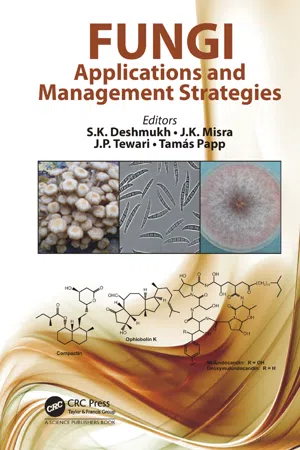
The book deals with the application of fungi and the strategic management of some plant pathogens. It covers fungal bioactive metabolites, with emphasis on those secondary metabolites that are produced by various endophytes, their pharmaceutical and agricultural uses, regulation of the metabolites, mycotoxins, nutritional value of mushrooms, prospecting of thermophilic and wood-rotting fungi, and fungi as myconano factories. Strategies for the management of some plant pathogenic fungi of rice and soybean have also been dealt with. Updated information for all these aspects has been presented and discussed in different chapters.
eBook - ePub
Fungi
Applications and Management Strategies
- 496 pages
- English
- ePUB (mobile friendly)
- Available on iOS & Android
eBook - ePub
Fungi
Applications and Management Strategies
About this book
Information
CHAPTER 1
The Promise of Endophytic Fungi as Sustainable Resource of Biologically Relevant Pro-drugs: A Focus on Cameroon
ABSTRACT
Fungal endophytes constitute an extraordinarily multifarious cluster of polyphyletic fungi pervasive in plants, and retain an indiscernible vibrant relationship with their associated host plants for at least a part of their life cycle. The potential of ‘novel’ endophytes capable of biosynthesizing bioactive natural products has undoubtedly been acknowledged. However, it is disappointing that there is still no known breakthrough in the commercial production of these bioactive secondary metabolites using endophytes. Thus, vigilant bio-prospecting strategies should be devised, in selecting the best possible plants thriving in propitious ecological niches, for isolating endophytes with potent pharmaceutical value. Cameroon (Africa) is such a largely unexplored biodiversity “hotspot”, where wild plants from ecologically distinct areas are intensively used by the local population in traditional medicine. Plants are a rich source of bioactive compounds and are vibrantly interacting with other organisms, including endophytes, for thriving in their distinct ‘natural’ ecological landscapes. In this chapter, we briefly highlight an interesting bio-prospecting strategy and provide a perspective of using the African traditional knowledge directed towards the study of plants and endophytic fungi harboring them in order to find new lead compounds with therapeutically relevant activities.
Introduction
The combined approach, using the knowledge from ecosystem analysis, phylogenetic background and also knowledge acquired from traditional medicinal applications (via traditional healers), is an efficient and promising route to discover new lead compounds, both from plants and the associated endophytic microorganisms. Endophytic organisms live together with plants in mutualistic association and produce plethora of secondary metabolites which, in case they have desired biological activities, are of high interest for pharmaceutical applications (Kusari et al., 2014). Even if the metabolites produced by the endophytes do not have the preferred biological function, they are of inestimable value as occasionally these natural products might have new lead structures (or act as pro-drugs), from which a number of new compounds can be derived by derivatization and/or chemical synthesis. Several reports have deliberated the products of endophytic microbes and their competence for usage in medicine, agriculture and industry (Kusari and Spiteller, 2011, 2012; Kusari et al., 2012, 2013a). In this chapter, we highlight and discuss about a particular tropical biodiversity hotspot of the world, namely Cameroon (Africa), in order to provide the readers an exhilarating perspective of bio-prospecting plants and endophytes from tropical rainforest microbes, which have unique and remarkable promise for utility in the pharmaceutical industry.
We started our endeavor of focusing on the tropical ecological niches in Africa, especially in Cameroon, within the purview of the recent “Welcome to Africa” initiative of the German Federal Ministry of Education and Research (BMBF) and the German Academic Exchange Service (DAAD), Germany. Throughout Cameroon, particularly in the south region, plants are intensively used by the local population in traditional medicine. Cameroonian plants have been found to be a rich source of bioactive compounds. Our program is directed towards the study of these plants and endophytic fungi harboring them in order to find new lead compounds with potent biological activity, mainly antibacterial and anti-inflammatory.
Introduction to Microbial Endophytes
Plants (or green plants) are a unique group of cellulose-containing multi-cellular organisms capable of performing photosynthesis. Beyond this generalized understanding of plants, however, is a much more complex veracity of comprehending them. This includes commanding the network of associations of plants with other organisms, various biotic and abiotic selection pressures, an assortment of cost-benefit mutualisms, and interaction-directed co-evolution of attack-defense-counterdefense mechanisms (Kusari et al., 2012, 2013a). One central ‘partner’ within these strata of natural acquaintances is a class of remarkably diverse group of microorganisms called endophytic microorganisms (typically known as endophytes). They inhabit living, internal tissues of plants, and retain a discreet association with their associated hosts for at least a part of their life (Bacon and White, 2000; Porras-Alfaro and Bayman, 2011; Kusari and Spiteller, 2012). This category of connotation is symptomless and established exclusively inside the living host plant tissues. “Endophytism”, therefore, epitomizes a specific form of plant-microbe mutualism.
The establishment of microorganisms, both fungi and bacteria, as endophytes occurs commonly by their coincidental encounters with potential host plants over an evolutionary period wherein a number of factors play an important role, viz., the ecological niche of the plant, plant population (wild and/or agriculture), plant tissue type, and site (localized and/or systemic manner) (Hyde and Soytong, 2008). Consequently, even a microbe that is pathogenic in one ecological niche can be endophytic to plant hosts in another ecosystem (Kusari et al., 2013b). Especially for fungi, it has been demonstrated that endophytic-pathogenic lifestyles are transposable and are due to a number of environmental, chemical and/or molecular triggers (Eaton et al., 2011; Hyde and Soytong, 2008; Schulz et al., 1999). Endophytes have been reported to function as plant growth and defense promoters by synthesizing phytohormones, producing bio surfactants, enzymes or precursors for secondary plant metabolites. They also fix atmospheric nitrogen and carbon dioxide, control plant diseases, and help in plant tolerance towards environmental stress like drought and salinity (Stone et al., 2000; Redman et al., 2002; Arnold et al., 2003; Rodriguez et al., 2004, 2008; Waller et al., 2005; Marquez et al., 2007; Rodriguez and Redman, 2008; Porras-Alfaro and Bayman, 2011). The competence of endophytes to yield a plethora of bioactive natural products has also been decisively established. Sporadically, endophytes can also produce the bioactive host plant secondary metabolites or precursors. Some notable examples include the production of paclitaxel, podophyllotoxin, deoxypodophyllotoxin, camptothecin and structural analogues, hypericin, and emodin by endophytic fungi (Kusari and Spiteller, 2011; Kusari et al., 2012). In addition to plants producing volatile compounds induced by parasitic or pathogenic fungi (Piel et al., 1997, 1998), endophytes themselves are also capable of producing volatile organic compounds (Strobel et al., 2007).
Present-Day Situation
The production of bioactive compounds by endophytic fungi, including those exclusive to their host plants, is striking both from the molecular and biochemical viewpoint, and the even from the ecological standpoint. The production of secondary metabolites by endophytes, which have pharmaceutically-relevant pro-drug-like biological function, fosters anticipations of exploiting them as substitute and viable sources of these compounds. However, the commercial implication of production of desirable compounds by endophytic fungi still remains an impending intention (Kusari and Spiteller, 2011, 2012). A foremost deterrent foiling the pharmaceutical application of endophytes is the bewildering problem of diminution of secondary metabolite production on repetitive sub-culturing under axenic monoculture conditions. In addition to a persistent quest of discovering competent endophytes with promise for pharmaceutical use, it is crucial to follow-up these discoveries with cutting-edge research to establish, restore and sustain the in vitro biosynthetic competence of endophytes. This can be realized by a multifaceted tactic encompassing the comprehensive interpretation of the dynamic endophyte-endophyte, endophyte-host, endophyte-pathogen, endophyte-herbivore, host-pathogen, and host-herbivore multipartite interactions concerning their biological, biochemical and genetic contexts.
The individual mutualistic suites, namely the plant-endophyte and plant-insect mutualisms, have been the major focus of research in the last decades (Kusari et al., 2012, 2013a). However, the interaction between these two highly diverse and almost entirely different mutualisms yet remains to be explored (Fig. 1). While the reciprocal benefits of many plant-fungal and plant-herbivore mutualisms have been sporadically studied independent of each other, lessunderstood are the interactions among the component members of these different symbioses. Moreover, even though endophytic interaction with other organisms has been somewhat exploited over the last decades, the role of such relationships on the endophytic production of host plant compounds is poorly known and only gained attention recently. It is highly desirable to investigate the various links between endophytes and plants, such as other coexisting endophytes and insects, with regard to their function in triggering chemical defense reactions. It has, therefore, become clear that it is vital to consider all the different types of interactions that endophytes have with other co-existing endophytes, host plants, insects and specific herbivores, and all their interconnectivity at the organ, species, population and community level will enable the comprehensive understanding of the plant-endophyte-insect networking.

Figure 1. The interspecies and multispecies crosstalk between endophytes (bacteria and fungi), pathogens, plants and feeders.
Can Plant Selection Strategy Dictate Paramount Probabilities of Isolating Endophytes with Extraordinary Biosynthetic Potential?
Exhilarating prospects for exploring and utilizing the potential of endophytes have been realized by employing suitable plant bio-prospecting strategies (Kusari and Spiteller, 2012). However, selecting the most appropriate plants for isolating endophytes with pharmaceutical value can be a daunting task. Therefore, various bio-prospecting strategies, each based on specific rationale, might be affianced in order to discover potent endophytes with appropriate traits (Fig. 2). These include, but are not limited to, the following:
1. Random plant sampling: In this approach, sampling of different plants from diverse populations is randomly undertaken, followed by isolation of the associated endophytes, and their characterization.
2. Traditional medicinal plants: This is one of the frequently employed strategies in which medicinal plants used by indigenous people in traditional medicinal preparations, or plants having a historical record of ethno-botanical use are bio-prospected for endophytes, especially for the ones capable of producing one or more of the bioactive secondary metabolites mimetic to the associated the host plants.
3. Phylogenetically related plants: This is a very interesting strategy where plants are selected based on their phylogenetic relatedness to well-known, well-investigated, or invaluable traditional medicinal plants, with or without knowledge of the phyto-chemical constituents of the selected plants.
4. Plants from unique ecosystems: This is an alternate methodology wherein the evolutionary relatedness among groups of plants at a particular sampling site, correlating to species, genus, and populations, through morphological data matrices and molecular sequencing is evaluated followed by isolation of endophytes from the desired plants. A preliminary assessment of a given ecosystem with regard to its features correlating to its natural
5. population of plant species, their association with the environment, soil composition, and biogeochemical cycles is often taken into account when employing this selection strategy.
6. Data mining approaches: This strategy can be used in combination and complementary to all the above four approaches. The valuable information acquired using the different bio-prospecting schemes can thus be assembled together, comparatively evaluated, and stored for further use applying suitable data mining approaches.

Figure 2. Various bio-prospecting strategies that might be exploited in order to discover novel or competent endophytes with desirable traits.
Dja Rainforest in Cameroon as a Natural Resource for Bioactive Compounds
The Dja Biosphere Res...
Table of contents
- Cover
- Half Title
- Title Page
- Copyright Page
- Preface
- Table of Contents
- About The Book
- 1. The Promise of Endophytic Fungi as Sustainable Resource of Biologically Relevant Pro-drugs: A Focus on Cameroon
- 2. Endophytic Fungi and Their Bioprospection
- 3. Antimycobacterials from Fungi
- 4. Antiphytopathogenic Metabolites Derived from Endophytic Fungi
- 5. Fungal Secondary Metabolites as Source of Antifungal Compounds
- 6. Modulation of Fungal Secondary Metabolites Biosynthesis by Chemical Epigenetics
- 7. Volatile Organic Compounds from Fungi: Impact and Exploitation
- 8. Fungi and Statins
- 9. Glycans of Higher Basidiomycetes Mushrooms with Antiphytoviral Properties: Isolation, Characterization, and Biological Activity#
- 10. Fungi: Myconanofactory, Mycoremediation and Medicine
- 11. Potential Biotechnological Applications of Thermophilic Moulds
- 12. Wood-Inhabiting Fungi: Applied Aspects
- 13. Fusarium Toxins in Cereals in Northern Europe and Asia
- 14. Mycotoxins: Fungal Secondary Metabolites with Toxic Properties
- 15. Nutritional Profile of Wild Edible Mushrooms of North India
- 16. Strategies for the Management of Rice Pathogenic Fungi
- 17. Integrated Management of Fungal Diseases of Soybean [Glycine max (L.) Merrill] Occurring in India
- Index
Trusted by 375,005 students
Access to over 1.5 million titles for a fair monthly price.
Study more efficiently using our study tools.
Frequently asked questions
Yes, you can cancel anytime from the Subscription tab in your account settings on the Perlego website. Your subscription will stay active until the end of your current billing period. Learn how to cancel your subscription
No, books cannot be downloaded as external files, such as PDFs, for use outside of Perlego. However, you can download books within the Perlego app for offline reading on mobile or tablet. Learn how to download books offline
Perlego offers two plans: Essential and Complete
- Essential is ideal for learners and professionals who enjoy exploring a wide range of subjects. Access the Essential Library with 800,000+ trusted titles and best-sellers across business, personal growth, and the humanities. Includes unlimited reading time and Standard Read Aloud voice.
- Complete: Perfect for advanced learners and researchers needing full, unrestricted access. Unlock 1.5M+ books across hundreds of subjects, including academic and specialized titles. The Complete Plan also includes advanced features like Premium Read Aloud and Research Assistant.
We are an online textbook subscription service, where you can get access to an entire online library for less than the price of a single book per month. With over 1.5 million books across 990+ topics, we’ve got you covered! Learn about our mission
Look out for the read-aloud symbol on your next book to see if you can listen to it. The read-aloud tool reads text aloud for you, highlighting the text as it is being read. You can pause it, speed it up and slow it down. Learn more about Read Aloud
Yes! You can use the Perlego app on both iOS and Android devices to read anytime, anywhere — even offline. Perfect for commutes or when you’re on the go.
Please note we cannot support devices running on iOS 13 and Android 7 or earlier. Learn more about using the app
Please note we cannot support devices running on iOS 13 and Android 7 or earlier. Learn more about using the app
Yes, you can access Fungi by Sunil K. Deshmukh, J. K. Misra, Jalpa P. Tewari, Tamas Papp, Sunil K. Deshmukh,J. K. Misra,Jalpa P. Tewari,Tamas Papp in PDF and/or ePUB format, as well as other popular books in Biological Sciences & Biochemistry. We have over 1.5 million books available in our catalogue for you to explore.