![]()
1 | Microwave Radiation in Biocatalysis |
David E. Q. Jimenez, Lucas Lima Zanin, Irlon M. Ferreira, Yara J. K. Araújo, and André L. M. Porto
Contents
1.1 Introduction
1.1.1 Principles of Microwave Radiation
1.1.2 Influence of Microwave Radiation on Enzymes
1.2 Application of microwave radiation in biocatalysis
1.2.1 Use of Isolated Enzymes in Biocatalysis under Microwave Radiation and Conventional Heating
1.2.2 Biocatalytic Reactions Using Whole Cells of Microorganisms under MW
1.3 Conclusions and perspectives
Acknowledgments
References
1.1 Introduction
Although microwave ovens manufactured for homes have been used since the 1970s, the first report that these energy sources were appropriately being used to accelerate organic reactions was in 1986. In their pioneering studies, Gedye [1] and Guiguere [2] used the domestic microwave as a tool for conducting organic reactions. In these studies, the authors described the results obtained in esterification reactions and cycloaddition with a domestic microwave apparatus [3].
The risk associated with the flammability of organic solvents and the lack of available systems to control temperature and pressure were the main reasons for using microwave reactors developed especially for organic synthesis. Today, this device is safe and allows the synthetic organic chemist control over all reaction parameters (temperature, pressure and power), thus achieving greater reproducibility and safety in the experiments [3, 4].
In the last decade, microwave radiation has been used to simplify and improve the reaction conditions of many classic organic reactions. Reactions carried out under microwave radiation are generally faster and cleaner and have better yields than reactions performed under conventional heating in similar conditions [5, 6]. The microwave methods provide an efficient and safe technology, according to the principles of “Green Chemistry” [7], because this technique enables solvent-free reactions to be performed, decreasing the number of competing side reactions, increasing the yield and reducing the reaction time [8–10].
More recently, microwave radiation became an important tool for performing biocatalytic reactions. The potential of this technique has been exploited, particularly in the resolution of racemates to obtain enantiomerically pure compounds using immobilized lipases [11–14].
The organic synthesis presents a great contribution to obtain molecules with biological activities. Thus, the development of methodologies that apply the principles of Green Chemistry in the synthesis of new selective products with chemo-, regio- and enantio-selective and environmentally benign characteristics is required. Therefore, the use of microwave radiation in synthetic protocols has been very advantageous because the reactions are performed in a very short time in the absence of organic solvents and with a low consumption of energy [15].
1.1.1 Principles of Microwave Radiation
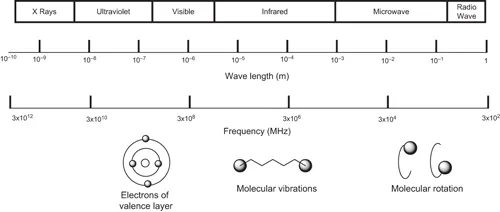
Microwaves are electromagnetic waves like energy carriers; these are located in the region of the electromagnetic spectrum between infrared light and radio waves in the frequency range between 300 and 300,000 MHz (Figure 1.1) [3, 7].
FIGURE 1.1 Illustration of electromagnetic spectrum. (Adapted from Young DD, Nichols J, Kelly RM, Deiters A (2008) Microwave activation of enzymatic catalysis. Journal of the American Chemical Society 130: 10048–10049.)
Domestic microwave ovens operate at a frequency of 2450 MHz (wavelength of 12.24 cm) to avoid interference with frequency telecommunications and mobile phones. According to the Federal Communications Commission (www.fcc.gov), only four frequencies are reserved for Industrial, Scientific and Medical (ISM) purposes: 915 ± 25, 2450 ± 13, 5800 ± 75 and 22,125 ± 125 MHz, with the most commonly used frequencies being 915 and 2450 MHz.
Microwave ovens that can process a frequency change of 0.9 to 18 GHz have been developed for the transformation of materials [16–18].
The microwave is a type of non-ionizing radiation capable of causing molecular motion in dipolar polarization and ionic conduction, but not changes in the molecular structure of molecules [11]. Since the energy of a microwave photon in this frequency region is 0.037 kcal.mol−1, very low energy is needed to break a chemical bond, which is generally of the order of 80–120 kcal.mol−1 [19].
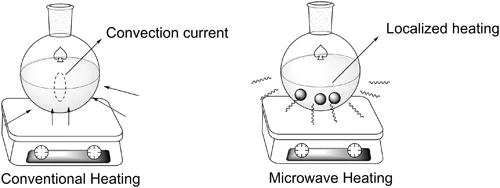
The conventional heating process is fundamentally different to microwave heating upon radiation. In conventional heating an external power source reaches the walls of the flask and heat is transferred from the flask surface into the solution (reagents and solvents); through the driving process, such heating can often cause a convection current in solution. In contrast, with heating under microwave radiation, the energy is transferred directly to the substances by molecular interaction with the ions dissolved in the solution and/or the solvent; thus localized overheating of the substance absorbs the microwave (Figure 1.2) [16, 17]. This type of heating will depend on the ability of that particular material, reagent or solvent to absorb the microwave energy and convert it into heat [19].
FIGURE 1.2 Illustration of conventional and microwave heatin...