![]()
1
Overview of the mining business
‘If it cannot be grown, it must be mined’ (Unknown) is a truism that captures the importance of mining in our evolution and its ongoing need as civilisation moves ever forward. Our civilisation has been defined by mining:
- Stone Age – pre 4000 BC
- Bronze Age – 4000 BC to 1500 BC
- Iron Age – 1500 BC to about 1800 AD
- Steel Age – 1800 to about 1945
- Nuclear Age – post 1945.
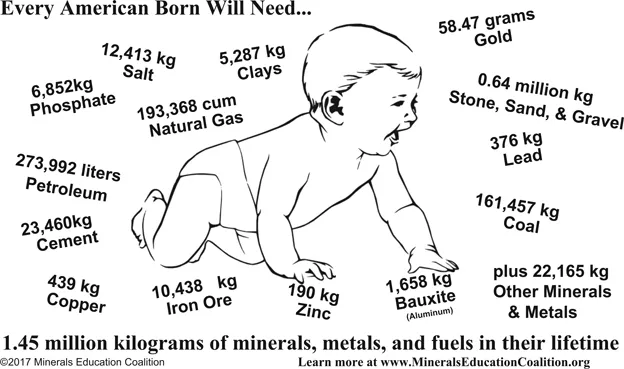
Figure 1.1 shows our dependence on minerals in the United States. It is still valid qualitatively and is globally correct.
Mining is a key commercial business which involves the production, processing, waste disposal, purchase and sale of goods and the management of a wide range of operational and advisory services which are required to ensure a safe, sustainable and profitable outcome. Mining companies purchase or lease mineral deposits or orebodies and convert them into saleable commodities and waste products. The processes involved in the securing or purchasing of the raw material can vary significantly.
Deposits can be either greenfields (in areas where exploring for or mining the type of ore or mineral has not occurred previously) or brownfields (in areas where similar ore or minerals have already been exploited or explored) where the technical risk and financial reward are obviously reduced.
If the findings of an exploration investigation are positive and are acceptable to the board of directors, investors and lending institutions, the required finances will flow to allow the development of the mine and associated plant and infrastructure. Alternatively, a mining company may, through a joint venture or takeover of another company, purchase a share in or gain ‘total control or ownership’ of a proven orebody or an operating mine.
Figure 1.1 Human consumption over a lifetime
This chapter includes an overview of the factors which are taken into account in developing the feasibility and bankable documents required to bring a prospective mine into operation. It also deals with the valuations of mines and the assessment of mining projects.
Extractive industries
‘Extractive industries’ is a term used to define those industries involved in extracting minerals or fossil fuels from the earth’s crust in order to produce material or products of use to mankind. It therefore embraces:
- Coal mining
- Oil and gas production
- Metalliferous mining
- Industrial minerals.
Extractive industries have always had an important influence on civilisation. They provide our major sources of energy and the raw material for the manufacture of almost all products which continue to shape our lives.
It is also important to remember that our mineral and fossil fuel deposits are wasting assets and if production is to be maintained, new replacement deposits have to be continually found. Intuitively, as the world’s population continues to expand, merely replacing existing production rates will not sustainably satisfy the growing demands of the global economy. Therefore, the need exists to actually replace as well as grow exploration, or ‘new find’, rates.
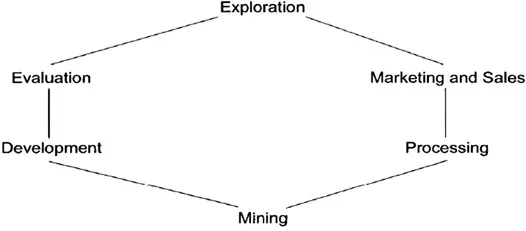
Figure 1.2 A typical exploration to mining cycle
The mining cycle therefore commences with exploration for viable deposits and is completed when the energy product, mineral or metallic commodity is marketed or sold and the waste safely disposed of. It is however important to point out that it is a continuous cycle with some of the income generated from commodity sales having to be reinvested in exploration in order to ensure the long-term viability and existence of the company.
Whilst this book concentrates on the coal and metalliferous mining industries, it includes references to the allied industries responsible for the production of oil and gas as well as industrial minerals.
The following are the stages involved in a mine life cycle:
- Literature review – This involves reviewing published data available from, say, the country’s geological survey or equivalent and any data from previous exploration activity.
- Prospecting – This is the first stage of exploration and generally involves considerable hard work by geologists (‘foot slogging’ frequently).
- Exploration – Once a target location has been identified, the exploration of it to establish its viability is undertaken, keeping costs as low as possible in case it proves uneconomic. Prospecting and exploration are the domains of geologists and geophysicists.
- Development – Development involves the construction of the mine site including access, provision of services, any processing facility, the mine access and future waste handling/disposal systems.
- Exploitation – This involves the production of the saleable product from the mine. Development and exploitation are the domain of the mining engineer and metallurgist.
- Reclamation/rehabilitation – This needs to be detailed and future funding generally obtained before development can start and is a key part of the permitting process as is the environmental impact study with its protections.
As may be applicable, it is critical from the exploration stage to actively involve any local communities.
Exploration
An exploration and mining company must decide what to search for and where to search for it. In assessing what to explore for, the long lead time between the discovery of a deposit or an orebody and its exploitation must be taken into account and can vary from a few years to over 10 years. Consequently, those responsible must take a long-term view of the need for the mineral commodity and this entails taking into account:
- The likely future demand for the commodity, factoring in such unknowns as future disruptive technology trends and the possible use and/or development of alternative materials.
- The likely future supply of the commodity as existing producers may cost-effectively expand production or potential new producers may bring economically more attractive production onto the market.
- The local availability and cost of labour and services.
- The likely future trends in royalties and taxes, as well as requirements around local equity participation.
- The political and social stability.
Before opting for an exploration area, which could be in any part of the globe, it is important to assess:
- Sovereign risk
- The exploration potential of the area
- The likely costs of exploration and any subsequent mine development
- Access to the product market.
Assessing the geological potential of a prospective exploration area involves an examination of available geological maps and any available geochemical or geophysical surveys. Due recognition should also be given to the existence of operational mines and/or known mineralisation.
Exploration and mine development costs would be influenced by distances from major supply centres and the availability of power supply and transport services. Account should also be taken of the availability of skilled labour and management staff.
In assessing the political situation, account must be taken of all factors controlled by governments such as:
- Legislation governing exploration and mining activities.
- Policies governing corporate taxation and mineral royalties.
- Legislation governing equity participation by either one or both of local and government bodies.
- Regulations governing the funding of foreign owned business ventures.
- Ability to repatriate capital through dividends or other means unimpeded and without penalty.
Project risks
There are risks associated with any mining project. Before embarking on the more costly but vital diamond drilling, aerial photography, geological, geochemical and tomography studies are usually undertaken first. This preliminary exploration program will only reveal approximate estimates of the potential deposit or orebody and subsequent core drilling is essential to define the overall structure of the deposit, grade (and distribution) and surrounding strata. There are also diminishing levels of risk associated with the subsequent stages of mine planning and development due to the difficulty of designing cost effective and efficient extractive and treatment processes. These risks are reflected in the available sources of finance for the various stages in mine development.
| Risk | Activity | Source of Finance |
|
| Very High | Exploration | Seed Capital |
| Very High | Scoping Study | Venture Capital |
| High | Pre-Feasibility Study | Venture Capital |
| High | Feasibility Study | Venture and/or Equity Capital |
| Moderate | Mine Development | Equity and/or Project Loan |
| Normal | Mine Production | Cashflows or Short-Term Loans |
Project financing
Due to the very high risk associated with mineral exploration, its financing is either provided by operating mining companies seeking to extend their in situ reserves or by speculators who are prepared to invest their savings in grass-roots exploration with the expectation that success would reap a high reward. Once an attractive resource has been located, a scoping study or pre-feasibility study may be carried out to attract the venture capital required to carry out the costly and time-consuming exercise of completing the final feasibility study. The principal objectives of a scoping or pre-feasibility study are to:
- Gauge the market’s economic attractiveness of the commodity being considered.
- Examine all possible project alternatives.
- Identify those aspects of the project that are critical to its feasibility.
- Explore whether the project proposal would be attractive to a particular investor or investor group in order to meet the expense of carrying out a detailed feasibility study.
For the various stages in determining the funding needed for a specific project, the following levels of accuracy are used as a general guideline (AusIMM, 2012):
- Conceptual design costs to ±30%
- Pre-feasibility costs to ±20%
- Feasibility costs to ±10%.
The scoping and both feasibility studies are structured in similar ways. The major difference is the much more detailed analysis of the technical, financial, economic and environmental factors contained in the final feasibility study report. Obviously this final study would either lead to a recommendation to continue or discontinue with the project. It should include an estimate of the working capital required and an investment appraisal and, if it recommends that the project proceed, it should identify the preferred sources of finance. The major sources of project finance are:
- Existing cashflows (if the company has other operations)
- Equity finance, including convertible loans
- Debt finance
- Commodity loans.
Equity finance is obtained from shareholders. As an example for a major mining and processing facility, the est...