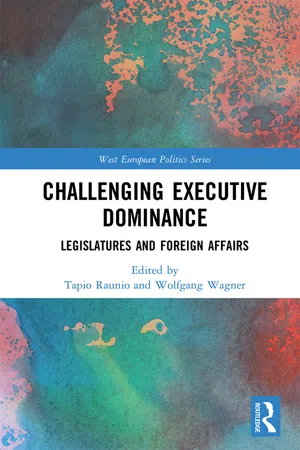
Bringing together scholars from Europe and North America, this book examines the engagement of legislatures across the world in foreign and security policy. The articles are specifically chosen to cover the whole range of foreign affairs questions from crisis management and military missions, arms trade, the Common Foreign and Security Policy (CFSP) of the European Union (EU), international energy agreements, to international trade negotiations. Drawing on a principal-agent framework, the book challenges the conventional wisdom of 'executive autonomy' in foreign affairs, with parliaments using multiple ex ante and ex post instruments to monitor, oversee and control governments in external relations. Moving beyond the 'politics stops at the water's edge' image, the articles highlight the role of party-political contestation instead of consensus in the name of national interest structuring parliamentary debates and decision-making in this increasingly politicized issue area. Considering the lack of research on parliamentary participation in foreign affairs beyond the specific case of the U.S. Congress, the book will also contribute to theory building and will deepen our understanding of legislative-executive relations. The chapters originally published as a special issue in West European Politics.
eBook - ePub
Challenging Executive Dominance
Legislatures and Foreign Affairs
- 228 pages
- English
- ePUB (mobile friendly)
- Available on iOS & Android
eBook - ePub
Towards parliamentarisation of foreign and security policy?
Tapio Raunio and Wolfgang Wagner
With two notable exceptions, legislative‒executive relations in the realm of foreign and security policy have attracted remarkably little scholarly attention. The first exception is the vast number of studies on the United States Congress whose unparalleled power has made it impossible to ignore in any comprehensive analysis of American foreign policy (Howell and Pevehouse 2007; Milner and Tingley 2015). The other exception is the recent wave of studies on the parliamentary control of military missions that emerged in the wake of the so-called Democratic Peace debate (e.g. Dieterich et al. 2015; Mello 2014). The study of legislative‒executive relations in external relations other than the use of force, however, is by and large unchartered territory for almost every democratic country other than the United States (Raunio 2014).
Scholarly interest in this topic has been discouraged in at least three ways. First, in contrast to the single remaining superpower (United States), the foreign policies of virtually every other country seem less consequential and naturally attract less scholarly interest. Second, a viable tradition in political theory holds that the role of parliament does and should stop at the ‘water’s edge’, where an area of executive privileges and responsibilities begin. Third, and related to the previous point, traditional notions of dividing labour between the sub-disciplines in political science suggest that comparative politics scholars study legislative‒executive relations but stop at the water’s edge where the domain of international relations scholars begins whose natural focus is on the relations of the executive with other governments or international organisations. This last point certainly applies more to Europe than to the United States, where there is a rich tradition of examining the influence of domestic actors and institutions on foreign and security policies.
This lack of research is regrettable for several reasons. As suggested above, there is a long line of thinking arguing that foreign and security policy is (and even should be) dominated by the executive, with parliaments wielding marginal or at best limited influence. However, the lack of research beyond the very specific case of the US Congress means that we actually do not know whether such ‘accepted wisdom’ applies to democracies in Europe and other continents. Hence there is a demand for subjecting this notion of ‘executive dominance’ to careful empirical scrutiny. Considering the stronger impact of regional and global regulations and the ever-growing interdependence of national and international political agendas, scholarly understanding of parliaments and of legislative‒executive relations remains seriously deficient without theory-driven empirical studies on whether and how legislatures become involved in foreign affairs. The expanding range of political issues that are subject to international regulation should produce stronger incentives for parliamentary engagement in foreign affairs, and signals the need to study whether that engagement differs between various policy sectors.
This collection addresses the lack of scholarly attention to national parliaments (other than the US Congress) in foreign and security policy.1 We understand foreign policy as the official external relations of a country, with security policy a key dimension of foreign affairs. The papers included in this collection cover the whole range of foreign policy questions from crisis management and military missions, the arms trade, the Common Foreign and Security Policy (CFSP) of the European Union (EU) to international trade and energy agreements. Our guiding question goes to the very heart of legislative‒executive relations: which factors allow parliaments to exercise influence over the executive and, by implication, under what circumstances does the executive succeed in maintaining or recapturing executive privilege? We also explore whether legislatures have become more involved in foreign affairs over time. The second main research question focuses on the party politics of foreign affairs: which political forces inside the legislature act as engines for tighter oversight of the government? In this context we examine the respective roles of party ideology and country-specific historical or constitutional features in explaining the level of parliamentary engagement. The next section reviews the state of the art on executive‒legislative relations in foreign and security policy. Based on principal‒agent models, the third section introduces our analytical framework and research hypotheses. The two final sections of this introductory paper discuss the main findings and their implications for future research.
The state of the art: weak parliaments, strong executives, and the changing foreign policy agenda
It is customary to argue that foreign policy is very much dominated by the executive, with parliaments weaker vis-à-vis the government in foreign policy than in domestic matters2 – and indeed, such bias in favour of the government is even perceived to benefit the country.3 This line of thinking is nothing new, and can be traced back to political philosophers such as Locke (1960) or de Tocqueville (1990).
The notion of ‘executive dominance’ can be best captured through comparing foreign affairs with domestic and EU policies (Hegeland 2007; Lüddecke 2010). Domestic and EU laws are processed in parliaments according to standard practices familiar to MPs, whereas foreign policy consists to a large degree of non-legislative items such as monitoring international negotiations or military conflicts. The information rights of legislatures can also be stronger in domestic and EU issues. Information asymmetries in favour of the executive that represents the country abroad are thus significant, even in those instances where the approval of the legislatures is required for the agreements reached by the governments.4 Differences are also found in policy-making style and level of contestation. In domestic issues party-political conflicts and public discussion are seen as normal or prerequisite for democratic deliberation, whereas foreign policy decision-makers often evoke notions of national unity and demand that the major political parties at least try to build consensus on these issues so that disunity at home does not undermine success abroad. This is indeed the core of the ‘politics stops at the water’s edge’ idiom, according to which ideological differences are set aside in favour of the national interest.
Such considerations apply particularly to security and military issues. The effective formulation and defence of the national interest requires that the executive is given sufficient room for manoeuvre, and secrecy is often presented as integral to the advancement of national interests. As the efficient conduct of security policy, especially regarding use of force, requires flexibility and fast reactive capacity, parliamentary involvement may cause unnecessary delays that obstruct the achievement of important foreign policy goals. Members of parliament (MPs) themselves may share the belief that public criticism of the government might compromise national security. Delegation to the executive can also be attractive for MPs as foreign relations are perhaps not that important for re-election and even with active scrutiny, it is the executive that gets the blame or credit for success abroad. There can thus be more costs than benefits for legislators in subjecting the government to tight scrutiny in foreign relations.
Governments can indeed seek to avoid legislative constraints through framing issues as security threats – in line with what is termed ‘securitisation’ in international relations literature (Buzan et al. 1998; Waever 1995). In the United States presidents can benefit from framing foreign policy issues as security or military matters or from employing the rhetoric of war in other issue areas such as fighting drugs. During wars presidents enjoy not only more discretion but also greater success in navigating policies through the Congress, and budgetary items with more direct connections to national security allow the president greater freedom from congressional constraints than foreign trade and aid, in which decision-making is shaped more by constituency interests and party-political differences (e.g. Broz 2011; Hiscox 2002; Howell et al. 2013; Milner and Judkins 2004; Milner and Tingley 2015). However, comparing the impact of the ‘war on terror’ on the legislative‒executive relationship in eight countries, the volume edited by Owens and Pelizzo (2009; see also Scott and Carter 2014) suggests that parliaments are not necessarily weakened during such crises, with only three cases – the United States, Great Britain and Russia – providing evidence of executive empowerment.
At least the US Congress has been fighting back. Since the Vietnam War it has clearly become more assertive in foreign affairs, with congressional influence on average stronger under divided governments. For example, it has introduced stricter reporting requirements that force the president to consult Congress prior to decision-making or during international economic negotiations and military conflicts, the most famous being the contested War Powers Resolution from 1973.5 The literature on the Congress also shows the variety of tools legislators have for engaging in foreign policy – from plenary debates and questions, committee scrutiny, voting on budgetary items and international agreements, setting tighter ex ante limits to presidential action, exercising direct control over the military, to public posturing and grandstanding (e.g. Auerswald and Campbell 2012; Campbell and Auerswald 2015; Carter and Scott 2009; Howell and Pevehouse 2007; Howell et al. 2013; Kriner 2010; Lindsay 1994; Milner and Tingley 2015).
Apart from Lüddecke (2010), who provides an in-depth overview of the German Bundestag, the British House of Commons and the Danish Folketinget, scholarly understanding of how European legislatures engage in foreign affairs is very limited. Recent studies of parliamentary control of CFSP indicate strong variation between legislatures (Huff 2015; Peters et al. 2008). Otherwise comparative research has almost exclusively focused on ‘war powers’. This body of work underlines the importance of historical experiences, such as wars, on structuring the constitutional framework for foreign policy, including parliamentary participation rights (Cassese 1980). It also provides support for the ‘parliamentary peace’ argument, according to which involvement in military conflicts decreases as the war powers of the respective national legislatures are strengthened. Negative war experiences and lower levels of security threats correlate with parliamentary veto power over troop deployments. On the other hand, joint military missions, coordinated primarily by the North Atlantic Treaty Organization (NATO), the United Nations (UN), and the EU, or collective defence clauses create challenges for parliamentary involvement.6 In the context of accession to NATO and the EU, many Central and Eastern European states relaxed their parliamentary restrictions and abolished their parliamentary provisos for NATO and EU operations. These studies also indicate that decisions about entering military missions can be much more politicised and contested than during the Cold War (e.g. Auerswald and Saideman 2014; Born and Hänggi 2004; Dieterich et al. 2015; Mello 2014; Peters and Wagner 2011, 2014).
However, whether to participate in military operations is just one, although highly important, aspect of foreign policy. This is where the changing nature of foreign policy enters into the equation. Previously one could more plausibly argue that international issues were significantly less relevant for MPs and voters, thus reducing incentives for parliamentary engagement. Already in the late 1970s, however, Manning (1977) paid attention to the rise of issues falling somewhere between pure foreign and domestic policy – or what he referred to as ‘intermestic’ issues. Growing levels of interdependence and globalisation have internationalised an increasing range of issues previously decided nationally, such as immigration (as exemplified by the current refugee crisis in Europe), trade, energy, and environment policies or human rights questions. Not only are more issues decided in or influenced by European or international negotiations, they also have more direct distributional consequences for voters and interest groups. Moreover, higher levels of education and more varied sources of information have brought about a comparably well-informed and interested public that pays more attention to international questions (Norris 2011), with the politicisation of international relations (Zürn 2014) thus providing an increasing ‘electoral connection’ to foreign affairs (Aldrich et al. 2006). The changes in the international system also facilitate broader interest and debate in foreign and security policy. In the post-Cold War era countries have more choice. Decisions about entering ‘wars of choice’ (see above), exporting arms, development aid, or trade agreements are thus likely to be more politicised decisions than during the Cold War. These developments should produce stronger incentives for parliamentary engagement in foreign affairs whilst bringing domestic, European and international politics closer together.
Turning to parliamentary culture in foreign affairs, the ‘politics stops at the water’s edge’ thesis suggests that consensus is the norm or goal, particularly in security and military matters. In a rare study from the European context, Jerneck et al. (1988) showed while foreign and security policy were characterised by consensus in the Swedish Riksdag, showed that while foreign and security policy were characterised by consensus, foreign aid and to a lesser extent general defence policy (which often has strong constituency links, for example through decisions on location of domestic military bases) produced conflict in the committees. Yet there is room for party politics and government‒opposition dialogue, although apparently less than in domestic policy. In foreign policy ‘hawks’ are more often found among right-leaning legislators and ‘doves’ on the left. In the US context there is strong evidence of such a divide between Democrats and Republicans (e.g. Alesina and Rosentha...
Table of contents
- Cover
- Half Title
- Series Page
- Title Page
- Copyright Page
- Table of Contents
- Citation Information
- Notes on Contributors
- 1 Towards parliamentarisation of foreign and security policy?
- 2 The party politics of legislative–executive relations in security and defence policy
- 3 Legislatures and civil–military relations in the United States and the United Kingdom
- 4 Precedents, parliaments, and foreign policy: historical analogy in the House of Commons vote on Syria
- 5 Curbing the royal prerogative to use military force: the British House of Commons and the conflicts in Libya and Syria
- 6 France’s reluctant parliamentarisation of military deployments: the 2008 constitutional reform in practice
- 7 Public critic or secretive monitor: party objectives and legislative oversight of the military in Canada
- 8 Japan’s uncertain security environment and changes in its legislative–executive relations
- 9 Parliamentary scrutiny of the EU’s Common Foreign and Security Policy
- 10 Energy diplomacy under scrutiny: parliamentary control of intergovernmental agreements with third-country suppliers
- 11 TTIP and legislative–executive relations in EU trade policy
- Index
Trusted by 375,005 students
Access to over 1.5 million titles for a fair monthly price.
Study more efficiently using our study tools.
Frequently asked questions
Yes, you can cancel anytime from the Subscription tab in your account settings on the Perlego website. Your subscription will stay active until the end of your current billing period. Learn how to cancel your subscription
No, books cannot be downloaded as external files, such as PDFs, for use outside of Perlego. However, you can download books within the Perlego app for offline reading on mobile or tablet. Learn how to download books offline
Perlego offers two plans: Essential and Complete
- Essential is ideal for learners and professionals who enjoy exploring a wide range of subjects. Access the Essential Library with 800,000+ trusted titles and best-sellers across business, personal growth, and the humanities. Includes unlimited reading time and Standard Read Aloud voice.
- Complete: Perfect for advanced learners and researchers needing full, unrestricted access. Unlock 1.5M+ books across hundreds of subjects, including academic and specialized titles. The Complete Plan also includes advanced features like Premium Read Aloud and Research Assistant.
We are an online textbook subscription service, where you can get access to an entire online library for less than the price of a single book per month. With over 1.5 million books across 990+ topics, we’ve got you covered! Learn about our mission
Look out for the read-aloud symbol on your next book to see if you can listen to it. The read-aloud tool reads text aloud for you, highlighting the text as it is being read. You can pause it, speed it up and slow it down. Learn more about Read Aloud
Yes! You can use the Perlego app on both iOS and Android devices to read anytime, anywhere — even offline. Perfect for commutes or when you’re on the go.
Please note we cannot support devices running on iOS 13 and Android 7 or earlier. Learn more about using the app
Please note we cannot support devices running on iOS 13 and Android 7 or earlier. Learn more about using the app
Yes, you can access Challenging Executive Dominance by Tapio Raunio,Wolfgang Wagner in PDF and/or ePUB format, as well as other popular books in History & Military & Maritime History. We have over 1.5 million books available in our catalogue for you to explore.