- 216 pages
- English
- ePUB (mobile friendly)
- Available on iOS & Android
eBook - ePub
About this book
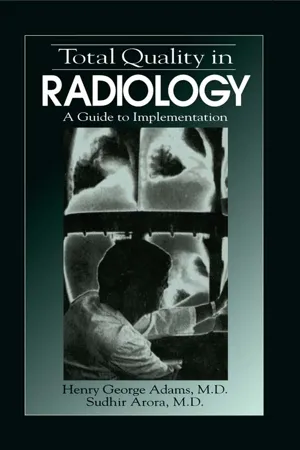
Total Quality is a practical, proven approach to management that is successfully being applied throughout American industry-and more recently in health care organizations. Total Quality in Radiology: A Guide to Implementation is designed to be used by the neophyte or experienced quality improvement practitioner. Written by two authors with extensive experience in departmental leadership, problem solving, and improvement programs, this new book provides the reader with a step-by-step, practical approach for implementing total quality in a radiology department.
The book covers all the principles of total quality and provides the basic tools necessary to begin and implement a detailed QI program.
For the administrator, there are examples of actual radiology improvement projects that have been implemented in U.S. hospitals-including successes and setbacks. Lessons learned and pitfalls are openly discussed.
For the radiologist, there is a fresh new look at quality from the "customer's" perspective-the patient and referring physician. Examples of programs "in operation" are provided as well as suggestions for other areas where radiology-initiated quality programs may have a positive impact on patient outcome.
This book has something for those who want relief from crisis management and wish to maintain an abiding commitment to an improved health care workplace.
Information
Part I
______________
THE BASICS
1
________________
INTRODUCTION to
TOTAL QUALITY MANAGEMENT
INTRODUCTION
Is the practice of radiology in the United States heading toward a state of crisis? Do external influences threaten to remove the autonomy of the practice enjoyed since the discovery of the X-ray? Is the economic structure of today’s practice changing unfavorably? Are inroads in the practice of radiology being made by individuals not trained in diagnosis? Many would respond affirmatively, but why?
Healthcare cost currently represents about 13% of the Gross Domestic Product (GDP) in the United States, which is the highest percentage among the five other major industrialized countries. If the cost continues to escalate at the present rate, by the turn of the century it may be 16 to 20% of the GDP. What do we have to show for this? Despite an inordinate financial outlay, the infant mortality rate in the United States is the highest compared to the same five countries. We do not even rank among the top ten countries with the lowest infant mortality rate. In addition, over 37 million Americans are either uninsured or underinsured for healthcare. The high cost of healthcare, which some measure as the most expensive per capita in the world, certainly harms the poor and underinsured. In addition, it has the potential to hinder the success of businesses which drive this economy in the world marketplace.
The American healthcare consumer is becoming much more intelligent and informed regarding his or her care and is demanding more for the expense. Public confidence in leaders of organized medicine has fallen from 73% in the mid-1960s to 33% in 1986. The vast majority of Americans believe that the increased cost of healthcare is not justified, and they believe that rising costs can be reduced by better organization and management, without cutting the quality of care. Failing that, there is rising public interest in mandated controls on costs. This interest is being transmitted to public policymakers who affect government-subsidized healthcare programs.
Cost and quality control mandates are already in place for radiologists as a result of the public perception of poor quality. The Breast and Cervical Cancer Screening Mortality Prevention Act of 1990 Is the direct result of the public outcry for improved quality. This act mandates certain standards in mammography and Pap smear screening. The Breast Cancer Quality Improvement Act of 1992 requires all mammography sites to be certified.
Some states (Michigan, New Mexico) have already passed laws requiring certain standards for mammography screening. In others (Kentucky, District of Columbia), insurers require accreditation before payment of mammography fees.
Whether or not this can be considered misdirected control of costs, physician reimbursements are coming under more intense downward pressure under the Resource Based Relative Value Scale (RBRVS) in an effort to reduce costs without concern for quality. One can only Interpret from this that the future of radiologic practice, where radiologists are told not only how much they will be paid for their work but also how they are to accomplish it, is here today.
Highly advanced technology has proliferated throughout the healthcare system and added to the cost of care, sometimes without benefit in the outcome of a patient encounter. Some find this state-of-the-art technology unnecessary; others demand it as a sign that they are receiving “quality” care. Excessive malpractice suits and awards have fueled overutilization of these diagnostic technologies.
The financial health of healthcare institutions is also of concern. Nearly 700 hospitals in the United States went out of business in the 1980s. Reasons for these closures include reduced federal reimbursements for Medicaid and Medicare patients, the high cost of emergency trauma care, caring for uninsured patients who are unable to pay, and in some cases a shortage of healthcare workers. This is convincing evidence that the U.S. healthcare system, and along with it radiology and its high-cost Imaging procedures, is in crisis.
Fundamental changes are needed in the ways the healthcare industry conducts business. Tort reform is not the only answer. Adjudicated and legislated policies are not an acceptable answer. The best defense for the healthcare profession is a good offense. As providers, we can apply our scientific skills and leadership to improve the medical knowledge base and provide a better product. As administrators, we can apply new management skills to root out problems in productivity, improve satisfaction of our customers, and better serve the needs of our patients. These answers imply a return to the basics of the industry: the needs of patients and the quality of care.
Total Quality Management (TQM), which focuses on the needs and expectations of customers and the continuous improvement of the product, applies as well to radiology as it has to many Fortune 500 industries. By adopting the principles of TQM, other industrial organizations have reduced operating expenses while improving consumer satisfaction and company profitability. To survive in the decades ahead, the healthcare industry, and radiology along with it, can build upon the valuable experience gained by other service industries: improved quality leads to improved productivity, which leads to greater market share.
A wide variety of terms have been used for quality management, including Total Quality Management (TQM), Total Quality Control (TQC), Total Quality Leadership (TQL), Total Quality Improvement (TQI), Statistical Quality Control (SQC), and Continuous Quality Improvement (CQI). The term is less significant than the substance. The intent is the same: to improve the product and increase market share.
TQM is a structured, systematic approach in which all employees are utilized as a source of ideas in order to continuously improve processes, services, and products. The system integrates the development, maintenance, and improvement of quality in a never-ending cycle to produce a product or service that satisfies the customer’s needs and expectations.
The quality of any product can be gauged by multiple objective criteria, such as durability, conformance to standards, reliability, performance, and serviceability. The quality of a service is perceived by the customer and is often measured against customer expectations. Because expectations (what is acceptable) are always changing, the system mandates continual awareness of customer needs and requirements and implementation of appropriate action; hence, the term continuous Improvement.
TQM is based on the following premises:
- Due to their intimate knowledge of job conditions, those workers closest to the problem are more likely to know what is wrong with a process and how to fix it.
- Every person in the organization wants to be a valuable contributor and wants to do a good job.
- Such contributions provide the employee a sense of ownership and reduce adversarial relationships between workers and management.
- Processes, not people, are the root of quality problems. The system is the cause of the problem 85% of the time; the cause is personnel 15% of the time (the 85/15 rule).
- A structured problem-solving process using statistical means produces better long-term solutions than an unstructured process.
- Quality improvement is everyone’s job because all processes can be improved; in healthcare, all processes are interrelated by one common factor: the patient.
- Practicing in an environment of fear is counterproductive and leads to poor performance in the long run.
- 80% of the problems are the result of 20% of the causes (the 80/ 20 rule),
This book goes beyond methods for ensuring quality. Meeting standards is no longer sufficient to stay in business. We must move beyond measuring quality and toward improving it—continuously. It is our intention t...
Table of contents
- Cover Page
- Halftitle Page
- Title Page
- Copyright Page
- Dedication
- Acknowledgments
- Contents
- Preface
- PART I. THE BASICS
- PART II. IMPLEMENTATION; MAKING IMPROVEMENT CONTINUOUS
- Appendix A: Quality Improvement Templates
- Additional Readings
- Index
Trusted by 375,005 students
Access to over 1.5 million titles for a fair monthly price.
Study more efficiently using our study tools.
Frequently asked questions
Yes, you can cancel anytime from the Subscription tab in your account settings on the Perlego website. Your subscription will stay active until the end of your current billing period. Learn how to cancel your subscription
No, books cannot be downloaded as external files, such as PDFs, for use outside of Perlego. However, you can download books within the Perlego app for offline reading on mobile or tablet. Learn how to download books offline
Perlego offers two plans: Essential and Complete
- Essential is ideal for learners and professionals who enjoy exploring a wide range of subjects. Access the Essential Library with 800,000+ trusted titles and best-sellers across business, personal growth, and the humanities. Includes unlimited reading time and Standard Read Aloud voice.
- Complete: Perfect for advanced learners and researchers needing full, unrestricted access. Unlock 1.5M+ books across hundreds of subjects, including academic and specialized titles. The Complete Plan also includes advanced features like Premium Read Aloud and Research Assistant.
We are an online textbook subscription service, where you can get access to an entire online library for less than the price of a single book per month. With over 1.5 million books across 990+ topics, we’ve got you covered! Learn about our mission
Look out for the read-aloud symbol on your next book to see if you can listen to it. The read-aloud tool reads text aloud for you, highlighting the text as it is being read. You can pause it, speed it up and slow it down. Learn more about Read Aloud
Yes! You can use the Perlego app on both iOS and Android devices to read anytime, anywhere — even offline. Perfect for commutes or when you’re on the go.
Please note we cannot support devices running on iOS 13 and Android 7 or earlier. Learn more about using the app
Please note we cannot support devices running on iOS 13 and Android 7 or earlier. Learn more about using the app
Yes, you can access Total Quality in Radiology by Sudhir Arora,Henry George Adams in PDF and/or ePUB format, as well as other popular books in Medicina & Ciencias forenses. We have over 1.5 million books available in our catalogue for you to explore.