- 60 pages
- English
- ePUB (mobile friendly)
- Available on iOS & Android
eBook - ePub
Dialogues in Dying
About this book
This is a unique resource to improve this difficult and highly sensitive area of communication, ideal for both individual use and by groups or in teaching. It offers a visual, interactive training experience, linking with supportive care frameworks. It is accompanied bya DVD which contains filmed scenes illustrating a range of challenging dialogues between health workers and a patient and his family through the journey of his terminal illness. Accompanying booklet highlights communication issues with suggested exercises, reflection points and advice. It is available as individual-use-only product for self-reflective learning, or institutional-use product for tutored learning, both priced to give excellent value.
Information
SCENE 1:
First outpatients appointment since diagnosis on the ward
OVERVIEW
Scene 1 on your DVD shows an outpatients appointment attended initially by the patient, Gerry, who is later joined by his girlfriend Esha. In the clips we see Gerry’s consultant and specialist nurse confirming his MND diagnosis, broaching difficult topics and managing some difficult and sensitive questions about quality of life and the prospect of dying.
Themes include: Confirming a terminal diagnosis, partner/carer inclusion, discussing life expectancy, talking about death, managing unwelcome news and conversations about quality of life.
COMMUNICATION ISSUES
Voiceover: ‘This DVD is not about communication skills …’
If this DVD is not about communication skills, what is it about? As the voiceover says, it’s partly about the problems people have in articulating their concerns. It isn’t enough to have the skills – they must be used as well. And also, partly, you will see in this DVD that sometimes saying the kind of thing one is advised to say can work less well if the words said fail to account for the context they are said in.
In other words, the really good communicator, under the kind of difficult circumstances you will see on this DVD, is someone who has four qualities:
■ Good basic communication skills.
■ A willingness (a kind of courage) to use them to open up difficult areas.
■ An ability to monitor what they are saying, and how the other person is responding.
■ And an ability to be flexible, i.e. to change one’s style if things aren’t working.
Doctor: ‘I don’t know if you know what it is …’ (i.e. what MND is)
This is a classic opening – the response to this question is likely to give information about how the patient perceives the condition (is he right or wrong in what he believes? Has he got any misconceptions?), and will also give insight into how he wants to perceive the illness, and the language he wants to use to talk about it. Does he want to use the word ‘dying’ for example?
One of the most important things that the healthcare worker does is to talk, wherever possible, in the same terms as the patient. This is usually suggested as if it’s simply a matter of, for example, not using jargon and that kind of thing – but actually it goes much deeper than this.
We talk more or less formally, depending on who we’re talking to; for example, notice that the healthcare worker here explicitly changes the nature of the relationship by asking permission to use the patient’s first name. But also we tend to use the same words as other people, as part of how we share and build a conversation. In difficult areas like this, there will probably be words and phrases whose use needs to be negotiated throughout.
As you listen to this excerpt, be aware of how the healthcare workers and the patient and his girlfriend use the language of ‘dying’. Who uses which words?
There is a serious risk that some patients will try to keep the difficult topics at a distance, and that the healthcare worker will want to collude with this.
Doctor: ‘If you remember nothing else about today …’
This is a key statement about the support on offer for Gerry (and his partner). The particular point is to notice how clearly and explicitly this key message is signalled by the use of the phrase above.
Notice also the phrase:
Doctor: ‘… to live well with MND’
All good healthcare workers in difficult areas develop words and phrases which they feel comfortable with, and which they find work for them. This is just such a key phrase and this healthcare worker uses a number of these in this interaction.
The exact phrases are likely to differ from one healthcare worker to another, and, of course, need to be used judiciously – they won’t be appropriate for every patient. Each healthcare worker needs to work their way towards some of these key phrases over their career, monitoring them constantly. Perhaps the phrase ‘live well with MND’ is one that you can imagine using – perhaps you can’t. This is a topic we’ll return to.
You might ask yourself what words you use in response to the common question, ‘Am I going to die?’
You will notice later that the healthcare worker here has a moderately complex but (do you agree?) very successful set of phrases around the idea that ‘MND is a disease that will kill the patient before another disease can kill the patient’.
SHARING A JOKE
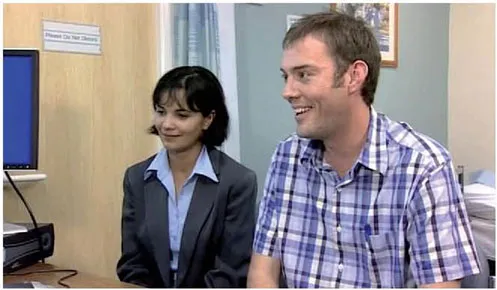
This is one occasion in this excerpt when the participants share a joke – the other is when Gerry gives permission for his first name to be used.
The importance of this should not be underestimated. It isn’t a question of ‘lightening the mood’. Sharing a joke is a perfect way of demonstrating to Gerry and his partner that he is a person quite apart from his disease. Human beings reach out and touch each other through humour – there is a lovely poem by an American poet whose son died as a child in which he remembers him, and remembers particularly what he calls ‘the laughter of love’. Laughter is the perfect way of respecting another person.
Doctor: ‘I think the diagnosis is quite clear …’
There are a number of things which the healthcare worker says about (a) how sure she is about the diagnosis and (b) what she thinks the prognosis is.
These are very important areas – notice carefully her various descriptions of both.
Clearly it matters very much that she removes doubt – in that sense, of course, removes hope of ‘cure’ or of a normal life-span.
One of the things that patients with serious illness often say they appreciate is clarity, knowing where they stand. This too, note, is a matter of offering the patient respect. So the first statement about the diagnosis is carefully designed to remove doubt. The aim here is to use language which ensures that ambiguity is removed.
Of course, here it is followed up by the phrase:
Doctor: ‘I so wish it wasn’t so …’
It is extremely rare in healthcare in general for a healthcare worker to commit herself to such an ostensibly emotive phrase – but entirely appropriate here. Listen to the tone of voice as the phrase is uttered – it sounds effortless, but it’s a beautiful blend of the personal (as one human being to another, ‘I wish it wasn’t so’) and the professional (obviously her wish for a different diagnosis is less than the patient’s wish, and she doesn’t try to suggest otherwise).
Doctor: ‘Did they mention anything about the prognosis …?’
Once more, a classic style of question, designed to help the healthcare worker understand what the patient knows, if anything, and also how he chooses to perceive it – consider how differently one would respond to ‘They told me I’d had it’ and ‘They suggested it might be quite serious’.
At this stage, the healthcare worker suggests inviting the girlfriend in. This is useful in itself, clearly, but is a clear signal to Gerry that it isn’t going to be good news.
Doctor: ‘Unfortunately I think the diagnosis is confirmed as Motor Neurone Disease.’
The diagnosis which was ‘quite clear’, earlier, is now ‘confirmed’, i.e. this is a further statement designed to remove ambiguity. (The phrase ‘I think’ is said in such a way that it can’t mean ‘maybe’.)
Doctor: ‘… a disorder that gets worse and causes people to die …’
This takes us into the healthcare worker’s carefully thought through ways of talking about dying …
FACILITATION SUGGESTIONS
Generic points pertaining to the facilitation are located at the end of the Introduction. Please refer back to this section (page 2) before starting. Summary points are: group confidentiality, flexibility of use, language focus and learner support (practical and emotional).
Of particular interest in Scene 1 is how explicit (or direct) the healthcare worker can be when confirming diagnosis of a terminal illness, and when deciding which aspects of it are relevant and appropriate to discuss in an early consultation.
Before watching the scene
Prior to watching, encourage participants (either as an entire group, in small groups or pairs) to consider what the issues are for (a) healthcare workers and (b) patients, when diagnosis of a condition leading to death is made.
■ What thoughts and feelings might the healthcare worker experience just before the consultation?
■ What thoughts and feelings might the patient and/or carer experience just before the consultation?
■ If the diagnosis to be confirmed is definitely terminal, are there any key issues that the group would consider it essential to cover?
■ What might the barriers be to the above taking place successfully?
Small group/paired findings can be reported back to the wider group.
Watching the scene
When setting up the clips invite the participants to watch in the light of their discussion from the pre-clip task (above). To make the observation task clearer you might like to invite individuals or sub-groups to consider and report back on a particular aspect of the pre-clip discussion.
An alternative viewing task (not dependent on the pre-viewing discussion) would be to group the participants so that some pay particular attention to the consultant, some to the patient, and the remainder to the patient’s girlfriend.
■ Each group should consider in detail the perspective, concerns and agenda of their nominated character. They may wish to make notes during the observation, or alternatively watch more than once for a recap. After watching, discussion can take place within the small groups, enabling each group to present a character perspective to the other two groups.
■ As a whole group exercise, the dialogue here can be considered in some detail. Invite the group to consider particular language choices made by the clinician, and the impact on the patient and his girlfriend. Observations should be precisely evidenced. What do the group think of the language choices made, the level of directness/honesty and the importance of the issues raised?
■ Another exercise involves inviting the group to reflect on their own thoughts and feelings about taking part in discussions similar to the one they have just witnessed. Reflection here should be considered at two levels:
1 If they had been in this consultant’s chair, would they have managed the interaction in a similar or dissimilar way? This can include the way the room is set up, communication strategies, language choices or any areas of interest. N.B. It is important to remind the group that the clinical context is not relevant to this creative discussion. We have deliberately excluded the clinical detail to facilitate participants, as an exercise, being able to imagine themselves as part of the scene irrespective of their own clinical responsibilities and background.
2 In addition, and importantly, this is an opportunity for participants to share their own experiences of managing patients’ and/or carers’ reactions to distressing news. This can be undertaken in pairs or small groups. The question of reporting back, or not, depends on the facilitator’s perceptions of group and individual sensibilities.
Expert view: Dr Iñigo Tolosa
Communicating life-shattering news like a diagnosis of MND is very demanding for healthcare workers, even more so when daring to address the most difficult questions that patients and their families often ask, such as ‘Am I going to die?’, ‘How long have I got?’ or even ‘How do I tell ...
Table of contents
- Cover
- Half Title
- Title Page
- Copyright Page
- Dedication
- Table of Contents
- Introduction
- SCENE 1: First outpatients appointment since diagnosis on the ward
- SCENE 2: Home visit by a nurse, 6 months later
- SCENE 3: On another home visit the nurse speaks to the patient’s partner while she waits for him
- SCENE 4: A General Practice consultation with one of Gerry’s relatives
- SCENE 5: Outpatients, 18 months later
- SCENE 6: Interlude in an outpatients consultation
- SCENE 7: Encounter between professional colleagues involved in Gerry’s case
- SCENE 8: A bereavement dialogue
Trusted by 375,005 students
Access to over 1.5 million titles for a fair monthly price.
Study more efficiently using our study tools.
Frequently asked questions
Yes, you can cancel anytime from the Subscription tab in your account settings on the Perlego website. Your subscription will stay active until the end of your current billing period. Learn how to cancel your subscription
No, books cannot be downloaded as external files, such as PDFs, for use outside of Perlego. However, you can download books within the Perlego app for offline reading on mobile or tablet. Learn how to download books offline
Perlego offers two plans: Essential and Complete
- Essential is ideal for learners and professionals who enjoy exploring a wide range of subjects. Access the Essential Library with 800,000+ trusted titles and best-sellers across business, personal growth, and the humanities. Includes unlimited reading time and Standard Read Aloud voice.
- Complete: Perfect for advanced learners and researchers needing full, unrestricted access. Unlock 1.5M+ books across hundreds of subjects, including academic and specialized titles. The Complete Plan also includes advanced features like Premium Read Aloud and Research Assistant.
We are an online textbook subscription service, where you can get access to an entire online library for less than the price of a single book per month. With over 1.5 million books across 990+ topics, we’ve got you covered! Learn about our mission
Look out for the read-aloud symbol on your next book to see if you can listen to it. The read-aloud tool reads text aloud for you, highlighting the text as it is being read. You can pause it, speed it up and slow it down. Learn more about Read Aloud
Yes! You can use the Perlego app on both iOS and Android devices to read anytime, anywhere — even offline. Perfect for commutes or when you’re on the go.
Please note we cannot support devices running on iOS 13 and Android 7 or earlier. Learn more about using the app
Please note we cannot support devices running on iOS 13 and Android 7 or earlier. Learn more about using the app
Yes, you can access Dialogues in Dying by Connie Wiskin,John Skelton,Karen Morrison,Pauline Smith in PDF and/or ePUB format, as well as other popular books in Medicine & Mathematical Analysis. We have over 1.5 million books available in our catalogue for you to explore.