Elite Discourse examines how language and communication – or just discourse – define, mediate and legitimize class privilege. It does so from the perspective of those people and places who often stand to gain most from inequality. Collectively, chapters consider language and communication that is elitist in its appeal to distinction, excellence and superiority; they also describe the ways in which various groups and institutions lay claim to 'eliteness' as a way to position themselves (or to be positioned by others) as elite or non-elite. As such, chapters are concerned as much with discourse about elite status as they are with the discourse of elites – those groups commonly defined by their material wealth, political control, or demographic rarity. Ultimately, Elite Discourse views 'elite' as something we do, rather than something we necessarily have or are. Indeed, elite status and eliteness point us to the rhetorical strategies by which many people differentiate themselves and by which they access symbolic-material resources for shoring up their status, privilege and power. This book was originally published as a special issue of Social Semiotics.
eBook - ePub
Elite Discourse
The rhetorics of status, privilege and power
- 146 pages
- English
- ePUB (mobile friendly)
- Available on iOS & Android
eBook - ePub
Elite Discourse
The rhetorics of status, privilege and power
About this book
Information
Discourses in conflict: resource inequality, class warfare and home repossessions
David Block
ABSTRACT
The topic of this paper is an ongoing discursive conflict which has arisen in Spain around home repossession and home evictions, understood here as part of a more general class warfare waged by the financial elites on the popular classes. Firmly grounded in political economy and Critical Discourse Analysis (CDA), it examines attempts by the governing Partido Popular to represent as undemocratic a particular kind of protest action called escraches, which have been carried out by the Platform for People Affected by Mortgages, an organization which defends the rights of evictees. The key argument in this paper is that resource inequality, endemic to capitalism, has been aggravated and intensified during the current economic crisis, and that there is the need for more CDA research which is grounded in political economy to explore how events on the ground are mediated by discourses in conflict.
The topic of this paper is an ongoing discursive conflict which has arisen in Spain around home repossession and home evictions, understood here as part of a more general class warfare waged by the financial elites on the popular classes. Firmly grounded in political economy and Critical Discourse Analysis (CDA), it examines attempts by the governing Partido Popular to represent as undemocratic a particular kind of protest action called escraches, which have been carried out by the Platform for People Affected by Mortgages, an organization which defends the rights of evictees. The key argument in this paper is that resource inequality, endemic to capitalism, has been aggravated and intensified during the current economic crisis, and that there is the need for more CDA research which is grounded in political economy to explore how events on the ground are mediated by discourses in conflict.
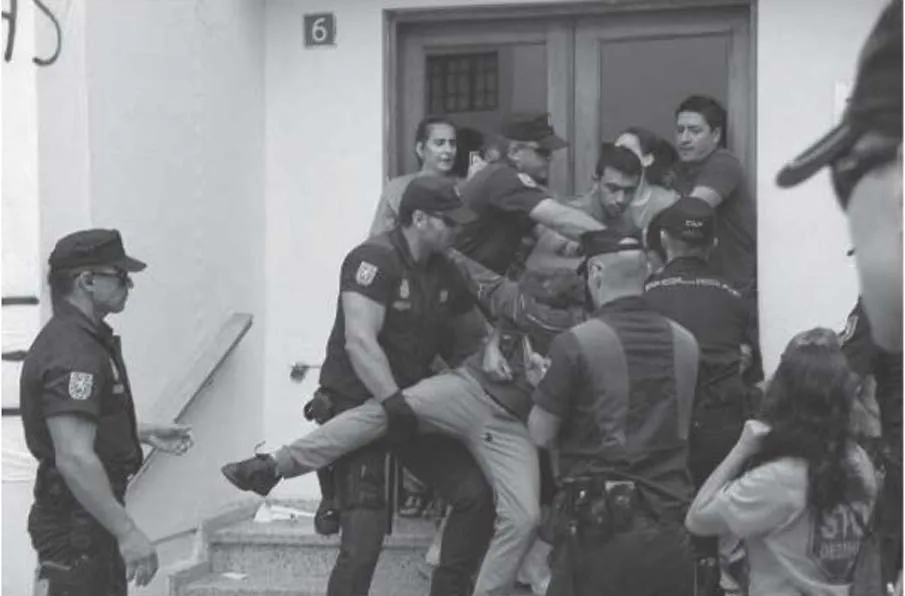
This photo is from an article published in September 2013 in the Diario de Lanzarote, a newspaper based in Lanzarote, Canary Islands (Garcia 2013).1 It shows the precise moment in which an unidentified man, who is trying to prevent the eviction from taking place, is bundled out of a block of flats. Three police officers are involved in this endeavour while a fourth prevents green-shirted members of the PAH (Platform for People Affected by Mortgages), an organization which defends the rights of evictees, from intervening. The scene is observed by several additional police officers, another member of the PAH and the photographer who took the photo (identified in the bi-line as “De la Cruz”). The article is from 2013, but at the time of writing, in the latter half of 2016, home eviction stories continue to appear in the media with some frequency, as the effects of the current economic crisis continue to be felt in southern European countries. In some cases, there are vivid photos of the evictees themselves, often retired octogenarians, being carried out of buildings by police offices dressed in riot gear, thus accentuating the physical differences between the powerful and the disempowered. In the specific case at hand, there is no such photo, as the evictee, the manager of a bar named Cati Villalonga, left her flat offering no resistance.
The exact trajectories of home evictions vary across individuals, but the common element is the inability to pay a mortgage or rent and the eventual loss of one’s home. Garcia recounts Villalonga’s mortgage default experience as follows:
[In 1998] Banco Santander granted her a loan of 6,850,000 pesetas (40,000 euros). Until 2005, she paid about 400 euros per month. Then she remortgaged her flat because she needed money and her monthly payments went up to 1000 euros. She managed to pay until three years ago, when she could no longer do so. The bar business was not going well then, and now after a bridge closing due to work on a bypass, it is even worse. The fact is that, although it may seem hard to believe, she has ended up paying almost 120,000 euros (three times the initial value of her loan) in installments to the bank and she still owes an additional 100,000 euros. Banco Santander has offered her no options and will repossess her flat. (Garcia 2013, np)2
Reading this account, and many others like it, one is left with the strange mix of incredulity and indignation, along with the temptation to utter the well-worn phrase: “you couldn’t make it up.” But home evictions are indeed real events (real people are physically removed from their real homes) and the photo reproduced above is eloquent in this regard. In it, we see the aggressive behaviour of police officers, who extract people from their homes, contrasted with the resistance of the latter, even if, as noted above, many evictees, resigned to their fate, simply walk away from their homes. There is, in addition, the resisting behaviour of PAH members, neighbours and family members, which ranges from human chains to block the entry of police offices, to less physical protests such as holding banners and chanting. Beyond these events on the ground, there is their mediatization in newspapers such as the Diario de Lanzarote. However, perhaps more importantly, there is the meaning making which occurs when powerful politicians and activists clash over interpretations of the actions of the latter, who protest against and try to obstruct what they see as unjust policies. In this paper I will address such clashes. I begin with discussion of key constructs undergirding my discussion – inequality and class warfare – before moving to the case of home evictions as the site of discursive class warfare. I end with a brief comment drawing strands together. Bearing in mind the topic of this special issue, elite discourses and the rhetorics of status and privilege, I position politicians in government as a kind of managerial elite. I feel justified in taking this stance, given their embeddedness in and collusion with power structures, and above all, how they act as agents carrying out class warfare against the popular classes on behalf of the banking sector.
Inequality and class warfare
If one thing has become clear in the midst of the current economic crisis, it is that the neoliberal policies applied in so many parts of the world over the past 40 years have led to greater inequality and larger proportion of populations living in poverty or near-poverty (Piketty 2014). In effect, the income gap between the upper end of the class scale and middle and lower end is by now already vast and continues to grow. This has happened because the policy followed by governments and supranational entities to combat the economic crisis caused by neoliberal polices is simply to adopt more neoliberal polices (Crouch 2011). Income inequality is of course very important in any attempt to grasp and understand unfair imbalances in societies, but there is a need to consider how it intersects with other forms of inequality. Therborn (2006), for example, has proposed a three-part model of equality. There is what he calls resource inequality, which refers to the variable access that individuals and collectives have to a large number of different, though interrelated, material (economic) resources, including property, income and wealth, as well as their access to sociocultural or symbolic resources, along the lines of Bourdieu’s cultural and social capitals (Bourdieu 1984). There is also vital inequality, that is, individuals and collectives’ basic life and death chances and their relative exposure to life-threatening natural phenomena, such as disease and famine; self-inflicted human conditions, such as violence and alcoholism; and larger human-made disasters, such as war and environmental pollution. Finally, there is existential inequality, which is about systems of oppression, such as patriarchy, racism, religious persecution and homophobia, which deny individuals and collectives what are understood today to be basic human rights.
Therborn’s multidimensional view of inequality maps onto class differences in a very direct way. In this paper, I understand class in terms of a constellation of dimensions model (Block 2014, 2016). This model draws on the foundational political economic work of Marx ([1867] 1990); the later, more sociocultural models of class elaborated by Durkheim ([1893] 1984), Weber ([1922] 1968) and (much later) Bourdieu (1984). It frames class in terms of a long list of factors, including property owned, material possessions, income, occupation, education, social networking, consumption patterns, symbolic behaviour, pastimes, mobility, neighbourhood and type of dwelling inhabited. These dimensions of class cluster together and index points of contrast between and among individuals in class-based societies where class struggle and class conflict are a part of daily life, albeit in ways that are often subtle and go unnoticed.
Class struggle may be defined as
conflicts between the practices of individuals and collectives in pursuit of opposing class interests … rang[ing] from the strategies of individual workers within the labour process to reduce their level of toil, to conflicts between highly organized collectivises of workers and capitalists over the distribution of rights and powers within production. (Wright 2005, 20–21)
The kind of conflicts cited by Wright have certainly come to a head recently in the midst of neoliberal polices which have favoured the interests of the wealthy while constituting an attack on the well-being of the popular classes in countries around the world. Nowhere has such an attack been more evident than in the transfer of capital assets from the less wealthy in society to the wealthiest since the beginning of the economic crisis in 2007.
In an attempt to understand this trend, Harvey (2010) updates Marx’s notion of “primitive accumulation,” proposing what he calls “accumulation by dispossession,” that is, how over the past 40 years, governments and financial institutions have transferred wealth from the popular classes to the already-affluent elites.3 Examples of government practices in this direction include the privatization of state-owned and operated industries and services, and the sale of state-owned assets, all of which effectively divest the public (the people) of what once belonged to all, transferring it to the wealthy. An example in the financial sector is banking improprieties in which individuals who turn over their life savings to financial advisors on the promise of low-risk, easy benefits, suddenly find that they have lost everything because their bank has failed. Another example is home repossessions such as the one presented at the beginning of this paper, a topic to which I will now turn. As I have done elsewhere (Block 2017a, 2017b), I will examine how such events are discursively constructed, and I will do so via the story of a conflict between a governing political party and a grassroots association defending the rights of home owners who cannot pay their mortgages or rent.
Political elites and class warfare: the PP, the PAH and escraches
In this discussion of inequality and class warfare, there are two key participating collectives. First, there is the PP (Partido Popular), the Spanish conservative party, in power from late 2011 to the present. From early 2012, the PP began to apply extreme austerity measures, including across-the-board pay cuts for civil servants and cutbacks in funding for essential services such as health care and education. One key development arising from the economic crisis from 2011 onwards was the increase in home evictions, a phenomenon which led directly to the formation and rise to media prominence of the second key participating collective in this discussion, the PAH. The PAH is a grassroots organization which campaigns on behalf of individuals and families who because of unemployment or other events find that they are unable to make mortgage or rent payments and therefore are either threatened with eviction from their homes or are actually evicted. It is composed of various groups of people, from left-leaning activists to individuals who have actually been evicted from their homes. Evictions normally occur with no provision of alternative accommodation and as we saw above, they can be extremely traumatic experiences for those who are evicted. On the PAH’s webpage, one finds the following explanation of why the organization was founded in September 2011:
The motives behind the campaign are simple: they steal our homes and condemn us to continue paying for them. We are left in the street without any housing alternative. Banks, including those which were rescued, continue to display an antisocial attitude, evicting families and accumulating a huge stock of empty houses disregarding the social function of housing. The government protects such actions: it neither stops them nor offers solutions such as social rent, putting a halt to evictions or waiver of payment. PAH’s social project consists of a campaign of occupations and the recovery of the right to housing in response to a generalized state of housing emergency generated artificially and intentionally by banks and the government. To address this situation, we propose the recovery of empty housing held by banks for the homeless and our main demand is a social rent for families, in accordance with their income. The social project connects seamlessly with the trajectory of the PAH: the defense of the population when their rights are amputated, disobedience to recover these rights and in this way drive solutions. (PAH, http://afectadosporlahipoteca.com)
This text is discursively framed according to notions of class struggle and class warfare, as outlined above. It suggests a clear division between the empowered capitalist class (backed by the government) and the relatively disempowered popular classes (with little or no formal institutional support). In effect, the former – “they” – act against the interests of the latter – “we” – thus engaging in a form of class warfare which is denied by the government and most of the media, but surely identified and felt by the popular classes. In the text, “we” refers to the population in general (or “families”) and those members of the general population directly affected by the unfair mortgage law which dated back to 1946 and had remained unaltered for over 65 years. Passed during the Franco regime, but left untouched during almost 40 years of democratic ...
Table of contents
- Cover
- Half Title
- Title Page
- Copyright
- Contents
- Citation Information
- Notes on Contributors
- Introducing elite discourse: the rhetorics of status, privilege, and power
- 1. Discourses in conflict: resource inequality, class warfare and home repossessions
- 2. Elite schools, class disavowal and the mystification of virtues
- 3. Mediatizing the “super-rich,” normalizing privilege
- 4. Beyond the “gentry aesthetic”: elites, Received Pronunciation and the dialectological gaze
- 5. Walking plutocratic London: exploring erotic, phantasmagoric Mayfair
- 6. Stinking to high heaven: olfactory aspirations and discourses of desire
- 7. The neoliberal definition of “elite space” in IKEA kitchens
- 8. Racial ideology as elite discourse: Nordicism and the visual in an age of mass culture
- 9. Elite discourses of conservation in Tanzania
- 10. Multilingualism and cosmopolitanism in the construction of a humanitarian elite
- 11. Differentiated eliteness: socialization for academic leadership
- Index
Trusted by 375,005 students
Access to over 1.5 million titles for a fair monthly price.
Study more efficiently using our study tools.
Frequently asked questions
Yes, you can cancel anytime from the Subscription tab in your account settings on the Perlego website. Your subscription will stay active until the end of your current billing period. Learn how to cancel your subscription
No, books cannot be downloaded as external files, such as PDFs, for use outside of Perlego. However, you can download books within the Perlego app for offline reading on mobile or tablet. Learn how to download books offline
Perlego offers two plans: Essential and Complete
- Essential is ideal for learners and professionals who enjoy exploring a wide range of subjects. Access the Essential Library with 800,000+ trusted titles and best-sellers across business, personal growth, and the humanities. Includes unlimited reading time and Standard Read Aloud voice.
- Complete: Perfect for advanced learners and researchers needing full, unrestricted access. Unlock 1.5M+ books across hundreds of subjects, including academic and specialized titles. The Complete Plan also includes advanced features like Premium Read Aloud and Research Assistant.
We are an online textbook subscription service, where you can get access to an entire online library for less than the price of a single book per month. With over 1.5 million books across 990+ topics, we’ve got you covered! Learn about our mission
Look out for the read-aloud symbol on your next book to see if you can listen to it. The read-aloud tool reads text aloud for you, highlighting the text as it is being read. You can pause it, speed it up and slow it down. Learn more about Read Aloud
Yes! You can use the Perlego app on both iOS and Android devices to read anytime, anywhere — even offline. Perfect for commutes or when you’re on the go.
Please note we cannot support devices running on iOS 13 and Android 7 or earlier. Learn more about using the app
Please note we cannot support devices running on iOS 13 and Android 7 or earlier. Learn more about using the app
Yes, you can access Elite Discourse by Crispin Thurlow, Adam Jaworski, Crispin Thurlow,Adam Jaworski in PDF and/or ePUB format, as well as other popular books in Languages & Linguistics & Communication Studies. We have over 1.5 million books available in our catalogue for you to explore.