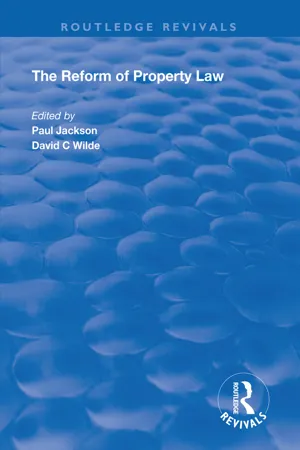
First published in 1997, this volume constitutes a collection of new papers by more than 20 United Kingdom and International experts on general and specific issues relating to the reform of all aspects of property law. Topics covered include the language of property law and the dangers of reform, the role of the Law Commission and the workings of Parliamentary procedures, registration of title to land, landlord and tenant, land pollution, mortgages, sale of goods, the Hague Convention on trusts, together with general comparative papers and papers dealing with specific issues of property law reform affecting Hong Kong, Ireland, Scotland and South Africa. The volume arises out of the successful conference 'The Reform of Property Law' hosted by the Centre for Property Law at The University of Reading in 1996.
- 400 pages
- English
- ePUB (mobile friendly)
- Available on iOS & Android
eBook - ePub
The Reform of Property Law
Part I
General Considerations
1 Reforming the Language of Property Law
PETER BUTT
Introduction
No aspect of modern law is more in need of reform than its language. This includes property law - perhaps especially property law. The language of property law renders it largely inaccessible to the general community. Doubtless, reforms are needed in many areas of substantive property law, to take account of changing social conditions and to ensure fairness and equity to those affected by it. But the language of property law must also be reformed, so that those it affects are able to understand it. Otherwise, access to the law will remain as elusive as ever, the preserve of those select few who have mastered the mystical incantations of legal language.
This chapter is a plea to reform the language of property law. It is a plea for plain language.
The Need for Reform
Lest anyone doubt the need for reform, let me give some examples of the language of present property law. They illustrate two main features, both undesirable: verbosity and undue technicality. I will look first at private legal documents, and then at statutes.
Private Legal Documents
Leases are a prime example of all that is bad in traditional legal drafting. Consider, for example, the "repairing" covenant which gave rise to the litigation in Ravenseft Properties Ltd v Davstone (Holdings) Ltd:1
[The tenant shall] when where and so often as occasion requires well and sufficiently ... repair renew rebuild uphold support sustain maintain pave purge scour cleanse glaze empty amend and keep the premises and every part thereof ... and all floors walls columns roofs canopies lifts and escalators ... shafts stairways fences pavements forecourts drains sewers ducts flues conduits wires cables gutters soil and other pipes tanks cisterns pumps and other water and sanitary apparatus thereon with all needful and necessary amendments whatsoever....
This clause exudes verbosity, a verbosity which makes it far more difficult to read than its subject matter requires - and (ironically) a verbosity which, though prompted by a desire to be exhaustive, did not in the end prevent litigation over meaning.
This Ravenseft clause is an example of that "torrential style" of drafting which has become endemic in leases.2 Commercial leases, in particular, commonly run to 50 or 60 pages, making them impossible for lay readers to comprehend and forcing lawyers into the unenviable drudgery of trawling through their turgid prose to advise clients about the obligations they impose. And yet, despite the almost universal distaste for such "over the top" leases, lawyers continue to produce them. Indeed, some lawyers argue fervently that short, simple leases are dangerous: witness the recent debate in the columns of the New South Wales Law Society Journal about a short, plain language retail lease drafted by a leading Sydney law firm.3 This predisposition towards prolixity calls to mind Davidson's comment that the legal profession prefers "to seek safety in verbosity rather than in discrimination of language".4
Of course, the problems are not confined to leases. Mortgages are just as bad - perhaps worse. Here is an example from a standard mortgage used by one of Australia's leading banks:
[The Mortgagor shall pay] Also interest upon all such moneys as aforesaid or on so much thereof as shall for the time being be owing or payable or remain unpaid without (unless the Bank otherwise in writing agrees) allowing credit for any credit balance in any account or accounts of the Mortgagor and the Debtor or either of them either alone or jointly with any other person with the Bank at the rate or respective rates agreed upon in writing if any and in the absence of any such agreement then without prior or other notice to the Mortgagor or to the Debtor at such rate or rates as the Bank from time to time determines: except as otherwise provided by the terms of any agreement in writing relating to the whole or part of such moneys such interest shall accrue from day to day and shall be computed from the day or respective days of such moneys being paid or disbursed or becoming owing and at the end of every period of such duration as the Bank may from time to time determine and ending at the end of such day as the Bank may from time to time determine (with power in the Bank to vary from time to time the length of such period or the day or days on which such period ends), or, in the absence of any such effective determination, at the end of each period of one calendar month ending at the end of the last day thereof the interest accrued up to and including such day upon any such moneys in respect of such period or any part thereof shall (if or to the extent to which it has not already been paid) commence and thereafter so long as the whole or any part thereof shall remain unpaid shall continue to carry interest at the rate aforesaid and such accrued but unpaid interest may at the option of the Bank be debited against the Debtor or in the case of interest upon moneys lent paid or advanced to for or on account of the Mortgagor or to for or on account of any other person as aforesaid at the request of the Mortgagor or for the payment of which the Mortgagor is liable to the Bank as hereinbefore stated then against the Mortgagor PROVIDED ALWAYS that such unpaid interest upon which interest shall become so payable shall not be deemed thereby or by reason of any such debiting as aforesaid or by the inclusion of interest with principal in any balance carried forward or account stated or otherwise than as hereinbefore provided to have become capitalised or added to principal but the Bank by express entry to that effect in its books and without the necessity of giving notice to the Debtor or the Mortgagor may at any time and from time to time and as from such date as the Bank shall determine capitalise and add to the principal all or any such unpaid interest upon which interest shall have become so payable and whether such unpaid interest shall have been debited as aforesaid or not and such debitings of interest and additions to principal may be continued and made and the provisions herein contained as to the moneys on which interest is payable shall continue to be applicable so long as any of such moneys remain unpaid notwithstanding that as between the Bank and the Debtor or as between the Bank and the Mortgagor or such other person as aforesaid the relationship of banker and customer may have ceased and notwithstanding the death or bankruptcy of the Mortgagor or of such other person as aforesaid and notwithstanding any composition or compromise entered into or assented to by the Bank with or in respect of the Debtor or the Mortgagor or such other person as aforesaid and notwithstanding any judgment obtained against the Debtor or the Mortgagor or such other person as aforesaid and notwithstanding any other matter or thing whatsoever; in interpreting the foregoing provisions money shall be deemed to remain unpaid notwithstanding any compromise compounding or release made or assented to by the Bank with or in respect of the Debtor or the Mortgagor or such other person as aforesaid until the Bank shall have received the full amount to which it would have been entitled if it had not entered into such compromise compounding or release PROVIDED that the amount of moneys deemed to have remained unpaid shall not include such sums as the Bank shall have received in respect thereof.5
This single sentence, virtually punctuationless, contains 763 words. As if not to be outdone, a leading New Zealand bank's standard guarantee form features an entirely punctuationless monster of 1,299 words, replete with embedded clauses and sub-clauses; and the same bank's standard mortgage has an average clause-length of 330 words. To some readers, these drafting feats may evoke admiration: after all, who amongst us can replicate such linguistic leviathans? But for most readers they evoke only bewilderment. Sometimes they bewilder even the banks themselves. In a recent Australian case, a bank's standard guarantee form was so tortuously drafted that the bank manager, when challenged in the witness box, had to admit that he could not understand it; nor, when challenged by the judge, could counsel for the bank.6 Examples like these aptly illustrate Professor Rodell's aphorism: "There are two things wrong with almost all legal writing. One is its style. The other is its content. That, I think, about covers the ground."7
Statutes
Many property statutes exhibit the same regrettable verbosity as private documents. In addition, they often add undue technicality, producing a mix that tests both concentration and knowledge. The result is incomprehensible to all except hardened property lawyers.
Consider, for example, section 141 of the Law of Property Act 1925, a section with counterparts in most common law jurisdictions:
(1) Rent reserved by a lease, and the benefit of every covenant or provision therein contained, having reference to the subject-matter thereof, and on the lessee's part to be observed or performed, and every condition of re-entry and other condition therein contained, shall be annexed and incident to and shall go with the reversionary estate in the land, or in any part thereof, immediately expectant on the term granted by the lease, notwithstanding severance of that reversionary estate, and without prejudice to any liability affecting a covenantor or his estate.
To a purchaser of tenanted property, wanting an answer to the simple question "Can I enforce the covenants the tenant made with the original landlord?", this provision would be utterly incomprehensible. I suspect that it is incomprehensible to many lawyers also, who will simply act on the received knowledge that a tenant's covenants "run with the land" if they "touch and concern" the land.8 In fact, as an Australian case shows, this provision quite likely goes beyond the common law, and makes all tenant's covenants run with the land, regardless of whether they touch and concern the land.9 The section's dense and technical verbiage hides that important consequence.
Historically, the worst perpetrators of statutory obscurity are the so-called "covenants for title" implied into conveyances and similar documents. Their language, statutorilv-prescribed, is a "jungle of verbiage",10 penetrable only by the initiate.11 The covenants are structurally deficient, grammatically contorted, and one is verbless. In England, happily, they have been superseded by more modern terminology,12 but they continue to bedevil other parts of the Commonwealth.13 And then there are the statutory "short-form covenants", so beloved of Commonwealth jurisdictions. These allow drafters to use a short form of covenant to invoke a corresponding long form, spelling out in detail the parties' rights under the covenant.14 Although admirably-motivated to encourage shorter documents, the long forms invariably exhibit the very worst excesses of legal gobbledygook. Some are almost caricatures of the English language.
The problem is not peculiar to old statutes. Modern property legislation often exhibits the same linguistic excesses. Examples can be culled from almost any field of property law: housing, perpetuities, rent control, and (as late as 1992 in England) timeshares.15 The experience of reading statutes such as these calls to mind Lord Justice Harman's reaction on reading the Housing Act 1957:
To reach a conclusion on this matter involved the court in wading through a monstrous legislative morass, staggering from stone to stone and ignoring the marsh gas exhaling from the forest ...
Table of contents
- Cover
- Half Title
- Title
- Copyright
- Contents
- List of Contributors
- Foreword
- Preface
- PART I: GENERAL CONSIDERATIONS
- PART II: LANDLORD AND TENANT
- PART III: SPECIFIC ISSUES
- PART IV: INTERNATIONAL AND COMPARATIVE PAPERS GENERAL PROPERTY LAW
- PART V: INTERNATIONAL AND COMPARATIVE PAPERS LAND LAW
Trusted by 375,005 students
Access to over 1.5 million titles for a fair monthly price.
Study more efficiently using our study tools.
Frequently asked questions
Yes, you can cancel anytime from the Subscription tab in your account settings on the Perlego website. Your subscription will stay active until the end of your current billing period. Learn how to cancel your subscription
No, books cannot be downloaded as external files, such as PDFs, for use outside of Perlego. However, you can download books within the Perlego app for offline reading on mobile or tablet. Learn how to download books offline
Perlego offers two plans: Essential and Complete
- Essential is ideal for learners and professionals who enjoy exploring a wide range of subjects. Access the Essential Library with 800,000+ trusted titles and best-sellers across business, personal growth, and the humanities. Includes unlimited reading time and Standard Read Aloud voice.
- Complete: Perfect for advanced learners and researchers needing full, unrestricted access. Unlock 1.5M+ books across hundreds of subjects, including academic and specialized titles. The Complete Plan also includes advanced features like Premium Read Aloud and Research Assistant.
We are an online textbook subscription service, where you can get access to an entire online library for less than the price of a single book per month. With over 1.5 million books across 990+ topics, we’ve got you covered! Learn about our mission
Look out for the read-aloud symbol on your next book to see if you can listen to it. The read-aloud tool reads text aloud for you, highlighting the text as it is being read. You can pause it, speed it up and slow it down. Learn more about Read Aloud
Yes! You can use the Perlego app on both iOS and Android devices to read anytime, anywhere — even offline. Perfect for commutes or when you’re on the go.
Please note we cannot support devices running on iOS 13 and Android 7 or earlier. Learn more about using the app
Please note we cannot support devices running on iOS 13 and Android 7 or earlier. Learn more about using the app
Yes, you can access The Reform of Property Law by Paul Jackson,David C. Wilde in PDF and/or ePUB format, as well as other popular books in Law & Law Theory & Practice. We have over 1.5 million books available in our catalogue for you to explore.