Situated Learning is generally understood as a context-dependent approach to translator and interpreter training under which learners are exposed to real-life and/or highly simulated collaborative work environments and tasks, both inside and outside the classroom. Ultimately, Situated Learning seeks to enhance learners' capacity to think and act like professionals. This book sets out to gauge the extent to which different factors influence the implementation of Situated Learning models in various teaching and learning contexts. It presents an understanding of Situated Learning that goes beyond previous interpretations of this notion, traditionally dominated by the discussion of pedagogical practices in authentic, i.e. real-world, or semi-authentic professional settings. This wider remit of Situated Learning encompasses previously underrepresented contextual factors pertaining to translation traditions, historical trends, community beliefs and customs, socio-economic constraints, market conditions, institutional practices, budgetary issues, or resource availability. The pedagogical considerations of these key aspects make this book particularly useful for both novice and seasoned teachers of translation and interpreting with an interest in informed practical advice on how to implement the principles of Situated Learning in collaborative teaching and learning environments that seek to promote translators' and/or interpreters' professional competence. This book was originally published as a special issue of The Interpreter and Translator Trainer.
eBook - ePub
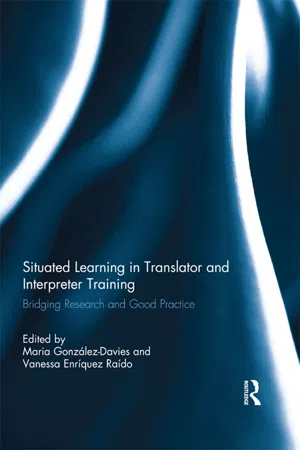
Situated Learning in Translator and Interpreter Training
Bridging research and good practice
- 154 pages
- English
- ePUB (mobile friendly)
- Available on iOS & Android
eBook - ePub
Situated Learning in Translator and Interpreter Training
Bridging research and good practice
About this book
Information
Situated learning in translator and interpreter training: bridging research and good practice
Maria González-Davies and Vanessa Enríquez Raído
ABSTRACT
This issue sets out to gauge the extent to which different embedding systems influence the implementation of Situated Learning models. Situated Learning is generally understood as a context-dependent approach to translator and interpreter training under which learners are exposed to real-life and/or highly simulated work environments and tasks, both inside and outside the classroom. Ultimately, Situated Learning seeks to enhance learners’ capacity to think and act like professionals. All our contributors address considerations pertaining to the impact of different learning environments, levels of study, fields of specialisation, the role of information, communication and translation/interpreting technologies, as well as optimal pedagogical procedures. Of these considerations, the latter stand out as one of the most prominent aspects of Situated Learning theories described in this issue, thus rendering it particularly useful for both novice and seasoned teachers of translation and interpreting (T&I) with an interest in informed practical advice on how to implement the principles of Situated Learning in teaching and learning environments that seek to promote translators’ and/or interpreters’ professional competence.
This issue sets out to gauge the extent to which different embedding systems influence the implementation of Situated Learning models. Situated Learning is generally understood as a context-dependent approach to translator and interpreter training under which learners are exposed to real-life and/or highly simulated work environments and tasks, both inside and outside the classroom. Ultimately, Situated Learning seeks to enhance learners’ capacity to think and act like professionals. All our contributors address considerations pertaining to the impact of different learning environments, levels of study, fields of specialisation, the role of information, communication and translation/interpreting technologies, as well as optimal pedagogical procedures. Of these considerations, the latter stand out as one of the most prominent aspects of Situated Learning theories described in this issue, thus rendering it particularly useful for both novice and seasoned teachers of translation and interpreting (T&I) with an interest in informed practical advice on how to implement the principles of Situated Learning in teaching and learning environments that seek to promote translators’ and/or interpreters’ professional competence.
1. Bridging academia and the profession: from DIY to situated learning
Situated Learning is generally understood as a context-dependent approach to translator and interpreter training under which learners are exposed to real-life and/or highly simulated work environments and tasks, both inside and outside the classroom. Under this approach, it is the tasks and real-life professional demands, as well as other contextual factors such as institutional, social, geographical, or community beliefs and customs, rather than a predetermined closed syllabus, that drive curricular design. Ultimately, Situated Learning seeks to enhance learners’ capacity to think and act like professionals.
Our understanding of Situated Learning goes beyond previous interpretations of this notion, traditionally dominated by the discussion of pedagogical practices in authentic, real-world professional settings. This wider remit of Situated Learning encompasses previously under-represented contextual factors, pertaining to translation traditions, historical trends, socio-economic constraints, market conditions, institutional practices, budgetary issues and/or resource availability. This issue sets out to gauge the extent to which different embedding systems influence the implementation of Situated Learning models.
The themes that may be addressed from this viewpoint include, but are not restricted to, the emergence of translator and interpreter competence(s); optimal pedagogical procedures that enable the transition from teaching and learning to authentic professional practice; the impact of learning environments, levels of study (undergraduate, postgraduate and others) and fields of specialisation; and the role of information and communication technologies (ICT), as well as of translation/interpreting technologies. Several of these themes as well as other related topics have been addressed by all our contributors to some extent. This is particularly true with regard to the emergence of translator and interpreter competence, generally understood in this issue as the ability to transition from a classroom community of practice to a professional community of practice through Situated Learning. Here, the emphasis is not so much on translation/interpreting competence but on translator/interpreter competence, a distinction made by Don Kiraly (2000) in his seminal socio-constructivist approach to Translator Training and which, as Jun Pan notes in this issue, was later adopted in Interpreter Training too (e.g. Sawyer 2004). And while this generic pedagogical goal is naturally implicit in all accounts of Situated Learning theories, including those in this special issue, explicit accounts that seek to foster specific translator competences in our issue include: Juan Antonio Prieto-Velasco and Adrián Fuentes-Luque’s collaborative and multimodal working environment to promote student translators’ instrumental competence; Francesca Bartrina, Montse Corrius, Marcella De Marco and Eva Espasa’s cross-disciplinary endeavours to foster student translators’ cultural and social competences; and Hanna Risku’s innovative implementation of Situated Learning in academic research (as opposed to translation and/or interpreting praxis) to promote translation students’ research skills in Translation Studies. Contributions on the situated development of interpreter competence — inherently associated with a highly practical and skills-based profession — address the generation of relevant skills in various interpreting modalities, in particular conference/simultaneous interpreting (Fanny Chouc and Jose María Conde, Manuela Motta and Jun Pan) and dialogue interpreting (DI) (Won Jun Nam).
In line with today’s emphasis on employability and lifelong learning, Nam regards DI as a more inclusive modality than community interpreting (CI) in undergraduate programmes that seek to develop translation and interpreting (T&I) skills in the various forms of work that future T&I graduates will be exposed to. By acknowledging that different interpreting modalities suit different levels of study, Nam, citing Chung (2008), explicitly highlights the ‘de facto division of aims between undergraduate and postgraduate T&I programmes’ and argues that undergraduate student interpreters should be nurtured in DI ‘because the majority of students do not wish to limit their career paths to [CI] but want to pursue various paths with their competences in [languages], culture/area studies and T&I’. Pan makes a similar point, albeit in the context of simultaneous interpreting (SI), and claims that ‘despite the potential benefits of a situated pedagogical design to the enhancement of students’ interpreter competence or employability skills, little has been addressed to its application, in particular in SI teaching, at the undergraduate level’. Like other scholars in the field, she states that ‘SI courses, among the most popular electives in many undergraduate T&I programmes, serve different purposes as compared to traditional professional SI or conference interpretation training, which are usually placed at the postgraduate level’ (cf. González Davies 2004b). What both Nam and Pan are in fact recognising by reflecting on the impact of different levels of study on Situated Learning is the new role of learners brought about by socio-economic changes, technology developments and specific local needs. This wider remit of Situated Learning considers key questions of e.g. ‘how to adjust SI [or any other modes of interpreting] teaching to the needs of local undergraduate students whose intentions [are] usually not to become ready-to-perform conference interpreters but to enhance their general employability prospects in finding interpretation related jobs’ (Pan, this issue).
Considerations pertaining to the impact of different learning environments — including the physical dimension commonly associated with the notion of ‘learning spaces’ — fields of specialisation and optimal pedagogical procedures are also addressed in a rather intertwined way by all our contributors. Of these considerations, the use of optimal pedagogical procedures stands out as one of the most prominent aspects of Situated Learning theories described in this issue. As we briefly indicated above, optimal pedagogical procedures in Situated Learning aim at facilitating the transition from (near-)authentic task- and/or project-based work to real-life professional practice. They take the form of various activities, tasks and projects (González Davies 2004a) and lie at the core of our contributors’ implementation of Situated Learning in different teaching and learning communities of practice. Here, we notice three main trends: one in which high simulation is implemented through collaborative task and/or project work and the use of authentic texts/materials based on a realistic task, thus bringing the professional world into the classroom (e.g. Risku, Prieto-Velasco and Fuentes-Luque, Pan and Bartrina et al.). Another trend is present in which student translators and interpreters engage in real-life professional work and/or settings facilitated through work placement schemes (e.g. Marco and Nam), thus taking the classroom outside its physical realm into various professional learning spaces (either physical, virtual or both). And a final trend in which Situated Learning procedures combine: (1) authentic materials and/or key industry players for simulated project work in the classroom or in blended learning; with (2) authentic professional work in real-life settings outside the classroom (e.g. Motta and Chouc and Conde).
The preference toward and/or ability to implement various pedagogical procedures through simulated work, real-life work or a combination of both very much depends on the contextual factors listed previously (i.e. socio-economic constraints, market conditions, institutional practices, budgetary issues and/or resource availability). This seems to imply, as Marco also points out in his contribution to this issue, that ‘consensus is not so wide’ — and, we would add, perhaps not so desirable either — ‘when it comes to designs and procedures’. In fact, the same approach ‘may give rise to different methodologies and these, in turn, can be embodied in different sets of procedures’. Thus, the optimality of said procedures can only be assessed in the context within which they are implemented, as a means to seeking understanding for the tailoring of efficient Situated Learning practices in T&I. One of the most valuable aspects of this special issue is that it spans across very diverse Situated Learning, social and cultural contexts in which T&I for either profit or non-profit purposes have a real significant impact on the role of translators and interpreters in society at large: From interpreting at the Scottish Parliament (Chouc and Conde), in a Geneva-based academic and international context (Motta) or a classroom community of practice in Hong Kong (Pan), to collaboratively translating across various disciplines (Communication Studies and Translation Studies) and educational settings (Universitat de Vic, Spain and London Metropolitan University, UK) (Bartrina et al.); in a multimodal environment in Spanish academia (Prieto-Velasco and Fuentes-Luque) or via work placements for literary translation in Spain (Marco) and humanitarian purposes in Korea (Nam); to researching Translation Studies as a reflection of practice at the University of Graz (Risku).
The last theme mentioned at the beginning of this article, i.e. the role of ICT and translation/interpreting technologies, was one we expected to attract a considerable number of contributions in response to: (1) The increase in (virtual) work placements and (near-)authentic practice schemes (e.g. dummy booths for student interpreters) afforded by technology; and (2) changes brought about by the digital era, the Internet and recent advances in technology and global social media practices, among others. Yet, the topic of recent technologies and their immediate impact on Situated Learning is only directly addressed by Prieto-Velasco and Fuentes-Luque in this special issue. Here, the authors show a positive correlation between the use of Web 2.0 tools in multimodal teaching-learning environments and improved learning performance, above all in the development of student translators’ instrumental and professional competences.
That we received almost no contributions addressing the role of ICT and/or translation/interpreting technologies in Situated Learning — especially in relation to new, digital work placements and schemes facilitated by crowdsourcing technologies and global social media platforms — highlights the fact that this relatively unexplored area has yet to be underpinned by systematic research. In a context in which the traditional boundaries of the discipline and practice of translation are constantly being blurred by new forms of organisation and work conditions, the time is more than opportune to research the impact of Situated Learning on new digital learning spaces that rely on (non-)traditional forms of language and cultural support. Perhaps, the evaluation of Situated Learning in new T&I learning spaces might help encourage the wider community of researchers, key industry players and practitioners to ‘focus on the long-neglected economic and financial aspects of the profession’ (Enríquez-Raído 2016; building on Pym et al. 2006; Gambier 2014) that will continue to challenge (professional) translations and translators, and hence the need in which they should be trained.
Another key aspect that can be seen in some of the contributions in this issue is that, it has been often the case that, once the decision to open university doors to T&I studies was taken, it was left to the programme administrators and teachers to deal with the ins and outs of everyday organisation and outcome quality. Translator and Interpreter Training has become a key issue that has risen to the challenge in the field and prompted relevant practices that are discussed in both academic and professional forums in an attempt to strike a balance between both perspectives. Unfortunately, most translation instructors have not been trained as teachers. In Kelly’s words:
In many countries, compulsory training exists for all other levels of education, but at universities it is simply assumed that those who know, know how to teach. It is still the case in many countries that new members of teaching staff are left literally to sink or to swim in the classroom, while more attention is paid, for example, to their training as researchers in their discipline. (2008, 102)
We are pleased to observe, however, that this situation has been improving in recent years, as perhaps best shown by the increase in the number of train-the-trainer offerings worldwide, which test...
Table of contents
- Cover
- Half Title
- Title
- Copyright
- Contents
- Citation Information
- Notes on Contributors
- 1. Situated learning in translator and interpreter training: bridging research and good practice
- 2. Situated learning in translation research training: academic research as a reflection of practice
- 3. On the margins of the profession: the work placement as a site for the literary translator trainee’s legitimate peripheral participation
- 4. T&I field training for undergraduate students: a case study of Korean undergraduate students’ peripheral participation into the community and their furthered understanding of the role of interpreters/translators
- 5. Situated learning and situated knowledge: gender, translating audiovisual adverts and professional responsibility
- 6. A collaborative multimodal working environment for the development of instrumental and professional competences of student translators: an innovative teaching experience
- 7. Enhancing the learning experience of interpreting students outside the classroom. A study of the benefits of situated learning at the Scottish Parliament
- 8. Linking classroom exercises to real-life practice: a case of situated simultaneous interpreting learning
- 9. A blended learning environment based on the principles of deliberate practice for the acquisition of interpreting skills
- Index
Trusted by 375,005 students
Access to over 1.5 million titles for a fair monthly price.
Study more efficiently using our study tools.
Frequently asked questions
Yes, you can cancel anytime from the Subscription tab in your account settings on the Perlego website. Your subscription will stay active until the end of your current billing period. Learn how to cancel your subscription
No, books cannot be downloaded as external files, such as PDFs, for use outside of Perlego. However, you can download books within the Perlego app for offline reading on mobile or tablet. Learn how to download books offline
Perlego offers two plans: Essential and Complete
- Essential is ideal for learners and professionals who enjoy exploring a wide range of subjects. Access the Essential Library with 800,000+ trusted titles and best-sellers across business, personal growth, and the humanities. Includes unlimited reading time and Standard Read Aloud voice.
- Complete: Perfect for advanced learners and researchers needing full, unrestricted access. Unlock 1.5M+ books across hundreds of subjects, including academic and specialized titles. The Complete Plan also includes advanced features like Premium Read Aloud and Research Assistant.
We are an online textbook subscription service, where you can get access to an entire online library for less than the price of a single book per month. With over 1.5 million books across 990+ topics, we’ve got you covered! Learn about our mission
Look out for the read-aloud symbol on your next book to see if you can listen to it. The read-aloud tool reads text aloud for you, highlighting the text as it is being read. You can pause it, speed it up and slow it down. Learn more about Read Aloud
Yes! You can use the Perlego app on both iOS and Android devices to read anytime, anywhere — even offline. Perfect for commutes or when you’re on the go.
Please note we cannot support devices running on iOS 13 and Android 7 or earlier. Learn more about using the app
Please note we cannot support devices running on iOS 13 and Android 7 or earlier. Learn more about using the app
Yes, you can access Situated Learning in Translator and Interpreter Training by Maria Gonzalez-Davies,Vanessa Enríquez Raído in PDF and/or ePUB format, as well as other popular books in Languages & Linguistics & Linguistics. We have over 1.5 million books available in our catalogue for you to explore.