Water and energy are inextricably linked as unsound management of either resource can have an impact on the cost, availability, and sustainability of the other. This book explores the "energy for water" component of the water–energy nexus. It offers diverse case studies from around the world including the deserts of Saudi Arabia, rural China, Pakistan's Indus Basin, arid Greek islands, and urban centers such as Los Angeles. The analyses show that while many regions face unique water scarcity challenges, they are all united by the fact that solutions require mobilizing energy.
This book focuses on how different policies and technologies are changing the way societies use energy to extract, treat, and transport water. In terms of policy, chapters explore how initiatives aimed at reducing demand for water and improved integrated resource planning can lead to energy savings. Regarding technology, case studies highlight the pros and cons of different methods of meeting water demand.
Through exploring both technology and policy across a wide range of diverse case studies, the book offers a robust explanation of the "energy for water" side of the water–energy nexus equation, making it valuable reading for academics and policymakers.
This book was originally published as a special issue as International Journal of Water Resources Development.
King Abdullah Petroleum Studies and Research Center, Riyadh, Saudi Arabia
ABSTRACT
This article offers a framework for understanding how energy is used to meet water demand in countries. Specifically, the relationships between energy use and water scarcity, the location of renewable water resources, and aggregate water demand are explored. The article also examines how policy options such as water price reforms, agriculture subsidies and crop elimination may influence the energy use and energy intensity of water withdrawals. Conclusions suggest that while policy options exist, certain uncontrollable factors such as severe water scarcity or substantial freshwater abundance limit the ability of some countries to significantly improve the aggregate energy efficiency of water provision.
Introduction
Oceans cover 71% of the earth’s surface and represent over 96% of the world’s total water resources. Of the remaining water, half is frozen in glaciers or ice caps and a quarter is locked in saline underground aquifers. This leaves less than 1% of the world’s total water resources available for consumption by life on earth, a small percentage in relative terms, but a figure representing 10.6 million km3, or 1.5 million m3 per person (own calculations, data from Gleick, 1993). As the hydrological cycle results in much of the world’s freshwater being recycled after consumption, the current stock of water is more than enough to sustain life on earth.
While there is enough freshwater on earth, nearly 20% of the world’s population faces physical water scarcity, a situation in which there is insufficient water to meet the demands of the ecosystem. The United Nations estimates that if population and economic growth continue to strain the world’s water resources, roughly two-thirds of the world’s population could be living in water-stressed regions by 2025 (United Nations Department of Economic & Social Affairs [UNDESA], 2014).
One of the fundamental components in addressing physical water scarcity is energy. This is because energy is a primary input for moving water from areas of relative abundance to areas of relative scarcity. For example, in California, water from the abundant north of the state travels hundreds of kilometres over the eastern Sierra Nevada mountain range in order to meet demand in Los Angeles, a region of increasing physical water scarcity. The energy required to transport water this distance is estimated to be 1.6 kWh/m3, or three times the energy required to extract and treat water withdrawn from sources in Los Angeles (Wilkinson, 2000). The need for energy-intensive interbasin water transfers is expected to increase as the population and economy of the city grow.
In Jordan, a severely water-scarce country, a different sort of water transport occurs. Groundwater from aquifers located more than 1 km below the earth’s surface is extracted for use by municipalities and agriculture. This extraction comes at a tremendous energy cost. Hayek (2014) estimates that the average energy required to extract groundwater in Jordan is roughly 1.2 kWh/m3, or nine times the energy required to withdraw groundwater in the Netherlands, a country also reliant on groundwater, but with much shallower bores (Imperial Irrigation District, 2015). The case of Jordan is important because the country imports 97% of its energy from neighbouring countries, and these energy supplies are largely in the form of non-renewable fossil fuels that can experience large fluctuations in price (Talozi, Al Sakaji, & Altz-Stamm, 2015).
In rare cases, such as Spain, Australia and the Gulf region, seawater is desalinated, as neither interbasin transfers nor deep aquifer extraction are sufficient to meet water demand. Desalination represents the most energy-intensive option for meeting water demand, and often entails significant financial and environmental costs.
Exploring the relationship between energy and water demand is important for two reasons. First, a significant amount of energy is used for direct water services. For example, Sanders and Webber (2012) have estimated that 8.3% of 2010 annual primary energy consumption in the United States was used for the heating, chilling, treating, pressurizing and pumping of water by the municipal, industrial and agricultural sectors. Thus, water conservation can have a direct effect on energy use, which can help improve energy security and climate change objectives, particularly when fossil fuels are used as the energy source.
Second, while water and energy are inextricably linked, they are typically governed in silos, which can lead to policy fragmentation and a misalignment of incentives. In general, the energy sector considers water only as it relates to hydropower and water requirements for thermal power plants. Similarly, water planners are typically more concerned with supply augmentation and management, as opposed to energy issues (Malik, 2002). Improving coordination of the management of water and energy resources can increase efficiency in both areas. For example, Kumar, Scott, and Singh (2013) have shown that power tariff reform that includes pro rata pricing and higher unit rates for electricity would likely lead to improved efficiency and sustainability of groundwater use by farmers in India. This is an important consideration given that in 2010 India extracted 684 km3 of water for agriculture, a figure representing 90% of total extractions (http://www.fao.org/nr/water/aquastat/data/query/).
This article offers a framework for understanding how energy is used to meet water demand in both water-scarce and water-abundant countries. Specifically, the supply and demand of water, and the energy required to withdraw that water, are disaggregated: supply is disaggregated by source and treatment process, while demand is disaggregated by user. This approach helps policy makers understand the ways decisions in one domain can affect the other, thus building the case for more integrated management of the water–energy nexus. Through a detailed examination of how energy is used for water supply, and how water is used in the economy, the framework also provides policy makers with a tool for assessing the possibilities (and limits) of efficiency improvements in both domains.
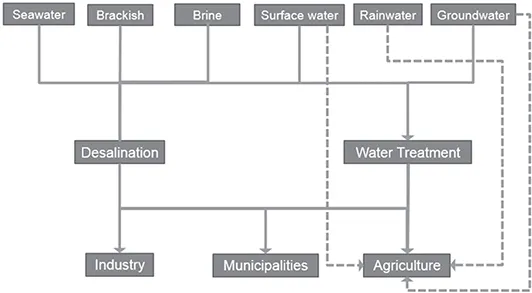
Figure 1. Sources and uses of water.
The article’s conclusions are threefold. First, energy use for water is a function of not only water scarcity, but also the location of renewable water resources: countries with abundant renewable water resources that are located in deep aquifers, or far from demand centres, may still require substantial energy resources to meet water demand. Second, while economic solutions for managing water resources exist, they can be politically sensitive, and therefore difficult to implement. This often results in the overuse of water, which can lead to increases in both aggregate energy use and overall energy intensity of water extraction. Last, while some countries can reduce the energy used for water by eliminating water-intensive agricultural crops, certain uncontrollable factors, such as severe water scarcity or high water abundance, reduce the efficacy of this option. By disaggregating and exploring how supply and demand for water can affect energy use, this article offers a theoretical framework through which to examine the case studies on managing energy for water presented in this special issue.
The supply of water: implications for energy
As described in Figure 1, water can come from both conventional and unconventional sources. Conventional sources refers to surface water, groundwater and rainwater, all of which may be treated and then consumed, or sent directly from the source to the final consumer. Unconventional sources refers to seawater, brackish water, brine and wastewater, which must be purified by advanced treatment technologies prior to consumption.
The energy required to meet water demand is dependent on the type of water used, whether it is treated, and the technology used for treatment. In almost all cases, water used for agriculture is untreated, and thus consumes the least energy. For example, rainwater consumed directly by agriculture incurs effectively no energy footprint; and untreated surface water requires only minimal energy for extraction. As farmers begin to extract water from underground bores or use desalinated water, energy requirements increase.
Water extracted for municipal and industrial use is typically purified prior to consumption. This can increase energy requirements. Surface water is often contaminated and must be pumped through numerous filters and disinfected with chlorine and other chemicals before being distributed to the water grid. Groundwater, in contrast, is typically cleaner, and does not require much treatment aside from the addition of chlorine and other purifying chemicals. As a result, most of the energy required to withdraw and purify groundwater is used for extraction (Burton, 1996; Copeland, 2014; Plappally & Lienhard, 2012).
The energy required for unconventional water withdrawals is a function of three factors: the type of water withdrawn; the quantity of water withdrawn; and the desalination technology used. Two primary types of desalination technologies exist: thermal and membrane. Thermal desalination is a process in which saline water is vaporized, thus separating pure water from any salts, minerals and other contaminants (Tonner, 2008). Membrane desalination is a process whereby saline water is passed through one or more semipermeable membranes. The membranes separate pure water from salts and other impurities. The energy required for thermal desalination processes such as multistage flash distillation (MSF) and multiple-effect distillation (MED) is higher, and is independent of the salinity or the source of water. In contrast, the energy required for membrane technology, such as reverse osmosis (RO) and electrodialysis (ED), is generally less, and varies with the salinity of water: the more saline the water, the more energy-intensive the extraction and treatment. In addition to the specific technology used, other factors will affect the energy required for desalination, including output capacity of the plant, thermal design, membrane type (for membrane technologies), efficiency of the plant, and system configuration. The latter is important to consider for dual-purpose plants (i.e. plants designed for power and water production). While global online seawater desalination capacity increased significantly between 2000 and 2014, from 0.72 km3 to 13.73 km3 (Global Water Intelligence, 2015), given its high capital and energy costs, the technology contributes only a small fraction to overall water supplied.
Figure 2 describes how energy use increases with different water sources and extraction technologies. With the exception of rainfall, untreated surface water requires the least energy for extraction, with the variance in energy required due primarily to the varying efficiency of pumps for extraction. In emerging economies, where pumps are often less efficient and energy costs are lower, energy intensity is generally higher. The figure also shows that while some water sources are more energy-intensive than others, each source has a large range of possible energy intensities. For example, while it is generally assumed that treated wastewater is more energy-intensive than groundwater extraction, this may not be the case when groundwater bores are deep and pumps are inefficient. This is an important consideration in water-scarce countries that must rely on deep groundwater aquifers. Wastewater treatment may also offer a less energy-intensive alternative to desalination. In Saudi Arabia, a severely water-scarce country, the government has begun to encourage the reuse of wastewater, and plans have been put in place to expand wastewater collection and treatment systems to cover about 60% of urban areas by 2014 – up from 42% in 2010 (Ouda, 2014). To date, much of the recycled water has been used for urban-area landscaping and, to a lesser extent, crop irrigation (Ouda, 2014). It is hoped that wastewater will help alleviate stress on non-renewable aquifers through less energy-intensive, cheaper means than can be offered by desalination. The case of Saudi Arabia shows that when countries understand the economic and energy implications of different water sources, it is feasible for strategies to be implemented that minimize these costs.
An important source of water that is not considered in Figure 2 is water transported over long distances. Lack of data and extreme differences in the characteristics of water transport networks make it difficult to establish useful energy-int...
Table of contents
Cover
Half Title
Title Page
Copyright Page
Contents
Citation Information
Notes on Contributors
1 A framework for understanding energy for water
2 The energy trade-offs of adapting to a water-scarce future: case study of Los Angeles
3 Quantifying and managing urban water-related energy use systemically: case study lessons from Australia
4 Energy for freshwater supply, use and disposal in the Netherlands: a case study of Dutch households
5 Evaluating the economic viability of solar-powered desalination: Saudi Arabia as a case study
6 Responding to water challenges in Greece through desalination: energy considerations
7 Modernization of irrigation systems in Spain: review and analysis for decision making
8 Drivers of groundwater use and technical efficiency of groundwater, canal water, and conjunctive use in Pakistan’s Indus Basin Irrigation System
9 Energy for water utilization in China and policy implications for integrated planning
Index
Trusted by 375,005 students
Access to over 1.5 million titles for a fair monthly price.
Study more efficiently using our study tools.
Frequently asked questions
Yes, you can cancel anytime from the Subscription tab in your account settings on the Perlego website. Your subscription will stay active until the end of your current billing period. Learn how to cancel your subscription
No, books cannot be downloaded as external files, such as PDFs, for use outside of Perlego. However, you can download books within the Perlego app for offline reading on mobile or tablet. Learn how to download books offline
Perlego offers two plans: Essential and Complete
Essential is ideal for learners and professionals who enjoy exploring a wide range of subjects. Access the Essential Library with 800,000+ trusted titles and best-sellers across business, personal growth, and the humanities. Includes unlimited reading time and Standard Read Aloud voice.
Complete: Perfect for advanced learners and researchers needing full, unrestricted access. Unlock 1.5M+ books across hundreds of subjects, including academic and specialized titles. The Complete Plan also includes advanced features like Premium Read Aloud and Research Assistant.
Both plans are available with monthly, semester, or annual billing cycles.
We are an online textbook subscription service, where you can get access to an entire online library for less than the price of a single book per month. With over 1.5 million books across 990+ topics, we’ve got you covered! Learn about our mission
Look out for the read-aloud symbol on your next book to see if you can listen to it. The read-aloud tool reads text aloud for you, highlighting the text as it is being read. You can pause it, speed it up and slow it down. Learn more about Read Aloud
Yes! You can use the Perlego app on both iOS and Android devices to read anytime, anywhere — even offline. Perfect for commutes or when you’re on the go. Please note we cannot support devices running on iOS 13 and Android 7 or earlier. Learn more about using the app
Yes, you can access Energy For Water by Christopher Napoli in PDF and/or ePUB format, as well as other popular books in Biological Sciences & Ecology. We have over 1.5 million books available in our catalogue for you to explore.