It is not hyperbole to suggest that the foundations of post-cold war security in Europe have been badly damaged by the conflict in Ukraine since 2014. Russia's annexation of Crimea and intervention in eastern Ukraine appear to have created a 'simmering' conflict, which may take years to resolve and have profound consequences for the European security environment. This volume explores the various political, economic and social aspects of these profound changes and their wider significance for Europe, bringing together contributions by scholars from across the continent and in various disciplinary fields to offer an authoritative, in-depth examination of the complex causes of the Ukraine crisis and the consequences for Ukrainian statehood, Ukraine's relations with Russia, Russia's own domestic governance and Russia's relations with Europe. This book was originally published as a special issue of Europe-Asia Studies.
eBook - ePub
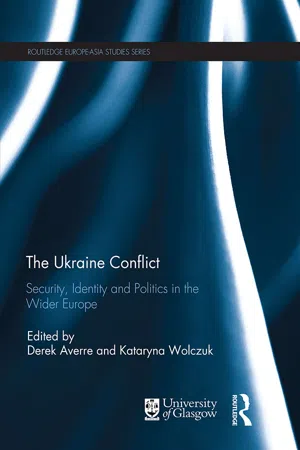
The Ukraine Conflict
Security, Identity and Politics in the Wider Europe
- 252 pages
- English
- ePUB (mobile friendly)
- Available on iOS & Android
eBook - ePub
The Ukraine Conflict
Security, Identity and Politics in the Wider Europe
Introduction: The Ukraine Crisis and Post-Post-Cold War Europe
NOBODY COULD HAVE FORESEEN THAT THE TURMOIL WHICH erupted on the streets of Kyiv in late 2013—which became known as the Euromaidan—would soon lead to what has been regarded as the collapse of the post-Cold War regional order in the wider Europe. It bears remembering that the Euromaidan was essentially a domestic affair, reflecting the rejection by most Ukrainians of their corrupt and ineffective political elites, embodied in the person of President Viktor Yanukovych. However, Yanukovych’s ignominious flight from Ukraine and the subsequent change of government in Kyiv triggered a sequence of events—the territorial annexation of Crimea by Russia and the war in the Donbas—the reverberations of which are likely to be felt in Europe and beyond for some time to come. These events have highlighted a fundamental shift, both in Ukraine’s relationship with Russia and—with unpredictable implications for the future of European security—Russia’s own relations with Europe. At this stage we can say with some certainty that the post-post-Cold War Europe1 is upon us but it is unclear what kind of order will emerge from the current tensions. The profound domestic and international implications of these ongoing developments present a major challenge to scholars specialising in Russia and Eastern Europe.
Amidst fast-changing events we need to consider the longer-term perspective in order to contextualise developments, both in Ukraine’s domestic politics and in its relations with Russia and Russia’s relations with the EU. Like most newly independent states which emerged from the collapse of the USSR, Ukraine was largely terra incognita in the early 1990s. Apart from domestic politics, scholarly research focused on two aspects. The first was nationalism, identity and language issues (Kuzio & Wilson 1994; Arel 1996; Wilson 1996; Janmaat 1999; Kuzio 1998; Wanner 1998; Wolczuk 2000) as well as the ethnic, linguistic and regional diversity of Ukraine (Solchanyk 1994; Pirie 1996; Sasse 1996; Shulman 1998; Zhurzhenko 2002). Second, research on Ukraine’s foreign policy in the first post-Soviet decade (D’Anieri 1995, 1997; Laba 1995; Larrabee 1996; Bukkvoll 1997; Garnett 1997; Moroney et al. 2002; Sherr 2002; Wolczuk 2003) demonstrated the extremely precarious position Ukraine occupied between two integrating blocs—the EU on the one hand, and Russia’s projects to reintegrate in some form the Soviet successor states on the other. Greater interest in Ukraine’s domestic politics was inspired by the 2004 Orange Revolution (Åslund & McFaul 2005; Wilson 2005; D’Anieri 2006). However, its failure to bring about lasting change led to diminishing interest in Ukrainian politics and foreign policy by the time Yanukovych came to power in 2010.
In similar fashion, Russia’s policy towards its ‘near abroad’ (as it was then called) was studied extensively in the 1990s and early 2000s (Lester 1994; Lieven 1999; Bukkvoll 2001; Tsygankov 2001), but interest declined thereafter (with the exceptions of Dragneva and de Kort (2007), Dusseault (2007) and Malfliet et al. (2007)). This changed to an extent with Russia’s intervention in Georgia over the latter’s invasion of South Ossetia in 2008; still, more attention was paid to the security implications of Moscow’s decision to intervene (Allison 2009) than to Russia’s renewed push for integration (Dragneva & Wolczuk 2012, 2013; Vinokurov & Libman 2012). It should therefore come as no surprise that, while Ukraine’s relations with Russia and its place in Russia-led regional integration projects lie at the root of the 2014 crisis, expertise on these topics had become rather scarce. Again, while Russia’s relations with the EU had been extensively explored, relatively few scholars had examined Russia’s and the EU’s respective policies towards the ‘common neighbourhood’ (Averre 2009; Haukkala 2009, 2011; Zagorsky 2011; Moshes 2013) or the role of domestic Ukrainian politics in the country’s relations with Russia and the EU (Gnedina & Sleptsova 2012; Kuzio 2012; Puglisi 2008; Wolczuk 2009).
This edited collection, drawing on contributions by scholars from across Europe who bring to bear their considerable expertise in various disciplinary fields, seeks to redress the gaps described above by offering a set of essays that, taken together, constitute a multifaceted, yet coherent, in-depth examination of the complex causes and consequences of the Ukraine crisis for domestic developments in Ukraine, Ukraine’s relations with Russia and Russia’s relations with Europe in the context of their common neighbourhood.2
The contributions fall into three broad sections. The first four articles focus on domestic developments in Ukraine, using extensive empirical research. Olga Onuch and Gwendolyn Sasse examine in considerable depth the dynamics of the Euromaidan protests. Based on the EuroMaidan Protest Participant Survey, they trace the actors, claims and frames of each phase in the protest cycle. They emphasise the diversity of actors, and the multi-dimensional, shifting and contingent nature of the protests in the build-up towards the violent denouement of the Maidan. Volodymyr Kulyk offers a subtle analysis of the changes in Ukrainian national identity that have become apparent as a result of the Euromaidan and Russia’s policy towards Ukraine. Drawing on data from focus groups and public opinion surveys, he argues that national identity in Ukraine is expressed in a much more overt way and is accompanied by an increased sense of alienation from Russia, although the embrace of Ukrainian nationalism is not unconditional. Kostiantyn Fedorenko, Olena Rybiy and Andreas Umland investigate the evolution of the Ukrainian party system, assessing the changes since the Euromaidan protests in the context of longer-term trends. Drawing on comprehensive empirical data they argue that, despite notable advances in democratisation as a result of the revolutionary events of 2013–2014, the essential features of Ukraine’s party system have not changed: the legislative, ideological and organisational foundations of the Ukrainian party-political landscape and parliamentary politics remain fragile and volatile. In the final contribution in this section, Andrew Wilson assesses the role of various factors in the conflict in eastern Ukraine. He suggests that historical and identity factors, economic problems and alienation from the new government in Kyiv form only part of the explanation accounting for the eruption of separatism in the Donbas in the spring of 2014 and draws attention to the effects of ‘Russian sponsorship’ and the role of local elites in supporting the separatist agenda.
The second section, comprising two shorter and three full-length essays, takes us into the international dimension of the Ukraine conflict. Hiski Haukkala charts the evolution of the EU’s policy towards its eastern neighbourhood and the causes of the rupture in relations between the EU and Russia. Marco Siddi highlights the importance of the Germany–Russia relationship and the former’s continuing efforts to engage the latter in a constructive political and trade relationship. Rilka Dragneva and Kataryna Wolczuk interrogate Ukraine’s policy towards Russia, with a particular focus on Ukraine’s reluctant yet continual participation in integration projects. They explain why and how Ukraine reacted to, and engaged with, Russia-led projects in terms of balancing economic dependence and legal commitment. Derek Averre investigates the motivation behind Russia’s intervention in Ukraine and the West’s response to it, considering the implications in terms of security governance of Russia’s apparent defection from the post-Cold War European security order. Lance Davies offers a close analysis of Russia’s role in the Donbas conflict in the context of Moscow’s broader approach to conflict management and the complex security logic underpinning Russian thinking.
The third and final section contains two essays in political economy. Richard Connolly assesses the costs imposed by the West’s economic statecraft, in the form of sanctions and trade restrictions, on Russia, and the impact of Russia’s response on its domestic political economy in the context of other economic factors. Tatiana Romanova examines the qualitative changes in the EU–Russia trade relationship resulting from the sanctions regime, highlighting the increasing poverty of governmental and transnational relations and the negative impact in terms of EU–Russia trade cooperation.
The collection of essays benefits from a time lapse of over two years since the Euromaidan.3 In that period, we suggest, certain trends have become clear, notably the shift in Ukrainian national identity analysed by Kulyk and (in the context of the Euromaidan dynamic) Onuch and Sasse; the limits of the EU’s transformative project in its eastern neighbourhood, as highlighted by Haukkala; the incompatible rationales of the EU and Russia-led integration projects, examined by Dragneva and Wolczuk; and the drift towards de-modernisation in Russia arising from the breakdown of governmental and economic relations with Europe described by Connolly and Romanova. In contrast, other aspects of domestic politics and foreign policies remain fraught with unpredictability and ambiguity. Fedorenko, Rybiy and Umland show that Ukraine’s domestic political environment remains fragile; Siddi reflects on the unresolved dilemmas in Germany’s traditional Ostpolitik towards Russia; and Averre and Davies both focus on the vacuum in security governance in the eastern neighbourhood stemming from Russia’s highly ambivalent approach to the European rules-based order and the failure to institutionalise pan-European security. And finally, Wilson brings our attention back to the crucible of the Ukraine conflict, the resolution of which may be a long time in coming. We hope that by providing in-depth analysis on their respective subjects, all of the essays in this collection raise theoretical and empirical questions which will stimulate further scholarly enquiry.
The guest co-editors gratefully acknowledge the financial contribution provided by the Centre for East European Language Based Area Studies (CEELBAS) and the University of Birmingham for a workshop held at the University of Birmingham to discuss drafts of the essays in this collection in March 2015.
1Michael Smith has referred to the ‘post-post-post Cold War’ period; in his view, the post-Cold War order was defined by the collapse of the Soviet Union and the predominance of the US, the post-post-Cold War order by recognition of the US’s power limitations, and the post-post-post-Cold War order by ‘the emergence of rising powers and their much more active (re-)engagement in world affairs’ (Smith 2013, p. 660). However, within the confines of the European continent, we suggest that the annexation of Crimea and the war in Eastern Donbas may be seen as marking the end of the post-Cold War period in Europe.
2Among individual empirical contributions to scholarship on the Ukraine crisis see Burke-White (2014), Allison (2014), Freedman (2014a, 2014b, 2015), Wilson (2014), Sakwa (2015a, 2015b), Tsygankov (2015), Yost (2015) and Forsberg (2016).
3We refer here to the protests which took place from November 2013 to February 2014 in Ukraine as the Euromaidan, as this is the most common term used in the English-language academic work, whereas in Ukraine they are increasingly referred to as the Revolution of Dignity.
References
Allison, R. (2009) ‘The Russian Case for Military Intervention in Georgia: International Law, Norms, and Political Calculation’, European Security, 18, 2.
Allison, R. (2014) ‘Russian “Deniable” Intervention in Ukraine: How and Why Russia Broke the Rules’, International Affairs, 90, 6.
Arel, D. (1996) ‘A Lurking Cascade of Assimilation in Kiev?’, Post-Soviet Affairs, 12, 1.
Åslund, A. & McFaul, M. (eds) (2005) Revolution in Orange: The Origins of Ukraine’s Democratic Breakthrough (Washington, DC, Carnegie Endowment for International Peace).
Averre, D. (2009) ‘Competing Rationalities: Russia, the EU and the “Shared Neighbourhood”’, Europe-Asia Studies, 61, 10.
Bukkvoll, T. (1997) Ukraine and European Security (London, Royal Institute of International Affairs).
Bukkvoll, T. (2001) ‘Off the Cuff Politics: Explaining Russia’s Lack of a Ukraine Strategy’, Europe-Asia Studies, 53, 8.
Burke-White, W. W. (2014) ‘Crimea and the International Legal Order’, Survival, 56, 4.
D’Anieri, P. (1995) ‘Interdependence and Sovereignty in the Ukrainian–Russian Relationship’, European Security, 4, 4, Winter.
D’Anieri, P. (1997) ‘Dilemmas of Interdependence: Autonomy, Prosperity, and Sovereignty in Ukraine’s Russia Policy’, Problems of Post-Communism, 44, 1.
D’Anieri, P. (2006) Understanding Ukrainian Politics: Power, Politics, and Institutional Design (Armonk, NY, M.E. Sharpe).
Dragneva, R. & de Kort, J. (2007) ‘Legal Regime for Free Trade in the CI...
Table of contents
- Cover
- Half Title
- Series Page
- Title Page
- Copyright Page
- Contents
- Citation Information
- Notes on Contributors
- 1 Introduction: The Ukraine Crisis and Post-Post-Cold War Europe
- 2 The Maidan in Movement: Diversity and the Cycles of Protest
- 3 National Identity in Ukraine: Impact of Euromaidan and the War
- 4 The Ukrainian Party System before and after the 2013–2014 Euromaidan
- 5 The Donbas in 2014: Explaining Civil Conflict Perhaps, but not Civil War
- 6 A Perfect Storm; Or What Went Wrong and What Went Right for the EU in Ukraine
- 7 German Foreign Policy towards Russia in the Aftermath of the Ukraine Crisis: A New Ostpolitik
- 8 Between Dependence and Integration: Ukraine’s Relations With Russia
- 9 The Ukraine Conflict: Russia’s Challenge to European Security Governance
- 10 Russia’s ‘Governance’ Approach: Intervention and the Conflict in the Donbas
- 11 The Empire Strikes Back: Economic Statecraft and the Securitisation of Political Economy in Russia
- 12 Sanctions and the Future of EU-Russian Economic Relations
- Index
Trusted by 375,005 students
Access to over 1.5 million titles for a fair monthly price.
Study more efficiently using our study tools.
Frequently asked questions
Yes, you can cancel anytime from the Subscription tab in your account settings on the Perlego website. Your subscription will stay active until the end of your current billing period. Learn how to cancel your subscription
No, books cannot be downloaded as external files, such as PDFs, for use outside of Perlego. However, you can download books within the Perlego app for offline reading on mobile or tablet. Learn how to download books offline
Perlego offers two plans: Essential and Complete
- Essential is ideal for learners and professionals who enjoy exploring a wide range of subjects. Access the Essential Library with 800,000+ trusted titles and best-sellers across business, personal growth, and the humanities. Includes unlimited reading time and Standard Read Aloud voice.
- Complete: Perfect for advanced learners and researchers needing full, unrestricted access. Unlock 1.5M+ books across hundreds of subjects, including academic and specialized titles. The Complete Plan also includes advanced features like Premium Read Aloud and Research Assistant.
We are an online textbook subscription service, where you can get access to an entire online library for less than the price of a single book per month. With over 1.5 million books across 990+ topics, we’ve got you covered! Learn about our mission
Look out for the read-aloud symbol on your next book to see if you can listen to it. The read-aloud tool reads text aloud for you, highlighting the text as it is being read. You can pause it, speed it up and slow it down. Learn more about Read Aloud
Yes! You can use the Perlego app on both iOS and Android devices to read anytime, anywhere — even offline. Perfect for commutes or when you’re on the go.
Please note we cannot support devices running on iOS 13 and Android 7 or earlier. Learn more about using the app
Please note we cannot support devices running on iOS 13 and Android 7 or earlier. Learn more about using the app
Yes, you can access The Ukraine Conflict by Derek Averre, Kataryna Wolczuk, Derek Averre,Kataryna Wolczuk in PDF and/or ePUB format, as well as other popular books in History & Military & Maritime History. We have over 1.5 million books available in our catalogue for you to explore.