Published in 1998, this book is a collected volume of papers from the first conference of the European Network for Biomedical ethics. The main subject of this conference is the ethical assessment of IVF in view of its concrete application as an infertility treatment and the consideration of possible alternatives for use. Twenty years after the introduction and the establishment of this therapy a more concrete evaluation of its medical indications, social conditions and consequences, the psychological consequences for the women involved and the parent-child relationship becomes possible. The legal and ethical evaluation of the reproduction technology as regards for example the legal and moral status of supernumery embyos in cryo-conservation has also to be considered in a European perspective. The ethical evaluation concentrates today on the new evolution that IVF technology takes in relation to the extension of diagnostics possibilities due to genetic research. Little work has been done on the connection between IVF and genetic diagnostics and therapy, so the medical and ethical evaluation of the connecting lines are also included in the book.
eBook - ePub
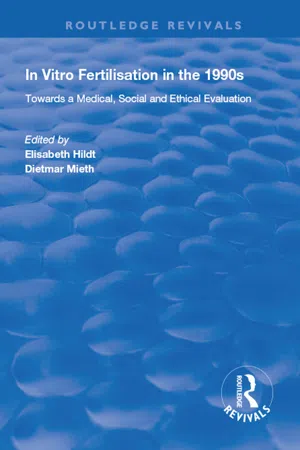
In Vitro Fertilisation in the 1990s
Towards a Medical, Social and Ethical Evaluation
- 370 pages
- English
- ePUB (mobile friendly)
- Available on iOS & Android
eBook - ePub
In Vitro Fertilisation in the 1990s
Towards a Medical, Social and Ethical Evaluation
About this book
Information
Part One
INTRODUCTION
1 Introduction and development of IVF and its ethical regulation
Human reproduction in its various forms has always attracted intense ethical attention. Sexuality in its various forms, prostitution, contraception, abortion and sperm donation by intercourse or by artificial insemination have dominated debate over many centuries. In vitro fertilisation (IVF) is a newcomer to this scene, yet it raises many equally important issues. My intention in this paper is to describe the origins of IVF and other forms of assisted human conception and the reasons why the early pioneers began these studies. I will then discuss the ethical role of doctors and scientists in the IVF clinic, and finally consider some modern aspects of the current methods of regulation of assisted human conception, especially the problems of legislation. Currently, ethical responsibility is shared between practising IVF clinics and regulatory agencies which interpret legislation and are responsible to a Minister of State. After welcoming the move to legislation a decade ago, I now have reservations about law as a primary regulator of the many complex personal and clinical situations in assisted human conception.
Scientific and clinical origins of human IVF
IVF has had diverse origins. Much of the initial work carried out on animals was concerned with pure and applied endocrine, embryological and genetic methods, which took almost 50 years to come to fruition. The first investigator contributing to the development of IVF is generally recognised as Heape (1890) who transferred genetically-marked embryos from a female rabbit to the reproductive tract of a recipient, and obtained offspring from the transferred embryos. This study was strictly concerned with embryo transfer, yet it also included a brief period of embryo culture in vitro. The first attempts to culture mammalian embryos through their cleavage stages in vitro were made by Lewis and Gregory (1933), Lewis and Hartman (1933), and Hammond (1949). Embryos of several species were cultured by these investigators through several cell cycles in vitro, using simple culture media. An improved understanding of tissue culture media (Paul 1961) accelerated these studies on embryo culture and led to the first colonies of mammalian (rabbit) embryonic stem cells in vitro (Cole et al. 1966). Meanwhile, Pincus and Saunders (1939) had carried out initial investigations on the maturation of rabbit and human ova in vitro. They aspirated resting (dictyate) oocytes from ovarian follicles and matured them in vitro to metaphase-2, to produce ‘ripe’ oocytes ready for fertilisation. They concluded that maturation required 12 hours, a mistaken conclusion that misled later investigators who tried to fertilise human oocytes in vitro by adding spermatozoa to oocytes that had been cultured for 12 hours; no fertilisation was recorded in these studies (Menkin and Rock 1968, Shettles 1955, Hayashi 1963). This situation period has been reviewed in detail elsewhere (Edwards and Brody 1995).
Rapidly increasing knowledge on the pituitary gland and hypothalamus in the second quarter of this century resulted in methods of endocrinologically stimulating many follicles in the ovary. These studies led in turn to methods of superovulating immature mice using pregnant mares’ serum as an follicle-stimulating hormone (FSH) preparation and human chorionic gonadotrophin (HCG) to induce oestrus and ovulation. The embryos developed normally in foster mothers (Gates and Beatty 1954). Ovarian stimulation was applied to adult mice – the first time in any adult mammal – and also induced timed oestrus and ovulation of many oocytes - often approaching 50 or 100 (‘superovulation’) (Fowler and Edwards 1957). Oocyte maturation and ovulation were exactly timed, many eggs were fertilised in vivo, and most of them cleaved, implanted and developed to birth (Fowler and Edwards 1957). Many mice had very large numbers of fetuses at full term, multiple births, and rates of fetal mortality in utero and at delivery were very high (Edwards and Fowler 1959).
Between 1950–1970, studies on fertilisation in vitro in animals led to the concept of capacitation of spermatozoa before fertilisation (Austin 1969, Chang 1969). Unfortunately, a widespread belief that spermatozoa became capacitated only in the uterus or oviduct led to immense problems in achieving fertilisation in vitro in mammals except in hamsters, where epididymal spermatozoa were simply mixed with ripe oocytes (Yanagimachi and Chang 1964). Methods of embryo culture were improving, especially with rabbit embryos, but those of mice, hamster, rat, farm animals still displayed blocks in development at different stages, and it was literally impossible to obtain late cleavage embryos in any of these species (see Edwards and Brody 1995).
In the 1960s, the first modern application of assisted human conception involved the use of pituitary extracts and hormone preparations to stimulate ovulation in some amenorrhoeic patients. The first studies were carried out by Gemzell (1967), using pituitary extracts for stimulation and HCG to induce ovulation. Multiple ovulation and births occurred just as in mice. Lunenfeld and Donini (1969) introduced the use of human menopausal gonadotrophins (HMG) for ovarian stimulation, and identified forms of hyperstimulation, multiple pregnancies and the standard use of HMG and HCG for inducing ovulation as a routine treatment in amenorrhoeic women. Clomiphene was also introduced some years later, and proved to be an effective and mild ovarian stimulant (Greenblatt et al. 1961). The induction of superovulation in amenorrhoeic women raised considerable ethical qualms, concerned at first with the establishment of many multiple births, some of a very high order. Recently, it has been discovered that the use of pituitary extracts to stimulate follicle growth in these women infected many of them with Jacob Creutzfeld disease. Many died from this condition several years after treatment.
Innovations in surgery in the early and mid-20th century, an increasing tempo of research on laparoscopy (Palmer 1946, Fragenheim 1964) led to the first attempts at endoscopy to examine the abdominal cavity. Laparoscopy were greatly refined and made safe by the application of cold light sources, and became a routine treatment in gynaecology as shown by Steptoe (1968). By now, laparoscopy (and keyhole surgery) is used in virtually every gynaecological operating theatre, and keyhole surgery in many other forms of surgery.
IVF itself has been practised widely only in the last quarter of the twentieth century, as the necessary hormone preparations, knowledge of oocyte maturation, fertilisation and embryonic growth in vitro, and new surgical methods, combined to facilitate its introduction. My own purposes in introducing IVF were to alleviate various clinical conditions and open new approaches to gaining fundamental knowledge on human conception, as listed in table 1. In fact, the alleviation of infertility has so far been its major application, although analyses of the origin of chromosomal disorders and the preimplantation diagnosis of genetic disease are making excellent progress. IVF raised many new ethical issues such as the status of the embryo in vitro, typing embryos and the possibilities of interference with gametes or embryos. The growth of early embryos in vitro also challenged the nature of parenthood by opening possibilities of oocyte and embryo donation, and of surrogate parenting of a transferred embryo.
Table 1. Original purposes of the introduction of IVF
| • Gain fundamental knowledge on human conception • Investigate the ethics of human conception involved in studies on IVF, contraception, gamete donation, embryo research, etc • Attempt to alleviate infertility • Understand and improve methods of contraception • Identify the causes of human chromosomal disorders • Design methods for diagnosing and avoiding genetic disease before implantation • Produce human stem cells in vitro for analyses on differentiation and transplantation |
The introduction of modern IVF
By 1955, the necessary techniques to introduce human IVF had been clarified, and new research programmes were essential to bring the method into clinical practice. Fundamental knowledge was needed on the processes of human follicle growth, oocyte maturation, ovulation, the origin of chromosomal anomalies such as trisomy, and fertilisation and embryo growth before and after implantation. Besides leading to the introduction of IVF, each of these studies would raise complex ethical situations, which would have to be debated and assessed.
The first target was to time oocyte maturation in vitro. This knowledge would help to avert the need for studies on patients during these initial investigative stages. Studies in animals had revealed that the duration of maturation in vitro was equal to the interval between an ovulatory injection of HCG and the beginning of follicle rupture at ovulation (Edwards 1965a). Modern IVF actually began when detailed analyses on the maturation of human oocytes in vitro revealed that 37 hours were needed for oocyte ripening to metaphase-2 (Edwards 1965a,b). This discovery enabled some of the studies outlined in table 1 to be carried out, namely the cause of chromosomal anomalies in oocytes, and the use of mature oocytes to study fertilisation in vitro.
Initial attempts at fertilisation in vitro using human oocytes matured in vitro, and at achieving human sperm capacitation by placing them in intrauterine chambers for several hours, were apparently unsuccessful (Edwards et al. 1966, Edwards et al. 1968). A closer analysis of the exact conditions of culture resulted in the first definite evidence of human fertilisation in vitro (Edwards et al. 1969). This was a major step towards clinical work. Related animal studies established the first embryonic stem cells in vitro, using rabbits (Cole et al. 1966), the first successful genetic diagnosis of a mammalian embryo using excised trophectoderm cells from rabbit blastocysts to sex the embryos (Edwards and Gardner 1968, Gardner and Edwards 1968), and new concepts on the causes of chromosomal anomalies (Henderson and Edwards 1968).
Knowledge on the timing of human maturation in vitro predicted the timing of ovulation in women at 37 hr post-HCG. The optimal time to collect ripe human oocytes from follicles in vivo would therefore be at 35–36 hr, i.e. shortly before ovulation occurred. Maturation in vivo was essential to obtain normal embryonic growth, because Chang (1969) had shown how rabbit oocytes matured in vitro would fail to develop normally unless their initial maturation was triggered within the follicle.
Clinical IVF began in Oldham and Cambridge using modern methods of laparoscopy to time human ovulation and to aspirate ripe oocytes from their follicles (Steptoe and Edwards 1970). The predicted timing of ovulation was 37 hours post-HCG and follicular growth was directly observed laparoscopically at this time. After the use of ovarian stimulation using HMG and HCG, several oocytes were aspirated from each patient at 36 hr post-HCG. Fertilisation and embryonic growth in vitro were accomplished very quickly (Edwards et al. 1970, Steptoe et al. 1971). Embryonic growth appeared to be normal.
The ethical issues were closely studied from the early years of IVF. I had been stimulated by ethical discussions between Professor Conrad Waddington and theologians on the ethics of genetic research, during lectures on the clinical practice of sperm donation, and when working with Professor Alan Parkes of the importance and ethics of contraception and fertility regulation. The first paper on the ethics of IVF in modern society was published in Nature by Edwards and Sharpe (1971), and later a detailed analysis was made of the ethics and law of human conception (Edwards 1974). These papers covered the same ground as the Wamock Report many years later. Ethical issues were constantly debated by Steptoe and I, including the significance of IVF and the need for fertilisation in vitro to alleviate various forms of infertility, the ethics of asking patients to help with research when they had little chance of benefit, how long to grow embryos in vitro, and the possibilities of alleviating infertility and genetic disease. The misuse of IVF, cloning, other forms of embryonic manipulation, surrogacy and egg donation were discussed constantly.
Early ethical objections to IVF stemmed from several sources, including theologians, politicians and some scientists and doctors, some of whom believed that conception was virtually sacred (table 2). Watson, the Nobel Laureate, believed that many children would be born abnormal. Accusations were made by Kass that IVF cured nothing because the wife remained infertile, even if she delivered a child, after the IVF process was completed. We were charged with misleading the infertile with false promises of babies, or hiding data on various experimental procedures in our laboratories. None of these arguments deterred us. All of our work was published openly, often in well-read journals such as Nature and Lancet. Throughout these years, we were fortified by the close collaboration in ethical matters between Steptoe, Jean Purdy and I, i.e. doctor, nurse and scientist. This helped us to maintain a strong discipline in our work, in clinical and ethical matters. This form of close collaboration has persisted in many IVF clinics today, and it still offers the same advantages.
Table 2. Original objections to the introduction of human IVF
| • Fertilising human eggs in vitro was unethical • The human embryo had full rights from fertilisation • Embryo research should be prohibited • Announcements about IVF were misleading the infertile with false promises • Many babies would be born abnormal • Embryos would be cryopreserved for centuries • The first step to cloning • Misuse of IVF such as its use by white supremacists to increase their population by transferring embryos to black women |
The replacement of embryos into infertile mothers began in 1972. After various tribulations concerned with establishing a correct luteal phase, short-lived pregnancies were identified in the early 1970s, and an ectopic pregnancy developed to 10 weeks in 1976 (Steptoe and Edwards 1976). Changes in hormone treatments seemed to be one cause of the low success of embryo transfer, so a switch was made to using the natural cycle and adding clomiphene or bromocryptine to the stimulation regimen. Using the natural cycle, three births occurred in 1978 and 1979 (Steptoe and Edwards 1978). Throughout these years, studies on human embryology and IVF had far outstripped comparable work on animals. Capacitation had now been found to occur in vitro in literally all animal species, just as in humans, but embryos of many animal species could still not be grown to blastocysts in vitro.
The pace of development accelerated in 1980. Bourn Hall and new clinics opened world-wide. Many babies were delivered, clomiphene was added to various forms of ovarian stimulation, the luteinising hormone releasing hormone (LHRH) agonists were introduced in the late 1980s, and recombinant gonadotrophins in the 1990s. Detailed follow-up studies revealed that IVF babies had virtually the same degree of anomalies as those conceived in vivo. Clinical problems were investigated including ovarian hyperstimulation, poor ovarian responses to stimulation, low rates of fertilisation in vitro especially in male infertility, multiple pregnancy and multiple births. Maternal and fetal morbidity and mortality were also generally within the same levels as after natural conception, with the exception of the risks imposed by the high frequency of multiple pregnancies and births, still a major clinical problem of human IVF. The diagnosis of genetic disease in human preimplantation embryos was introduced in 1986, the injection of a single spermatozoon into an oocyte (intracytoplasmic sperm injection – ICSI) in 1993, and currently we await the commercial production of LHRH antagonists to simplify current forms of ovarian stimulation.
Taking clinical and ethical decisions in the IVF clinic
The major interest of this meeting lies in the current ethical situation of assisted human conception. In this part of my lecture, I will describe three recent advances in assisted conception and their ethical consequences, stressing how scientists and doctors (professionals) are taking complex ethical decisions during the course of their daily work.
Ovarian stimulation today: time for a change?
Procedures of ovarian stimulation have steadily become more complex since 1980. HMG and HCG are effective in inducing ovulation but unexpected or attenuated luteinising hormone (LH) surges can induce premature ovulation and abnormal forms of luteinisation. Consequently, din...
Table of contents
- Cover
- Half Title
- Title Page
- Copyright Page
- Table of Contents
- List of contributors
- Preface
- Acknowledgement
- List of abbreviations
- Part One: Introduction
- Part Two: Infertility
- Part Three: Indications for in vitro fertilisation
- Part Four: Counselling in the process of decision-making
- Part Five: IVF-treatment: Chances and risks
- Part Six: Human embryos in IVF
- Part Seven: The status of human embryos
- Part Eight: Connecting lines between IVF and preimplantation diagnosis and gene therapy
- Part Nine: A fundamental approach: Technicalisation of reproduction
- Index
Trusted by 375,005 students
Access to over 1.5 million titles for a fair monthly price.
Study more efficiently using our study tools.
Frequently asked questions
Yes, you can cancel anytime from the Subscription tab in your account settings on the Perlego website. Your subscription will stay active until the end of your current billing period. Learn how to cancel your subscription
No, books cannot be downloaded as external files, such as PDFs, for use outside of Perlego. However, you can download books within the Perlego app for offline reading on mobile or tablet. Learn how to download books offline
Perlego offers two plans: Essential and Complete
- Essential is ideal for learners and professionals who enjoy exploring a wide range of subjects. Access the Essential Library with 800,000+ trusted titles and best-sellers across business, personal growth, and the humanities. Includes unlimited reading time and Standard Read Aloud voice.
- Complete: Perfect for advanced learners and researchers needing full, unrestricted access. Unlock 1.5M+ books across hundreds of subjects, including academic and specialized titles. The Complete Plan also includes advanced features like Premium Read Aloud and Research Assistant.
We are an online textbook subscription service, where you can get access to an entire online library for less than the price of a single book per month. With over 1.5 million books across 990+ topics, we’ve got you covered! Learn about our mission
Look out for the read-aloud symbol on your next book to see if you can listen to it. The read-aloud tool reads text aloud for you, highlighting the text as it is being read. You can pause it, speed it up and slow it down. Learn more about Read Aloud
Yes! You can use the Perlego app on both iOS and Android devices to read anytime, anywhere — even offline. Perfect for commutes or when you’re on the go.
Please note we cannot support devices running on iOS 13 and Android 7 or earlier. Learn more about using the app
Please note we cannot support devices running on iOS 13 and Android 7 or earlier. Learn more about using the app
Yes, you can access In Vitro Fertilisation in the 1990s by Elisabeth Hildt,Dietmar Mieth in PDF and/or ePUB format, as well as other popular books in Social Sciences & Sociology. We have over 1.5 million books available in our catalogue for you to explore.