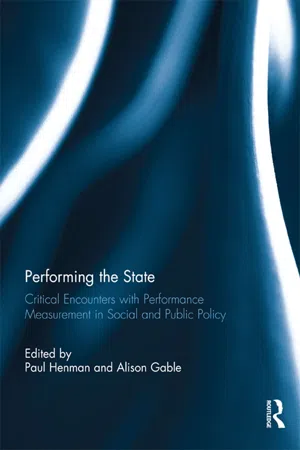
Performance measurement is now a key management tool used by government to assess and enhance public services. It is also used as a tool for public sector transparency and accountability. Despite these noble objectives, performance measurement can also generate counterproductive and sometimes paradoxical outcomes. This book innovatively conceptualises performance measurement as a 'policy instrument'. Such an approach necessarily invites careful and critical examination of instances of the formation, application and contestation of particular performance measurement regimes, the tools used to measure performance, the way in which performance data is produced and used, and the complex dynamics between professionals, managers and service users that arise from these practices. The book provides detailed empirical examples of performance measurement in the delivery of health, schooling and child welfare services, as well as the problematics of assessing national wellbeing. Instead of a form of scientific and rational management, performance measurement is revealed as an intrinsically contested, socio-politically charged and value laden practice. The book concludes that to succeed in delivering authentic performance improvements public sector managers must be aware of these complex, paradoxical dynamics and the circumstances that make performance measurement perform. This book was originally published as a special issue of Policy Studies.
eBook - ePub
Performing the State
Critical encounters with performance measurement in social and public policy
- 118 pages
- English
- ePUB (mobile friendly)
- Available on iOS & Android
eBook - ePub
Performing the State
Critical encounters with performance measurement in social and public policy
About this book
Information
Performance measurement as a policy instrument
Patrick Le Galès
ABSTRACT
The rise of government by indicators, by figures may reveal a new wave of rationalization organized by the state in the classic Weberian sense. Contemporary forms of government are marked by the rise of indicators, measures and new metrics to compare, certify, codify and evaluate. In many countries, performance measurement has become one of the symbols of the transformation of governance. The paper aims to show how performance indicators are a particular type of policy instrument that increases competitive pressure within societies even if that cannot be analysed only in terms of neoliberalism.
The rise of government by indicators, by figures may reveal a new wave of rationalization organized by the state in the classic Weberian sense. Contemporary forms of government are marked by the rise of indicators, measures and new metrics to compare, certify, codify and evaluate. In many countries, performance measurement has become one of the symbols of the transformation of governance. The paper aims to show how performance indicators are a particular type of policy instrument that increases competitive pressure within societies even if that cannot be analysed only in terms of neoliberalism.
The instruments of the performative state
As the great political scientist Christopher Hood puts it in the phrase ‘Welcome to the ranking world’, and in the delights of what Paul Henman analyses as the ‘Performance State’ in the introduction, measuring, quantifying, evaluating have become massive activities in the contemporary world. Once again, Max Weber was correct; those activities reflect relations of domination alike in the private and the public sector.
The rise of government by indicators, by figures may reveal a new wave of rationalization organized by the state in the classic Weberian sense. Many papers in the special issue bear witness of this trend. On the other hand, the state is not only performative, it is also performed. In other words, the state (together with large firms) is a massive quantifier and producer of measures and ranking. But the state is part of a globalizing world. The state is also increasingly being quantified, measured (Fourcade 2016; Lemoine 2016). In the neo-Marxist or neoliberal account, the contemporary state (the Schumpeterian globalizing workfare state as once suggested by Jessop (2002)) is mobilizing society for generalized economic competition. One account of neoliberalism is the idea of the disciplining of the state by private sectors measures, metrics and indicators, rating agencies with the use of financial indicators. The performative state might be the result of those transformations.
There are many ways to think about the transformation of states, from the interdependance with capitalism, to the rise of neoliberalism, the transformation of violence and war, the rationalization of state organizations, the impact of democratic pressure, the role of migration (King and Le Galès 2016). Contemporary forms of government are marked by the rise of indicators, measures and new metrics to compare, certify, codify and evaluate. In many countries, performance measurement has become one of the symbols of the transformation of governance. Various groups of scholars inspired by Foucault, Weber, Bourdieu, the sociology of science and technology, the sociology of quantification and management studies have documented the rise of measurement, and quantification, for instance Michael Power with his classic book The Audit Society (1999).
Several schools of thought have developed to make sense of this transformation and importance of measurement of performance and quantification. Historically, the development of statistics, measures and categories was associated with the development of the modern state (Porter 1995; Didier 2009). Even more incisively, sociologist and statistician Alain Desrosières has developed critical thinking about the making of the metrics of the state to rationalize, ‘Seeing like a state’ (Scott 1998). In his classic book on The Politics of Large Numbers (2010), Desrosières makes a compelling case showing the relationship between the rise of statistics, of various measurements and the increasing role of the state over time. In Europe in particular, the state was the master of measure, of categories. In order to make the society legible (Scott 1998), the modernist state used all sorts of census, measures and calculations in order to prepare the war, to mobilize populations, to tax, in other words, to govern its territory and population as Foucault eloquently put it. Foucault’s insight was precisely to decentre the analysis of the state in order to show different modes of étatisation of society; that is, the use of new technologies and dispositifs. In Britain, the group of critical scholars within business schools that started the journal Accounting, Organization and Society produced a wealth of incisive analysis and criticism of performative instruments. Nowadays, US cultural and economic sociology is developing a whole range of understanding processes associated with forms of measurement, valuation and evaluation (Fourcade 2011; Lamont 2012). The making of different metrics also produces and reveals different forms of inequalities (Espeland and Stevens 1998; Lawn and Normand 2014)
The paper aims to show how performance indicators are a particular type of policy instrument that increases competitive pressure within societies even if that cannot be analysed only in terms of neoliberalism. It starts by showing how the policy instrument approach has been elaborated in relation to Weber and Foucault. It then shows how policy instruments such as indicators of performance are central to the restructuring of states.
Policy instruments and technologies of government
Together with Pierre Lascoumes, and later with Charlotte Halpern, I have suggested that the rise of policy indicators should be analysed in terms of policy instruments, They are a concrete modality of exercising power revealing the structures of domination in the Weberian sense. Over the past decade, reflection on policy instruments and on public policy instrumentation in particular has shaped debate and fuelled in-depth discussions in relation to the rise of managerialism, forms of neoliberalism and the production of data associated with new technologies (Hood and Margetts 2007).
The contributions in our book Gouverner par les instruments, published in 2004 and the 2007 special issue of the journal Governance, sought to contribute to the policy debate. At the time, public policy – which falls within political sociology – was dominated by approaches that centred on stakeholders, ideas and institutions. We thus shifted our focus to the technologies of government. Social scientists studying the state and government have long taken an interest in the issue of technologies of government, including its instruments – Weber and Foucault, for instance.1
Michel Foucault took up this subject in his own way and pointed out the importance of what he called the ‘technical procedures’ of power – that is, ‘instrumentation’ – as a central activity in ‘the art of governing’ (Sennellart 1995). In a 1994 text, he formulated his programme for the study of governmentality as an approach that
does not revolve around the general principle of the law or the myth of power, but concerns itself with the complex and multiple practices of a ‘governmentality’ that presupposes, on the one hand, rational forms, technical procedures, instrumentations through which to operate, and, on the other, strategic games that subject the power relations they are supposed to guarantee to instability and reversal. (Foucault 1994)
Foucault contributed to the renewal of thinking on the state and governmental practices by shunning conventional debates of political philosophy about the nature and legitimacy of governments, devoting himself instead to their materiality, their policies and their modes of acting. In his reflections on the political, he put forward the question of the ‘statization of society’ – that is, the development of concrete devices, instruments, practices functioning more through discipline than constraint, and framing actions and representations of all social actors. He then refers to the contribution of the cameral sciences, to show the basis of his approach.
It was in the late 1960s that Foucault, in the context of his work on political liberalism, turned his attention to the writings of the cameral sciences (Foucault 1998). This science of police – that is, of the concrete organization of society – took shape in Prussia in the second half of the eighteenth century; it combined a political vision based on the philosophy of Aufklärung (Enlightenment) with principles that claimed rationality in administering the affairs of the city (Sennellart 1995). This current in rationalist thought was gradually displaced by ‘populationist concern for the happiness of populations’, combining dimensions of public order, well-being and culture. In classical political philosophy (e.g. Jean Bodin’s sixteenth-century work), there was an important separation between the attributes of sovereignty and the administration of everyday life. In contrast, from the late seventeenth century, there was a search for unity in the exercise of power, and these two dimensions came to be gradually integrated. Thus, the cameral sciences were the melting-pot of contemporary public policies. In his argument, Foucault distinguishes three stages in the development of this type of knowledge (1998) an initial stage of critical utopia, where the conceptualization of an alternative model of government enabled implicit criticism of the monarchical regime. He refers to Louis Turquet de Mayenne, who, in 1611, envisaged the development of a specialization of executive power – ‘police’ – to look after both the productivity of society and the security of its inhabitants. He saw this as a fourth ‘major function’, alongside the classic attributes of the royal prerogative: the judiciary, the army and the exchequer.
A second stage took shape at the beginning of the eighteenth century, when the general movement towards rationalization was applied to the royal administration by some of its officials, who were concerned for better efficiency. Various treatises made proposals for bringing order to the forest of royal regulations, and devoted themselves to the tasks of listing, classifying and categorizing in order to foster the organization of public policy. One of the most famous in Europe was written by Nicolas Delamare, who published his Traité de la police in 1705. According to him, ‘happiness (that is, “individual security and prosperity”) is a requirement for the development of the state’, and it is the responsibility of the political to achieve this objective.
Finally, a third stage was marked by the creation, mainly in Germany, of Polizeiwissenschaft, a more theoretical approach, which also became an academic discipline. Foucault’s reference work here is Johann Von Justi’s Elements of Police (1756), which proposed principles for action in ‘taking care of individuals living in society’ and aimed to ‘consolidate the citizen’s life with a view to fostering the state’s strength’. Training academies were developed. These welcomed the future civil servants of Prussia, Austria and Russia, who were to promote various administrative reforms in their countries. This current of thought spread more widely throughout Europe, and is viewed as having inspired some Napoleonic reforms of the executive.
This view, focused on the cameral sciences, led Foucault to clarify his thinking on analysis of the political. First of all, he pointed out the importance of differentiating between Politik and Polizei. This distinction is important, since Polizei has its own dual political rationality. One rationality is that of aim – the aim of expressing the interdependence between the productivity of civil society and the state’s strength. This is complemented by a rationality of means, viewing religious faith and love of sovereign or republic as insufficient for the construction of the collective. This second rationality must be filtered through concrete practices relating to security, the economy and culture (education, health, trade, the arts, etc.), which are just as much essential tasks of the state. For him, the central issue was not the democratic or authoritarian nature of the state; nor did it relate to the essence of the state or to its ideology, factors which legitimize or fail to legitimize it. He looked from the opposite end of the telescope, taking the view that the central issue was that of the statization of society – that is, the development of a set of concrete devices, practices through which power is exercised materially. Foucault proposed to analyse ‘practical systems’ (1998). That is, not to consider societies as they present themselves or to question the conditions that determine these representations, but rather to apply himself to what they do and the way they do it. This led him to propose a study of the forms of rationality that organize powers. Finally, in analysing practices, he stressed that the exercise of discipline was at least as important as constraint. Contrary to the traditional concept of an authoritarian power functioning through handing down injunction and sanction, he proposed a disciplinary concept that was based on concrete techniques for framing individuals, allowing their behaviours to be led from a distance.
The legacy of this thought has been remobilized, in the contemporary period, to account for changes in modes of government/governance. Focusing on policy instruments is a way to link sociological analysis of forms of rationalizati...
Table of contents
- Cover
- Half Title
- Title Page
- Copyright
- Contents
- Citation Information
- Notes on Contributors
- Introduction – Performing the state: the socio-political dimensions of performance measurement in policy and public services
- 1. Performance measurement as a policy instrument
- 2. Population health performance as primary healthcare governance in Australia: professionals and the politics of performance
- 3. Hitting the target without missing the point: New Zealand’s immunisation health target for two year olds
- 4. The challenge of quantifying national well-being: lessons from the Measures of Australia’s Progress initiative
- 5. NAPLAN data: a new policy assemblage and mode of governance in Australian schooling
- 6. Repositioning prevention in child protection using performance indicators
- 7. Techniques and paradoxes in performing performance measurements: concluding reflections
- Index
Trusted by 375,005 students
Access to over 1.5 million titles for a fair monthly price.
Study more efficiently using our study tools.
Frequently asked questions
Yes, you can cancel anytime from the Subscription tab in your account settings on the Perlego website. Your subscription will stay active until the end of your current billing period. Learn how to cancel your subscription
No, books cannot be downloaded as external files, such as PDFs, for use outside of Perlego. However, you can download books within the Perlego app for offline reading on mobile or tablet. Learn how to download books offline
Perlego offers two plans: Essential and Complete
- Essential is ideal for learners and professionals who enjoy exploring a wide range of subjects. Access the Essential Library with 800,000+ trusted titles and best-sellers across business, personal growth, and the humanities. Includes unlimited reading time and Standard Read Aloud voice.
- Complete: Perfect for advanced learners and researchers needing full, unrestricted access. Unlock 1.5M+ books across hundreds of subjects, including academic and specialized titles. The Complete Plan also includes advanced features like Premium Read Aloud and Research Assistant.
We are an online textbook subscription service, where you can get access to an entire online library for less than the price of a single book per month. With over 1.5 million books across 990+ topics, we’ve got you covered! Learn about our mission
Look out for the read-aloud symbol on your next book to see if you can listen to it. The read-aloud tool reads text aloud for you, highlighting the text as it is being read. You can pause it, speed it up and slow it down. Learn more about Read Aloud
Yes! You can use the Perlego app on both iOS and Android devices to read anytime, anywhere — even offline. Perfect for commutes or when you’re on the go.
Please note we cannot support devices running on iOS 13 and Android 7 or earlier. Learn more about using the app
Please note we cannot support devices running on iOS 13 and Android 7 or earlier. Learn more about using the app
Yes, you can access Performing the State by Paul Henman,Alison Gable in PDF and/or ePUB format, as well as other popular books in Social Sciences & Sociology. We have over 1.5 million books available in our catalogue for you to explore.