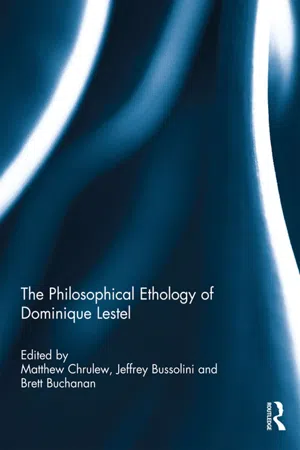
Dominique Lestel is a French philosopher whose work is significant for the rethinking of animality and human-animal relations. Throughout such important books as L'Animalité (1996), Les Origines animales de la culture (2001) and L'Animal singulier (2004), he offers a fierce critique of reductive, mechanistic models of animal behaviour, as well as a positive contribution to etho-ethnographic and phenomenological methods for understanding animal life. Centred around hybrid human–animal communities of shared interests, affects and meaning, his critical and speculative approach to the animal sciences offers a vision of animals as acting subjects and bearers of culture, who form their own worlds and transform them in concert with human and other partners. In tracing the ways in which we share our lives with animals in the texture of animality, Lestel's cutting-edge philosophical ethology also contributes to an overarching philosophical anthropology of the human as the most animal of animals. This book was originally published as a special issue of Angelaki: Journal of the Theoretical Humanities.
eBook - ePub
The Philosophical Ethology of Dominique Lestel
- 208 pages
- English
- ePUB (mobile friendly)
- Available on iOS & Android
eBook - ePub
The Philosophical Ethology of Dominique Lestel
About this book
Information
matthew chrulew
THE PHILOSOPHICAL ETHOLOGY OF DOMINIQUE LESTEL
We must transform ethology into wild philosophy.
Lestel, “Les Enjeux de l’éthologie” 57
The work of French philosopher Dominique Lestel is of vital interest for twenty-first-century reflection on humanity and animality. Deeply engaged with forms of life shared with other species, his thought responds to the changes wrought by new knowledges and technologies, particularly the uncanny proliferation of novel intelligences, both artificial and animal. Pursuing an empirical and constructivist phenomenology devoted to interpreting the significance of humanity’s animal inheritance and interpenetration, he gives classical questions unfamiliar forms and surprising answers: what or who is the human, the animal, the machine? His methods are interdisciplinary, combining textual and conceptual analysis of philosophy, ethology, culture and ethnography with field and laboratory observation and speculative concept creation. His sources are broad and often unexpected, including Gregory Bateson’s ecology of mind, Bruno Latour’s anthropology of the laboratory, Jakob von Uexküll’s biosemiotics, Arne Næss’s ecosophy, Louis Bec’s technozoosemiotics, Gilles Deleuze and Félix Guattari’s becoming-animal and Paul Shepard’s evolutionary ontology.1 Yet their ideas are deployed in unfamiliar manners and domains, shedding light on a bestiary of non-human subjects from ant colonies, fish and birds to signing chimpanzees and lifelike robots – and the people who bring them all together. The results are distinctive and noteworthy: an often iconoclastic oeuvre that skewers anthropocentric dogmas and doxas of science and philosophy and offers in their stead procedures for adequate knowledge that double as practices for a worthy life. From his early essay on animality and opus on ethology, through his reflections on animals as singular subjects and indeed friends, to his most recent contributions on ethical questions, Lestel’s work offers idiosyncratic yet consequential interventions into widely important debates. Yet, while he regularly engages with scholarship in English, most of his writings remain untranslated and unknown in relevant fields.2 Scholars working in animal studies and posthumanism, but also within the theoretical humanities more broadly, as well as the social and life sciences, will greatly benefit from engaging with his thought.
Lestel’s early work emerged from the philosophy and anthropology of the cognitive sciences, exploring the rhetoric and epistemology of artificial life and intelligence research, as well as of the ethological sciences to which he became increasingly devoted.3 Lestel was intrigued by the unprecedented meaningful agents revealed in the heady contact zones of these distinct yet often convergent fields: alongside the production of autonomous artefacts and machines came the forceful recognition of minded biological subjects. It was the significance of the latter that his first five books explored – talking animals, technological and cultural animals, singular animals, animal friends – as well as, more broadly, the question of animality itself. His most recent and forthcoming books build from these analyses to engage forthrightly with ethical issues, helping to defend animals against culturally ingrained hatred and persecution, alongside an apology for responsible carnivory that would ally with political vegetarianism. Throughout his work, he has not been slow to criticize widespread reductive approaches to animal life, non-human and human. Regular attacks on the problematic reasoning of dualists and positivists, performed with acerbic humour and rare ferocity, clear the ground on which he builds a new vision of shared animality steeped in meaningful reciprocity.
One of the most central elements of Lestel’s work is its philosophical ethology: a sustained critical engagement with the sciences of animal behaviour, emotion and mind.4 He thoroughly critiques the legacy of Cartesianism that sees animals as machines, a formidable intellectual and cultural apparatus that has persisted in numerous forms in the history of philosophy and science. He acknowledges the revolution in the understanding of animals that took place in twentieth-century ethology, presenting and elaborating the significance of numerous studies of animal culture, tool-use, communication, aesthetics and other once-excluded aspects of non-human life. Further, he offers his own methodological proposals for the future of ethology as a fully social science founded on shared existence and understanding. This profusion of new evidence and edifying approaches demands that we rethink our ideas both of animality and of the nature and origins of culture.
In the course of Lestel’s work, a range of novel concepts and positions emerge. At the forefront of these is his recognition that humans live in hybrid communities with animals with whom they share meaning, interests and affects. We can no longer ignore that we are surrounded by, and surround ourselves with, non-human animals who are indeed subjects, capable not only of constructing their own worlds and communicating with those of others but even of authentic friendships within and outside their species. Among numerous scientific, cultural and literary examples, Lestel often returns to that of the great ape language experiments, which formed unprecedented convergences in order to teach animals to speak. Alike communities proliferate today, revealing, producing and transforming the nature of an overflowing animality. Yet they are always mediated by the third parties of artefacts and machines, whose increasing significance and animalization lures the animality of humans and non-humans across new and profound thresholds. For Lestel, we owe to all animals – they who constitute our animality and humanity, they who give us to think – an infinite debt, at once unpayable and innervating. Indeed, at the centre of his rethinking of animality is a renewed image of humanity that offers, in addition to a critique of the humanist exceptionalism that would decisively separate human from animal, an affirmative exploration of the particular, zoophilic niche that humankind has elaborated within the texture and significance of animality.
philosophical ethology
Throughout his writings, Lestel pays due attention to the varied history of cultural ideas about animals, those obscure figures of otherness and similitude through which human identity is defined. In the first part of his foundational book L’Animalité, “Elements for a history of representations of human and animal” (11–65), Lestel gathers together some “key moments” (11) of this entangled interspecies history.5 The fundamental gulf between human and animal was centrally established in Greek and Christian thought, notwithstanding the exemplary animality of the Cynics and the biophilia of St Francis. Numerous intermediaries and limit cases served to define and problematize the uniqueness of the human, from feral children to deaf-mutes, “Hottentots,” orangutans and cannibals. Lestel’s ensuing tour touches on a wide range of figures of animality: the Cartesian “animal-machines”; the more complex machines of ethology, Darwinism, sociobiology, and AI research; artistic practices that seek to replicate processes of life such as evolution and reproduction; the suffering animals of modern animal rights discourse and the tradition of anti-Cartesianism; the “talking apes” of the American ape language experiments; and the cultural, tool-using animals of late twentieth-century ethology and naturalist observation.
Yet from the springboard of this initial reconnoitre, Lestel propels his analysis into specific domains, and with particular methods and objectives, that seek not only to deepen or critique this history of ideas but also to reconfigure the very figures, concepts and practices with which we represent, think and perform animality. His intentions are not historicist but zooanthropological and speculative. In Part II of L’Animalité, after also examining modern representations of hominization, the emergence of humanity from animality, he steps out of this cultural and intellectual history and begins to elaborate his concept of hybrid communities in an attempt to rethink animality itself. The previous year, he had already published Paroles de singes, an analysis of the “talking ape” experiments mentioned late in his brief tour. While this book includes a short introductory excursion into the history of apes as limit-figures in Enlightenment philosophy and comparative biology, “a recurring fantasy” (11–14) through which human nature was imagined, and does ultimately speak to the venerable humanist themes expressed by these attempts to teach creatures supposedly deprived of language to speak, it does not stay on this discursive register to examine this newly experimental approach. Its core, rather, is an in-depth anthropological investigation of a domain at once empirical and epistemological but also social and zoontological, a concrete zone of interspecies curiosity and interaction. And in the book that follows L’Animalité – but only after a fecund fallow period of five years – Les Origines animales de la culture, he turns his attention to those “cultural animals” envisaged by twentieth-century ethological sciences, recognizing the fundamental changes that developments in ethology have made to understandings of animals.
What is distinctive about Lestel’s work as a whole is its focus on these latter figures in his history of animal representations. The bulk of his thought is directed not towards the philosophical ideas about or cultural depictions of animals obsessed over in contemporary scholarship, from Heidegger’s world-poor tick to Coetzee’s dying dog, but rather towards the knowledge of animal lives, expression, behaviour and cognition produced by the animal sciences. Despite being recognized as the peculiar fascination of modern, scientific culture, this knowledge is not analysed on the same level or in quite the same manner as other conjectures. Without being held up as beacons of light dispersing the vapours of myth, the ideas about animals produced within these domains of observation and experimentation are taken seriously – that is, critically – in their empirical claims, in so far as their distinctively edifying practices reveal something of animal nature obscured by anthropocentric representations. Moreover, they demand a new ontology of human/animal relations. As he put it in Paroles de singes:
As for the wolf children and leopard-men, their relations to the animal are on a whole other level, fusional, assimilative and fantastical. The relationship between ape-researchers and primates is on the contrary entirely turned towards the possibility of a shared understanding. (8)
Something similar might also be said of the relationships between researchers and chimpanzees in the forests of Gombe and Taï, and to different degrees of numerous other intensive associations that produce mutual insights. Such affiliations of shared understanding must, of course, be analysed anthropologically and zoopolitically; but they also produce knowledge about animals that ought in turn to impact on the concepts and practices of philosophy.
Thus at the centre of Lestel’s work is a simultaneously critical and constructive engagement with the sciences of animal behaviour, culture and cognition. As he put it recently, “these animal sciences need to be deconstructed (and reconstructed) by the philosopher – and not used as such” (“Like the Fingers” 62–63). While complex and multi-faceted, operating in different modes and taking up various cases throughout his books and major articles, Lestel’s critical field epistemology of this empirical domain consistently proceeds through three integrated yet nonetheless distinguishable undertakings: (1) a critique of Cartesianism in the ethological sciences; (2) an acknowledgement of the new knowledge produced by ethology and its upheaval of inherited ideas; and (3) the reconstruction of ethology through the rehabilitation of marginalized traditions and the development of novel methods for understanding animal worlds.
critique of cartesianism
Lestel rarely misses an opportunity to attack the perpetuation of Cartesianism in contemporary philosophy, science and culture. Nor does he see such holdovers as the innocuous remnants of obsolete ideas: a mechanistic view of animality is still behind much of our treatment of animals, is shared by both analytic and Continental philosophy, and what he calls the “realist-Cartesian” posture holds the majority ground in the university disciplines which produce authorized knowledge about animals (“What Capabilities”). Thus he repeatedly performs a thoroughgoing critique of the practices and knowledge claims that maintain a Cartesian view of the human/animal divide. While it appears in various guises, at its core this viewpoint fundamentally separates humans from animals, and reduces the latter to reactive machines, determined by environmental and biological causes, with species-specific competencies that can be exhaustively known from an external, objective viewpoint. This position – reinforced by the dominant strands of ethology – is identified as the enemy by a minoritarian ethology that recognizes animals as creative agents constructing and interpreting their own subjective worlds.
As Derrida’s late work has shown, the legacy of this Cartesianism can be found in the concepts of thinkers as different as Kant, Heidegger, Lacan and Levinas, all of whom in some way differentiate human response from animal reaction. Yet Lestel does not isolate his critique to the history of philosophy; rather, he confronts in depth the domain of scientific knowledge of animals.6 Ethologists have often naively proceeded using deficient and problematic concepts and methods inherited from anthropocentric traditions. This conceptual ballast has had a debilitating eff...
Table of contents
- Cover
- Half Title
- Title
- Copyright
- Contents
- Citation Information
- Notes on Contributors
- General Introduction: Philosophical Ethology
- Preface: A Field Philosopher with a Certain Taste for Fish, and Who Does Not Mistake his Hat for an Ethology
- Introduction: Dominique Lestel
- 1. The Philosophical Ethology of Dominique Lestel
- 2. Mirror Effects
- 3. Hybrid Communities
- 4. Toward an Ethnography of Animal Worlds
- 5. Dissolving Nature in Culture: Some Philosophical Stakes of the Question of Animal Cultures
- 6. The Question of the Animal Subject: Thoughts on the Fourth Wound to Human Narcissism
- 7. The Friends of My Friends
- 8. Epistemological Interlude
- 9. The Carnivore’s Ethics
- 10. The Infinite Debt of the Human Towards the Animal
- 11. The Animal Outside the Text: An Interview with Dominique Lestel
- Index
Trusted by 375,005 students
Access to over 1.5 million titles for a fair monthly price.
Study more efficiently using our study tools.
Frequently asked questions
Yes, you can cancel anytime from the Subscription tab in your account settings on the Perlego website. Your subscription will stay active until the end of your current billing period. Learn how to cancel your subscription
No, books cannot be downloaded as external files, such as PDFs, for use outside of Perlego. However, you can download books within the Perlego app for offline reading on mobile or tablet. Learn how to download books offline
Perlego offers two plans: Essential and Complete
- Essential is ideal for learners and professionals who enjoy exploring a wide range of subjects. Access the Essential Library with 800,000+ trusted titles and best-sellers across business, personal growth, and the humanities. Includes unlimited reading time and Standard Read Aloud voice.
- Complete: Perfect for advanced learners and researchers needing full, unrestricted access. Unlock 1.5M+ books across hundreds of subjects, including academic and specialized titles. The Complete Plan also includes advanced features like Premium Read Aloud and Research Assistant.
We are an online textbook subscription service, where you can get access to an entire online library for less than the price of a single book per month. With over 1.5 million books across 990+ topics, we’ve got you covered! Learn about our mission
Look out for the read-aloud symbol on your next book to see if you can listen to it. The read-aloud tool reads text aloud for you, highlighting the text as it is being read. You can pause it, speed it up and slow it down. Learn more about Read Aloud
Yes! You can use the Perlego app on both iOS and Android devices to read anytime, anywhere — even offline. Perfect for commutes or when you’re on the go.
Please note we cannot support devices running on iOS 13 and Android 7 or earlier. Learn more about using the app
Please note we cannot support devices running on iOS 13 and Android 7 or earlier. Learn more about using the app
Yes, you can access The Philosophical Ethology of Dominique Lestel by Matthew Chrulew, Jeffrey Bussolini, Brett Buchanan, Matthew Chrulew,Jeffrey Bussolini,Brett Buchanan in PDF and/or ePUB format, as well as other popular books in Philosophy & Philosophy History & Theory. We have over 1.5 million books available in our catalogue for you to explore.