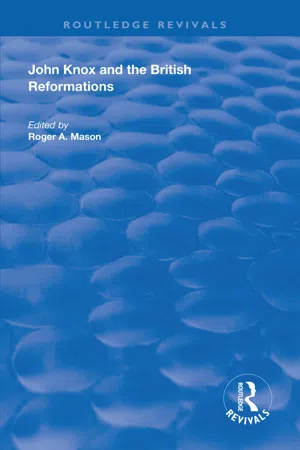
Published in 1998. John Knox is one of the towering figures of the European reformation, his name synonymous with hard-line evangelical Protestantism, and his influence spreading far beyond his native Scotland. This volume seeks to reassess Knox's career in the context of the European Reformation as a whole, but with particular reference to his impact in Scotland and England. The 13 contributors, all acknowledged authorities in the field, together provide a significant reappraisal of Knox and his role in the British Reformations.
- 297 pages
- English
- ePUB (mobile friendly)
- Available on iOS & Android
eBook - ePub
John Knox and the British Reformations
About this book
Information
Part One
Early Years and Exile
Chapter Two
John Knox and the Castilians: A Crucible of Reforming Opinion?
Carol Edington*
In the name of God, and of his Sone Jesus Christ, and in the name of these that presentile calles yow by my mouth, I charge yow, that ye refuise not this holy vocatioun, but that as ye tender the glorie of God, the encrease of Christ his kingdome, the edification of your brethrene, and the conforte of me ... that ye tack upoun yow the publict office and charge of preaching, evin as ye looke to avoid Goddis heavye displeasur, and desyre that he shall multiplye his graces with yow.1
With these stirring words was John Knox called to the ministry shortly after Easter 1547. Confronted with such passion, he responded in kind, bursting into noisy tears and seeking the sanctuary of his room. There he spent several fraught days examining his conscience and considering the direction his future should take. Eventually he emerged to refute the teachings of that 'rottin Papist', John Annand, and, on being challenged to explain his attack, he himself climbed into the pulpit of Holy Trinity, St Andrews, the following Sunday.2 Thus, according to Knox, was he called upon to acknowledge and accept his vocation. For a man whose surviving works exceed 3 500 pages collected in six volumes, this two-paragraph report is a remarkably brief account of what must have been one of the central experiences of his life.3 Certainly, we might expect any account of the personal and defining episodes of his life to be - if not altogether accurate - at least expansive. Indeed, it is Knox's uncharacteristic reticence on this matter which convinces. While this restraint has not gone unnoticed by his biographers, few have felt able to enlarge upon the episode and endow it with the importance it most surely deserves.4 This is a great pity for the manner of Knox's calling to the ministry, the way in which he perceived his vocation and the nature of his first public appearances, all have a great deal to tell us concerning the character of Protestant thinking in Scotland during the 1540s. This in turn sheds valuable light on Knox himself, for although it remains true that the most formative influences on his thought were rooted in experiences outwith Scotland, his early career and association with other Scottish reformers provided the inspiration for his faith and the bedrock of many of his best known attitudes.5 Obviously there are methodological problems in an uncritical acceptance of Knox's own version of this episode, written up in his History in the mid-1560s. Any account of the 1540s reflects not simply Knox's experiences of that decade but also the later years of his life and his overriding evangelical purpose. Nevertheless, historians are surely correct to conclude that, used with caution, his History represents an indispensable source for the events of the Scottish Reformation and, although independent corroboration for much of what Knox has to say concerning the early episodes of his career is scant, focusing on some of the other individuals associated with him at this time offers a potentially fruitful approach to the problem.6
The events leading up to John Knox's dramatic emergence into public life are well known. Less fully appreciated, however, is the complex network of Protestant sympathizers and the heterogeneous collection of reforming beliefs they espoused, which together had contributed to a situation in which a small group of political and religious rebels were able to assassinate the most powerful figure in the land and plot a coup intended to topple the ruling administration and - in the dreams of some - the established Catholic Church. Significantly, several of those associated with Knox at this critical period in his life had long been involved in Scotland's nascent Protestant movement. In particular, Henry Balnaves, John Rough and David Lindsay of the Mount, the three men whom Knox names as being instrumental in persuading him to preach, each had long-standing connections reaching back into the difficult, often dangerous, days of the 1530s and which, in the following decade, saw them propelled centre stage.7
The nature and extent of early Scottish Protestantism has been the subject of considerable academic debate.8 However, whether one talks the numbers up or down, it seems clear that the movement - if that is not too elevated and specific a term - was geographically scattered and fragmentary. While the majority of early Scottish Protestants were clerics, there was at court a small yet significant number of influential laymen who in the course of the 1530s began to attack the established Church and religious status quo.9 By no means all of these were confessed Protestants and, even amongst those who could be said to have embraced the reformed religion, views were often so diverse and contradictory that it is no wonder historians fall with relief upon the convenient concept of 'evangelicalism', a term now frequently used to denote that reforming impulse and attachment to the message of the Gospel which characterizes much early Reformation thinking and which helpfully precludes the use of over-precise definitions in an uncertain religious climate.10 Thus, on the one hand, we can consider such future Castilians as Sir David Lindsay of the Mount, a Fife laird and royal herald, who combined a savage - and very public - criticism of clerical abuse and papal authority with a humanist-inspired call for renewed spirituality based on the Word of God and the uncorrupted teachings of the early Church, yet who never embraced the central tenets of reformed theology. On the other hand, one who certainly took this path was Sir John Borthwick, who first seems to have made Lutheran contacts in France and whose outspoken criticisms of the Church led to accusations of heresy, flight to England, and the burning of his effigy in the marketplace at St Andrews.11 Other evangelicals at the Scottish court included men such as James Kirkcaldy of Grange, the Royal Treasurer, reputed to have 'becom ane heretik and [to have] had alwayes a New Testament in his poutch'; and James Learmonth of Dairsie, the Master of the Household.12 Another key figure in this respect was Henry Balnaves. Appointed earlier in his career as Procurator and spokesman in the consistorial courts, Balnaves was later made Treasurer's Clerk by Kirkcaldy of Grange. He also acted as advocate and Lord of Session, his service receiving recognition and reward in 1538 when he was created Lord Halhill.13 The presence of such men at court should not be taken to indicate Crown support for the type of ideas they espoused. The actions of James V suggest a conventional enough piety and - for diplomatic reasons if no other - the Scottish king was anxious to be viewed as a stalwart guardian of Catholic orthodoxy in the face of English schism.
The religious tensions present at court during the 1530s were, of course, much more complex than this necessarily brief and overly simplistic sketch suggests.14 Nevertheless, by the end of the reign, the evangelicals - be they moderate or more radical in their opinions - must have hoped that many of their most cherished aims were about to be realized for, with the unexpected death of James V in December 1542 and the accession of his infant daughter, power passed to James Hamilton, Earl of Arran. Persuaded that his family's interests were best served by the adoption of a more reforming, pro-English policy, Arran patronized Protestant preachers such as John Rough; he agreed to dynastic union between Scotland and schismatic England; and in March 1543, in response to a bill sponsored by, amongst others, Henry Balnaves, Parliament authorized the reading of Scripture 'in the vulgar toung'.15 In the eyes of many, it must have seemed as if a religious settlement along the lines of that enacted in England was now a real possibility. And, in similar fashion, historians too have viewed 1543 as 'a natural moment for the Reformation in Scotland'.16 Too much, however, lay with the political will of the supremely malleable Arran. By the end of the year the Governor was firmly under Cardinal David Beaton's pro-Catholic, pro-French, influence and Parliament was vigorously calling for the implementation of Scotland's anti-heresy legislation. At first sight, this may seem like the Reformation that foundered, a premature putsch which failed to accomplish for Lutheranism what the events of 1560 would later achieve for Calvinism, but we should not underestimate the influence that the ideas and events of the first two decades of Scottish Protestantism exercised over its later development.
By the early 1540s Protestantism in Scotland was a potentially influential creed yet, without clear leadership, it lacked unity or a sense of purpose. These vital, yet hitherto elusive qualities, seemed poised to emerge in the person of George Wishart whose return to Scotland and subsequent ministry did so much to alarm the ecclesiastical authorities. Arriving via England from Germany and Switzerland, Wishart's theology owed a great deal to the ideas of Zwingli (in 1536 he had completed an English translation of the First Helvetic Confession of Faith, published circa 1548). Wishart's energetic proselytizing, his charismatic personality and evangelical message appealed not only to the large crowds who flocked to listen to his open-air sermons in Angus and East Lothian but also, and more significantly, to a group of influential nobles and local lairds whose support offered the preacher temporary protection. At this time employed as a tutor by one of those lairds sympathetic to Wishart, Knox found himself caught up in the events surrounding this unorthodox mission.17 Without doubt, Wishart made an enormous personal impression upon him and, as we shall see, both Wishart's ideas and the character of his ministry were echoed by several of those later holed up in St Andrews Castle, not least Knox himself.
The disturbing conflation of popular appeal and influential patronage generated by Wishart's ministry, together with the genuinely subversive challenge which his teaching posed to the Catholic faith, persuaded the authorities to act. He was arrested and tried before an ecclesi...
Table of contents
- Cover
- Half Title
- Title
- Copyright
- Contents
- Notes on Contributors
- Preface
- List of Abbreviations
- Introduction
- Part One Early Years and Exile
- Part Two Political and Theological Thought
- Part Three The Scottish Reformation
- Index
Trusted by 375,005 students
Access to over 1.5 million titles for a fair monthly price.
Study more efficiently using our study tools.
Frequently asked questions
Yes, you can cancel anytime from the Subscription tab in your account settings on the Perlego website. Your subscription will stay active until the end of your current billing period. Learn how to cancel your subscription
No, books cannot be downloaded as external files, such as PDFs, for use outside of Perlego. However, you can download books within the Perlego app for offline reading on mobile or tablet. Learn how to download books offline
We are an online textbook subscription service, where you can get access to an entire online library for less than the price of a single book per month. With over 1.5 million books across 990+ topics, we’ve got you covered! Learn about our mission
Look out for the read-aloud symbol on your next book to see if you can listen to it. The read-aloud tool reads text aloud for you, highlighting the text as it is being read. You can pause it, speed it up and slow it down. Learn more about Read Aloud
Yes! You can use the Perlego app on both iOS and Android devices to read anytime, anywhere — even offline. Perfect for commutes or when you’re on the go.
Please note we cannot support devices running on iOS 13 and Android 7 or earlier. Learn more about using the app
Please note we cannot support devices running on iOS 13 and Android 7 or earlier. Learn more about using the app
Yes, you can access John Knox and the British Reformations by Roger A. Mason in PDF and/or ePUB format, as well as other popular books in Social Sciences & Sociology. We have over 1.5 million books available in our catalogue for you to explore.