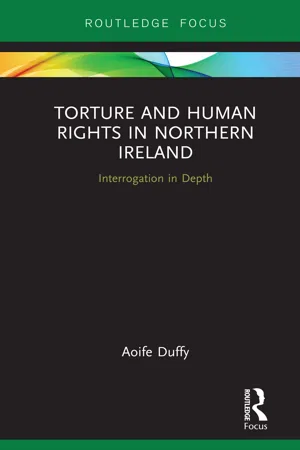
This book presents a compelling and highly sophisticated politico-legal history of a particular security operation that resulted in one of the most high-profile torture cases in the world. It reveals the extent to which the Ireland v. United Kingdom judgment misrepresents the interrogation system that was developed and utilised in Northern Ireland. Finally, the truth about the operation is presented in a comprehensive narrative, sometimes corroborating secondary literature already in the public domain, but at other times significantly debunking aphorisms, or, indeed, lies that circulated about interrogation in depth. The book sets out the theoretical reference paradigm with respect to the culture and practice of state denial often associated with torture, and uses this model to excavate the buried aspects of this most famous of torture cases. Through the lens of a single operation, conducted twice, it presents a fascinating exposé of the complicated structures of state-sponsored denial designed to hide the truth about the long-term effects of these techniques and the way in which they were authorised.
- 96 pages
- English
- ePUB (mobile friendly)
- Available on iOS & Android
eBook - ePub
1 Background context
During the Northern Ireland conflict, the politico-legal and military powers that controlled the region utilised emergency lawfare as the linchpin of their counter-emergency toolkit. Detention without trial became intimately associated with stories of violence. Interrogation was a lightning rod for violence; situations were created and practices were pursued that increased detainees’ vulnerability. Torture occurs in the darkest spaces of society, shielded from view by denial and subterfuge. Much has been written about the combined usage of five techniques as pre-interrogation methods on 14 individuals (the ‘hooded men’) in Northern Ireland in 1971. 1 Operation Calaba was the vehicle through which the system, known euphemistically within the security forces as ‘deep interrogation’ or ‘interrogation in depth,’ was applied twice at a secret location off the grid of detention centres in Northern Ireland. As mentioned above, the system entailed hooding, stress postures (wall standing), sleep deprivation, subjection to white noise, and a reduced diet. In summary, the operation triggered two public inquiries (the Compton Committee and the Parker Committee), civil litigation in Northern Ireland, and an inter-state application to the regional European system of human rights brought by Ireland against the United Kingdom. The book knits together a tight historiography of these practices by analysing recently declassified documents associated with the inter-state application, as well as other contemporaneous state-sponsored public inquiries, and civil litigation.
Although the European Commission of Human Rights found that the techniques amounted to torture, the European Court of Human Rights took a different view. Referring to a 1975 UN General Assembly Resolution, which indicated that torture was an aggravated form of cruel, inhuman, or degrading treatment, the Court concluded that the treatment fell under the latter category, as it ‘did not occasion suffering of the particular intensity and cruelty implied by the word torture as so understood.’ 2 The high threshold for torture set by the Court has resonated in other jurisdictions and states of emergency over the years. The primary archives are analysed here against the reinvigorated debate and contemporary litigation. But, more importantly, the evidence is superimposed on its own temporal context to reach the following conclusion – the gravity of the Commission’s torture finding was quietly accepted within the UK politico-security bureaucracy – this was not really at issue. What was more important to the establishment was hiding the paper trail that would give credence to the Commission’s finding and obfuscating lines of authorisation so that there would be no individual or institutional accountability.
Despite all the debate on the classification of the five techniques, this is the first definitive account of how the events unfolded, and the conspiracy of silence that surrounded Operation Calaba and its aftermath, which severely restricted all subsequent truth-seeking endeavours. The role of the security forces and the political establishment in Stormont and Westminster, both in instigating detention and related practices, and covering up the resulting abuses, is elucidated here. The culture of denial is shown in high relief, particularly with respect to the manner in which the public narrative of ‘interrogation in depth’ was formed, which reverberates through the 1978 Strasbourg judgment.
In December 2014, the Irish government returned to the European Court of Human Rights seeking to have the case reopened in light of new materials disseminated by an RTÉ documentary, The Torture Files, broadcast that June. 3 Under Rule 80 of the Court this is possible if the following three conditions are met:
(a) A fact is discovered, which might by its nature have had a decisive influence;
(b) This fact was unknown to the Court at the time of the judgment;
(c) and could not reasonably have been known by the requesting party. 4
In addition, the request must be submitted within a period of six months following the acquisition of new information. 5 Thus, regarding admissibility, as some of the files underpinning the RTÉ documentary had actually been released into the United Kingdom’s National Archives between 2003 and 2008 pursuant to the ‘thirty year rule,’ the Court had to consider whether these facts could have been reasonably known to the Irish government at a point earlier than mid-2014.
A key document highlighted in the programme illustrated that the decision to use torture was taken at a high level by ministers within the British Cabinet. 6 In addition, medical reports were presented that graphically depicted persistent psychiatric symptoms in some of the men. While the Court found the revision request to be admissible, it was not convinced that the new materials presented in the review request would have had a decisive influence on the original judgment and, therefore, in recognition of the principle of legal certainty, let the original judgment stand. 7 Material presented in this book is drawn from some of the same documents recently examined by the European Court. Though cognisant of the technical straightjacket of Rule 80 that seemingly constrained the Court’s consideration of the declassified material, this historiography does provide a new perspective on the events, by delineating levels of authorisation, and the politico-legal, social, and psychological consequences of Operation Calaba.
Not long before the Irish government’s renewed application to Strasbourg, one of the ‘hooded men,’ Francis McGuigan, and the daughter of Sean McKenna, who died less than four years after subjection to the techniques, applied for a judicial review of the Police Service of Northern Ireland’s (PSNI) decision to terminate its investigation into these historic events. In 2014, a PSNI Investigating Officer concluded, on the basis of a cursory look at some files located in the UK National Archives, that s/he could not find any evidence to show how these methods were authorised, and therefore the Assistant Chief Constable decided not to take the matter any further. 8 This monograph reconstructs the complex layers of command and authorisation for the torture operation and highlights significant communications between Brian Faulkner, who was Prime Minister and Home Affairs Minister of the Northern Ireland government, and key members of the security forces (the RUC, the British Army, and the UK intelligence services), as well as UK government ministers and senior civil servants based in Whitehall. Indeed, in October 2017, although the Northern Ireland High Court was unable to order an investigation compliant with the European Convention on Human Rights (due to the non-retroactivity of the UK Human Rights Act 1998 in this instance), it did nevertheless quash the PSNI’s decision to terminate the investigation. 9 Though the High Court did not specify any framework for investigation, the presiding judge commented on the PSNI’s lack of independence in reviewing these cases. 10 The PSNI’s reluctance to pursue the matter is contextualised here against historic patterns of denial and cover-up whose lineage can be traced to its predecessor policing organisation – the RUC, which is unquestionably implicated in the abuses that occurred.
Through law and history, this scholarship narrates the past by drawing from recently declassified files released under the 30-year rule into the public domain. 11 By methodologically reconstructing the landscape of emergency laws in Northern Ireland, Chapter 2 shows how emergency lawfare was an accepted element of the counter-insurgency toolkit, purportedly a necessary politico-legal response to violent Republicanism. Whereas this regulatory framework created the space for illegal violence, it also effectively hid the violence under a façade of legality. Chapter 2 outlines the chronological development of extraordinary emergency diktats that framed the legal scene in Northern Ireland both during times of peace and rebellion. Chapter 3 carefully pieces together the politico-military context in which the suspension of legal protections via internment occurred. Interrogation was a flashpoint for detention-based violence, and Chapter 4 analyses a particularised military format designed to produce a global breakdown in its subjects, sustained by impunity and shielded from view by a sophisticated apparatus of denial supported by various strategies and techniques.
It is possible to add significant texture to what is known about the events as they unfolded, and the mental and physical suffering experienced by the ‘hooded men.’ Perhaps, though, what is even more important here is the rigorous unpicking of the multi-layered apparatus of denial that couched state and security force narratives about Operation Calaba, and ultimately shaped the UK government’s involvement with the regional human rights mechanisms in Strasbourg throughout the 1970s. Using the conceptual paradigm provided by Stanley Cohen in States of Denial, the apparatus of denial is dismantled in Chapter 5. This denial framework for detention-based abuses was a centrepiece in the struggle against Republican paramilitaries during the Northern Ireland conflict. 12 Many files that document the mistreatment of detainees remain withheld under Freedom of Information Act exemptions, but it has been possible to penetrate the apparatus of denial by carefully examining the files that have been released. 13 Thus, it is theorised that there are multifaceted levels of denial, from deception plans utilised by the security forces during such operations, backed up by higher level assurances and immunities (also manifested in the inability of the criminal justice system to prosecute state abuses), the manipulation of ‘independent’ public inquiries, and the disingenuous nature of UK government engagement with the human rights infrastructure at Strasbourg. Plausible deniability was essential for Operation Calaba, delivered on the ground by a shadowy British Army agency directed by Lieutenant Colonel Nicholson, whose job had to be ‘kept secret.’ 14
The security force responses to allegations of harm fell along a continuum, from outright or literal denial on one end, to interpretive or implicatory denial at the other. 15 Cohen explores the complicated politics of denial that often mark state responses to atrocities. Such collective denial result from ‘professional ethics, traditions of loyalty and secrecy, mutual reciprocity or codes of silence. Myths are maintained that prevent outsiders knowing about discreditable information; there are unspoken arrangements for concerted or strategic ignorance.’ 16 Cohen adopts a tripartite approach to denial in its literal, interpretive, and implicatory aspects. Literal denial is blatant denial, whereby the ‘fact or knowledge of the fact is denied.’ 17 Interp...
Table of contents
- Cover
- Half-Title
- Title
- Copyright
- Dedication
- Contents
- Acknowledgements
- Introduction
- 1 Background context
- 2 Emergency regulations
- 3 Internment 1971
- 4 Interrogation in depth
- 5 Denial and concealment
- Conclusion
- Bibliography
- Index
Trusted by 375,005 students
Access to over 1.5 million titles for a fair monthly price.
Study more efficiently using our study tools.
Frequently asked questions
Yes, you can cancel anytime from the Subscription tab in your account settings on the Perlego website. Your subscription will stay active until the end of your current billing period. Learn how to cancel your subscription
No, books cannot be downloaded as external files, such as PDFs, for use outside of Perlego. However, you can download books within the Perlego app for offline reading on mobile or tablet. Learn how to download books offline
Perlego offers two plans: Essential and Complete
- Essential is ideal for learners and professionals who enjoy exploring a wide range of subjects. Access the Essential Library with 800,000+ trusted titles and best-sellers across business, personal growth, and the humanities. Includes unlimited reading time and Standard Read Aloud voice.
- Complete: Perfect for advanced learners and researchers needing full, unrestricted access. Unlock 1.5M+ books across hundreds of subjects, including academic and specialized titles. The Complete Plan also includes advanced features like Premium Read Aloud and Research Assistant.
We are an online textbook subscription service, where you can get access to an entire online library for less than the price of a single book per month. With over 1.5 million books across 990+ topics, we’ve got you covered! Learn about our mission
Look out for the read-aloud symbol on your next book to see if you can listen to it. The read-aloud tool reads text aloud for you, highlighting the text as it is being read. You can pause it, speed it up and slow it down. Learn more about Read Aloud
Yes! You can use the Perlego app on both iOS and Android devices to read anytime, anywhere — even offline. Perfect for commutes or when you’re on the go.
Please note we cannot support devices running on iOS 13 and Android 7 or earlier. Learn more about using the app
Please note we cannot support devices running on iOS 13 and Android 7 or earlier. Learn more about using the app
Yes, you can access Torture and Human Rights in Northern Ireland by Aoife Duffy in PDF and/or ePUB format, as well as other popular books in Law & British History. We have over 1.5 million books available in our catalogue for you to explore.