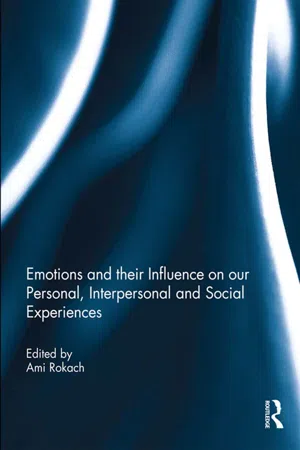
Research indicates that each emotion is associated with cognitive appraisals that influence our decision-making, our behavior and our relationships. Positive emotions may enhance our point of view and affect our decision to execute what we meant to. Negative emotions are known to not only affect the manner in which we view the world, but our plans, our willingness to interact with others, and our choices, both behaviorally, and cognitively. Emotions are also known to affect us physically. Positive emotions support our immune system, are responsible for our health enhancing behavior, and allow us to be open to our social support network. Negative emotions are known to hamper our immune system and thus make us more prone to illnesses, sometimes life threatening ones, and interfere with successfully coping with them. This book focuses on the role of emotions in everyday life, and particularly, the destructive effects of negative emotions such as anger, anxiety, depression, and the fear of death that humans share. The articles in this book were originally published in the Journal of Psychology: Interdisciplinary and Applied.
eBook - ePub
Emotions and their influence on our personal, interpersonal and social experiences
- 238 pages
- English
- ePUB (mobile friendly)
- Available on iOS & Android
eBook - ePub
Emotions and their influence on our personal, interpersonal and social experiences
About this book
Information
Emotion Regulation Strategies, Secondary Traumatic Stress, and Compassion Satisfaction in Healthcare Providers
Cornelia Măirean
ABSTRACT
The aim of the present study is to examine the relationships between two emotion regulation strategies (cognitive reappraisal and expressive suppression), secondary traumatic stress, and compassion satisfaction in a sample of 190 healthcare providers. Another aim of this study is to examine if the relations between emotion regulation strategies and traumatic stress symptoms are moderated by compassion satisfaction. The respondents volunteered to take part in the research and completed self-reporting measures describing the use of emotional regulation strategies, the symptoms of secondary traumatic stress, and the compassion satisfaction. The results revealed negative associations between cognitive reappraisal and secondary traumatic stress, while expressive suppression is positively associated with arousal. Moreover, cognitive reappraisal is positively related to compassion satisfaction, while secondary traumatic stress symptoms are negatively correlated with compassion satisfaction. Furthermore, the relationship between expressive suppression and intrusions is moderated by compassion satisfaction. The implications of these results for enhancing professional quality of life in the context of secondary exposure to traumatic life events are discussed.
The aim of the present study is to examine the relationships between two emotion regulation strategies (cognitive reappraisal and expressive suppression), secondary traumatic stress, and compassion satisfaction in a sample of 190 healthcare providers. Another aim of this study is to examine if the relations between emotion regulation strategies and traumatic stress symptoms are moderated by compassion satisfaction. The respondents volunteered to take part in the research and completed self-reporting measures describing the use of emotional regulation strategies, the symptoms of secondary traumatic stress, and the compassion satisfaction. The results revealed negative associations between cognitive reappraisal and secondary traumatic stress, while expressive suppression is positively associated with arousal. Moreover, cognitive reappraisal is positively related to compassion satisfaction, while secondary traumatic stress symptoms are negatively correlated with compassion satisfaction. Furthermore, the relationship between expressive suppression and intrusions is moderated by compassion satisfaction. The implications of these results for enhancing professional quality of life in the context of secondary exposure to traumatic life events are discussed.
Introduction
In the context of healthcare, stressful life events do not occur in isolation from each other. It is well-documented that continuous exposure to traumatic life events predicts maladjustment, emotional exhaustion, feelings of distress, dissatisfaction, and secondary traumatic stress (Jeon & Ha, 2012; Măirean, 2016; Van der Wath, van Wyk, & Janse van Rensburg, 2013). These manifestations have been documented in different samples, including nurses and physicians from various fields (Duffy, Avalos, & Dowling, 2015; Măirean, 2016; Măirean & Turliuc, 2013; Young, Derr, Cicchillo, & Bressler, 2011). Concerning the secondary traumatic stress, the percentage of nurses affected vary from 21.42% (Măirean, 2016) to 82% of the sample (Duffy et al., 2015). Among physicians, previous studies report that considerable percentage of the samples (e.g., 35.2%) are at extremely high risk for secondary traumatization (El-bar, Levy, Wald, & Biderman, 2013).
Since continuous exposure to human pain and trauma, overload and emergency situations lead to a variety of negative emotions, people often try to control the way they feel or express different emotional states (Tschan, Rochat, & Zapf, 2005). Emotion regulation is defined as a process through which a person modulates his/her emotions elicited by daily events, consciously and unconsciously, in order to reduce their intensity and to respond appropriately to different environmental demands (Campbell-Sills & Barlow, 2007; Gratz & Roemer, 2004; Rottenberg & Gross, 2003). There are different emotional regulation strategies, considered either adaptive or maladaptive, especially based on their relationships to psychopathology (see reviews in Aldao, Nolen-Hoeksema, & Schweizer, 2010; Nolen-Hoeksema & Watkins, 2011). However, despite important progress in this field, a minimal amount of research was conducted to identify the relationship between emotion regulation strategies and specific outcomes in the context of secondary exposure to trauma. This study seeks to advance a better understanding of the relationship among emotion regulation, secondary traumatic stress, and compassion satisfaction, defined as the pleasure derived from being able to do the work well, in a sample of healthcare providers. Moreover, the interaction between emotion regulation and compassion satisfaction in predicting secondary traumatic stress is addressed. Two emotion regulation strategies, cognitive reappraisal and expressive suppression, were examined.
Reappraisal, Suppression, and Secondary Traumatic Stress
Gross (1998) identified two types of emotion regulation strategies: antecedent-focused strategies (regulatory efforts to control the emotional response tendencies, before they have become fully activated) and response-focused strategies (regulatory efforts to control the emotional responses, after they have been generated). Cognitive Reappraisal (CR) is an antecedent-focused emotion regulation strategy that involves thinking differently about a situation in order to change its meaning and emotional impact (Gross, 1998). Expressive suppression (ES) is a response-focused emotion regulation strategy that involves efforts attempting to actively inhibit the observable ongoing expression of emotional experience (Gross & Thompson, 2007) as a way of reducing distress (Gross, 1998). There is empirical evidence supporting the assumption that there are relatively stable tendencies that determine an individual to systematically use a particular emotion regulation strategy in different emotion eliciting situations (e.g., John & Gross, 2004; Liu, Prati, Perrewe, & Brymer, 2010).
Cognitive reappraisal and expressive suppression are considered as coping mechanisms and have been studied in association with different psychological outcomes. Previous studies showed that reappraisal appears to be effective across a variety of contexts, being associated with low levels of psychopathology (Aldao et al., 2010), with reduced negative affectivity (e.g., Goldin, McRae, Ramel, & Gross, 2008), increased pain tolerance (Hayes et al., 1999), greater self-esteem (Gross & John, 2003), increased levels of psychological well-being (Matta, Erol-Korkmaz, Johnson, & Biçaksiz, 2014), and even diminished cardiac reactivity (e.g., Campbell-Sills, Barlow, Brown, & Hofmann, 2006). On the other hand, the use of suppression has been linked to reduced positive affect and life satisfaction, low quality of life (Ciuluvica, Amerio, & Fulcheri, 2014), higher depression (e.g., Langner, Epel, Matthews, Moskowitz, & Adler, 2012), anxiety (Lemaire, El-Hage & Frangou, 2014), eating disorders (e.g., Evers, Stok, & De Ridder, 2010), and borderline personality disorder (e.g., Dixon-Gordon, Chapman, Lovasz, & Walters, 2011).
Several studies suggest a relationship between emotion regulation and posttraumatic stress symptoms (Bardeen, Kumpula, & Orcutt, 2013; Bonn-Miller, Vujanovic, Boden, & Gross, 2011; Vujanovic, Bonn-Miller, Potter, Marshall, & Zvolensky, 2011). Specifically, cognitive reappraisal is generally associated with a low level of traumatic stress, whereas expressive suppression is associated with a high level of traumatic stress symptoms (e.g. Boden et al., 2013; Ehring & Quack, 2010; Moore, Zoellner, & Mollenholt, 2008). Although the previous studies mainly analyzed the relationship between emotion regulation and posttraumatic stress symptoms in persons directly exposed to traumatic life events, sim...
Table of contents
- Cover
- Half Title
- Title
- Copyright
- Contents
- Citation Information
- Notes on Contributors
- Dedication
- Introduction: Emotions and their Effect in Everyday Life
- 1. Emotion Regulation Strategies, Secondary Traumatic Stress, and Compassion Satisfaction in Healthcare Providers
- 2. Facial Expressions of Emotions: Recognition Accuracy and Affective Reactions During Late Childhood
- 3. The Effect of Death Anxiety and Age on Health-Promoting Behaviors: A Terror-Management Theory Perspective
- 4. The Effects of Material and Experiential Discretionary Purchases on Consumer Happiness: Moderators and Mediators
- 5. Aggression among Male Alcohol-Dependent Inpatients who Smoke Cigarettes
- 6. Angry Versus Furious: A Comparison Between Valence and Arousal in Dimensional Models of Emotions
- 7. Faces of Shame: Implications for Self-Esteem, Emotion Regulation, Aggression, and Well-Being
- 8. The Myth of the Angry Atheist
- 9. Assessment of Anger Terms in Hebrew: A Gender Comparison
- 10. The Effects of Dysphoria and Personality on Negative Self-Referent Attitudes and Perceptions of the Attitudes of Others
- 11. Hope, Anger, and Depression as Mediators for Forgiveness and Social Behavior in Turkish Children
- 12. Hostility/Anger as a Mediator Between College Students’ Emotion Regulation Abilities and Symptoms of Depression, Social Anxiety, and Generalized Anxiety
- 13. Social Hierarchy and Depression: The Role of Emotion Suppression
- 14. Negatively Biased Emotion Perception in Depression as a Contributing Factor to Psychological Aggression Perpetration: A Preliminary Study
- Index
Trusted by 375,005 students
Access to over 1.5 million titles for a fair monthly price.
Study more efficiently using our study tools.
Frequently asked questions
Yes, you can cancel anytime from the Subscription tab in your account settings on the Perlego website. Your subscription will stay active until the end of your current billing period. Learn how to cancel your subscription
No, books cannot be downloaded as external files, such as PDFs, for use outside of Perlego. However, you can download books within the Perlego app for offline reading on mobile or tablet. Learn how to download books offline
Perlego offers two plans: Essential and Complete
- Essential is ideal for learners and professionals who enjoy exploring a wide range of subjects. Access the Essential Library with 800,000+ trusted titles and best-sellers across business, personal growth, and the humanities. Includes unlimited reading time and Standard Read Aloud voice.
- Complete: Perfect for advanced learners and researchers needing full, unrestricted access. Unlock 1.5M+ books across hundreds of subjects, including academic and specialized titles. The Complete Plan also includes advanced features like Premium Read Aloud and Research Assistant.
We are an online textbook subscription service, where you can get access to an entire online library for less than the price of a single book per month. With over 1.5 million books across 990+ topics, we’ve got you covered! Learn about our mission
Look out for the read-aloud symbol on your next book to see if you can listen to it. The read-aloud tool reads text aloud for you, highlighting the text as it is being read. You can pause it, speed it up and slow it down. Learn more about Read Aloud
Yes! You can use the Perlego app on both iOS and Android devices to read anytime, anywhere — even offline. Perfect for commutes or when you’re on the go.
Please note we cannot support devices running on iOS 13 and Android 7 or earlier. Learn more about using the app
Please note we cannot support devices running on iOS 13 and Android 7 or earlier. Learn more about using the app
Yes, you can access Emotions and their influence on our personal, interpersonal and social experiences by Ami Rokach in PDF and/or ePUB format, as well as other popular books in Psychology & History & Theory in Psychology. We have over 1.5 million books available in our catalogue for you to explore.