eBook - ePub
The Economics of Agro-Chemicals
An International Overview of Use Patterns, Technical and Institutional Determinants, Policies and Perspectives
- 386 pages
- English
- ePUB (mobile friendly)
- Available on iOS & Android
eBook - ePub
The Economics of Agro-Chemicals
An International Overview of Use Patterns, Technical and Institutional Determinants, Policies and Perspectives
About this book
Published in 1998. This book provides a global overview of agrochemical use against the backdrop of future agricultural production requirements and environmental concerns. From acknowledged experts in their field this book examines the relationship between agro-chemical use and sustainability, producer knowledge and policy analysis for less developed and industrialized economies.
1 Introduction to Agro-chemicals Use
G.A.A. Wossinka, G.H. Petersb and G.C. van Kootenc
Introduction
Efficiency gains in agricultural production as a result of agro-chemicals (chemical pesticides and fertilizers) are reported to be significant. That is obviously important given the projected growth of world population, though in many countries there is an increasing concern about the public health risks and negative environmental effects of agro-chemicals application. These contrary positions – the positive contribution of agro-chemicals to food production versus their real and perceived negative impacts on health and the environment – justify a careful analysis of the role of agro-chemicals within sustainable agriculture. For agriculture to become more sustainable, the relationships between agro-chemical use, crop response and environmental quality and human health need to be studied. Many factors are involved in these interrelationships and their dynamics: agro-ecology and climate, crops and rotations, socioeconomic conditions, farmers’ knowledge and their preferences, the influence of research, education and extension, and developments within the chemical industry.
Against this complex background a conference on the economics of agro-chemical use was held under the aegis of the International Association of Agricultural Economists in April 1996 in Wageningen, The Netherlands. The objective was to bring together experts from both industrialized and developing countries to exchange experience and information. This book presents a selection of the papers presented at the conference.
This first chapter presents an introduction to agro-chemical use. Information is provided on the growth of fertilizer and pesticide use and on their productivity during recent decades both by region and globally. Environment and health problems related to agro-chemical use are described and their nature is indicated. Finally, we highlight some of the most urgent research questions and major findings emerging from the conference. The text contains many references to the basic literature which readers might find useful as further reading.
Developments in the Use and Productivity of Agro-chemicals
Chemical Fertilizers
The objective of fertilizer use is to limit reductions in crop yield due to shortage (temporal or spatial) of nutrient supply. All crops remove nutrients nitrogen, phosphorus and potassium (NPK) from the soil and, unless these are replaced, the fertility of the soil declines. Nutrients can be produced from different sources: chemical (manufactured or mined), recycling (green manure, animal waste), mineralization in the soil and atmospheric deposition. Here we focus on chemical fertilizers, where average application varies enormously throughout the world (Table 1.1).
Compared with 1951, total use is now almost nine times greater. This is particularly due to increases in the consumption of nitrogen fertilizers. Table 1.2 shows that, in 1994/95, by far the largest share of fertilizers was used in Asia, North and Central America and in Europe. There are differences among these regions in the relative importance of the three types of chemical fertilizers. In Asia, nitrogen fertilizers in particular are important, whereas Europe and NC America have a relatively larger share in the consumption of potash. As indicated by Hiremath and Singh and by Li in Chapters 2 and 6, in Asia there has been an emphasis on nitrogen use, enhanced by subsidies. This excessive use of nitrogen has led to distortions in the supply of nutrients in balanced proportions and declining yields. The differences in average application rates per unit of area among the regions are as significant as those with respect to differences in total consumption. In some parts of Western Europe and Asia, application rates exceed 300 kg per hectare (see Chapters 5 and 7). In West Africa average use is less than 10 kg per hectare, which leads to significant soil nutrient depletion (see Chapter 4).
Table 1.1 Comparison of world consumption of fertilizers, 1951/52 and 1994/5
1951/52 (m. tons) | Volume/share (%) | 1994/95 (m. tons) | (%) | |
Nitrogen (N) | 4.2 | 29.1 | 73.5 | 59.7 |
Phosphate (P2O5) | 5.7 | 39.5 | 29.7 | 24.1 |
Potash (K2O) | 4.6 | 31.4 | 20.0 | 16.2 |
Total | 14.5 | 100.0 | 123.2 | 100.0 |
Source: FAO Production Yearbook: Fertilizers, several years.
Table 1.2 Regional shares in total consumption of chemical fertilizers, 1994/5
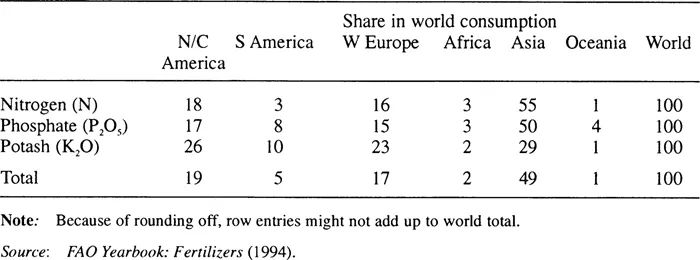
Additional information on aggregate changes in chemical fertilizer use by major regions of the world for a period of four decades is shown in Table 1.3. The huge increase in world use has already been mentioned. Within that, however, there are marked differences. At the beginning of the period the bulk of use was in NC America and Europe, with both areas showing considerable increases to around the mid-1970s. Since then there has been no change in NC America, while European use has marginally declined. Oceania, with its naturally small aggregate use, broadly follows that pattern.
The striking difference is in Asia. There was a steep increase from 1969–71 to 1975–77 (3.87 to 17.60 million tonnes), which has continued. The 1990–92 figure is up by a further 41.22 million tonnes, or by more than three times the 1957–1977 share in the total consumption of N, P2O5 and K2O by region. That experience has not been shared by South America, where use from 1957 to 1977 is only about 50 per cent higher, while Africa lags behind with a much smaller increment of 35 per cent.
Analysis of the productivity of fertilizer use is, of course, a complex exercise which cannot be attempted here. However, attention is drawn to one feature of Table 1.3 which is of interest in the general context. Though fertilizer is used in many farming applications, much of it contributes to cereal production, which is illustrated in the table, along with a figure of ‘average yield’ per unit of fertilizer employed. It hardly needs to be stated that its use is only one factor which may account for changes in production. What the crude ‘productivity’ measure shows, however, is the importance of deeper study of use within the developing world. In Asia, for example, the marked increase in output, which has more than doubled in the years from the start of the 1960s, has also been accompanied by a change in average yield, which is declining. Production per tonne of fertilizer applied is now relatively low, at 14.9 tonnes. The importance of Asia within the world totals, allied to the fact that the ‘average yield’ in the developed world and in South America is of broadly similar magnitude, accounts for the lack of major change in the ‘world total’ average yield over the past two decades.
Table 1.3 Development in chemical fertilizer (NPK) use and productivity, by region, 1950–91


The outlier is again Africa. Though the production figures may be distorted by drought, its relatively poor performance in raising output, and the apparently higher fertilizer ‘yield’ (it is about double the Asian figure), could be an indicator of unused potential for agricultural production through additional, more effective, fertilizer use. As stressed by Koffi-Tessio in Chapter 11, there are many features of the African situation, including the need for innovation and extension services to alter cropping systems and optimize application rates and the timing of use, which deserve attention as means of increasing income and food production.
Chemical Pesticides
Whereas fertilizers are used throughout the world and the chemical compounds they contain are easy to define, chemical crop protection is much more complex. There are mechanical, chemical and biological methods of crop protection. Chemical crop protection agents can be defined as substances that protect plants from diseases, pests and weeds, or which are used to secure yields and facilitate harvesting (growth regulators, haulm-killing chemicals).
Pesticides can be classified in many different ways. One might classify them according to intended use: disease and weed control, haulm killing, soil disinfecting, growth regulation, grassland enhancement, and so on. One might also use biological classification: herbicides, nematicides, bactericides and fungicides, herbicides, insecticides and acaricides (to control mites). In practice, usually a mixture of classifications is used. It is common to indicate use figures, by category or in total, in kg of active ingredient (ai); that is, by the weight of the toxic substances.
Since the 1960s, the market for chemical pesticides has increased appreciably, and in this case a value measure can be used (Table 1.4). Sales of chemical pesticides worldwide have doubled since the 1970s, with herbicide sales showing the greatest rate of increase.
Table 1.4 Comparison of the world market value of chemical pesticides by category, 1972 and 1991
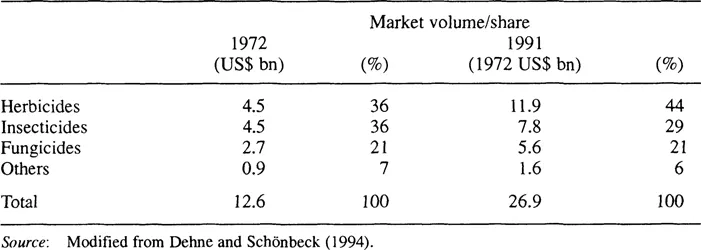
The importance of chemical pesticides varies from region to region (Table 1.5). Currently, more than three-quarters of them are used in the USA, Western Europe and Asia. Herbicides are the principal pesticides used in the USA; fungicides are least important in this region. In the temperate regions of Western Europe fungal diseases dominate and fungicides account for about half of chemical pesticide usage. In Asia the main problems are insect pests and fungal disease, so insecticides and fungicides are most important here (see Chapter 3). This use is still rather localized; more than two-thirds of all cropland in the world is not treated with any chemical pesticide at all (Dehne and Schõnbeck, 1994).
Since the 1930s, when the first chemical pesticides were introduced (dithiocarbamate fungicides), there have been substantial developments ...
Table of contents
- Cover
- Title Page
- Copyright Page
- Table of Contents
- List of Figures
- List of Tables
- Foreword
- 1 Introduction to Agro-chemicals Use
- Part I Inventories and Overviews for Different Areas of the World
- Part II Agro-Chemicals use and Sustainable Agriculture
- Part III Efficiency and Producers’ Knowledge and Perceptions
- Part IV Determinants of Fertilizer and Pesticide Use
- Part V Policy Instruments and Policy Analysis: LDCS
- Part VI Policy Instruments and Policy Analysis: Industrialized Countries
- Part VII Perspectives for the 21st Century
- Author Index
- Subject Index
Trusted by 375,005 students
Access to over 1.5 million titles for a fair monthly price.
Study more efficiently using our study tools.
Frequently asked questions
Yes, you can cancel anytime from the Subscription tab in your account settings on the Perlego website. Your subscription will stay active until the end of your current billing period. Learn how to cancel your subscription
No, books cannot be downloaded as external files, such as PDFs, for use outside of Perlego. However, you can download books within the Perlego app for offline reading on mobile or tablet. Learn how to download books offline
Perlego offers two plans: Essential and Complete
- Essential is ideal for learners and professionals who enjoy exploring a wide range of subjects. Access the Essential Library with 800,000+ trusted titles and best-sellers across business, personal growth, and the humanities. Includes unlimited reading time and Standard Read Aloud voice.
- Complete: Perfect for advanced learners and researchers needing full, unrestricted access. Unlock 1.5M+ books across hundreds of subjects, including academic and specialized titles. The Complete Plan also includes advanced features like Premium Read Aloud and Research Assistant.
We are an online textbook subscription service, where you can get access to an entire online library for less than the price of a single book per month. With over 1.5 million books across 990+ topics, we’ve got you covered! Learn about our mission
Look out for the read-aloud symbol on your next book to see if you can listen to it. The read-aloud tool reads text aloud for you, highlighting the text as it is being read. You can pause it, speed it up and slow it down. Learn more about Read Aloud
Yes! You can use the Perlego app on both iOS and Android devices to read anytime, anywhere — even offline. Perfect for commutes or when you’re on the go.
Please note we cannot support devices running on iOS 13 and Android 7 or earlier. Learn more about using the app
Please note we cannot support devices running on iOS 13 and Android 7 or earlier. Learn more about using the app
Yes, you can access The Economics of Agro-Chemicals by G.A.A. Wossink, G.C. van Kooten, G.H. Peters, G.A.A. Wossink,G.C. van Kooten,G.H. Peters in PDF and/or ePUB format, as well as other popular books in Business & Business General. We have over 1.5 million books available in our catalogue for you to explore.