Published in 1999, this text sets out to provide an historical, present and futuristic understanding of China's enormous population problems. It sets out to provide a fundamental understanding of China through an understanding of its population problems and the efforts to control them. With the world's largest population, China has a dynamic economy and is emerging as a world power. This book aims to provide a comprehensive discussion on issues relating to China's population in English, based on historical and macro-level analysis of Chinese society.
- 245 pages
- English
- ePUB (mobile friendly)
- Available on iOS & Android
eBook - ePub
About this book
Information
1 China’s Population and Population Problems (Introduction)
Significance of China’s Population
China’s 1.22 billion population in 1996 was the largest population in the world, and it was more than one-fifth of the world’s 5.79 billion population (World Almanac, 1997). By the end of 1996, China’s population was greater than the total population of all the developed countries in the world or about 42 times that of Canada’s population in the same year. In other words, the population of China is about the same size as that of the Arab countries, Africa, and Latin America combined (Gugler, 1996). If we just take the sheer numbers into consideration, to understand people in China is equal to understanding people in Arab countries, African countries, and Latin American countries combined. It is important to understand the enormous population in China.
Recently, China has experienced dramatic demographic and economic changes which were unprecedented in the world during the twentieth century. These changes have brought about the demographic transition from a premodern to a modern regime in only four decades in China (Goldstein, 1996). These changes, in turn, have a fundamental impact on China’s current development and will have a far-reaching effect on the nation’s future development.
Similarly, the current dramatic social and economic changes in China will definitely have a significant impact on the world politics, economy, environment, and development. If China’s economy continues to develop rapidly, as it has in the past two decades, China’s economy may become the most important economy in the world during the next century. As the former Chancellor of the Federal Republic of Germany, Helmut Schmidt points out that China will be the biggest economy of all – the greatest market, the greatest importer, and the greatest exporter in the next century (1994).
The huge market of China’s 1.2 billion population may stimulate the world economic development considerably. On the other hand, if China falls into chaos, as it did about half a century ago, the world will suffer its consequences. Either way, the world will be unavoidably affected by China as China will be inevitably affected by the world. China and the world are ever more closely related to each other. Therefore, the world needs to understand China.
In late 1970s, when China started its economic reform, the Chinese government had two strategic goals. The first was to quadruple its Gross National Product (GNP) and the second was to limit its population growth to within 1.2 billion during the last two decades of the twentieth century. China’s economic reform and development have been welcomed and praised by many people in the world. However, China’s efforts to control its population growth which is equally significant to China and the world has seldom been fully appreciated by the world.
Figure 1.1
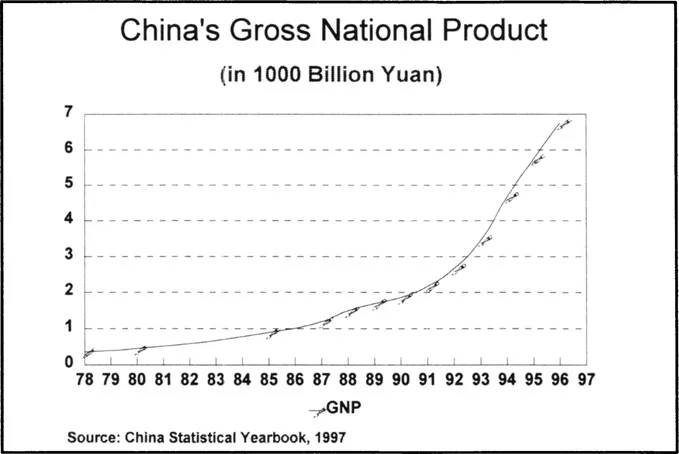
Table 1.1 Indicators of China’s Economic and Social Development
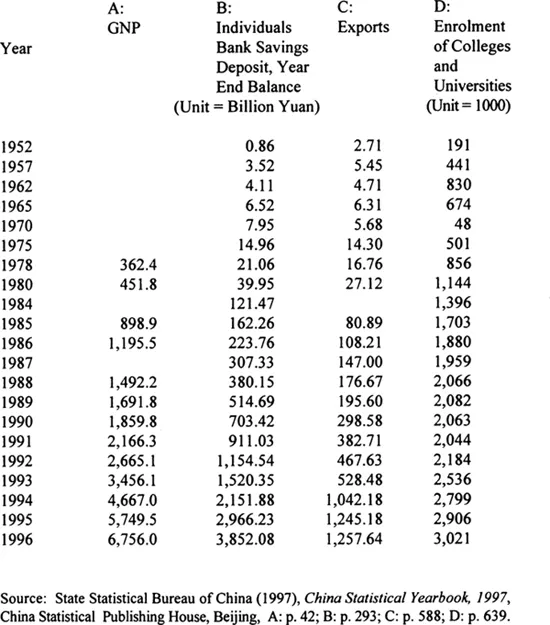
Since the reform began in the late 1970s, China has maintained a rapid economic and social development. Between 1979 and 1994, China’s annual average GNP increase rate was 9.8 percent (State Statistical Bureau of China, 1995). Between 1991 and 1996, the annual average increase rate was 11.2 percent. The individuals’ bank savings deposit in China also increased 183 times from 1978 to 1996 without considering inflation. Similarly, the export of the country also increased 75 times between 1978 and 1996 (State Statistical Bureau of China, 1997). It seems that China’s ambitious economic development goal could be reached by the end of this century without any doubt (see Table 1.1). China’s dramatic economic development may best be demonstrated in Figure 1.1.
However, its set goal of limiting the population within 1.2 billion by the end of the century has proved much more difficult to reach. The enormous population will definitely be more than 1.2 billion by the end of this century although the population growth has been considerably curbed. This may also indicate that the challenge posed by China’s enormous population is greater than the challenge posed by its backward economy. Therefore, it is equally important, if not more important, for the world to understand China’s population problems and her efforts in combating the problems.
In fact, China’s population may reach 1.275 billion in the year 2000. There may be 75 million more population in China than the Chinese government planned in the late 1970s. This unplanned 75 million extra population equals twice the projected total population in Canada in 2010 (The World Almanac, 1997). Since population growth and economy are closely related, to understand China’s population and the efforts to control the growth and distribution of the population is fundamental to understanding China’s economic development.
China’s population problem and its efforts in controlling the growth and distribution of the population are quite different from those of the Western developed countries. The developed countries have never had to suffer the population pressure that China has suffered. While the developed countries have experienced a gradual and smooth population transition, China’s population transition seems much more dramatic and instantaneous. When the Western developed countries faced mounting population pressure during their early development, they translated it into a steady flow of migrants mostly to the New World (Brown, 1995).
However, China has nowhere to send its much larger and much more rapidly increasing population. More important, while developed countries’ population growth had directly or indirectly enhanced their economic development, China’s population growth was perceived as a colossal obstacle to China’s development by many Chinese. The enormous population had endangered China’s survival in the past two centuries, and it might again endanger the survival of the largest nation if the population growth were not effectively controlled. Therefore, it is important to understand China’s population and population problems although they are difficult to understand.
On the other hand, China’s population problem and her efforts in controlling the population are similar to those of other Asian developing countries, such as India, Indonesia, the Philippines, Vietnam, Malaysia, and Pakistan. The only difference is that China’s population is larger, and its effort to control its population growth seems more compelling than other Asian countries. Nevertheless, many other Asian countries also rigorously control their population growth, and their governments have also adopted various measures to enforce their population control. Similar to China, some of the measures utilized by other Asian countries to control their population growth may be considered inappropriate by many people in the Western countries.
Therefore, to understand China’s population problems and population control is, to some extent, to understand other developing countries in Asia. Western countries response toward China’s population control policy often reflects the fundamental differences in culture, politics, history, religion, and economic development between China and the Western countries. To a certain extent, Western countries’ response towards China’s population control also reflects the differences between the Asian countries and the Western countries, or between the developed and the developing countries. Therefore, understanding China’s population problem and its efforts to control the population growth can be conducive to the understanding of the differences and the relationships between China and the Western countries, between the East and the West, and between the developed and the developing countries.
China’s Population Growth and Development
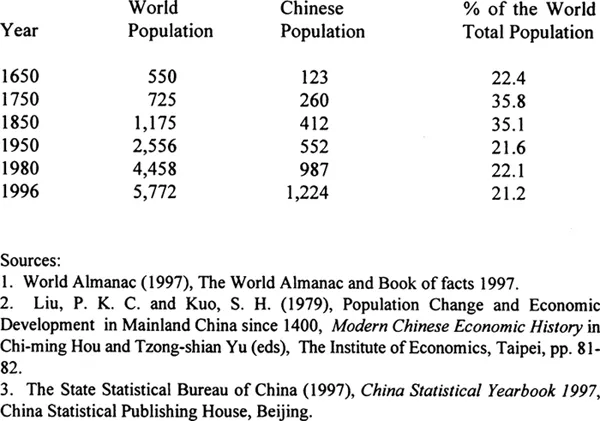
China’s population has had a fundamental impact on her development in the past three centuries. Unlike most of the developing countries, China went through a steady population growth for several centuries (Cartier, 1995). In 1650, China had a population of about 123 million; that was 22.4 percent of the world’s 550 million population at that time (see Table 1.2). In 1750, China’s population dramatically increased to about 260 million, and that was 35.9 percent of the world’s 725 million population. In another one hundred years, China’s population continued its rapid growth and increased to about 412 million. Its high percentage of the world’s 1,175 million population was maintained at 35.1 percent in 1850.
Under the pressure of such a large population and rapid growth, China’s social and economic development suffered. As Professor Ho pointed out, “In consequence, by the end of the eighteenth century, China’s resources had become so strained that her economy had begun to assume the pattern with which modern students are familiar” (1959). After that, China started its most frustrating and humiliating history of about one hundred years during which famine, turmoil, foreign invasions, uprisings, and civil wars were prevalent.
As a result of the positive checks stated by Malthus, between 1850 and 1950, China’s population growth slowed down and its percentage of the world population lowered to 21.6. During the same period, China fell further behind the industrialized countries substantially and became a semi-colonial country despite its tremendous population size. Although many factors may have contributed to China’s decline in recent centuries, population was no doubt a fundamental one.
Table 1.2 The World and China’s Population Growth from 1650 to 1996 (in millions)
China’s explosive population growth in the past three centuries has been viewed as an almost unsolvable problem confronting the Chinese government, especially by scholars and politicians from Western countries. For example, on July 30, 1949, at the fall of the Nationalist government on mainland China, the Secretary of State of the United States of America, Dean Acheson, wrote to President Truman to explain why the Nationalist government had failed in China.
In his Letter of Transmittal, Acheson stated that two factors had played a major role in shaping the destiny of modern China.
The population of China during the eighteenth and nineteenth centuries doubled, thereby creating an unbearable pressure upon the land. The first problem which every Chinese government has had to face is that of feeding this population. So far none has succeeded... The second major factor which has shaped the pattern of contemporary China is the impact of the West and of western ideas (1949: 4-5).
Although these two factors were partially true at that time, the enormous population in China did give the previous Chinese governments tremendous problems in terms of food, housing, employment, and social as well as economic development. It also has been a source of many problems for the present government, such as housing, schools for education, employment, and even a sufficient food supply. All of these have severely hindered China’s economic and social development.
Since 1950, China has experienced another unprecedented upsurge in its population growth. In 1950, China’s population was about 552 million (Yao and Yin, 1994). In 1997, it reached 1.236 billion. During these forty-seven years, China’s population has increased about 124 percent. Between 1750 and 1950, it took almost two hundred years for China’s population to double. Even between 1650 and 1750 during which China’s population increased most rapidly in history, it took about a hundred years for China to double its population. However, between 1950 and 1990, it only took forty years for China to double its enormous population. China’s huge population and its explosive growth were and still are serious problems for China.
Since the early 1970s, overwhelmed by its population problems, the Chinese government has adopted a rigorous population control policy to reduce its rapid population growth. Consequently, China’s population birth rate was dramatically reduced from 37.9 per thousand in 1965 to 18.3 per thousand in 1978. After 1979, while facing another baby boom, the Chinese government adopted the most controversial and urgent one-child-per-couple policy. This new policy has further reduced China’s birth rate from 18.3 per thousand in 1978 to 16.6 per thousand in 1997, although China was expecting an unusually large number of young people who were born in the 1960s and would get married in this period. The natural increase rate has also been reduced from 28.4 per thousand in 1965 to 10.1 per thousand in 1997 (Fan, 1998).
In addition to the control of the population increase, China also controls its population distribution, which is often a problem for many developing countries. Although China’s control of population distribution (or urbanization) is less known, or less praised or criticized than the population growth control policy, it is equally unique in the world. Recently, China has adopted a new strategy of economic development and population distribution that encourages urbanization in small towns in the rural areas instead of letting rural population move into its already crowded cities. This development is less controversial but equally significant to China’s economic development as well as its population growth and distribution.
China’s population growth has slowed down considerably since the 1970s; however, its population is still increasing very rapidly in sheer numbers because of its large population base and a very young population age structure. In 1994 alone, China had a net increase of 13.33 million people (State Statistics Bureau of China, 1995) which equals about four times that of Singapore’s total population in 1996. Although China’s population growth has substantially reduced, the projected increase of the population in China between 1996 and 2010 will be about 130 million. This increased number will be greater than the projected total population in Japan in 2010 (World Almanac, 1997).
Worse still, China’s per capita tillable land decreased from 0.18 hectare in the 1950s to 0.08 hectare in 1993, and per capita grain also decreased from 392 kilograms in 1984 to 387 kilograms in 1993 when China’s grain production almost hit the ceiling. Not only is China’s food still a problem, fresh water is also a problem. China’s per capita fresh water is only about one-fourth of the world average, and lack of fresh water has already affected many people’s lives, especially in the northern part of the country (Gu, 1995).
According to the ten-year plan of the State Family Planning Commission in 1991, China would try to keep the annual natural growth rate within 12.5 per thousand and to bring about a drop in the gross fertility rate from 2.3 in 1990 to 2.1 in 1995. According to Peng Peiyun, Minister of the State Family Planning Commission, if China’s ten-year population growth plan is realized, China’s population will reach 1.6 billion by the middle of the twenty-first century and the increase after that will be zero (China Daily, 1992). Without family planning, China’s population would reach two billion by 2025 (Huo, 1991), which might be more than China’s resources could support. China’s reality seems to indicate that its population growth needs to be controlled and China...
Table of contents
- Cover
- Half Title
- Title Page
- Copyright Page
- Dedication Page
- Table of Contents
- List of Tables
- List of Figures
- Preface
- Acknowledgments
- 1 China’s Population and Population Problems (Introduction)
- 2 China’s Traditional Population Thought and Policy
- 3 China’s Population Thought Since 1949
- 4 Population Control Policy and Implementation
- 5 Population Distribution in China
- 6 Minority Population in China
- 7 China’s Population and the Future Perspectives
- 8 China’s Population and the World
- Index
Trusted by 375,005 students
Access to over 1.5 million titles for a fair monthly price.
Study more efficiently using our study tools.
Frequently asked questions
Yes, you can cancel anytime from the Subscription tab in your account settings on the Perlego website. Your subscription will stay active until the end of your current billing period. Learn how to cancel your subscription
No, books cannot be downloaded as external files, such as PDFs, for use outside of Perlego. However, you can download books within the Perlego app for offline reading on mobile or tablet. Learn how to download books offline
We are an online textbook subscription service, where you can get access to an entire online library for less than the price of a single book per month. With over 1.5 million books across 990+ topics, we’ve got you covered! Learn about our mission
Look out for the read-aloud symbol on your next book to see if you can listen to it. The read-aloud tool reads text aloud for you, highlighting the text as it is being read. You can pause it, speed it up and slow it down. Learn more about Read Aloud
Yes! You can use the Perlego app on both iOS and Android devices to read anytime, anywhere — even offline. Perfect for commutes or when you’re on the go.
Please note we cannot support devices running on iOS 13 and Android 7 or earlier. Learn more about using the app
Please note we cannot support devices running on iOS 13 and Android 7 or earlier. Learn more about using the app
Yes, you can access China's Population by Gabe T. Wang in PDF and/or ePUB format, as well as other popular books in Ciencias sociales & Sociología. We have over 1.5 million books available in our catalogue for you to explore.