First published in 1998, this was the first book to present a comprehensive summary of both the global as well as institutional issues which are involved in biotechnology sharing. It covers the controversial subject of intellectual property rights (IPR) and the patenting of new discoveries in genetic knowledge in both agriculture and the human genome. One controversial issue is the creation of public and private DNA sequencing data bases. Of special interest is the sharing of biotechnology between the developed (rich) and developing (poor) nations. A related topic which requires immediate attention is the exploitation of biodiversity in the developing countries and the resulting extinction of rare species. Sharing or transferring biotechnology and its applications between institutions or different countries raises numerous ethical and moral dilemmas. A comprehensive summary of these issues is presented in this book.

- 166 pages
- English
- ePUB (mobile friendly)
- Available on iOS & Android
eBook - ePub
Biological and Social Issues in Biotechnology Sharing
About this book
Information
1 Introduction
There is hardly any one among the educated public who is not familiar with Intellectual Property Rights (IPR) although the full meaning of these words may not always be clearly understood. Intellectual property mainly consists of patents, copyrights, trademarks, trade secrets, and plant breeder’s rights. The primary purpose of promoting IPR is to provide an incentive for creating new inventions, especially by individual inventors. Patents are also viewed as major incentives for large firms to encourage inventiveness and invest a significant share of the profits in R & D. Some believe that patents also help in disseminating information about new inventions sooner than later. On the other hand, others believe that patents tend to hinder rather than encourage R & D by maintaining secrecy and by blocking free access to information. There is also the widespread belief in the developing countries that the IPR systems are mainly designed by the developed nations for the specific purpose of exploiting the natural resources of developing countries. Furthermore, creation of monopoly positions by large firms in selected industries increases the social costs. Ideally, a nation’s patent laws must reflect a balancing of incentives for inventors and rapid diffusion of new technology (Mansfield, 1993).
Most books on the subject of IPR are either written or edited by lawyers. Quite understandably, they have tended to examine the legal issues involved. As a geneticist and biologist, with a background in human genetics, I am primarily interested in the nature of patents in biotechnology, their ethical and social implications, and the impact of patents on the biodiversity of our planet. Also, one born in India, a developing nation, I am deeply interested in the IPR systems of developing countries and their impact on the trade relations between developing and developed nations. Several pages are devoted to this particular aspect.
One of the most controversial aspects of this subject is the discussion surrounding the whole issue of patenting human genes. The pros and cons of this debate and the ethical and social issues involved are of great interest. Another aspect of IPR which has aroused deep passions in the developing world is the protection of plant genetic resources including both food crops and medicinal plants. Plant breeder’s rights have received special attention in India in recent years, partly due to the efforts of Professor M.S. Swaminathan of Madras. This has led to the first legislation proposed to the Indian Parliament to protect plant breeder’s rights.
It is hoped that this book will help to stimulate further interest in the subject of IPR, creating a realistic understanding of the controversial issues involved. It is a subject which is becoming increasingly important as more and more research is being privatized. Because of budgetary constraints, many universities are entering into contracts with private industries to market their inventions. Increasing research collaboration between academia, business, and government is leading to a greater awareness of the importance of IPR systems.
Future developments will show whether IPR systems will prove to be a stimulus for increasing R & D or a hindrance to free exchange of information. It also remains to be seen if IPR will serve to protect biodiversity or merely serve to exploit and deplete world’s natural resources. The answer to these questions largely depends on what kind of IPR we are likely to develop globally and whether a meaningful dialogue can occur between the developed and developing nations.
Developing nations may eventually develop their own special brand of IPR which would suit their economic interests better than the western models. As Evenson (1993) aptly put it: “As developing countries recover from the ‘surprise attack’ launched by the United States and converted into the GATT initiative, they may be able to develop a more positive set of tactics and programs than they have managed to date. For the short run, they could bargain aggressively with the developed countries for trade concessions, in return for strengthened domestic treatment of foreigners’ intellectual property. Developing countries have not been very good at this. Their stance has been one of continued resistance to strengthening IPRs and including them in the GATT. They would probably do better by acknowledging that IPRs are going to be part of trade laws and policy, and then proceeding to bargain for concessions”.
Whatever direction the present negotiations may lead to, IPR issues are here to stay for good or evil and they are expected to play an increasingly important role in international relations. It is also correct to say that IPR have been around, in one form or another, from the dawn of civilization, and have played a significant role in promoting international trade and commerce.
This book is intended for educated lay readers as well as individuals in the legal, scientific, medical or business professions who may wish to know more about the issues surrounding the IPR systems. It can also be used in teaching courses in these professions at the graduate or undergraduate levels.
Pamela Smith (1996), in a review of global intellectual property rights, classified various nations according to the strength of their intellectual property laws (as compared to the IPR standards proposed by the U.S. Chamber of Commerce) - see Tables 1.1 and Table 1.2.
Table 1.1 Classification of nations according to the strength of their intellectual property laws
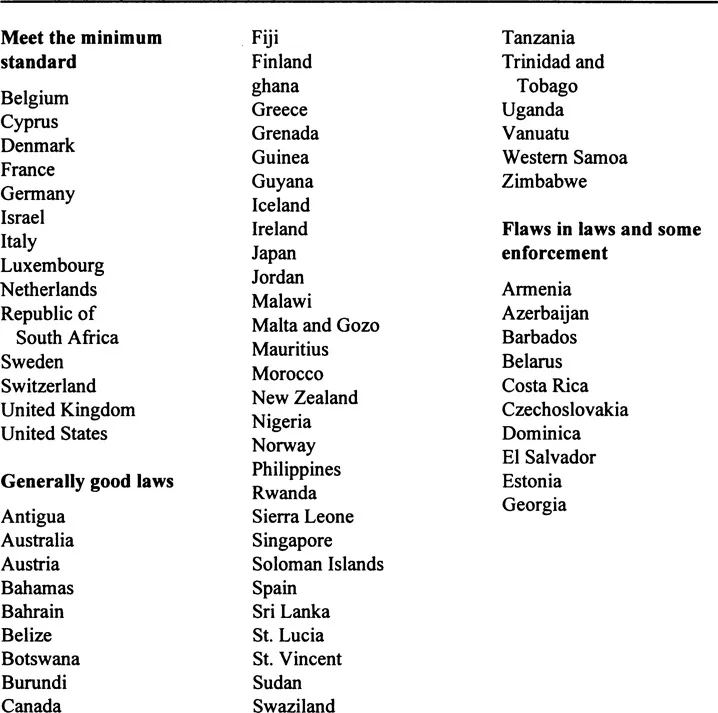
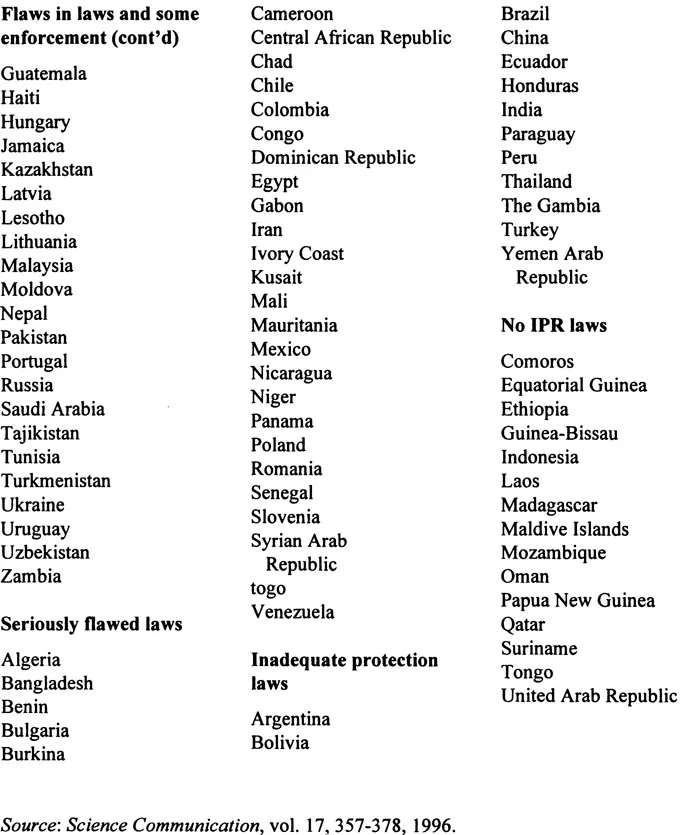
Table 1.2 Countries signing science and technology agreements and an IPR Annex with the U.S.
Belarus
Brazil
Chile
China
Czech Republic
Finland
Hungary
Indonesia
Italy
Japan
Kazakhstan
Korea
Republic of Poland
Russia
Republic of Slovenia
Slovak Republic
Ukraine
Venezuela |
2 Biotechnology and society
Public perception of biotechnology is influenced by several factors:
Financial success The commercial success of biotechnology is a well known phenomenon in recent years. Market research in the U.S. has shown that human health care was the focus of research for most companies, whereas agriculture and chemicals were the focus of far fewer firms. Environmental applications of biotechnology were even less represented. For pharmaceutical companies the percentage of price change in stock performance in a recent year ranged from 35 percent to 160 percent. For agricultural biotechnology companies, the range of increase during the same period was 11 percent to 103 percent. A big share of the basic research which led to biotechnology in the U.S. today was funded by the National Institutes of Health. The industry thus created had annual revenues of $ 4 billion in 1991-92. It is estimated further that the two areas of greatest impact-health and agriculture-account for more than $ 1 trillion value in goods and services.
Media coverage Frequent media coverage through television, newspapers and magazines has heightened public awareness of biotechnology. Awareness and appreciation of biotechnology is further heightened by sensational events such as a new discovery which could lead to a cure for cancer or the award of Nobel prizes for certain achievements. Occasionally, negative publicity also results from perceived evils of technology such as the possible toxic effects of human gene therapy or the impact of “transgenes” on various farm animals and crops. The adverse impact of technology on ecology was heightened by the oil spill from Exxon Valdez in Alaska although that situation did not directly involve biotechnology. But in the public mind such subtle distinctions may not seem particularly significant.
Crisis An occasional crisis may lead to greater attention on biotechnology. Examples are the high cost of certain therapeutic drugs and other substances (e.g. insulin) or the shortage of blood, both leading to research to discover artificial substitutes.
Apprehension Paradoxically, attempts to regulate biotechnology lead to greater apprehension among the public. Appropriate regulation that is justified on scientific grounds should be encouraged. Excessive zeal in regulating biotechnology would tend to discourage the growth of biotechnology industry.
Biotechnology
What is biotechnology? It may be simply defined as the application of biological knowledge for the purpose of solving practical problems in heathcare, agriculture, and related fields. It encompasses a whole range of problems in food production and nutrition, hygiene and public health, to name a few of the many areas of technology it covers.
In what follows, I propose to consider certain aspects of human genetics and agriculture and draw some general observations concerning the transfer of biotechnology to the developing nations and intellectual property rights.
Human genetics
The genetic burden of the population is expressed in the appearance of various congenital malformations and diseases. In some instances these diseases have a late age of onset. In other cases, the genetic burden is expressed in terms of varying degrees of fetal mortality. The cumulative effect can be measured in terms of “Darwinian” fitness, namely the impairment of reproductive capacity as a result of the underlying genetic burden.
In recent years, the traditional pedigree studies have been replaced by “reverse” genetics. That is to say, the recombinant DNA techniques have made it possible to locate the gene on a specific segment of the chromosome first, and later the gene sequence and the protein product are studied. In classical genetics, the chromosomal location is the eventual goal, not the beginning.
Human gene therapy is being attempted now on a limited scale but only for somatic cells, not for gonodal cells. Consequently, our present experience is limited to immediate somatic cell therapy which has no bearing on subsequent generations.
In the U.S., this is carefully regulated by the National Institutes of Health and its “Recombinant DNA Advisory Committee” of which I am a member. The technique of gene therapy generally includes the introduction of a new sequence or a rearranged piece of DNA (which is usually derived from the patient’s DNA itself) into the diseased cells of the patient, for instance the tumor cells in certain cancers. In other instances, the transfer is achieved with known markers for the purpose of improving techniques of “transfection”, but may not involve any gene transfer.
Human gene therapy is still very much in its infancy. Several scientists as well as the lay public have voiced much concern about its possible adverse effects. However, only somatic cell therapy has been attempted so far. The possibility of germ line therapy, which could alter the composition of the future gene pool, is still being debated. In order to address the concerns regarding the possibility of toxicity and to ensure that the required results are obtained, the following aspects should be considered in planning somatic cell therapy: (a) the availability of an adequate source of the correct gene, (b) single or fewer treatments of “gene therapy” must by involved, (c) there must be a high efficiency delivery system to reach the target cell, (d) minimal toxic effects, (e) adjacent cells unaffected, (f) possible to regulate the introduced gene product, (h) therapy must be performed before irreversible pathology occurs, and (i) benefits must outweigh the risks.
Patentability?
What is patentable in human genetics? Naturally occurring gene sequences are certainly not patentable, either from a moral or legal point of view. Laboratory techniques of novel DNA analysis and methods leading to certain “valuable” sequences may be patentable depending upon the circumstances, the products of gene technology may be patentable, and certain techniques of “gene therapy” may be patentable. This is a rapidly evolving field and new techniques of treating various types of cancer may be patented in the near future.
However, much of the recombinant DNA technology as applied to human genetics is beyond the capacity of almost all developing nations at present. Consequently, any concern regarding the possibility of illegal copying of these techniques or processes is not warranted at the present time.
Agriculture
In agriculture, both techniques and products have been identified for the purpose of patenting long before the developments in human genetics. However, recombinant DNA technology has introduced new methods and new products, for instance, the role of “transgenes” in creating new varieties, and these new developments have complicated the process of patenting.
Several problems of patenting and transfer of biotechnology to the developing nations have been identified before (see Swaminathan and Jana, 1992). Some are listed here: (a) there is the problem of non-recognition of certain traditional ...
Table of contents
- Cover
- Title Page
- Copyright Page
- Dedication Page
- Table of Contents
- List of tables
- Foreword
- 1 Introduction
- 2 Biotechnology and society
- 3 Patenting culture in science
- 4 Patenting of micro-organisms: the Chakrabarty case
- 5 Different types of biotechnological innovations
- 6 International treaties
- 7 Safety considerations for transgenic organisms
- 8 Intellectual property rights and plant genetic resources
- 9 Conservation of medicinal plants
- 10 Patenting cDNA sequences: the NIH controversy
- 11 NIH patent policy
- 12 Patenting human gene therapy
- 13 IPR in a north-south context
- 14 Is a uniform IPR system necessary?
- 15 Ethical issues in transfer of technology
- Bibiliography
- Index
Trusted by 375,005 students
Access to over 1.5 million titles for a fair monthly price.
Study more efficiently using our study tools.
Frequently asked questions
Yes, you can cancel anytime from the Subscription tab in your account settings on the Perlego website. Your subscription will stay active until the end of your current billing period. Learn how to cancel your subscription
No, books cannot be downloaded as external files, such as PDFs, for use outside of Perlego. However, you can download books within the Perlego app for offline reading on mobile or tablet. Learn how to download books offline
Perlego offers two plans: Essential and Complete
- Essential is ideal for learners and professionals who enjoy exploring a wide range of subjects. Access the Essential Library with 800,000+ trusted titles and best-sellers across business, personal growth, and the humanities. Includes unlimited reading time and Standard Read Aloud voice.
- Complete: Perfect for advanced learners and researchers needing full, unrestricted access. Unlock 1.5M+ books across hundreds of subjects, including academic and specialized titles. The Complete Plan also includes advanced features like Premium Read Aloud and Research Assistant.
We are an online textbook subscription service, where you can get access to an entire online library for less than the price of a single book per month. With over 1.5 million books across 990+ topics, we’ve got you covered! Learn about our mission
Look out for the read-aloud symbol on your next book to see if you can listen to it. The read-aloud tool reads text aloud for you, highlighting the text as it is being read. You can pause it, speed it up and slow it down. Learn more about Read Aloud
Yes! You can use the Perlego app on both iOS and Android devices to read anytime, anywhere — even offline. Perfect for commutes or when you’re on the go.
Please note we cannot support devices running on iOS 13 and Android 7 or earlier. Learn more about using the app
Please note we cannot support devices running on iOS 13 and Android 7 or earlier. Learn more about using the app
Yes, you can access Biological and Social Issues in Biotechnology Sharing by Krishna R. Dronamraju in PDF and/or ePUB format, as well as other popular books in Social Sciences & Sociology. We have over 1.5 million books available in our catalogue for you to explore.