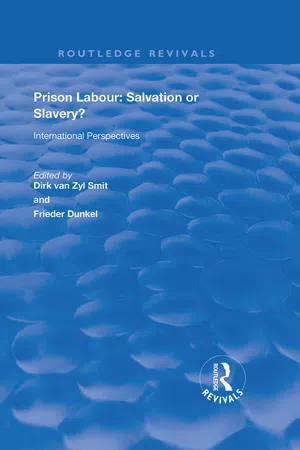
First published in 1999, this collection of articles responds to the controversial debate on whether prison labour constitutes betterment or slave labour. The volume is a stock-taking exercise designed to elicit basic information as a foundation for reconsidering fixed assumptions about prison labour. This controversial issue has had sometimes diametrically opposed claims about it over the years. Contributors examine the issue within the context of a range of countries, alongside broader perspectives on international elements and reflections.
eBook - ePub
Prison Labour: Salvation or Slavery?
International Perspectives
- 368 pages
- English
- ePUB (mobile friendly)
- Available on iOS & Android
eBook - ePub
About this book
Information
1
Austria
1 History and Current Situation
1.1 Introduction: Methods of Research and Available Information
Imprisonment and prison labour have only occasionally been the object of historical or sociological research in Austria. Hitherto, all the available reports and surveys have been based on sources taken from the administration of justice and legislation: on law, decisions, decrees and, in some few cases, on reports and comments in the media. This has meant that there has been a judicially and hierarchically dominated discourse with its own specific criteria for what is relevant. The available material nevertheless suffices for us to estimate the significance of prison labour as part of the government’s representation of its activities towards the relevant sectors of the public. The political and administrative designs concerning prisons and prisoners are, in each era, an expression of the ‘rationality’ of governmental policy on matters of order and the exercise of authority, or they reflect the historical dispute about this ‘rationality’.
The practical aspect of prison labour and its real effect on the prisons and the prisoners’ daily life is quite a different matter. Reports or written testimonies are scarce and have not been granted sufficient attention; nor has their historiographic significance been evaluated. There are many questions about the conformity between the logic of the central administration and the logic of the decentralized executive institutions; about the applicability of concepts of prison labour in everyday prison life; about perceptions and construction of reality by the custodians and the prisoners themselves; and about the underlife in prisons and prison workshops.
There is good reason to assume that prison labour has always acted as a major trigger for establishing subcultures and contracultures among the prisoners, an effect which has been completely ignored by the official policy on prison labour. We can safely assume that the daily interaction between staff and prisoners on labour matters produces a number of ‘secret’ arrangements that do not correspond to norms and regulations. As to the prisoners’ and the junior staff’s opinions on the issue of prison labour and on how prison labour is and has been handled, there are far more open questions than there are answers. Complaints and directives occasionally offer insight into the real state of affairs: for example, when so-called ‘corruptive agreements’ between staff and prisoners have come to light or when means have been sought to prevent staff members from dealing privately with commodities produced by the inmates (Stekl, 1978: 232). Most scientific surveys and reports, however, have completely neglected the subject of prison reality.
1.2 The History and Tradition of Prison Labour in Austria
Prison labour in Austria can be traced back to at least two roots, one of which has since died out. One is the policy of physical punishment, the other the policy of work provision and discipline of the period of absolutism. Hard labour was introduced as a demonstration of public physical punishment. This was considered a more reasonable form of punishment than that of pure chastisement.
Labour penalties that deliberately took into account a possibly destructive effect on the delinquents’ health were introduced as a substitute for the abolished death penalty in the penal code of 1787 under Joseph II and were sharply criticized by enlightened citizens (Wangermann, 1995: 648). By introducing sentences of forced labour in fortification construction work, mining, and even the manual towing of vessels against the current of the Danube, a ‘semi-enlightene’ absolutism endeavoured temporarily to combine a set of conflicting principles of governance. Law (codification), mercy (abstention from torture and the death penalty, retention of the extra-curial granting of mercy) and terror each had a role to play. (The most cruel public labour penalties were abolished under the reign of Leopold II (1790–92) but labour penalties were not fully repealed until 1852.)
This penal policy had little or nothing to do with economic considerations. The lack of any mercantile approach only reflects the underdeveloped state of mercantilism in general during the time of Austrian absolutism. The early chastisement institutions and workhouses in Austria were also a manifestation of this reality. Their introduction in the seventeenth century was based on illusory conservative ideals. There was a strong desire to reinstate an order for the ‘Ganze Haus’.1 This was a reaction to the rapid decline of the old social order. Economic development was leading to the emancipation of large parts of the population from their respective traditional social groups. In order to find remedies for the ever-growing problem of poverty, both the traditional channels of distribution and the moral attitude towards those who had lost the social basis formerly provided by the old social structure required revision. The solution was the institutionalization of marginalized persons (orphans, children who had run away from their homes, servants, vagrants, pedlars, beggars and the like).
It was argued that labour could and had to be expected from the able-bodied poor in exchange for public board, protection and schooling, and as a contribution to cost reduction. (Nevertheless, the bulk of the income used for prisons for hard labour and workhouses was not drawn from labour profits. Specifically earmarked taxes on gambling, entertainment or tobacco provided the required means.) The utilization of manpower in innovative governmental or municipal manufacturing projects, a specifically mercantilist form of rationalization, was not mentioned in any of the documents concerned with the establishment of the workhouses. Such endeavours were first pursued at the beginning of the eighteenth century, when new forms of labour houses were introduced. Consequently, the efficiency of operational and labour processes was widely ignored. In addition, means to invest in more sophisticated lines of production were scarce. As a result, simple textile manufacture prevailed (Stekl, 1978: 300).
From the very beginning, all hard labour institutions and workhouses also served as prisons for those subjected to detention or serving sentences; these groups were naturally also part of the poverty-stricken population (Stekl, 1978: 304). Until the late nineteenth century, such institutions, together with prisons and jails for delinquents, remained under the control of the police authorities.
The original distinction between ‘voluntary’ labour houses offering work, schooling and wages for the innocent poor, on the one hand, and the forced labour institutions for the ‘dishonest’ poor and the convicts, on the other hand, gradually dissolved. The aspect of productive unemployment welfare eventually lost ground to the notion of exemplary punishment. As early as the end of the eighteenth century, the city of Vienna was strongly opposed to any extension of the ‘voluntary’ workhouse system. The opposition was fully in accordance with the ideas of the liberal economists who opposed government intervention and guaranteed employment. They were in favour of labour and provision of services in the home and the emergence of a job market on a pure supply and demand basis (Stekl, 1978), that is, a kind of ‘repressive de-institutionalization’ of services.
The remaining voluntary workhouses were eventually transformed into correctional and disciplinary institutions that were frequently administered very strictly. (Most of today’s prisons originated as such institutions.) In spite of this trend, the forced labour institutions were not placed under the control of the Department of Justice or coordinated until 1873: that is, not until the end of the period of neo-absolutism. The reasons for custody in such institutions were now clearly defined as statutory offences (vagrancy and prostitution) and the procedure for incarceration subjected to legal rules.
The idea of improvement and rehabilitation by means of labour nevertheless originated in the tradition of the workhouses. This idea also implied schooling, wages as motivation, honourable release and financial relief, as well as cooperation with and recruiting for private business enterprises. Not only certain organizational structures, but many of these ideas, including the general duty of all able-bodied prisoners to work, were applied in the new system of penal institutions.
In the middle of the nineteenth century, both hard labour institutions and a large penitentiary were run by Catholic orders in the area of present-day Austria. These monasteries were granted government funds and the permission to utilize prison manpower as they saw fit. The connection (‘Wahlverwandtschaf’2) between monastery, factory and prison (Treiber and Steinert, 1980), all of them being laboratories of discipline and work, and the concept of knowhow transfer between them are expressed in this system. Factory premises and prison manpower were leased to private companies as well. There was constant debate about whether this system was most profitable to the community (cost reduction), to those exploiting prison manpower directly (market advantage) or to the prisoners themselves (opportunities to earn an income, albeit varying and often inadequate). Did the system produce better vocational training, education and discipline among the prisoners, or did it...
Table of contents
- Cover
- Half Title
- Series Page
- Title
- Copyright
- Contents
- Preface
- 1 Austria
- 2 Botswana and Ghana
- 3 England and Wales
- 4 Germany
- 5 Hungary
- 6 Israel
- 7 Japan
- 8 Namibia
- 9 The Netherlands: Work in the Dutch Prison
- 10 The Netherlands: Labour Imposed as a Criminal Punishment outside the Dutch Prison
- 11 Poland
- 12 South Africa
- 13 Spain
- 14 Switzerland
- 15 United States of America: Prison Labour: A Tale of Two Penologies
- 16 United States of America: Inmate Work and Consensual Management in the Federal Bureau of Prisons
- 17 International Perspectives
- 18 Still ‘Slaves of the State’: Prison Labour and International Law
- 19 Conclusion: Prison Labour – Salvation or Slavery?
- Index
Trusted by 375,005 students
Access to over 1.5 million titles for a fair monthly price.
Study more efficiently using our study tools.
Frequently asked questions
Yes, you can cancel anytime from the Subscription tab in your account settings on the Perlego website. Your subscription will stay active until the end of your current billing period. Learn how to cancel your subscription
No, books cannot be downloaded as external files, such as PDFs, for use outside of Perlego. However, you can download books within the Perlego app for offline reading on mobile or tablet. Learn how to download books offline
Perlego offers two plans: Essential and Complete
- Essential is ideal for learners and professionals who enjoy exploring a wide range of subjects. Access the Essential Library with 800,000+ trusted titles and best-sellers across business, personal growth, and the humanities. Includes unlimited reading time and Standard Read Aloud voice.
- Complete: Perfect for advanced learners and researchers needing full, unrestricted access. Unlock 1.5M+ books across hundreds of subjects, including academic and specialized titles. The Complete Plan also includes advanced features like Premium Read Aloud and Research Assistant.
We are an online textbook subscription service, where you can get access to an entire online library for less than the price of a single book per month. With over 1.5 million books across 990+ topics, we’ve got you covered! Learn about our mission
Look out for the read-aloud symbol on your next book to see if you can listen to it. The read-aloud tool reads text aloud for you, highlighting the text as it is being read. You can pause it, speed it up and slow it down. Learn more about Read Aloud
Yes! You can use the Perlego app on both iOS and Android devices to read anytime, anywhere — even offline. Perfect for commutes or when you’re on the go.
Please note we cannot support devices running on iOS 13 and Android 7 or earlier. Learn more about using the app
Please note we cannot support devices running on iOS 13 and Android 7 or earlier. Learn more about using the app
Yes, you can access Prison Labour: Salvation or Slavery? by Dirk van Zyl Smit,Frieder Dünkel in PDF and/or ePUB format, as well as other popular books in Ciencias sociales & Sociología. We have over 1.5 million books available in our catalogue for you to explore.